
Peptide chemistry
AOD-9604 identity: structure, molecular weight and form
NuuVive Journal · · 7 min read · Updated
Short answer
AOD-9604 is a synthetic 16-amino-acid peptide with the chemical formula C78H123N23O23S2. Its average molecular weight is 1815.1 g/mol as a free base. The peptide features a single intramolecular disulfide bond that forms a constrained cyclic loop. In laboratory supply, AOD-9604 is provided as a lyophilised solid, typically containing acetate or trifluoroacetate counterions. Analytical laboratories verify its monoisotopic mass of 1813.86 Da using high-resolution mass spectrometry and confirm its purity via reversed-phase high-performance liquid chromatography.
Key takeaways
- AOD-9604 is a 16-amino-acid synthetic peptide identified by CAS number 221231-10-3.
- The molecule features a constrained monocyclic loop formed by an intramolecular disulfide bond between two cysteine residues.
- The average molecular weight of the free base is 1815.1 Da, with a target monoisotopic mass of 1813.86 Da.
- Laboratories must use high-resolution mass spectrometry to confirm the sequence and verify the intact disulfide bridge.
- The material is supplied as a lyophilised solid to maintain stability during long-term storage.
Chemical structure and amino acid sequence
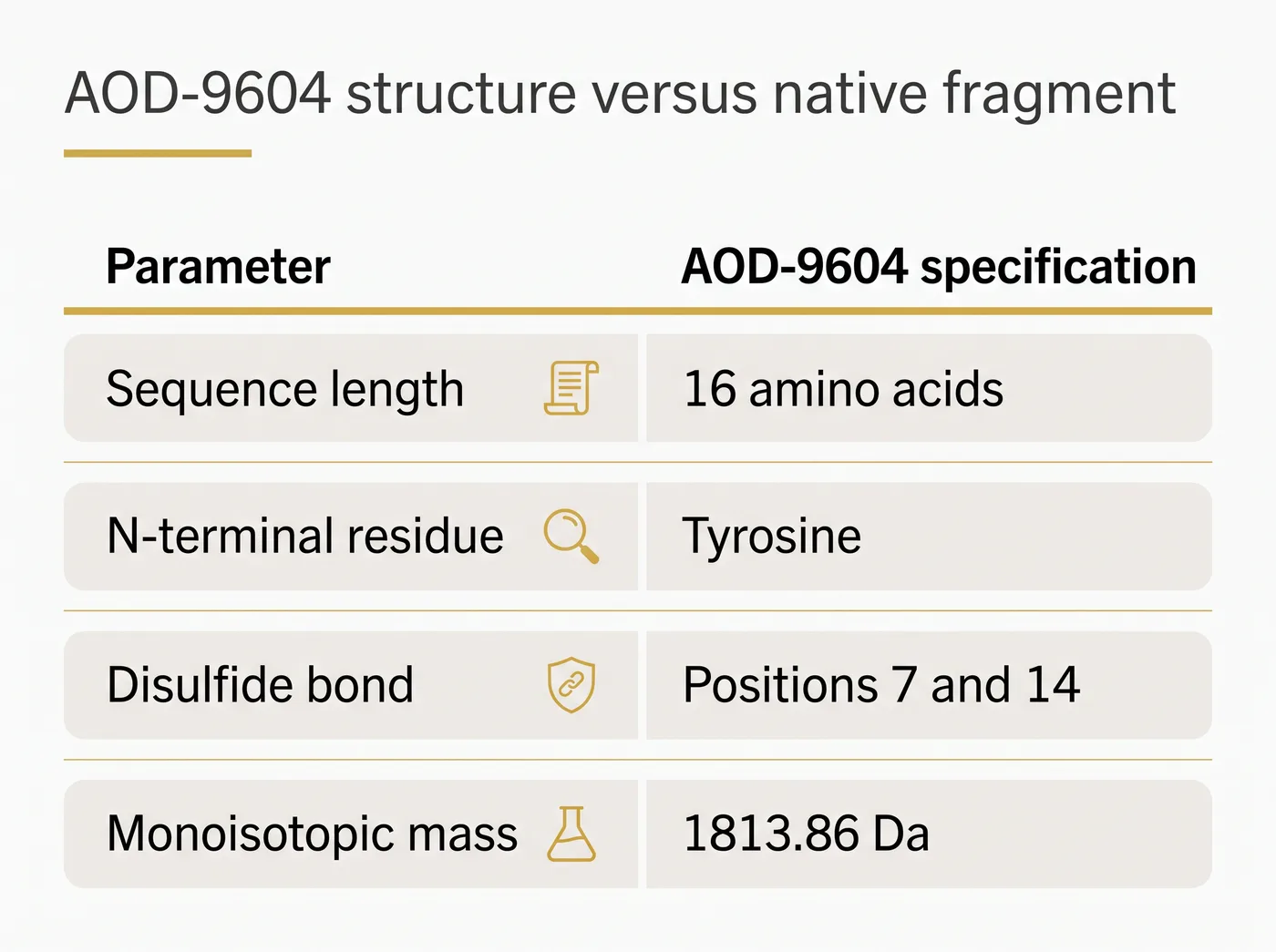
Buying a synthetic peptide means trusting that someone snapped sixteen microscopic building blocks together in the right order. AOD-9604 is a synthetic hexadecapeptide, meaning it carries 16 amino acids in its chain. The primary sequence reads Tyrosine-Leucine-Arginine-Isoleucine-Valine-Glutamine-Cysteine-Arginine-Serine-Valine-Glutamic acid-Glycine-Serine-Cysteine-Glycine-Phenylalanine. Translated into standard single-letter laboratory shorthand, analysts look for YLRIVQCRSVEGSCGF. The intact molecule holds the chemical formula C78H123N23O23S2 and is registered under CAS number 221231-10-3.
The structure itself is a modified fragment mimicking the C-terminal region of a native protein, specifically residues 177 to 191. The twist that defines AOD-9604 happens right at the N-terminus. Where the native sequence starts with a phenylalanine residue, this synthetic version kicks off with a tyrosine residue. That single substitution adds one oxygen atom, which steps the total mass up by approximately 16 Da compared to the unmodified fragment. When chemists sketch out the full molecule, it features a free N-terminal amine on one end and a free C-terminal carboxylic acid on the other.
| Property | Value |
|---|---|
| Sequence length | 16 amino acids |
| Chemical formula | C78H123N23O23S2 |
| CAS number | 221231-10-3 |
| N-terminal substitution | Tyrosine |
| Disulfide connectivity | Positions 7 and 14 |
The role of the disulfide bridge
The entire structural identity of AOD-9604 hinges on an intramolecular disulfide bridge. Think of it as a molecular paperclip snapping the two cysteine residues at positions 7 and 14 together. This single connection forces the otherwise linear chain into a constrained monocyclic loop. That specific cyclic topology dictates how the molecule behaves when dissolved in an aqueous environment and determines when it will emerge from a chromatography column.
Keeping that fragile connection intact is the hardest part of handling the material. The bond is highly sensitive to reducing environments and thiol-disulfide exchange. Something as simple as vigorous physical agitation or a stray drop of a strong reducing agent will cleave the connection, irreversibly destroying the monocyclic loop. When that happens, the peptide straightens out into an open-chain free-thiol form. This structural failure shifts the chromatographic retention time and kicks the overall mass up by approximately 2 Da. To prove the loop is closed, analytical chemists use a colourimetric assay called Ellman's reagent to verify the complete absence of free thiols.
Molecular weight and mass spectrometry
Liquid chromatography can tell you if a sample is pure, but it cannot tell you what the substance actually is. To verify the sequence, laboratories rely on mass spectrometry. The average molecular weight of the AOD-9604 free base is 1815.1 g/mol, but the number analysts genuinely care about is the monoisotopic mass of 1813.86 Da. Measuring the mass-to-charge ratio is the only definitive way to confirm that the factory produced the intended target rather than a closely related cousin.
High-resolution mass spectrometry coupled with liquid chromatography (LC-HRMS) provides the gold standard for identification. Because electrospray ionisation throws multiple charges onto large molecules, analysts rarely see a single clean number. For AOD-9604, they scan for a protonated target ion [M+H]+ at m/z 1814.87. Usually, the doubly charged species dominates the chart at m/z 907.9 to 909.5, with a triply charged species hovering near m/z 606.7. According to laboratory guidelines, you have to discriminate between structurally similar compounds, which makes LC-MS an absolute requirement for passing identification checks.
To double-check the disulfide bond location, careful laboratories run a deliberate reduction and alkylation procedure. They smash the bond open with dithiothreitol (DTT) and immediately cap the loose ends with iodoacetamide so it cannot stitch itself back together. This forces the monoisotopic mass to leap to a very specific 1929.9189 Da. Documenting that precise mass shift proves the disulfide bridge was in the right place to begin with 2.
Solid-phase synthesis and the lyophilised solid
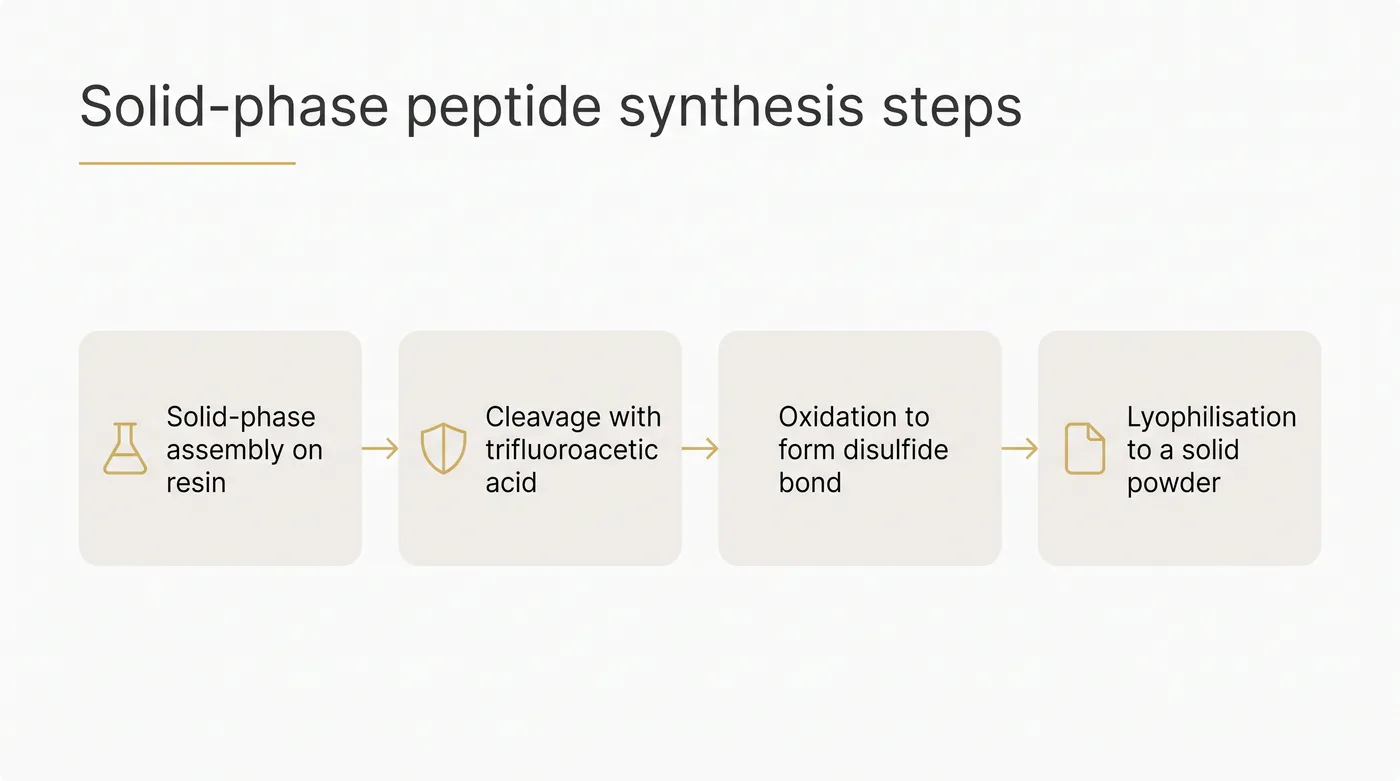
Manufacturers build AOD-9604 through solid-phase peptide synthesis (SPPS), an industrial process that links amino acids one by one on an insoluble resin support. Once the sixteen-link chain is complete, chemists flush the system with a highly concentrated trifluoroacetic acid (TFA) cocktail. This cleavage step knocks the finished peptide off the resin and strips away temporary protecting groups on the side chains, leaving a crude liquid. They then subject this raw material to specific oxidation conditions to coax the Cys7 and Cys14 residues into forming their required disulfide bond 3.
Because aqueous peptides degrade fast, the final step locks the purified liquid into a stable solid. Lyophilisation, or freeze-drying, drops the temperature below the mixture's collapse threshold before pulling a deep vacuum. This causes the solid ice to sublimate directly into a gas during the primary drying phase. A careful secondary drying phase then strips out any stubborn bound water. Nailing these parameters secures a low residual moisture content, which is the only way to halt hydrolytic degradation of the finished powder 4.
Thanks to that harsh TFA cleavage step and the subsequent purification runs, the final lyophilised solid emerges as a salt rather than a pure free base. The positively charged peptide molecules pair up with negatively charged counterions, typically acetate or trifluoroacetate. This makes the finished white powder intensely hygroscopic. If it is not kept sealed, sheltered from light and moisture, and stored firmly at -20 degrees Celsius, ambient humidity will ruin the structural integrity of the solid.
Chromatographic purity and laboratory reports
Reversed-phase high-performance liquid chromatography (RP-HPLC) acts as the final gatekeeper, isolating the intact AOD-9604 from the inevitable synthesis junk. A typical setup relies on a C18 analytical column and a mobile phase gradient mixing water with acetonitrile. Chemists almost always spike the mobile phase with 0.1% trifluoroacetic acid to act as an ion-pairing reagent, which sharpens the peak shapes nicely. If the system feeds directly into a mass spectrometer, they will substitute formic acid instead to avoid suppressing the ion signal 1.
The RP-HPLC run separates the pristine primary peptide from a mess of truncated sequences, unreacted amino acids and broken, unbridged forms. The machine's optical detector tracks the UV absorbance coming off the peptide bonds and the aromatic ring on that single tyrosine residue. The software then compares the area under the towering main peak against the tiny bumps of all the other peaks combined to calculate a hard chromatographic purity percentage. For serious laboratory supply, the research-grade specification demands an RP-HPLC purity of 98.0% or greater.
When you crack open a certificate of analysis, make sure the document actually features a matching lot number, a sharp HPLC chromatogram, and a corresponding mass spectrometry chart proving that 1813.86 Da monoisotopic mass. For fully verified laboratory stock, you can review the current analytical reports and check the specifications, current price, available inventory and measured purity directly on the AOD-9604 product page.
Questions
Why does AOD-9604 contain a tyrosine residue instead of phenylalanine?
The native protein fragment begins with a phenylalanine residue. In AOD-9604, this position is deliberately substituted with a tyrosine residue. This structural modification adds a single oxygen atom to the chain, shifting the molecule's mass upward by approximately 16 Da compared to the unmodified sequence.
What happens if the disulfide bond breaks?
If the delicate disulfide bond connecting the two cysteine residues breaks apart, the constrained monocyclic loop snaps open into a linear chain. This structural failure entirely alters the physicochemical properties, changes the chromatographic retention time, and increases the apparent molecular mass by roughly 2 Da.
Why is the peptide supplied as a lyophilised powder?
Peptides sitting in aqueous solutions are prime targets for rapid hydrolysis and structural degradation. Lyophilisation carefully removes the water content through deep freeze-drying, locking the peptide into a highly stable solid salt form that easily survives long-term storage at -20 degrees Celsius.
How does mass spectrometry verify the sequence?
High-resolution mass spectrometry ionises the physical sample and measures its specific mass-to-charge ratio. By checking the measured monoisotopic mass against the theoretical target value of 1813.86 Da, analysts can confidently confirm that the sixteen-amino-acid sequence was synthesised and that the fragile disulfide bridge remains present.
Sources
- agilent.com. Agilent
- nih.gov. National Library of Medicine
- Advances in Fmoc solid-phase peptide synthesis (Journal of Peptide Science). Wiley
- Design of freeze-drying processes for pharmaceuticals: practical advice (Pharmaceutical Research). Springer