

BPC-157
A 15-amino-acid peptide whose sequence comes from a protein first found in gastric juice.
from$70
The NuuVive guide
New to peptides? Start here. In a few minutes you will know what they are, which ones people ask about most, how to read a lab report, and where the FDA fits in.
The basics
A peptide is a short chain of amino acids, the same small building blocks that make up every protein. Link a few dozen together and you have a peptide. Link hundreds and you have a protein.
Amino acids are small molecules. There are 20 common kinds, and all living things build with the same set.
Amino acids join end to end through a peptide bond. The order they sit in is called the sequence, and it is what makes each peptide its own molecule.
Peptides are short chains, usually from 2 to about 50 amino acids. Proteins are far longer, often hundreds, folded into a 3D shape.
Research peptides are built by machine one amino acid at a time, purified, then freeze-dried into a fine powder and sealed in a glass vial. That powder is what you see at the bottom of each vial.
Popular compounds
These are the compounds people ask us about most. Each card says what the molecule is, in plain words. Tap one to see its full page and its lab report.
A 15-amino-acid peptide whose sequence comes from a protein first found in gastric juice.
from$70

The full 43-amino-acid form of thymosin beta-4, a peptide found in nearly all animal cells.
from$52

Three amino acids (glycine, histidine, lysine) holding a copper ion, which gives the powder its blue color.
from$48

Three peptides pre-mixed in one vial: GHK-Cu 50 mg with BPC-157 and TB-500 at 10 mg each.
from$139

Not a peptide: a coenzyme called nicotinamide adenine dinucleotide, found in every living cell.
from$104

A 16-amino-acid peptide encoded in mitochondrial DNA, the small genome inside the cell's mitochondria.
from$55

A lab-made peptide that acts on three hormone receptors (GLP-1, GIP and glucagon).
from$121
The full range
See every peptide, with its lab report.
Shop peptidesLab reports
A lab report is a record of what an independent lab measured in a sample. Six spots on the page tell you almost everything: the task number, the sample, the purity, the amount, the date, and how to check it with the lab yourself.
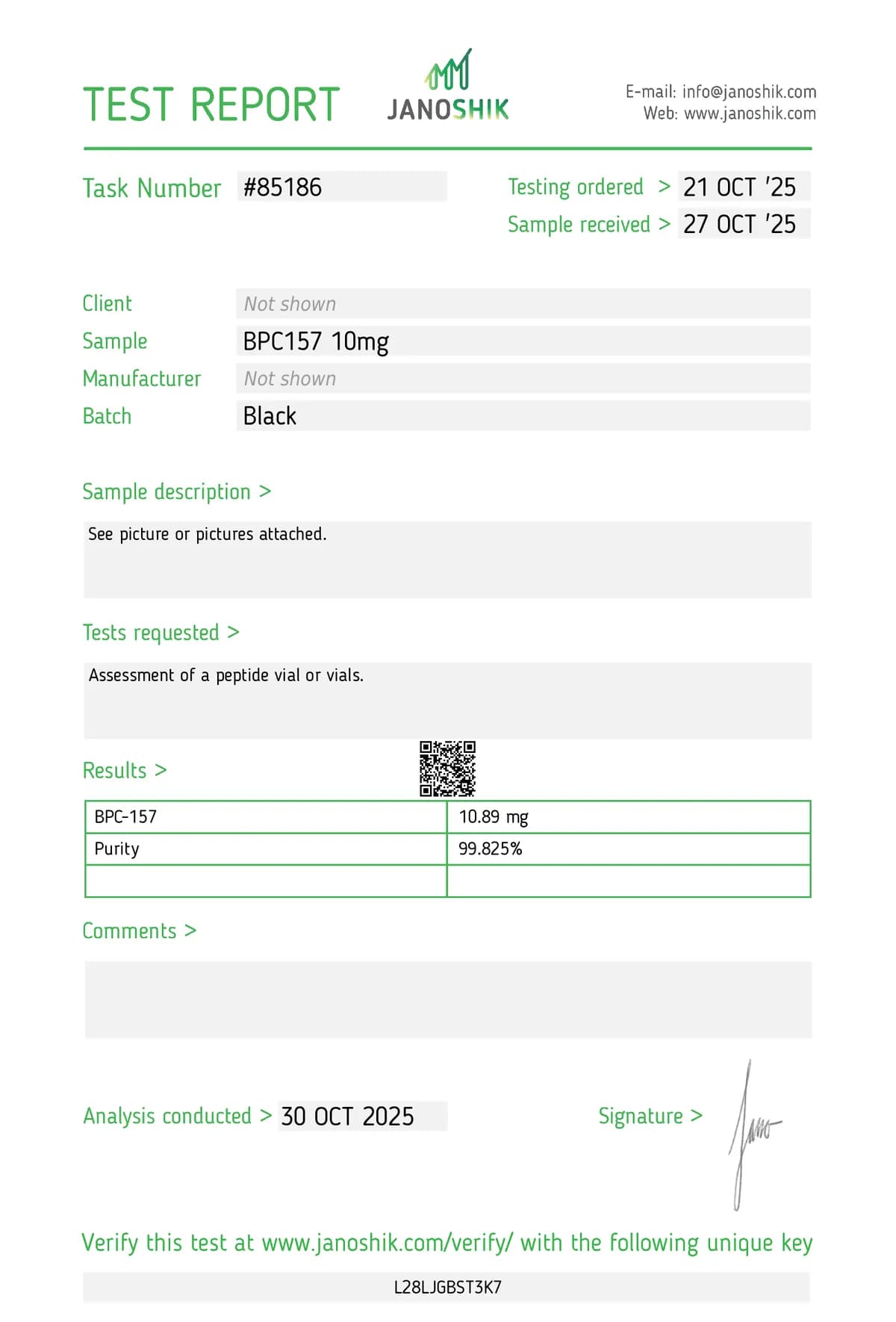
Every report has its own number. This one is #85186. It is how the lab finds the report again.
What was tested: BPC-157 from a 10 mg vial. It should match the product you are looking at.
How much of the powder is the peptide itself. HPLC is the lab method that separates and measures it. Here it reads 99.825%.
How much peptide the lab found in the vial: 10.89 mg, in a vial labelled 10 mg.
When the analysis was done, here 30 October 2025. A clear date tells you when the sample was measured.
Go to janoshik.com/verify and enter the unique key printed at the bottom. The lab's own site shows you its copy, so you can see it matches.
Look for a named, independent lab you can verify online. A report with no lab name cannot be checked.
A clear test date tells you when the material was measured. Recent is better.
The sample name and strength on the report should match the vial you are buying.
FDA approval
Follow the money.
10–15years
of trials before a drug can be sold
$1B+
spent per approved drug
77%
of the FDA's drug-review budget is paid by the drug companies it reviews
#1
Pharma is the biggest lobbying industry in America. $457M in 2025.
Two paths
That's why we let the lab reports do the talking.
Every vial arrives sealed, as it left the maker.
The compound name and strength are printed on the vial.
Third-party lab reports you can check with the lab yourself.
Offered as research compounds, for laboratory research.
Want the longer story? Read why peptides are not FDA approved
Each product page links its lab report, so you can check before you buy.