
Reading lab reports
BPC-157 lab report: what to check
NuuVive Journal · · 7 min read · Updated

Short answer
A valid BPC-157 laboratory report pairs a traceable lot number with specific analytical methods and measured results. Read the header first to confirm traceability to the specific vial. Next, evaluate liquid chromatography (HPLC) results to verify relative chemical purity against the specification. Finally, check mass spectrometry (MS) data to confirm the molecular weight matches the established mass of 1419.53 g/mol, which confirms the primary identity of the sequence.
Key takeaways
- A certificate requires a specific, matching lot number to prove it actually describes the solid material in the container.
- Mass spectrometry confirms the molecular identity of BPC-157 by verifying its exact mass of 1419.53 g/mol.
- Liquid chromatography (HPLC) measures the relative chemical purity of the sample against manufacturing byproducts.
- Net peptide content is an entirely separate measurement from purity, accounting for the mass of residual water and salt counterions.
- A complete characterisation report includes testing for residual organic solvents and bacterial endotoxins.
Why the document header matters more than the graph
Opening a chemical analysis report for the first time feels a bit like reading a foreign language backward. You are staring at jagged lines that look like a seismograph reading, looking for reassurance that the white powder is what the label claims. Before you scroll down to admire the big, bold purity percentage, stop at the header. That boring block of administrative text is where most weak documentation quietly folds its hand.
The lot number or batch number is the absolute anchor of the document. It serves as the physical link between the analytical data on the screen and the material in the glass. Regulatory guidelines define a lot number as a distinctive combination of letters, numbers or symbols from which the complete history of manufacture can be determined 21 CFR Part 210. If the certificate lacks a lot number, it is untethered. It describes some material, tested somewhere, at some point in time. If the number on the document does not match the number printed on the material container, the report is essentially a nice piece of fiction.
The laboratory itself must also step out of the shadows. Professional facilities operate under established competence frameworks and report results with metrological traceability ISO/IEC 17025:2017. A trustworthy certificate identifies the testing laboratory by name, complete with an address you could theoretically visit. Certificates bearing generic, copy-pasted descriptions rather than a named facility cannot be verified against any accreditation records. Throw in a test date that represents the actual date of analysis, and you have a document that might actually be worth your time.
Confirming the molecular identity with mass spectrometry
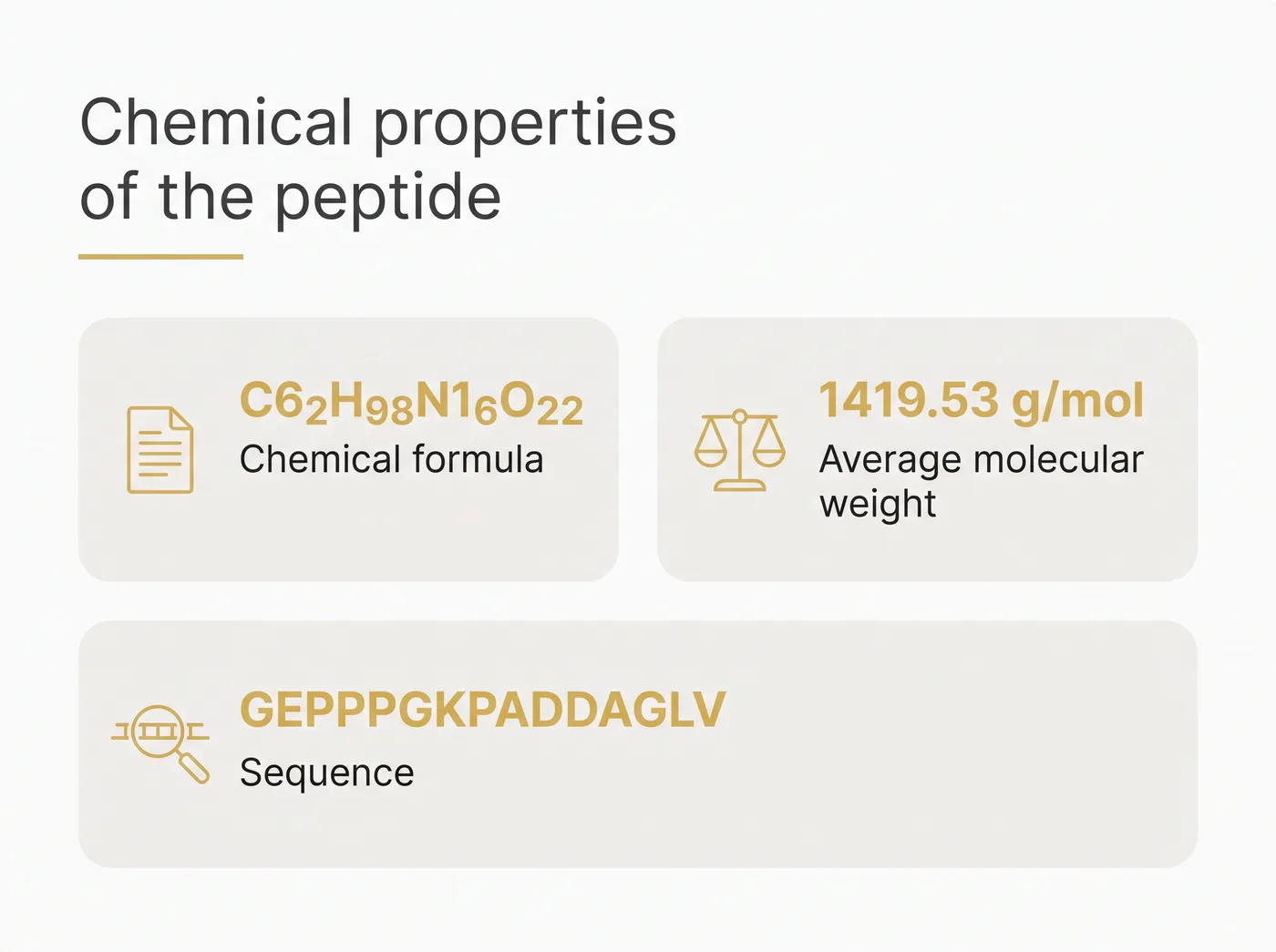
BPC-157 is a synthetic pentadecapeptide, meaning it strings together fifteen specific amino acids into the sequence GEPPPGKPADDAGLV. It possesses a chemical formula of C62H98N16O22 and an average molecular weight of 1419.53 g/mol. Mass spectrometry serves as the analytical bouncer, verifying the identity of the material by confirming that the measured mass matches this theoretical target.
When liquid chromatography is coupled with mass spectrometry (LC-MS), it introduces the sample into an ion source, typically electrospray ionisation (ESI). Picture this as a microscopic sorting hat. During this process, the peptide acquires one or more protons, creating charged ions that fly through a detector. A standard report displays multiple mass-to-charge (m/z) signals representing different charge states, such as [M+2H]2+ or [M+3H]3+. Analytical software then deconvolutes these signals, solving the algebraic puzzle to calculate the intact molecular mass.
Intact mass analysis confirms the total molecular weight, which is excellent, but it does not directly map the sequence. Two sequence isomers, where amino acids of identical mass are transposed within the chain, produce the same intact mass. Advanced characterisation steps up the game by using tandem mass spectrometry (MS/MS) to intentionally fragment the peptide at its bonds. This maps the specific sequence of amino acids through characteristic b-ions and y-ions, leaving no doubt about what is in the sample.
Judging relative purity on the chromatography track
High-performance liquid chromatography (HPLC) evaluates the relative chemical purity of the sample. Think of it as an obstacle course where every molecule has to run to the finish line. The method separates the primary BPC-157 peptide from synthetic byproducts, deletion sequences and degradation impurities. Reversed-phase HPLC is the standard analytical method for peptides, typically using a highly controlled gradient of water and acetonitrile Agilent.
When you look at the laboratory report, you will see a chromatogram mapping detector response against retention time. Ultraviolet (UV) detection is the standard here, usually measured at a specific wavelength between 210 nm and 220 nm to capture the absorbance of the peptide bonds. Purity is reported as a percentage, calculated by dividing the area under the curve (AUC) of the main BPC-157 peak by the total area of all integrated peaks in the run.
For the result to mean anything at all, the chromatographic parameters must be detailed on the page. The certificate must state the column type, mobile phase composition, gradient profile and total run time. System suitability parameters, such as peak resolution and symmetry factor, prove that the analytical machine was actually awake and operating correctly during the run. To see what a transparent document looks like, NuuVive's product page lists the specification and the lab report on file, which documents a measured purity of 99.825% by this method.
Finding the hidden counterions in the salt form
Synthetic peptides are basic in nature, and as a result, they are manufactured and supplied as salts. The solid material comprises the peptide base and an invisible partner called a counterion. BPC-157 is frequently synthesised as an acetate salt, though arginate (arginine salt) forms also exist in laboratory environments. The specific salt form directly alters the total molecular weight of the solid material.
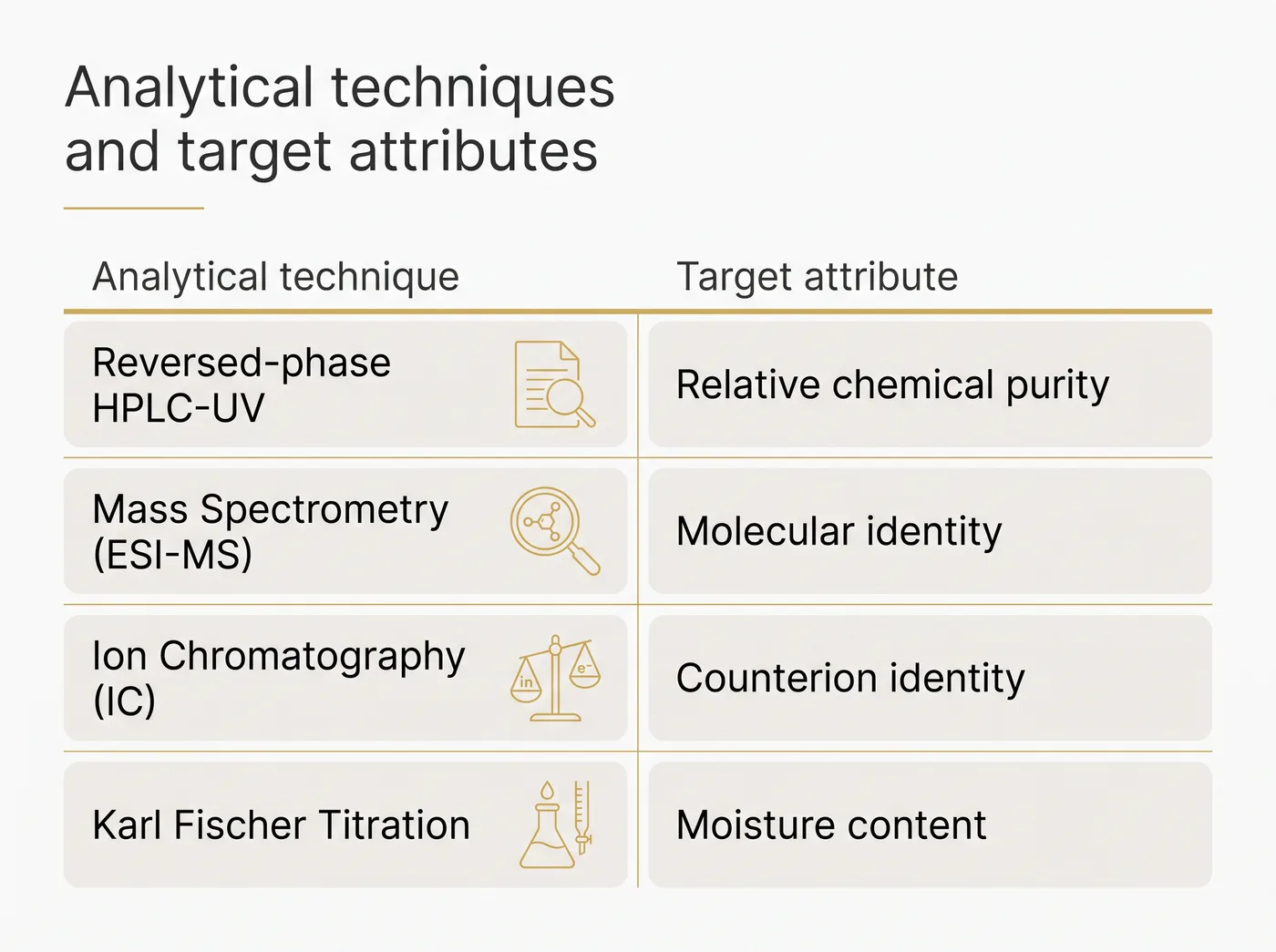
Identification of the counterion requires dedicated chromatographic techniques entirely distinct from reversed-phase HPLC or mass spectrometry. Ion chromatography (IC) or high-performance anion-exchange chromatography (HPAEC) steps in to isolate and measure these small, highly polar counterions. A complete characterisation report includes these specific assays to properly define the molecular composition of the supplied salt, ensuring no surprises when calculating molecular equivalents.
| Analytical technique | Target attribute | Reported parameter |
|---|---|---|
| Reversed-phase HPLC-UV | Relative chemical purity | Peak area percentage |
| Mass Spectrometry (ESI-MS) | Molecular identity | Deconvoluted mass (Da) |
| Ion Chromatography (IC) | Counterion identity | Salt form (e.g., Acetate) |
| Karl Fischer Titration | Moisture content | Water mass percentage |
Why net peptide content never matches HPLC purity
Here is the trap that catches almost everyone: HPLC purity and net peptide content measure entirely different parameters. HPLC measures the ratio of the BPC-157 molecule against other peptide-related impurities. Net peptide content measures the actual mass fraction of the peptide base relative to the total mass of the lyophilised powder. That total mass includes heavy baggage like residual water and those salt counterions.
A vial of BPC-157 with an HPLC purity of 99.8% does not consist of 99.8% peptide by mass. The lyophilised solid contains residual moisture left over from the freeze-drying step and counterions bound during the synthesis. A standard peptide sample frequently exhibits a net peptide content somewhere between 70% and 85%. The remaining mass consists of water and salt.
Absolute peptide quantification requires its own specific methods. Amino acid analysis (AAA) hydrolyses the peptide into free amino acids for measurement. Moisture content is typically determined through Karl Fischer titration. Specifications for biotechnological products maintain distinctions between characterisation testing and routine release testing for these parameters, because knowing what you have is half the battle ICH Q6B.
Spotting residual solvents and invisible endotoxins
Solid-phase peptide synthesis is a messy chemical business that requires harsh organic solvents such as acetonitrile, dimethylformamide or dichloromethane. These reagents must be removed during the purification and freeze-drying steps before the material ever reaches a laboratory. Gas chromatography (GC) serves as the inspector, measuring the volatile residual solvents remaining in the final powder. A proper certificate reports these specific values against established limit thresholds.
Finally, there is the biological check. Bacterial endotoxin testing evaluates the material for the presence of pyrogenic lipopolysaccharides of bacterial origin. The standard analytical method for this is the Limulus Amebocyte Lysate (LAL) assay. Certificates report endotoxin limits in Endotoxin Units (EU) per mass unit or per container. The analytical method description must specify the assay format and the established limit of detection. If you want to see how these documents look in the real world, you can always check the lab reports.
Questions
Why is it impossible to find an absolute HPLC purity?
Synthetic processes naturally yield minor chemical byproducts, such as incomplete amino acid sequences or leftover synthesis reagents. HPLC measures the ratio of the main BPC-157 peak to these unavoidable trace impurities. Analytical methods possess finite detection limits, meaning absolute purity exists only as a theoretical concept on a chalkboard, never in a real chemical synthesis.
What happens if a certificate has no lot number?
A missing lot number severs traceability. The certificate describes an abstract analysis of some material, rather than a specific batch of powder. Regulatory definitions require a distinctive combination of characters to link the analytical record to the physical manufacturing history.
Why doesn't the salt form appear on the mass spectrometry scan?
Mass spectrometry relies on harsh ionisation methods that instantly strip the salt counterion away from the peptide base. The detector only records the mass of the newly ionised peptide flying through the vacuum. Determining the exact salt form requires a separate analysis using ion chromatography.
How does net peptide content change laboratory measurements?
Net peptide content determines the actual, physical mass of the peptide base contained within the solid powder. The fraction of net peptide content dictates the true mass of the peptide base transferred into the solvent during sample introduction. Adjustments must account for the mass of water and counterions.