
Peptide chemistry
Cagrilintide identity: structure, molecular weight and form
NuuVive Journal · · 4 min read

Short answer
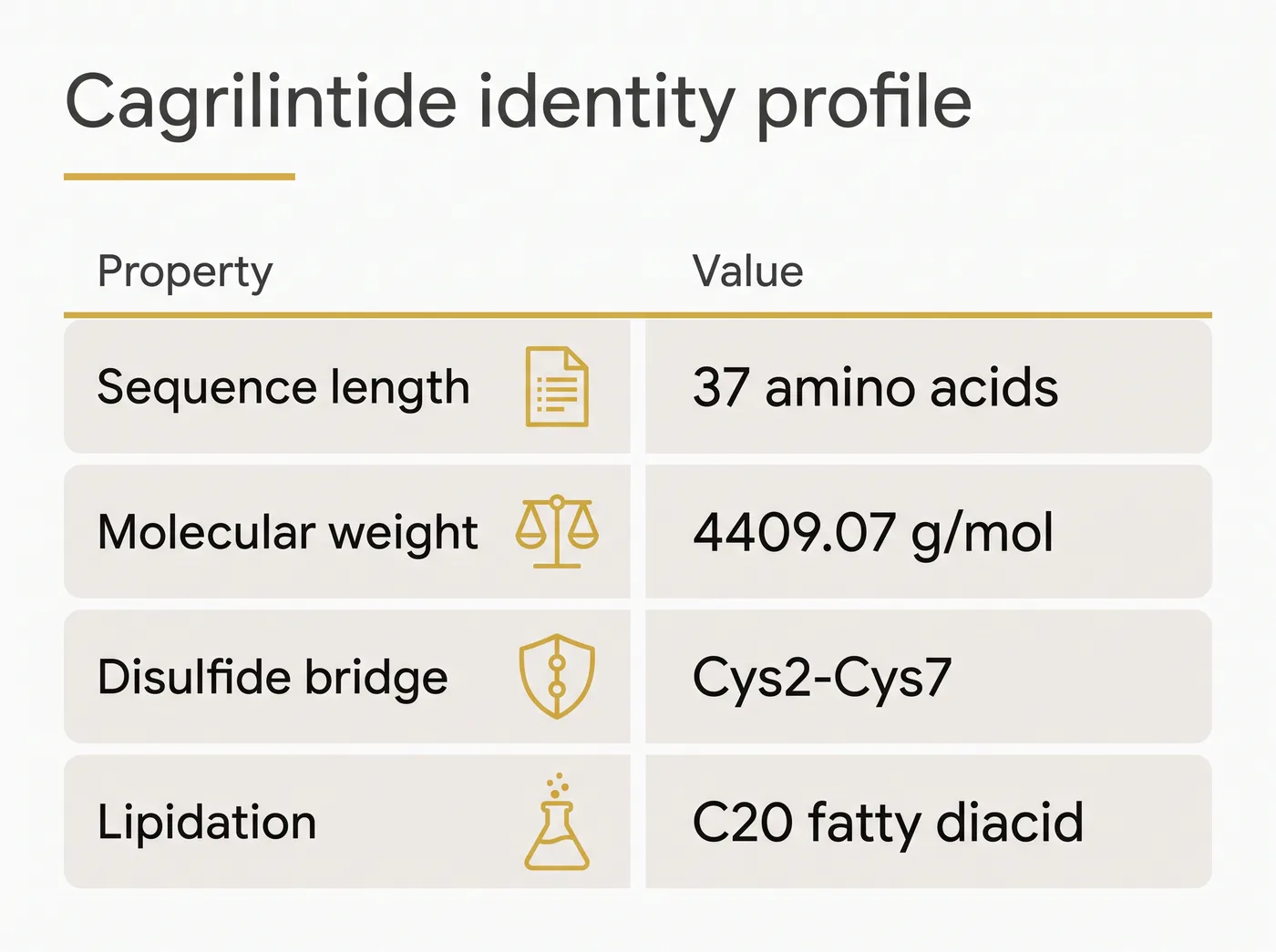
Cagrilintide is a 37-amino-acid synthetic peptide with an average molecular weight of 4409.07 g/mol and the molecular formula C194H312N54O59S2. It is engineered with a Cys2-Cys7 disulfide bridge and a C20 fatty diacid attached to an N-terminal lysine via a gamma-glutamyl spacer. It is supplied as a white lyophilised powder.
Key takeaways
- Cagrilintide has a molecular weight of roughly 4409.07 g/mol.
- Its structure features an eicosanedioic acid chain that dictates its chemical behaviour and solubility.
- A Cys2-Cys7 disulfide bridge must be intact for the molecule to fold correctly.
- It is supplied as a lyophilised solid that is highly prone to foaming if agitated vigorously during sample preparation.
- Laboratories verify its purity using high-resolution liquid chromatography and mass spectrometry.
An engineered synthetic peptide
When you look at a certificate of analysis for cagrilintide, you are looking at the verification of a highly engineered 37-amino-acid synthetic peptide. Unmodified sequences often have an inconvenient habit of clumping together into solid fibrils during storage. To fix this, researchers altered the chemical sequence to create a stable, non-fibrillating version nih.gov.
The result is a molecule with the molecular formula C194H312N54O59S2 pubchem.ncbi.nlm.nih.gov. Building a chain of this length requires intensive chemistry. Laboratories typically use solid-phase peptide synthesis to assemble the sequence backwards, starting from the C-terminus and linking each amino acid one by one Advances in Fmoc solid-phase peptide synthesis. Because the chain is long, even a minor inefficiency at one stage creates truncated impurities that a good laboratory report has to identify.
The lipidation strategy
The peptide backbone is only half the story. The major modification that gives analytical chemists something specific to look for on a mass spectrometer is a long lipid chain attached to one of its amino acids. A C20 fatty diacid, specifically eicosanedioic acid, is attached to a lysine residue using a gamma-glutamyl spacer pubchem.ncbi.nlm.nih.gov.
This lipophilic tail alters the entire physical profile of the molecule. This modification makes manufacturing and analysis significantly more demanding. Ensuring this fatty chain attaches where it should, without causing off-target reactions elsewhere on the sequence, requires strict control of the coupling chemistry during synthesis.
When running liquid chromatography, this lipid tail changes everything about how the molecule behaves. Most simple peptides elute predictably based on their polarity. Cagrilintide, however, has a massive non-polar tail dragging behind it. This forces analysts to use specialised reversed-phase columns, often packed with tightly bonded C18 stationary phases. If the mobile phase gradient is not correctly tuned, the peptide simply sticks to the column and refuses to elute, ruining the analytical run.
Molecular weight and disulfide bonds
The average molecular weight of cagrilintide is approximately 4409.07 g/mol pubchem.ncbi.nlm.nih.gov. When a laboratory runs an intact mass measurement using high-resolution mass spectrometry, they are looking for a peak that matches this mass.
But mass alone does not prove the structure is correct. Cagrilintide relies on an intramolecular disulfide bridge between its second and seventh cysteine residues (Cys2-Cys7). This bond holds the front end of the molecule in a structural loop. To verify it, chemists perform a targeted reduction experiment: they break the bond chemically and watch the mass shift by roughly +2 Da as two hydrogen atoms are added HPLC analysis and purification of peptides.
Spotting this shift requires capable equipment. A standard low-resolution mass spectrometer struggles to confidently separate 4409 Da from 4411 Da in a noisy spectrum. Therefore, testing facilities rely on time-of-flight analysers. These machines provide isotopic resolution, showing not just a single smeared peak, but the individual peaks for molecules containing natural heavy isotopes of carbon and nitrogen.
Supplied form and handling properties
Cagrilintide is universally supplied as a white or off-white lyophilised powder Design of freeze-drying processes for pharmaceuticals. The freeze-drying step removes water to stabilise the peptide for long-term storage, typically requiring temperatures of -20 °C to prevent degradation.
Freeze-drying is a physical process. The laboratory drops the temperature well below freezing, then pulls a deep vacuum to allow the ice to sublimate directly into vapour. The resulting solid cake should look uniform. If it appears melted or collapsed, the freeze-drying step was likely rushed, which can trap excess moisture and accelerate the breakdown of the peptide over time.
To check the quality of this solid, laboratories run it through reversed-phase high-performance liquid chromatography. The lipid tail means the peptide requires specific mobile phase gradients, often running from 20% to 60% acetonitrile over thirty minutes, to separate the main compound from any truncated or deletion sequences left over from synthesis HPLC analysis and purification of peptides.
A chromatogram is basically a race where every impurity has to cross the finish line in public. A sharp, symmetrical main peak indicates good method design, while broad or splitting peaks suggest the peptide is aggregating in the column. For researchers looking to verify the identity and quality of a sample, reliable documentation is key. You can find the figures, purity measurements and the current batch documentation on the product page.
Questions
What does lipidation mean for cagrilintide?
Lipidation is the attachment of a fatty acid chain. In cagrilintide, a C20 eicosanedioic acid chain is attached to a lysine residue. This drastically alters the molecule's polarity, shifting how it interacts with solvents and chromatography columns.
Why is cagrilintide supplied as a lyophilised powder?
Peptides are prone to rapid degradation when stored in an aqueous solution. Lyophilisation removes the water through sublimation under a vacuum, creating a stable solid that can be stored long-term at -20 °C without breaking down.
How does a lab test for the disulfide bridge?
Analytical chemists use mass spectrometry to compare the intact peptide against a sample that has been chemically reduced. If the Cys2-Cys7 bond was present, the mass increases by about 2 Daltons when the bond is broken and two hydrogen atoms are added.
Sources
- nih.gov. National Library of Medicine
- HPLC analysis and purification of peptides (Methods in Molecular Biology 386). Springer
- Advances in Fmoc solid-phase peptide synthesis (Journal of Peptide Science). Wiley
- Design of freeze-drying processes for pharmaceuticals: practical advice (Pharmaceutical Research). Springer
- pubchem.ncbi.nlm.nih.gov. National Library of Medicine