
Peptide chemistry
CJC-1295 (no DAC) identity: structure, molecular weight and form
NuuVive Journal · · 6 min read · Updated
Short answer
CJC-1295 (no DAC), also known as Modified GRF (1-29), is a synthetic 29-amino acid peptide with the molecular formula C152H252N44O42 and a molecular weight of 3367.97 g/mol. It includes four targeted amino acid substitutions that increase chemical stability for laboratory storage. Supplied as a lyophilised white powder for analytical research, this specific compound intentionally lacks the bulky maleimidopropionic acid linker found in standard CJC-1295.
Key takeaways
- CJC-1295 (no DAC) is a 29-amino acid sequence featuring four structural modifications to improve stability during laboratory storage.
- The molecular weight is 3367.97 g/mol, establishing a distinct analytical signature from the heavier DAC-containing variant.
- Solid-phase peptide synthesis and subsequent freeze-drying yield a stable, lyophilised powder that requires strict cold-chain storage.
- Authentication requires liquid chromatography-mass spectrometry to confirm the absence of the affinity complex.
Sorting out the name and chemical identity
The naming conventions in research supply catalogues are often a mess. The term CJC-1295 technically belongs to a peptide sequence carrying a bulky molecular anchor called an Affinity Complex (DAC). When you see the "no DAC" designation, it is a supplier's clumsy way of explicitly stating that the anchor is missing. Because of this structural reality, analytical chemists and testing laboratories simply refer to the molecule by its correct name: tetrasubstituted GRF(1-29) or Modified GRF (1-29).
You will find the compound logged in chemical databases under identifiers like PubChem CID 91976842. But a label is just ink on glass; the chemical identity relies entirely on the primary amino acid sequence and the final molecular mass. When a laboratory report crosses your desk, the objective is simple. You are verifying a bare 29-amino acid chain and proving that no heavy maleimido linker came along for the ride.
Mapping the four sequence substitutions
The backbone of CJC-1295 (no DAC) is a 29-amino acid chain clipped from a larger, naturally occurring sequence. Early structural mapping proved these 29 links represent the minimal sequence required for isolated cellular assays. The molecular blueprint looks like this: Tyr-D-Ala-Asp-Ala-Ile-Phe-Thr-Gln-Ser-Tyr-Arg-Lys-Val-Leu-Ala-Gln-Leu-Ser-Ala-Arg-Lys-Leu-Leu-Gln-Asp-Ile-Leu-Ser-Arg-NH2.
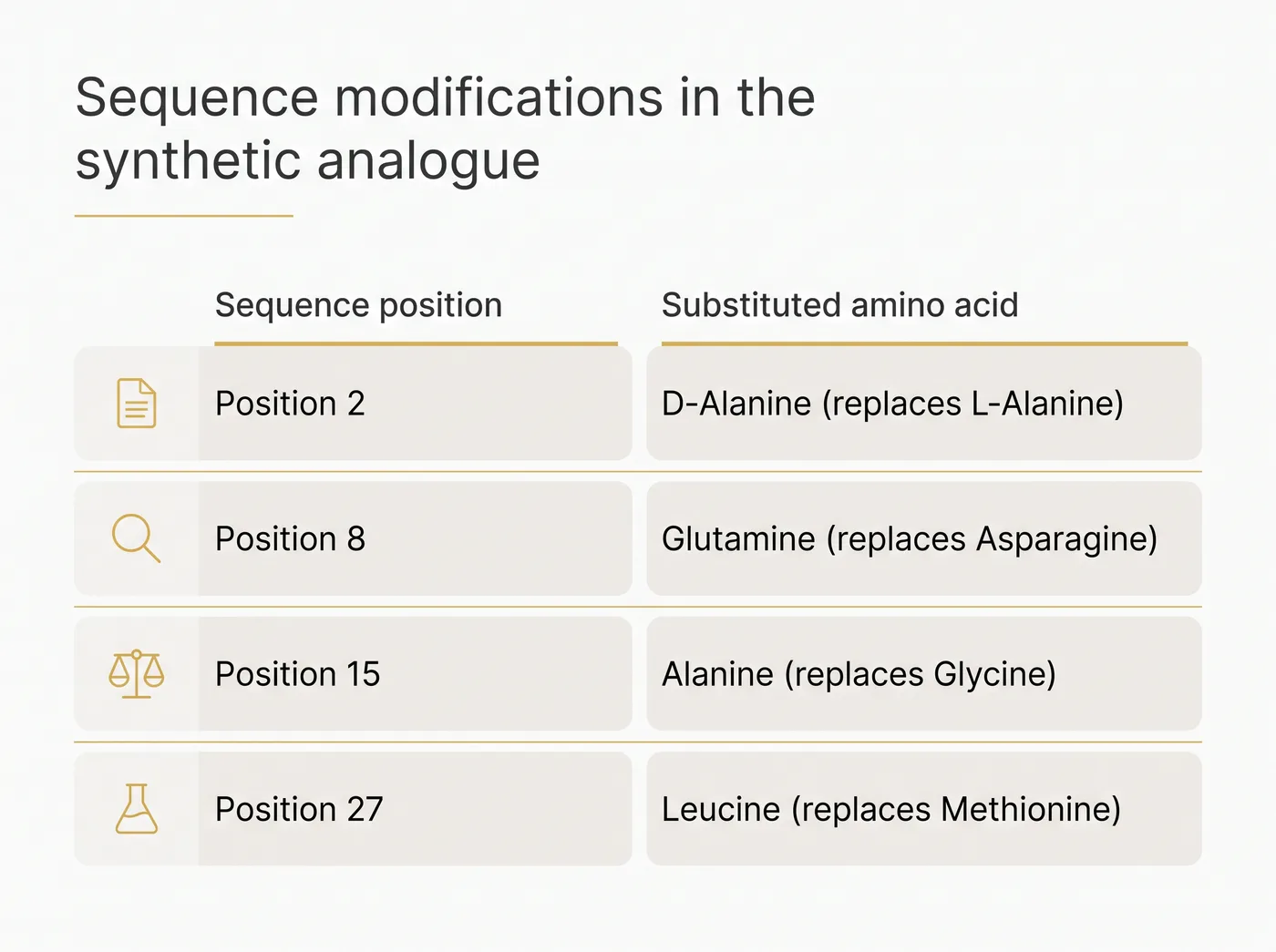
That fundamental length mimics a native peptide, but native peptides fall apart quickly in a laboratory flask. To survive routine handling, this synthetic analogue features four deliberate amino acid swaps, known collectively as tetrasubstitution. Think of it as replacing weak structural hinges with hardened steel to stop the material from breaking down under room lights.
| Position | Substitution | Chemical rationale for modification |
|---|---|---|
| Position 2 | D-Alanine replaces L-Alanine | Prevents rapid enzymatic cleavage at the N-terminus by hindering recognition. |
| Position 8 | Glutamine replaces Asparagine | Reduces chemical instability, as native asparagine is highly prone to spontaneous deamidation. |
| Position 15 | Alanine replaces Glycine | Optimises the overall structural folding and spatial stability of the peptide backbone. |
| Position 27 | Leucine replaces Methionine | Eliminates a primary oxidation route, as native methionine rapidly degrades when exposed to oxygen. |
That swap at position 27 does an enormous amount of work for a stored solid. Native methionine carries a sulfur atom that eagerly grabs oxygen from the air, turning into a sulfoxide. Swapping it out for leucine, an aliphatic amino acid of similar physical size, keeps the molecular shape identical while shutting the door on that specific oxidation reaction. Similarly, fixing position 8 stops deamidation, a quiet chemical reaction that flips a side chain amide into an acid and irreversibly ruins the electrical charge of the entire peptide.
Building the chain and cleaving the resin
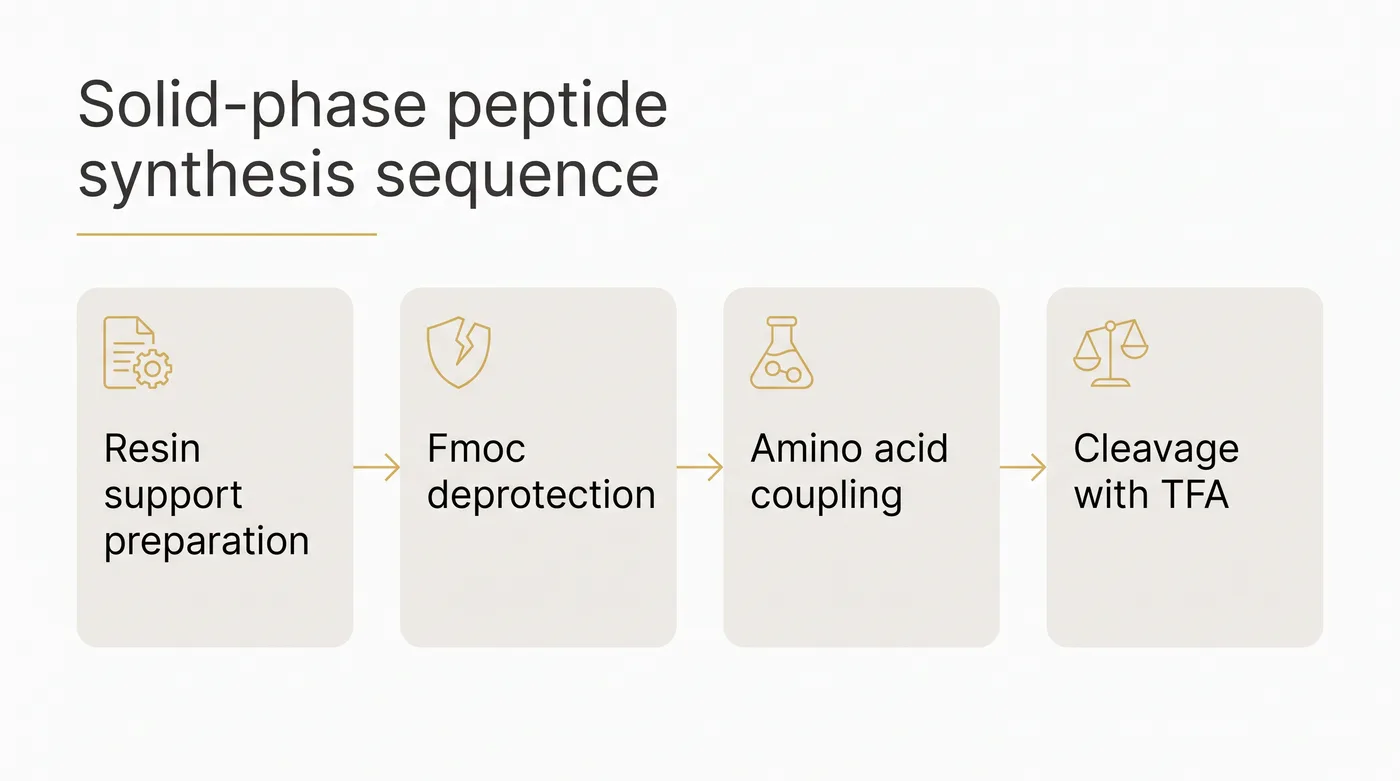
Assembling a precise 29-amino acid chain requires serious chemistry. Commercial laboratories build this molecule using Fmoc solid-phase peptide synthesis (SPPS), constructing it piece by piece on a microscopic resin bead. The first amino acid anchors to the resin, wearing a temporary Fmoc chemical shield over its reactive amine group. A deprotection reagent strips the shield, the resin is washed to remove the chemical waste, and the next amino acid attaches using specific activating reagents. This delicate microscopic assembly line runs 29 times.
Getting the finished sequence off the solid support is violent work. Advanced synthesis methods require the completed chain to be cleaved with TFA (trifluoroacetic acid), a harsh acid bath that snaps the anchor and strips away any temporary chemical shielding from the side chains 1. This aggressive step can trigger collateral damage if not carefully monitored. Poor technique leads to unwanted side reactions, like aspartimide formation or the creation of truncation sequences where an amino acid simply failed to attach 1.
Lyophilisation and surviving the freeze
Immediately after synthesis and purification, the peptide is floating in a liquid solvent. Turning that fragile solution into a stable powder ready for transport requires lyophilisation, which is the technical term for freeze-drying. It is a three-act process designed specifically to protect delicate molecular bonds from shearing under stress.
First, the liquid is frozen solid. Next, primary drying pulls a deep vacuum on the chamber while feeding in careful heat, forcing the ice to sublime directly into a vapour without ever melting into a liquid 2. Finally, secondary drying slowly ramps the temperature up to bake off any stubborn water molecules clinging to the structure. If the laboratory lets the material cross its collapse temperature during the vacuum stage, the structure ruins itself right there 2.
Proving the powder on a mass spectrometer
A vial of white powder tells you nothing by looking at it. Authentication means loading a sample into high-end machinery. High-Performance Liquid Chromatography (HPLC) tackles the purity question by forcing the dissolved sample through a dense separation column under extreme pressure. Every synthesis error and truncated fragment runs the race at a different speed. A highly pure batch hands you a single, dominant peak on the chromatogram, leaving the impurities behind in the baseline noise. The stationary phase of the column interacts uniquely with the tetrasubstituted sequence, ensuring no two compounds share the same retention time.
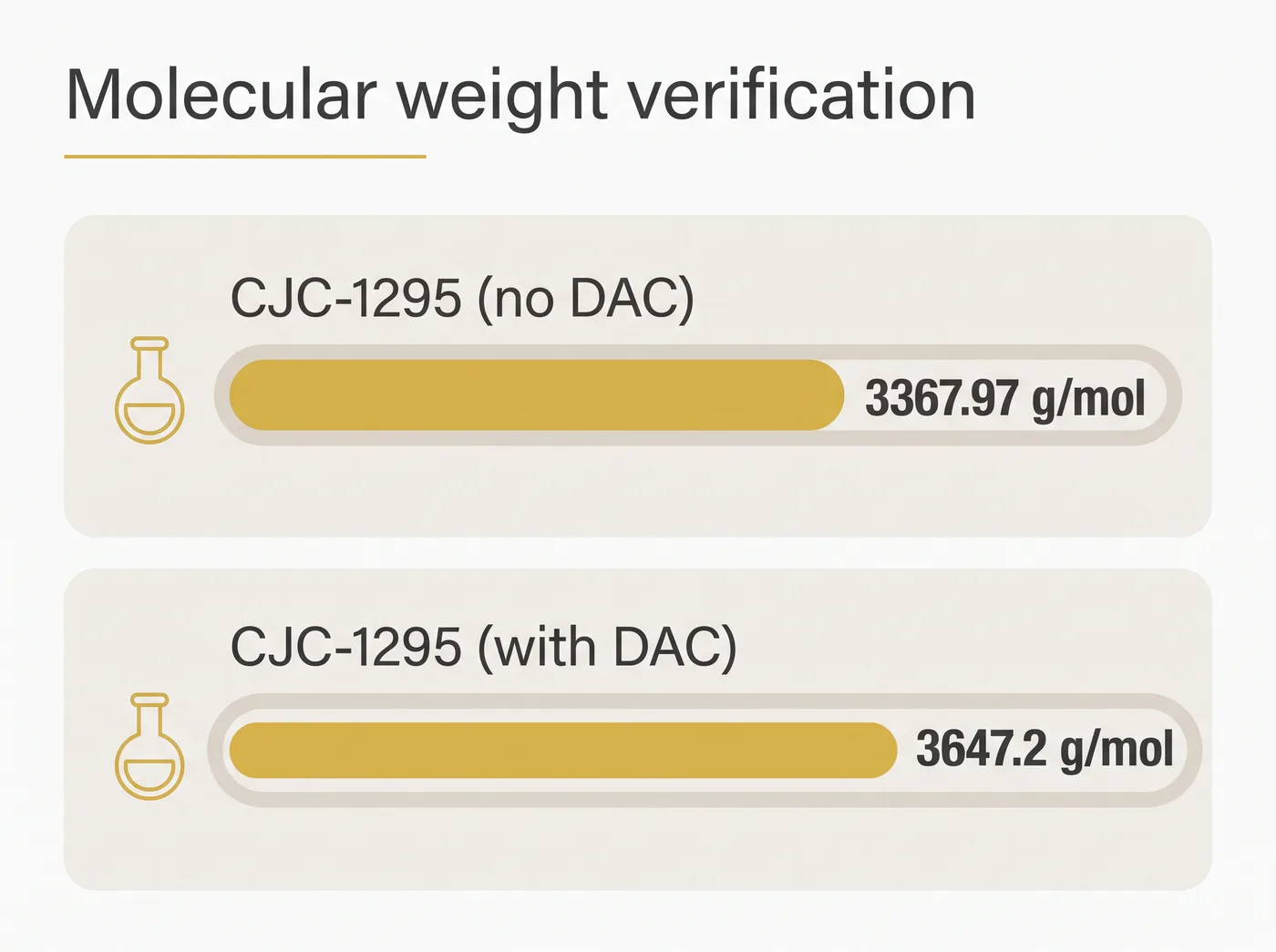
HPLC proves the material is pure, but it refuses to tell you what the sample actually is. For identity, laboratories rely on Liquid Chromatography-Mass Spectrometry (LC-MS). This instrument ionises the molecules and measures their mass-to-charge ratio. For CJC-1295 (no DAC), the machine must clock a specific intact molecular weight of 3367.97 g/mol and confirm the molecular formula C152H252N44O42.
Here is a classic analytical trap that catches careless technicians. If an analyst programmes their mass spectrometer to search for the heavy DAC-modified variant, they are hunting for a mass of roughly 3647.2 g/mol. When the machine finds nothing, they might flag a perfectly good batch as empty simply because they asked the wrong question. Knowing the molecular mass is your best defence against sloppy lab work. You can find current stock, pricing, and independent analytical results verifying ≥99% purity (99.106%, Janoshik report #89880) directly on the CJC-1295 (no DAC) product page.
Questions
What is the difference between CJC-1295 with DAC and without DAC?
The DAC variant carries a heavy maleimidopropionic acid appendage welded to the end of its chain. The "without DAC" version skips this attachment, resulting in a much lighter molecule and a different analytical signature.
Why is D-Alanine used in the sequence?
D-Alanine is an optical isomer placed deliberately at position 2 of the chain. This subtle switch prevents naturally occurring enzymes from recognising and destroying the N-terminus of the sequence during analysis.
What does Mod GRF 1-29 stand for?
It is shorthand for Modified GRF (1-29). This name confirms the base structure matches the first 29 amino acids of the native sequence, while pointing out the four deliberate amino acid swaps made to improve structural stability.
How must the lyophilised solid be stored?
The freeze-dried powder demands unbroken cold-chain storage. It requires a sealed laboratory freezer running at -20°C, safely away from light and ambient humidity to stop the chemical structure from unravelling over time.
Sources
- Advances in Fmoc solid-phase peptide synthesis (Journal of Peptide Science). Wiley
- Design of freeze-drying processes for pharmaceuticals: practical advice (Pharmaceutical Research). Springer
- nih.gov. National Library of Medicine