
Reading lab reports
HPLC purity vs net peptide content
NuuVive Journal · · 7 min read · Updated

Short answer
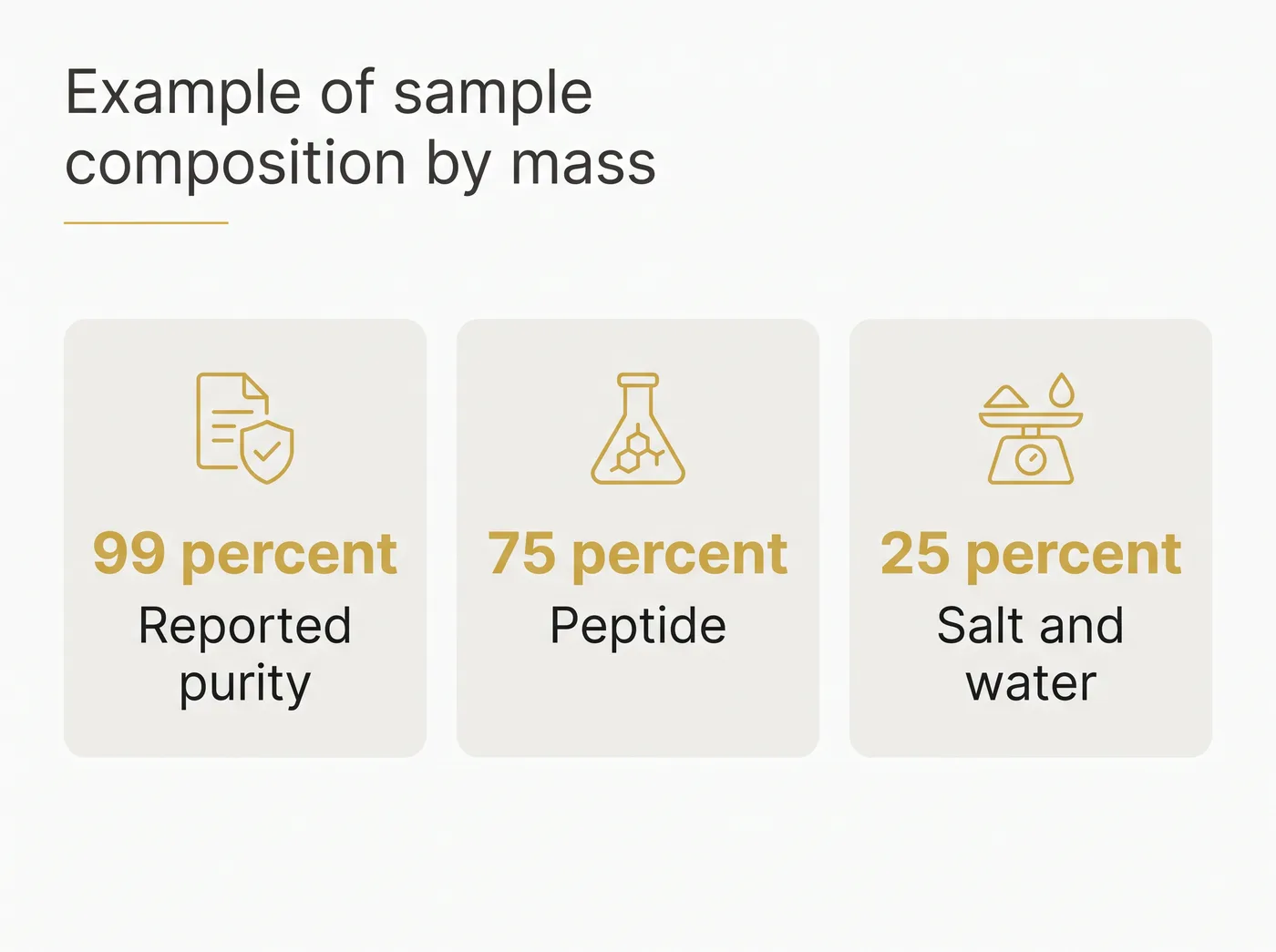
High-performance liquid chromatography purity is a relative measurement defining the percentage of the target sequence within the total detected peptidic material. Net peptide content is an absolute measurement defining the percentage of a lyophilised powder mass that consists of peptides, as opposed to salts and moisture. Purity describes the composition of the peptide fraction, whereas content describes how much of the solid material is peptidic.
Key takeaways
- Purity measures the relative composition of the peptide fraction, while content measures the absolute mass of that fraction within the total powder.
- High-performance liquid chromatography relies on ultraviolet light, which ignores invisible salts and moisture passing through the detector.
- Absolute content measurements require techniques like elemental nitrogen analysis to quantify the actual mass.
- Calculating an accurate molar concentration requires multiplying the gross powder weight by both the purity and the content fractions.
How high-performance liquid chromatography spots impurities
Think of a chromatogram as a structured race where every molecule has to cross the finish line in public. Purity evaluations rely on reversed-phase chromatography to separate the target sequence from incomplete truncation or deletion sequences. The laboratory introduces the sample so it flows through a stationary phase column under a programmed gradient of aqueous and organic solvents. This mobile phase usually combines water and acetonitrile, relying on an ion-pairing agent to keep the molecular traffic orderly. An ultraviolet detector waits at the end of the column, measuring absorbance at 214 or 220 nanometres. This specific wavelength corresponds to the absorbance of the peptide bond, allowing the machine to spot peptidic material crossing the line.
Laboratories calculate the final purity percentage through a mathematical method called area normalisation. The software calculates the integrated area of the target peak and divides it by the total integrated area of every peak detected at that wavelength. Getting this right relies on system suitability parameters. Metrics such as resolution, plate number, and the tailing factor govern the validity of the chromatographic separation, ensuring the column actually separates the molecules harmonised general chapter on chromatography. Allowable adjustments to these operating conditions are defined by pharmacopeial standards, leaving no room for laboratory guesswork.
The catch is that ultraviolet detection only registers chromophoric species that absorb light. Water, inorganic salts, and counter-ions lack strong absorbance at these wavelengths, meaning they pass through the detector unnoticed. Purity reports evaluate only the visible peptidic fraction, ignoring the invisible bulk of the material. Standard reversed-phase methods also generally fail to distinguish between stereoisomers, allowing mirrored impurities to hide in plain sight unless the laboratory relies on chiral chromatography or capillary electrophoresis.
Why content measurements tell a different story
Chromatography is brilliant at finding impurities, but it fails at weighing them. Because of the invisible salts and moisture, laboratories turn to absolute quantitation techniques to measure the true mass fraction of peptidic material. Elemental nitrogen analysis provides one standard method for doing this. The equipment measures total nitrogen by combusting the sample Easy and precise analysis of the absolute peptide content. Because common counter-ions and bound water lack nitrogen, this measurement correlates tightly with the total peptide mass. This works provided no external nitrogen sources, such as stray ammonium salts from the synthesis step, remain trapped in the powder.
Amino acid analysis offers another accurate technique, though it requires more laboratory effort. This method involves hydrolysing the sample, breaking it down into individual amino acids for exact quantification. Subtraction methods provide a different path, allowing laboratories to calculate the content by measuring and subtracting the non-peptide components directly. Residual moisture is quantified by running a Karl Fischer titration, a technique designed to isolate water. Counter-ions are quantified via ion chromatography or nuclear magnetic resonance spectroscopy.
Content metrics cannot establish the identity or the cleanliness of the peptide fraction. Since elemental and amino acid analyses measure all peptidic material in the vial, the resulting value sweeps up every synthesis impurity alongside the target. A laboratory report showing an 85 percent content result does not confirm that the 85 percent is solely the target sequence. It simply confirms that 85 percent of the solid powder is peptidic material, leaving the chromatography to sort out what that material actually is.
| Parameter | High-performance liquid chromatography purity | Net peptide content |
|---|---|---|
| Property measured | Relative composition of peptide fraction | Absolute mass fraction of peptide in solid |
| Typical analytical method | Reversed-phase chromatography | Elemental nitrogen analysis or amino acid analysis |
| Accounts for water and salts | No | Yes |
| Accounts for synthesis errors | Yes | No |
| Establishes peptide identity | No | No |
The reason some sequences attract moisture and salts
Synthesising a peptide leaves a trail of chemical baggage behind. Content typically ranges from 60 to 90 percent of the total powder mass. This happens because synthetic peptides are isolated as salts, commonly trifluoroacetate or acetate, during the final purification steps. These salts are highly hygroscopic, acting like tiny sponges for atmospheric moisture. The final mass fraction depends on both the inherent structural properties of the specific sequence and the parameters of the freeze-drying step used to create the solid powder.
A hydrophilic sequence loaded with basic amino acids, such as arginine, lysine, or histidine, naturally hoards counter-ions and bound water. Such a sequence exhibits a structurally lower content value. This remains true even if the chromatography purity is high. Assuming a uniform mass fraction across different synthetic peptides introduces systematic errors into routine laboratory preparations. You cannot assume two different sequences contain the same mass of actual peptide simply because they weigh the same on a balance.
This inherent variability explains why specifications for biological products mandate clear criteria for both characterisation and release testing ICH Q6B: Specifications for biotechnological/biological products. Evaluating a laboratory report requires checking both the purity and the content metrics to understand the true composition of the provided solid. Proper characterisation includes evaluating the physicochemical properties, the relative purity, and the absolute quantity together. Ignoring one metric renders the others functionally useless.
Rules for validating a laboratory procedure
Handing a sample over to a laboratory is only as reliable as the rules governing their machines. Validating the analytical procedures for both of these metrics requires demonstrating specific, measurable characteristics. International guidelines define these required validation characteristics, ensuring no laboratory simply guesses at the results. The rules mandate proving specificity, demonstrating linearity over a working range, and documenting both accuracy and precision across repeatable conditions ICH Q2(R2): Validation of analytical procedures. Showing intermediate precision and reproducibility ensures that a laboratory reports the same numbers on a Tuesday morning as they do on a Friday afternoon.
Testing laboratories operate under competence and impartiality frameworks designed to eliminate bias and error. These frameworks require metrological traceability, ensuring every measurement traces back to recognized global standards. They also require documented reporting of measurement uncertainty for any absolute mass quantification method. The entire basis of laboratory accreditation relies on this consistent, transparent operation. Accredited facilities use validated methods that report both the relative composition and the absolute quantity accurately, leaving no room for vague marketing claims.
Fixing the calculation errors in laboratory preparation
Preparing accurate molar concentrations for analytical methods requires factoring both the purity and the content metrics directly into mass calculations. Relying solely on the gross powder weight systematically overstates the target peptide concentration every time. The measured mass of the solid sitting on a laboratory balance includes the non-peptidic fraction and the synthesis impurities. Neither the salts, the moisture, nor the truncation errors contribute to the actual target sequence molarity. Ignoring them means dissolving a significant amount of invisible weight while believing it to be pure target material.
Determining the actual mass of the target sequence demands a little necessary arithmetic to strip away those illusions. The absolute mass of the target sequence equals the weighed powder mass multiplied by the content fraction, and then multiplied again by the purity fraction. It is a straightforward calculation, but skipping it ruins the math.
Failing to apply these basic structural corrections alters molarity calculations across the board. This omission generates systemic reproducibility errors across experiments, quietly degrading data. This is particularly noticeable when calculating binding constants or determining stoichiometric ratios for laboratory analysis. Standardising sample concentrations demands batch-specific data for every single material tested. Without knowing both the purity and the content, any precise measurement is just guesswork, which is why you always need to verify the exact numbers on the lab reports.
Questions
Does high purity indicate high peptide content?
Not at all. A high purity percentage merely indicates that the peptidic fraction is mostly the target sequence. A sample boasting high purity can still possess a low mass fraction of actual peptide if it contains a significant amount of invisible water and heavy counter-ions.
Can chromatography measure net peptide content?
Standard chromatography with ultraviolet detection cannot measure absolute mass content. Water, inorganic salts, and common counter-ions lack strong absorbance at standard analytical wavelengths, rendering them invisible to the detector. Determining the true mass content requires absolute quantitation methods like elemental nitrogen analysis.
Why are synthetic peptides isolated as salts?
Synthetic peptides contain ionisable side chains that naturally pair with the acids used during the cleavage and purification stages, such as trifluoroacetic acid or acetic acid. The final freeze-drying step traps these paired counter-ions alongside the peptide, leaving them in the resulting solid powder.
How does sequence composition alter content?
Sequences containing basic amino acids or strongly hydrophilic structures actively retain more moisture and hold tighter to counter-ions during synthesis. These chemical properties naturally lower the total mass fraction of peptide in the resulting powder, meaning the gross weight includes a higher proportion of non-peptidic material.