
Peptide chemistry
Ipamorelin identity: structure, molecular weight and form
NuuVive Journal · · 6 min read · Updated
Short answer
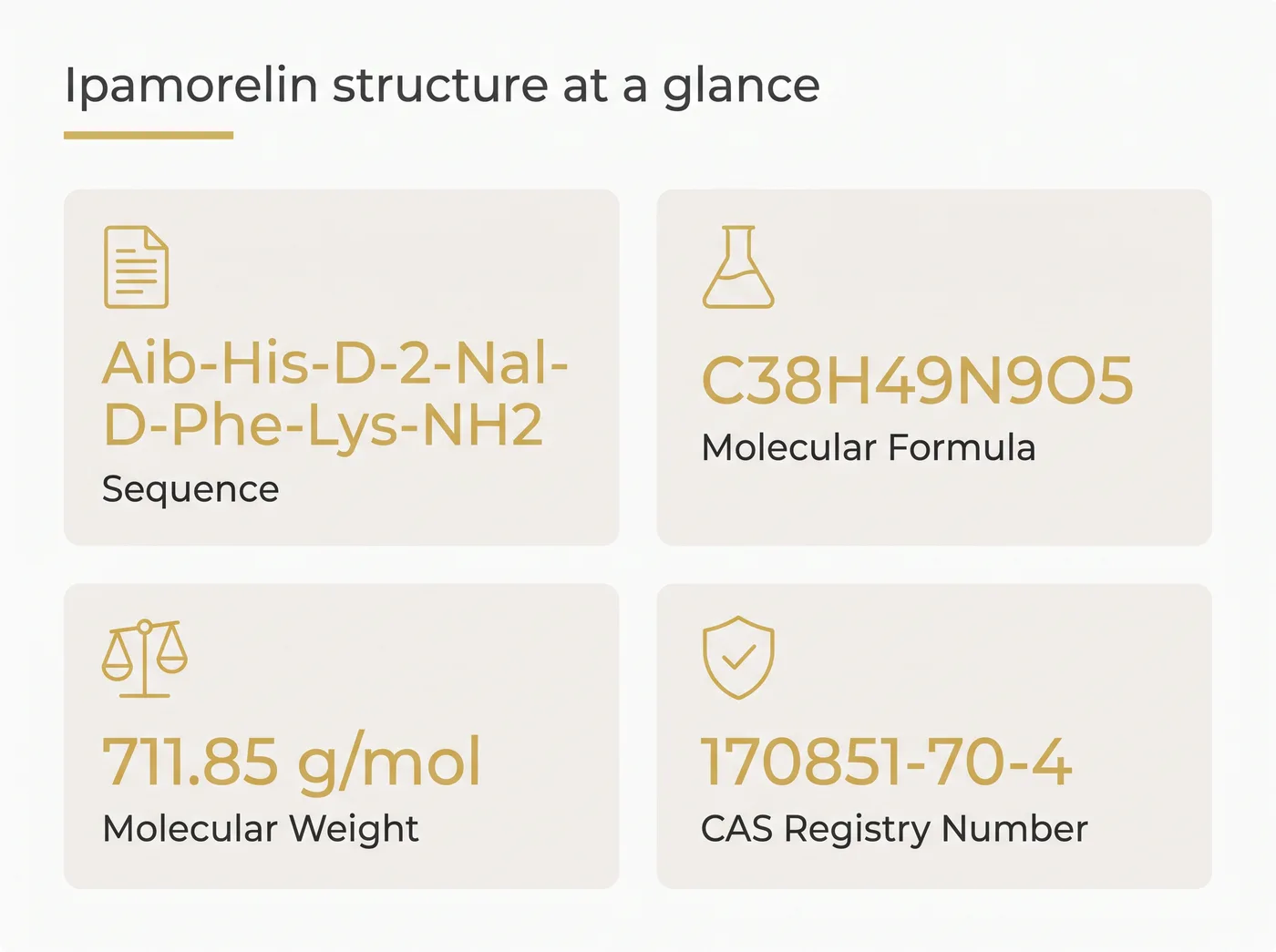
Ipamorelin is a synthetic pentapeptide composed of five amino acids, with the sequence Aib-His-D-2-Nal-D-Phe-Lys-NH2. It features three non-proteinogenic residues and is C-terminally amidated. The theoretical average molecular weight for the free base is 711.85 g/mol (molecular formula C38H49N9O5). It is synthesised via solid-phase methods and supplied as a white lyophilised powder, typically as an acetate or trifluoroacetate salt.
Key takeaways
- Ipamorelin (CAS 170851-70-4) is a synthetic pentapeptide with a modified sequence.
- Its linear structure is Aib-His-D-2-Nal-D-Phe-Lys-NH2, featuring non-proteinogenic D-isomer building blocks.
- The free base molecular weight is approximately 711.85 g/mol, which analytical laboratories verify via mass spectrometry.
- The C-terminus is amidated; if it hydrolyses to a free acid, the mass shifts by 0.984 Da, indicating degradation.
- NuuVive's Ipamorelin tested at ≥99% purity, achieving 99.897% on Janoshik report #215323.
Decoding the primary sequence
Looking at a chemical sequence for the first time is a bit like reading a foreign alphabet. If you do not know the grammar, it just looks like a random string of letters. Ipamorelin is a synthetic pentapeptide, meaning it is built from five amino acid residues. The linear sequence reads as Aib-His-D-2-Nal-D-Phe-Lys-NH2. Unlike natural biological peptides that stick to a standard menu of components, this compound incorporates highly specific non-proteinogenic and D-isomer building blocks.
The first position contains 2-aminoisobutyric acid (Aib), while the third and fourth positions feature D-configured aromatic residues: D-2-naphthylalanine (D-2-Nal) and D-phenylalanine (D-Phe). The Chemical Abstracts Service (CAS) registry number for the free peptide is 170851-70-4 PubChem. Because it contains these D-isomers, advanced analytical testing sometimes employs chiral chromatography. Standard columns separate molecules based on hydrophobicity, but chiral columns distinguish between the left-handed and right-handed orientations of these specific residues. It is the analytical equivalent of making sure the compound is wearing its shoes on the correct feet.
An essential structural element of Ipamorelin is its C-terminal amidation (Lys-NH2). This means the terminal lysine residue ends in an amide group rather than a free carboxylic acid. This modification defines its chemical identity. If the amide group hydrolyses to a free acid over time, or during a faulty synthesis run, the peptide's mass increases by 0.984 Daltons (Da). This represents a degradation product that analysts must carefully resolve during testing, as it tries to pass as the genuine article.
Formula, mass and the synthesis machinery
The molecular formula for the Ipamorelin free base is C38H49N9O5. Its theoretical average molecular weight clocks in at 711.85 g/mol, a figure you will often see rounded to 711.9 g/mol in standard literature. If a laboratory is looking at the monoisotopic mass, the monoisotopic mass ranges from 711.38 to 711.39 Da.
Laboratories manufacture Ipamorelin via Solid-Phase Peptide Synthesis (SPPS). This method acts like a microscopic assembly line, building the peptide chain one amino acid at a time on a solid resin support. Following assembly, the peptide is cleaved with TFA, which simultaneously detaches the chain from the resin and removes the temporary side-chain protecting groups Advances in Fmoc solid-phase peptide synthesis.
Synthesis is rarely perfect out of the gate. During the process, truncated sequences missing one or more amino acids inevitably form. The purification stage must isolate the main Ipamorelin peak from these closely related impurities. Because of the basic residues (Histidine and Lysine) and the basic N-terminus, Ipamorelin readily forms salts with acids during this phase.
Salt forms and the invisible baggage
The distinction between the free base and the salt form alters how laboratories handle the material. The theoretical mass of 711.85 g/mol applies to the free peptide sequence floating in a vacuum. As basic amino acid side chains bind with acid molecules during purification, the final solid accumulates additional mass that researchers must account for.
| Salt form | Counterion mass contribution |
|---|---|
| Free base | 0 g/mol |
| Acetate | Approximately 60 g/mol per ion |
| Trifluoroacetate (TFA) | Approximately 114 g/mol per ion |
When an analyst prepares a liquid sample, they must account for the salt multiplier and the Net Peptide Content. The weighed mass of the lyophilised solid incorporates the peptide, the counterions and residual moisture all clumped together. Understanding this distinction prevents massive dilution errors during analytical sample preparation. The salt acts as a silent passenger, adding bulk without adding peptide.
Physical form and moisture management
Following purification, the liquid peptide solution undergoes a rigorous freeze-drying step to produce a stable solid. Ipamorelin is supplied as a white to off-white lyophilised powder. The process involves freezing the solution, followed by primary and secondary drying under high vacuum to sublime the ice directly into vapour and remove tightly bound water Design of freeze-drying processes for pharmaceuticals: practical advice.
Lyophilised peptides contain substantial amounts of water and counterions that do not register during standard UV detection. Net Peptide Content (NPC) determines the mass fraction of the true Ipamorelin sequence relative to the total powder weight. A standard lyophilised peptide typically maintains an NPC of 75% to 85%. The rest of the mass is just the scaffolding required to keep the molecule stable.
Chromatographic analysis and spotting impurities
Ipamorelin identity and purity require verification through orthogonal analytical methods. Purity alone does not establish identity; a beautifully pure peak of an entirely different sequence provides no value to a researcher.
Reversed-Phase High-Performance Liquid Chromatography (RP-HPLC) establishes the chromatographic purity of the sample and isolates the target pentapeptide from synthesis byproducts. The sample introduction loads the dissolved peptide onto a hydrophobic stationary phase, typically a C18 column. The instrument pumps a gradient of organic and aqueous mobile phases, such as acetonitrile and water with 0.1% TFA, to elute the compounds. It is a high-pressure race where every impurity must cross the finish line in public.
Detectors monitor the elution using ultraviolet light, usually set between 210 nm and 220 nm to capture the absorbance of the peptide bonds. The area under the primary Ipamorelin peak is compared against the total area of all integrated peaks to calculate the purity percentage. If an impurity hides under the main peak, the purity number lies, which is why the gradient timing is so rigorously controlled.
Mass spectrometry and trusting the certificate
While HPLC determines purity, Mass Spectrometry confirms the molecular identity by measuring the mass-to-charge ratio (m/z) of the individual ions. A proper spectrum for Ipamorelin shows a sharp primary protonated peak at [M+H]+ of 712.8 m/z. A doubly charged species [M+2H]2+ at 356.9 m/z is also common and highly characteristic of this specific sequence.
If you have ever opened a peptide lab report and felt unsure where to look first, start with the header, not the giant purity number. Most weak certificates quietly fail right there. A trustworthy certificate requires a defined lot number that matches the printed vial, a named laboratory with an address you could look up, and a recent test date.
These details tie the analytical data securely to the physical material sitting in front of you. NuuVive's Ipamorelin tested at ≥99% purity, achieving 99.897% on Janoshik report #215323. You can view the current price, stock and measured purity on the product page.
Questions
What is the difference between Ipamorelin free base and its salt form?
The free base refers to the peptide sequence C38H49N9O5 without any associated ions. In practice, due to its basic residues, the peptide binds with acids during purification to form a stable salt, such as Ipamorelin acetate or trifluoroacetate. This salt form alters the bulk molecular formula and the total handling weight of the solid.
Why does the C-terminal amidation matter?
Amidation at the C-terminus (Lys-NH2) is a highly specific structural modification of the sequence. If the amide group is missing or hydrolyses back to a free acid, the molecular mass stubbornly increases by 0.984 Da. Analytical methods must check for this mass shift to confirm the peptide has not degraded over time.
What does Net Peptide Content mean for a sample?
Net Peptide Content (NPC) represents the fraction of actual peptide molecules in the lyophilised powder, distinct from the counterions and residual moisture. While HPLC measures the purity of the peptide portion itself, NPC determines how much of the total powder mass is genuinely the peptide.
How do chiral D-isomers affect Ipamorelin testing?
The Ipamorelin sequence contains synthetic D-configured amino acids, which are stereoisomers of natural L-amino acids. Because standard reversed-phase columns cannot always distinguish between these orientations, laboratories may employ specific chiral chromatography. This targeted analytical step confirms the correct enantiomer is actually present in the sample.
Sources
- Advances in Fmoc solid-phase peptide synthesis (Journal of Peptide Science). Wiley
- Design of freeze-drying processes for pharmaceuticals: practical advice (Pharmaceutical Research). Springer
- nih.gov. National Library of Medicine