
Reading lab reports
KPV lab report: what to check
NuuVive Journal · · 7 min read · Updated

Short answer
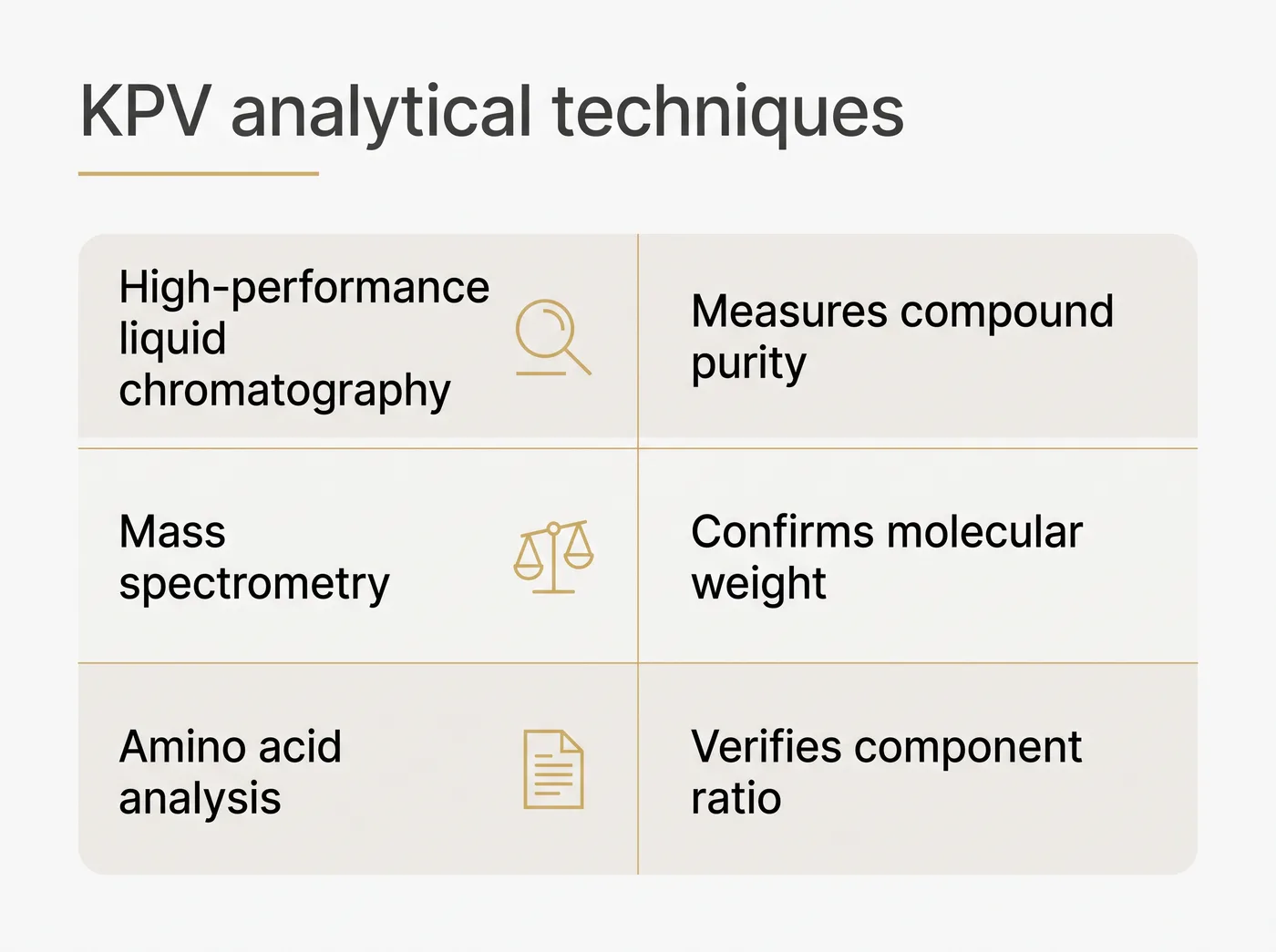
When reading a KPV lab report, look for a named laboratory, a clear lot number and two primary analytical methods. High-performance liquid chromatography determines the purity of the solid material, while mass spectrometry confirms the chemical identity by matching the molecular weight to 342.43 g/mol. A trustworthy certificate always includes the raw chromatogram data graphs, rather than simply printing a standalone percentage that asks for your blind faith.
Key takeaways
- A complete document pairs high-performance liquid chromatography to measure purity with mass spectrometry to confirm molecular identity.
- The mass spectrometry result must display an intact mass matching 342.43 g/mol to verify the correct material.
- A lot number must appear on both the certificate and the glass vial to maintain a clear, traceable link.
- Trustworthy laboratories always provide the raw analytical data graphs alongside the final percentage to prove their working.
- Amino acid analysis serves as a highly specific secondary check to confirm the ratio of the constituent parts.
The chemical blueprint of a tiny molecule
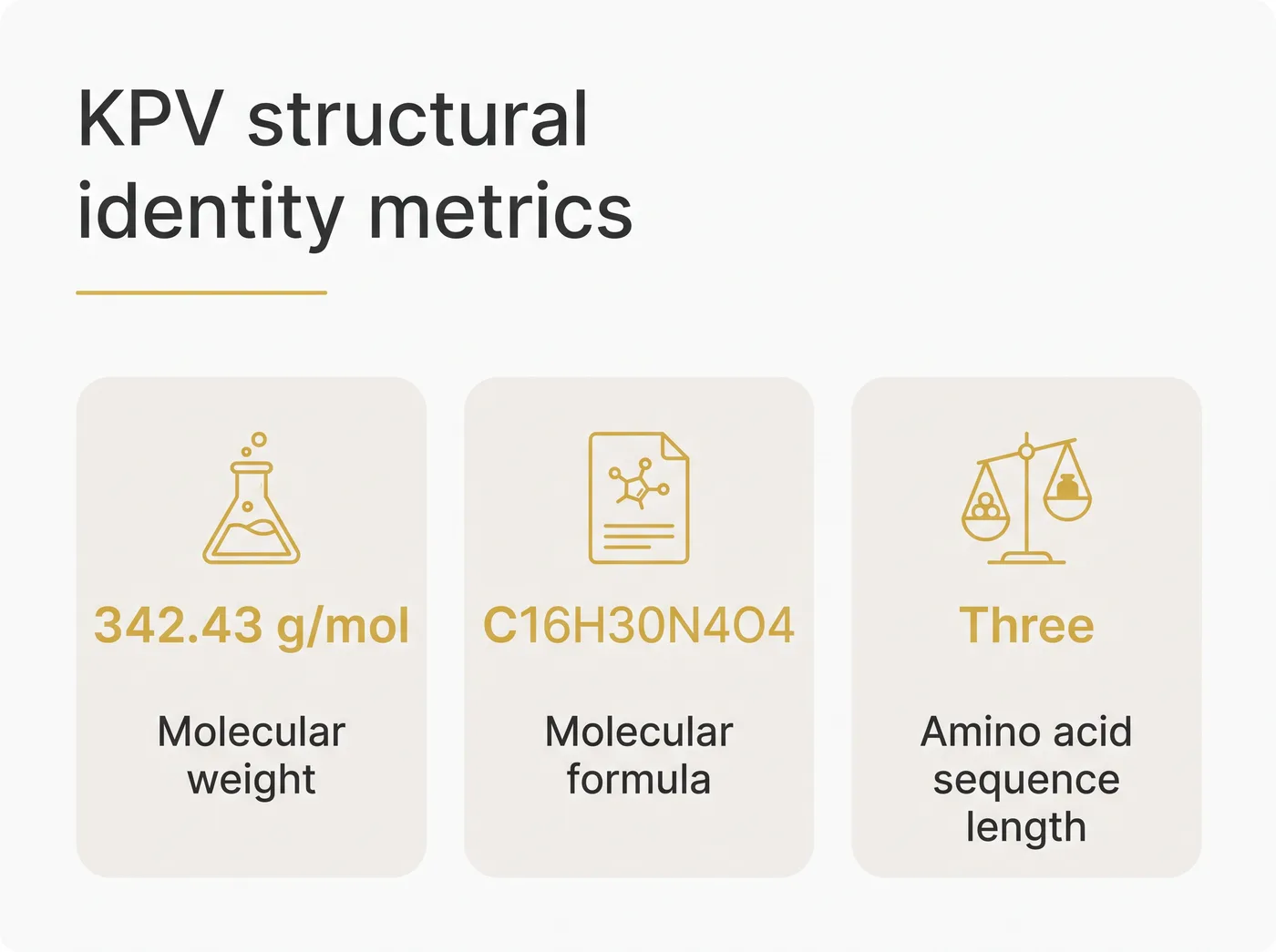
Before diving into a laboratory report, you need to know what material the document describes. KPV is a synthetic tripeptide, which simply means it contains three amino acids arranged in a specific sequence: lysine, proline and valine. It features a basic residue at the nitrogen terminus, a conformationally constrained proline in the central position, and a hydrophobic valine anchoring the carbon terminus. That specific chemical structure dictates how the material behaves when a laboratory runs it through heavy analytical machinery.
In a standard laboratory setting, the compound arrives as a lyophilised powder. The freeze-drying step removes water under a vacuum, leaving behind a stable solid cake, usually in either a free base or an acetate salt form. The material carries the molecular formula C16H30N4O4 and a defined molecular weight of 342.43 g/mol. Because it contains only three amino acids, it falls well within the small-molecule framework defined by the FDA, distinguishing it structurally from larger biological proteins Waters. It is exceptionally small, and that tiny size means instruments can characterise it with high accuracy.
This sequence corresponds to a specific terminal fragment. When analytical chemists evaluate this solid substance, they rely on established pharmacopoeial and regulatory frameworks to ensure the molecular structure remains intact. A trustworthy laboratory report proves that the material matches this chemical blueprint, free from the severe contamination that haunts poor manufacturing environments.
Spotting true purity through liquid chromatography
A trustworthy certificate of analysis always leans on high-performance liquid chromatography to establish baseline purity. Think of this analytical technique as a highly regulated race, designed specifically to separate the target peptide from any rogue synthesis byproducts that may have formed during the manufacturing process. The industry standard for analytical-grade synthetic peptides typically sits at or above 98 percent purity, measured cleanly by the area percentage on the resulting chromatogram.
The most common method deployed is reversed-phase chromatography, which separates the chemical components based purely on their hydrophobicity. The machinery uses a stationary column packed with tiny silica particles. The mobile phases usually consist of an aqueous solvent and acetonitrile, acting as the liquid that pushes the sample through. A small amount of trifluoroacetic acid is conventionally added to yield sharp, well-resolved ultraviolet absorption peaks. As the sample load moves through the tightly packed column, impurities naturally separate from the main KPV peak because they interact with the silica differently.
These unwanted extras often include deletion sequences missing an amino acid, truncated sequences, or stubborn residual reagents left over from the solid-phase synthesis step. They cross the detector's finish line at different retention times. The final report calculates purity by comparing the area of the main peak against the total mathematical area of all detected peaks combined. However, a solitary percentage printed in bold ink is never enough. Quality laboratory practice demands the clear provision of the raw chromatogram. Seeing the actual graph, complete with crisp baseline resolution and individual peak integrations, ensures the data has not been subjectively manipulated by a vendor trying to hide a sloppy synthesis run.
Why mass spectrometry is the ultimate polygraph
While liquid chromatography brilliantly measures the homogeneity of the sample, it possesses a glaring analytical blind spot. It cannot definitively identify the chemical compound sequence or its true molecular weight. A sample could test as highly pure, but be the wrong substance. For unquestionable verification, a laboratory report must include mass spectrometry data. This method determines the mass-to-charge ratio of the compound present in the sample, acting as an unforgeable chemical fingerprint.
For this specific tripeptide, the report should show a dominant, intact mass peak corresponding to 342.43 g/mol. Finding this mass proves that the dominant substance in the vial has the correct physical size and atomic weight. It acts as a hard filter, instantly ruling out heavy molecular debris or different compounds that just happen to share a similar chromatography retention time in the column.
| Analytical method | Primary purpose | What the instrument measures | Method limitation |
|---|---|---|---|
| Liquid chromatography | Purity assessment | Area percentage of the main compound | Cannot confirm molecular identity |
| Mass spectrometry | Identity verification | Mass-to-charge ratio (intact mass) | Does not quantify total sample purity |
| Amino acid analysis | Composition check | Stoichiometric ratio of amino acids | Requires destroying the peptide chain |
An entirely preventable error often seen in careless peptide analysis is attempting mass spectrometry using high concentrations of trifluoroacetic acid in the solvent. This leads to a phenomenon known as extreme ion suppression. In plain terms, the acid literally swamps the sensitive detector, rendering the mass data artificially clean because the smaller impurities fail to ionise properly and remain invisible. Correctly calibrated analytical methods deliberately avoid this pitfall to deliver clear, unambiguous identity confirmation, leaving poor quality material nowhere to hide.
Amino acid analysis and the sequence isomer trap
Because a matching intact mass alone does not definitively confirm the specific sequence order of the amino acids, clever laboratories often deploy amino acid analysis as an orthogonal testing method. Mass spectrometry confirms the total atomic weight, but it does not tell you the order the molecular building blocks are snapped together in. Amino acid analysis solves this puzzle by physically hydrolysing the peptide back into its constituent singular amino acids for separate, individual measurement.
For KPV, the laboratory report should demonstrate a strict stoichiometric ratio of lysine, proline and valine. This 1:1:1 ratio serves as an elegant, highly specific secondary check on the chemical sequence composition, distinct from the mass measurement. Sequence isomers, which are peptides constructed with the same amino acids but in the wrong physical order, would share the identical intact mass of 342.43 g/mol. This quirk of chemistry makes a secondary compositional check a brilliant, often overlooked part of thorough material characterisation.
Paperwork, traceability and the salt form math
A strong laboratory document follows clear regulatory definitions for batch records and traceability ICH. The certificate must visibly display a distinct lot number that directly matches the alphanumeric code printed on the physical vial. Without this unbroken linkage, the pristine analytical data floating on the PDF cannot be tied to the physical solid material sitting on the lab bench. A missing lot number instantly turns a supposed certificate of analysis into a meaningless piece of historical fiction.
Laboratory competence relies on providing transparent raw data and adhering to recognised global standards such as ISO/IEC 17025 ISO. Missing salt form accounting on a certificate can also cause massive calculation issues later during analytical assays. If a sample contains the standard acetate salt form, the net peptide content will naturally be mathematically lower than the total gross powder weight due to the added chemical mass of the invisible counter-ions.
Reviewing these documents requires a sharp eye and a little basic attention to analytical detail. Checking the lot number, verifying the mass and inspecting the chromatogram baseline ensures you are evaluating the material you set out to acquire. You can visit the KPV product page to review the current price, stock levels and detailed measured purity reports.
Questions
What does a missing chromatogram mean on a certificate?
A missing chromatogram means the primary raw analytical data is absent. Without the visual graph clearly showing the peaks and baseline resolution, it is mathematically impossible to verify if the reported percentage is actually accurate, or if inconvenient impurities were subjectively excluded by the laboratory.
Why is the intact mass of 342.43 g/mol so important?
The intact mass confirms the literal physical size of the molecule present in the tested sample. Matching the measured mass directly to the fixed theoretical mass of 342.43 g/mol ensures the correct tripeptide is actually present, rather than a different chemical compound or random fragmented debris.
How does the salt form affect the laboratory report?
Synthetic peptides are commonly supplied as an acetate salt. These microscopic counter-ions add real chemical mass to the total solid, meaning the actual net peptide content is lower than the gross powder weight inside the glass vial, which must be carefully factored into any analytical assay calculations.
What is an amino acid deletion sequence?
A deletion sequence is a specific manufacturing impurity where the chemical synthesis process failed to attach one of the required amino acids, resulting in a physically shorter molecular fragment. Liquid chromatography physically separates these shorter fragments from the main peak so the laboratory can quantify them accurately as distinct impurities.