
Peptide chemistry
MOTS-c identity: structure, molecular weight and form
NuuVive Journal · · 5 min read

Short answer
MOTS-c is a 16-amino-acid synthetic peptide with the molecular formula C101H152N28O22S2 and an average molecular weight of approximately 2174.6 g/mol. It features a linear structure containing two methionine residues and no disulfide bonds. For laboratory use, it is supplied as a sterile, white lyophilised solid that requires strict cold storage and dissolving in a suitable aqueous or organic solvent prior to analytical handling.
Key takeaways
- The MOTS-c sequence is a linear 16-mer lacking any internal disulfide bridges.
- Its exact average molecular weight is 2174.6 g/mol, a figure required for mass spectrometry verification.
- Two methionine residues in the chain make the material highly susceptible to oxidation if handled poorly.
- Laboratory supply is universally a lyophilised solid that demands careful handling to prevent precipitation.
- A reliable certificate of analysis must include both chromatographic purity and mass identity matching the theoretical weight.
The 16-amino-acid blueprint
Before you open a vial of MOTS-c in the laboratory, you need to know what is sitting inside it. MOTS-c is a synthetic, 16-amino-acid linear peptide. The sequence runs Met-Arg-Trp-Gln-Glu-Met-Gly-Tyr-Ile-Phe-Tyr-Pro-Arg-Lys-Leu-Arg. Unlike complex cyclic peptides, this chain is entirely linear and lacks any cysteine residues. That means there are no disulfide bridges holding the structure in a specific folded shape, which simplifies synthesis but leaves the chain fully exposed to its environment.
The chemical makeup of that sequence dictates how the material behaves under analysis. It carries four basic residues, consisting of three arginines and one lysine. This combination gives the molecule a strong net positive charge at standard physiological pH, strongly influencing its retention time during reversed-phase high-performance liquid chromatography. You will also find four aromatic amino acids in the sequence. Tryptophan and tyrosine give the peptide strong ultraviolet absorbance at 280 nm, which is why analysts rely on HPLC-UV detection to map out the compound.
Manufacturing this 16-mer relies on standard solid-phase peptide synthesis. The sequential addition of amino acids is highly controlled, but side reactions can occur. As the chain grows, failure to attach an amino acid creates deletion errors, while premature termination yields truncated sequences. These process-related impurities are the primary reason rigorous chromatographic purification is an absolute requirement before the material ever reaches a laboratory.
Methionine and the oxidation problem
If there is a structural weak point in MOTS-c, it is the two methionine residues located at positions 1 and 6. Methionine contains sulfur, and in an aqueous environment exposed to oxygen, sulfur is highly prone to forming methionine sulfoxide. This oxidation process is the primary cause of structural degradation for this specific peptide.
When methionine oxidises, the mass of the peptide increases. Mass spectrometry will immediately reveal a +16 Da mass shift if one methionine is oxidised, or a +32 Da shift if both have degraded. This is why careful handling of the solid powder and its subsequent solutions is necessary. Prolonged exposure to ambient air, high temperatures, or careless mixing in unheated aqueous media dramatically accelerates this degradation. A solid stability profile requires keeping the lyophilised material sealed at sub-zero temperatures until the exact moment of analytical preparation.
Tracking the molecular weight
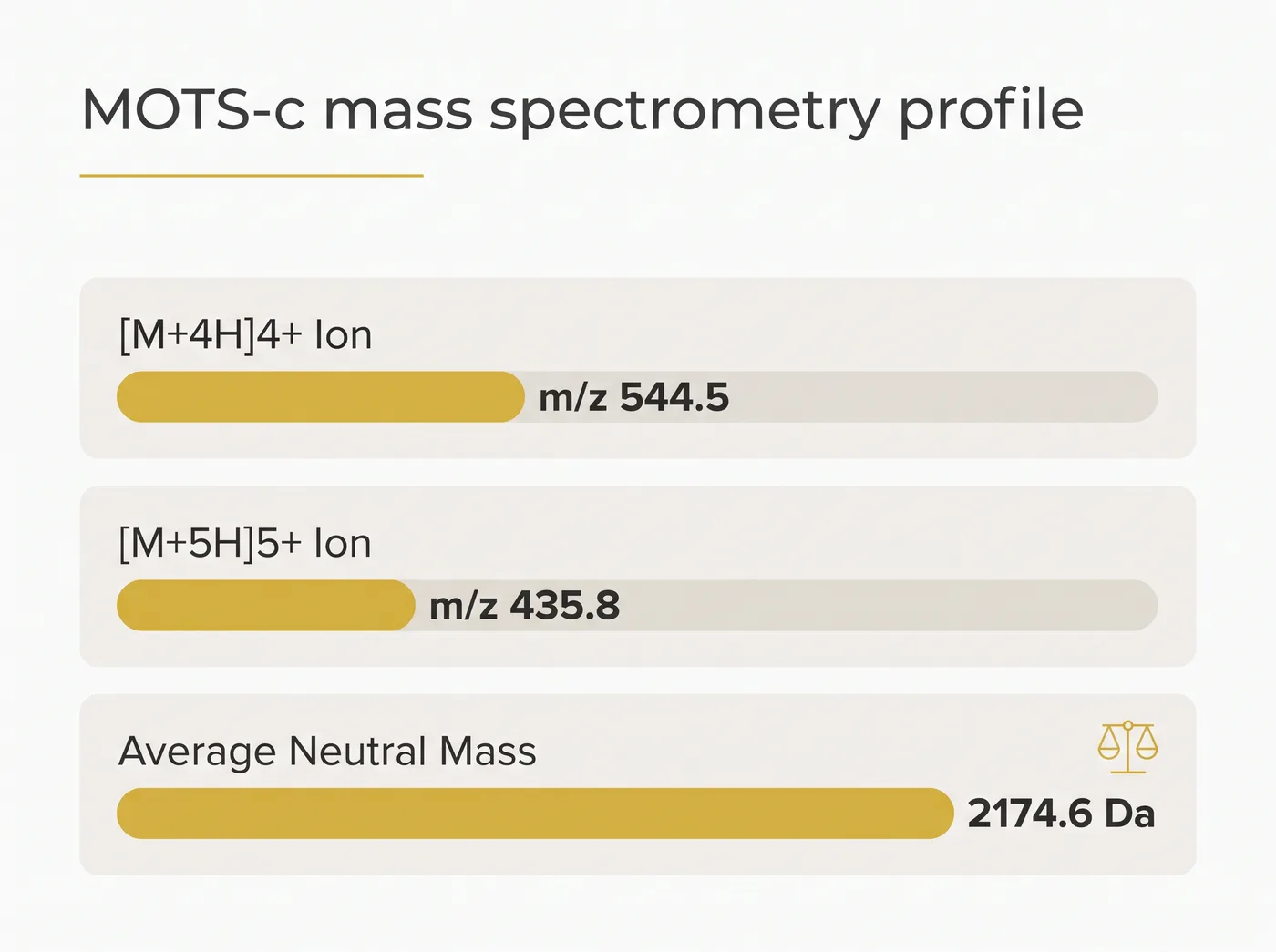
You cannot confirm the identity of a chemical without knowing its exact mass. The molecular formula for MOTS-c is C101H152N28O22S2. When you calculate the average mass of those 305 atoms, you get approximately 2174.6 g/mol. That number is the anchor point for every mass spectrometry test run on the material.
| Chemical Property | Specification |
|---|---|
| Molecular Formula | C101H152N28O22S2 |
| Average Molecular Weight | 2174.6 g/mol |
| Sequence Length | 16 amino acids |
| CAS Registry Number | 1627580-64-6 |
When evaluating a mass spectrometry report, the number 2174.6 will rarely appear as a single clean peak. Because MOTS-c is a relatively large synthetic peptide, liquid chromatography coupled with mass spectrometry in positive electrospray ionisation mode will strip protons from the basic residues. This creates multiply charged precursor ions. You will typically see a cluster of signals at specific mass-to-charge ratios, such as the [M+4H]4+ ion at m/z 544.5 and the [M+5H]5+ ion at m/z 435.8. An analyst must deconvolve these charged states to mathematically converge back to the 2174.6 Da average mass.
The freeze-dried solid
MOTS-c is universally supplied as a sterile, white to off-white lyophilised powder. The process of lyophilisation, or freeze-drying, removes the bulk solvent used during final purification while preserving the fragile peptide structure. The liquid is frozen, and the ambient pressure is reduced to allow the frozen water to sublimate directly from the solid phase into a gas.
This process leaves behind a highly porous solid cake. However, the resulting powder is never simply pure peptide. The primary and secondary drying stages intentionally leave a very small percentage of residual moisture to prevent the crystal structure from collapsing. The powder also contains counterions, typically acetate or trifluoroacetate, left over from the synthesis cleavage steps. These counterions are a normal part of the chemical complex and contribute to the total mass inside the vial.
Preparing this solid for analysis requires patience. When introducing an analytical solvent, analysts add the liquid gently to avoid shear stress from mechanical agitation, which can physically break the peptide backbone or cause irreversible aggregation. If precipitation occurs, pre-heating the aqueous media to 37 degrees Celsius or applying brief sonication may help resolve the supersaturation.
Verifying the lab report
A certificate of analysis is only as useful as the methods it lists. Relying solely on a high HPLC purity percentage is an error. An HPLC chromatogram maps the relative abundance of components in the sample; a single sharp peak simply means the powder is highly homogeneous and free of synthesis errors. It does not mean the peak is actually MOTS-c.
To verify the material, the lab report must pair that chromatographic purity with a clear mass spectrometry result. The MS data is the fingerprint that ties the homogeneous powder back to the C101H152N28O22S2 formula. Without both documents aligning perfectly with the listed lot number, the certificate is merely paperwork. For verified structural identity and exact purity figures, examine the current test documents for NuuVive's MOTS-c.
Questions
Why must the MOTS-c solid be dissolved prior to analysis?
The material is supplied as a lyophilised solid to ensure chemical stability during transport and storage. It must be dissolved into a suitable solvent to allow for accurate volumetric measurement and sample introduction during laboratory analysis.
What causes the peptide solution to turn cloudy?
Cloudiness or precipitation usually indicates solvent shock or supersaturation. This often happens if an organic stock solution is mixed too rapidly into cold aqueous media.
Can HPLC alone confirm the peptide is MOTS-c?
No. HPLC separates compounds and establishes purity based on relative peak areas. Molecular identity must be verified independently using mass spectrometry to confirm the 2174.6 g/mol weight.