
Peptide chemistry
MT-2 (Melanotan II) identity: structure, molecular weight and form
NuuVive Journal · · 7 min read · Updated
Short answer
MT-2 (Melanotan II) is a synthetic cyclic heptapeptide consisting of seven amino acids, with the chemical formula C50H69N15O9 and an average molecular mass of 1024.2 g/mol. Its molecular architecture features an internal lactam bridge forming a 23-member ring, an N-terminal acetyl group and a C-terminal amide. For laboratory research, it is supplied as a sterile-filtered, white lyophilised solid, typically isolated as an acetate or trifluoroacetate salt. Verifying the material requires specific analytical methods, including reversed-phase chromatography and tandem mass spectrometry, to confirm its chemical purity and structural identity.
Key takeaways
- MT-2 (Melanotan II) is a synthetic cyclic heptapeptide with the sequence Ac-Nle-cyclo(Asp-His-D-Phe-Arg-Trp-Lys)-NH2.
- The chemical formula of the free peptide base is C50H69N15O9, corresponding to an average molecular weight of 1024.2 g/mol.
- A covalent lactam bridge forms an internal ring by linking the aspartic acid and lysine side chains.
- Laboratories isolate the material as a lyophilised solid containing the peptide base, a counterion and residual moisture.
- Chromatography and mass spectrometry are required to verify the purity and monoisotopic mass of a laboratory sample.
Building the chain from scratch
Look at the formal sequence notation for MT-2, and it reads a bit like an algebra equation: Ac-Nle-cyclo(Asp-His-D-Phe-Arg-Trp-Lys)-NH2. That string of letters represents seven amino acids assembled in a highly specific order. In a laboratory setting, chemists build this chain one link at a time using Fmoc solid-phase peptide synthesis. The process relies on repeated coupling and deprotection steps to assemble the sequence accurately, while sidestepping constant chemical hurdles like aspartimide formation or the creation of truncation sequences during production Fmoc solid-phase peptide synthesis.
Unpack that heptapeptide chain, and you find these residues from position one through seven:
- N-acetyl-norleucine (Nle)
- Aspartic acid (Asp)
- Histidine (His)
- D-phenylalanine (D-Phe)
- Arginine (Arg)
- Tryptophan (Trp)
- Lysine (Lys)
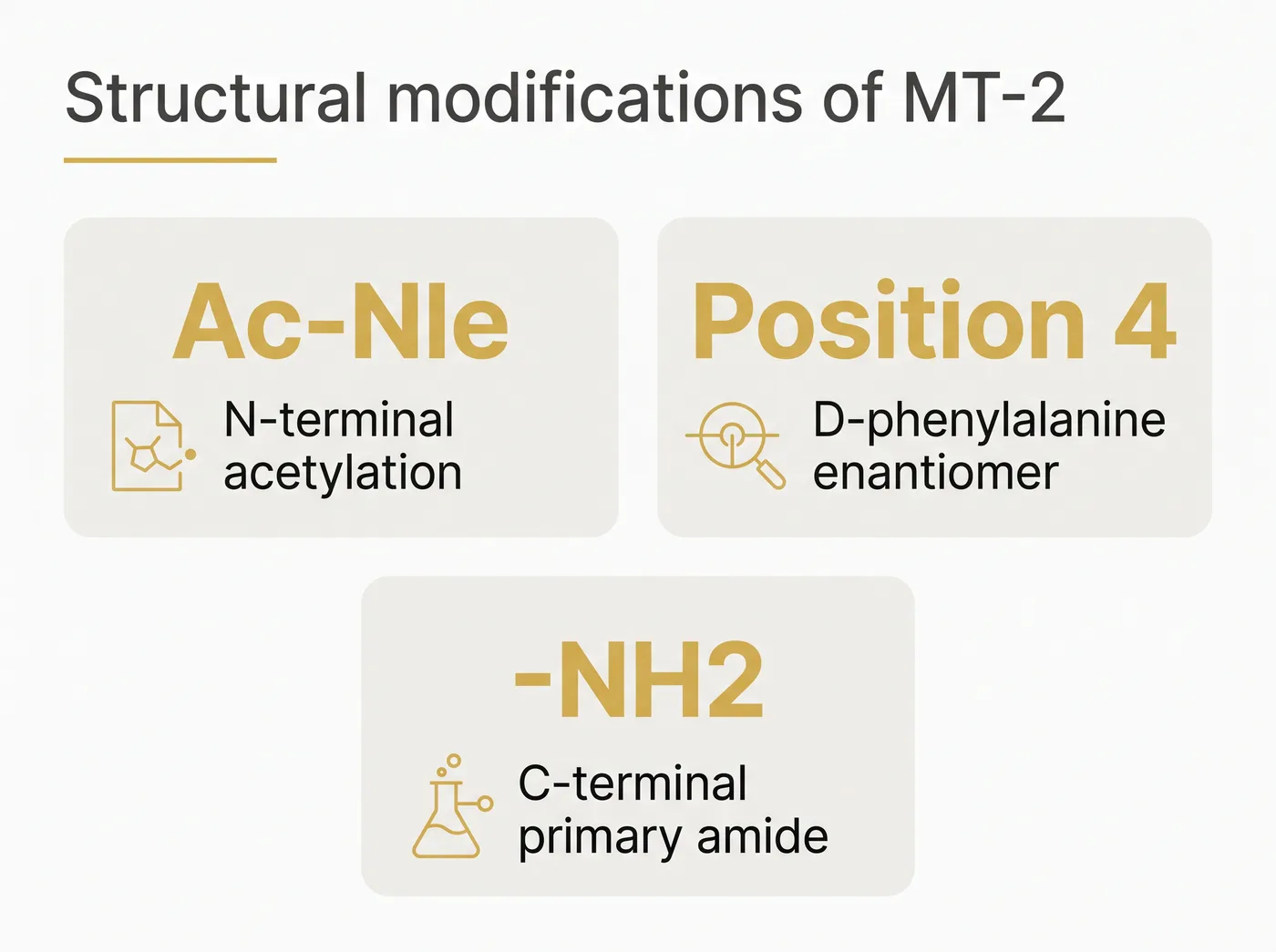
This is not your standard string of simple L-amino acids. The synthetic sequence incorporates specific architectural twists. The N-terminus is capped with an acetyl group attached to a synthetic norleucine residue, locking the front door of the molecule. At the fourth position, the sequence swaps in a non-natural dextrorotatory enantiomer, D-phenylalanine. Finally, the C-terminal carboxyl group of the lysine residue is modified to a primary amide PubChem MT-2. In Fmoc synthesis, the growing peptide chain stays anchored to a solid resin. The temporary Fmoc protecting group on the incoming amino acid is stripped away, usually with a secondary amine like piperidine, to expose a reactive site for the next coupling step. Once the full sequence is complete, the peptide is cleaved from the resin Fmoc solid-phase peptide synthesis.
Closing the circle with a lactam bridge
Many cyclic peptides rely on a disulfide bridge, the chemical equivalent of a handshake between two cysteine residues. MT-2 contains absolutely zero cysteine. Instead, it forces a closed loop through a side-chain to side-chain covalent linkage known as a lactam bridge. This amide bond bridges the gap between the gamma-carboxyl side chain of the aspartic acid residue at position two and the epsilon-amino side chain of the lysine residue at position seven.
That lactam bridge is the defining structural signature of MT-2. Left as an open-chain linear peptide, the molecule would flop around in a mobile phase, adopting countless loose conformations. Forcing that covalent linkage traps the molecule into a constrained 23-member ring. The condensation process to form this amide bond requires stripping away two hydrogen atoms and one oxygen atom. Because this loop must close perfectly without snagging other reactive side chains, chemists use specialised orthogonal protecting groups. These chemical shields stay firmly in place while the primary chain grows, but pop off on command so the cyclisation step can occur before the final peptide is cleaved with TFA Fmoc solid-phase peptide synthesis.
Database fingerprints and chemical identity
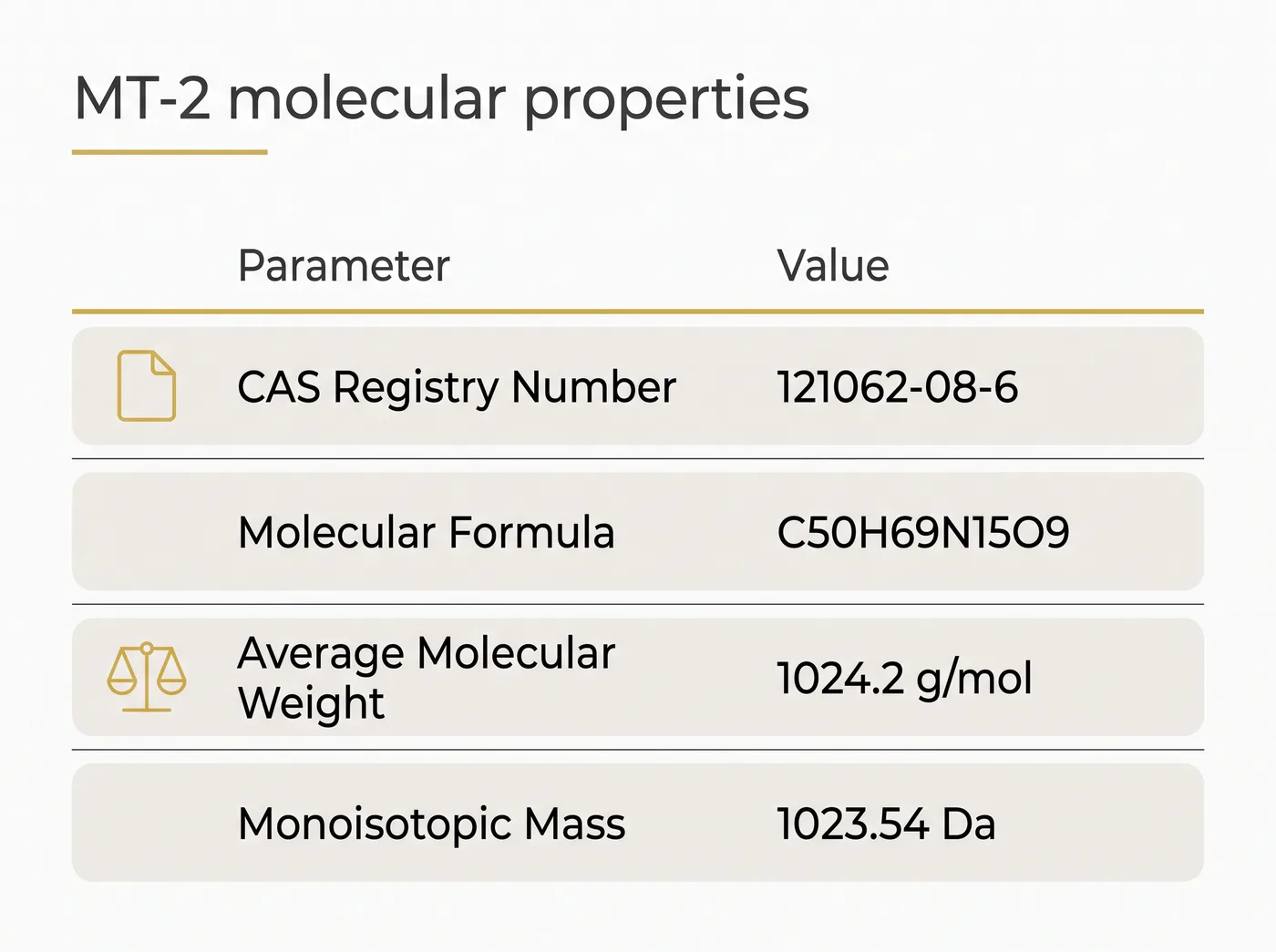
When standardising a reference material, ambiguity is the enemy. Chemical databases track MT-2 under specific identifiers to keep analytical laboratories on the same page. The CAS registry number 121062-08-6 points exclusively to the free peptide base, entirely ignoring any counterions or salt forms that might tag along later PubChem MT-2. The formula C50H69N15O9 accounts for 50 carbon atoms, 69 hydrogen atoms, 15 nitrogen atoms and 9 oxygen atoms. That raw formula does not factor in the mass of any counterions associating with the peptide after purification.
| Parameter | Value |
|---|---|
| Common Name | MT-2 (Melanotan II) |
| CAS Registry Number | 121062-08-6 |
| Sequence | Ac-Nle-cyclo(Asp-His-D-Phe-Arg-Trp-Lys)-NH2 |
| Molecular Formula | C50H69N15O9 |
| Average Molecular Weight | 1024.2 g/mol |
That molecular formula maps out the neutral free base, giving a calculated average molecular weight of 1024.2 g/mol. Mass spectrometers, however, do not care about averages; they measure the mass-to-charge ratio of specific isotopes. The calculated monoisotopic mass of MT-2 is 1023.54 Da PubChem MT-2. When an analyst reviews high-resolution mass spectrometry data, 1023.54 Da is the finish line they need to see crossed.
The freeze-drying step and physical form
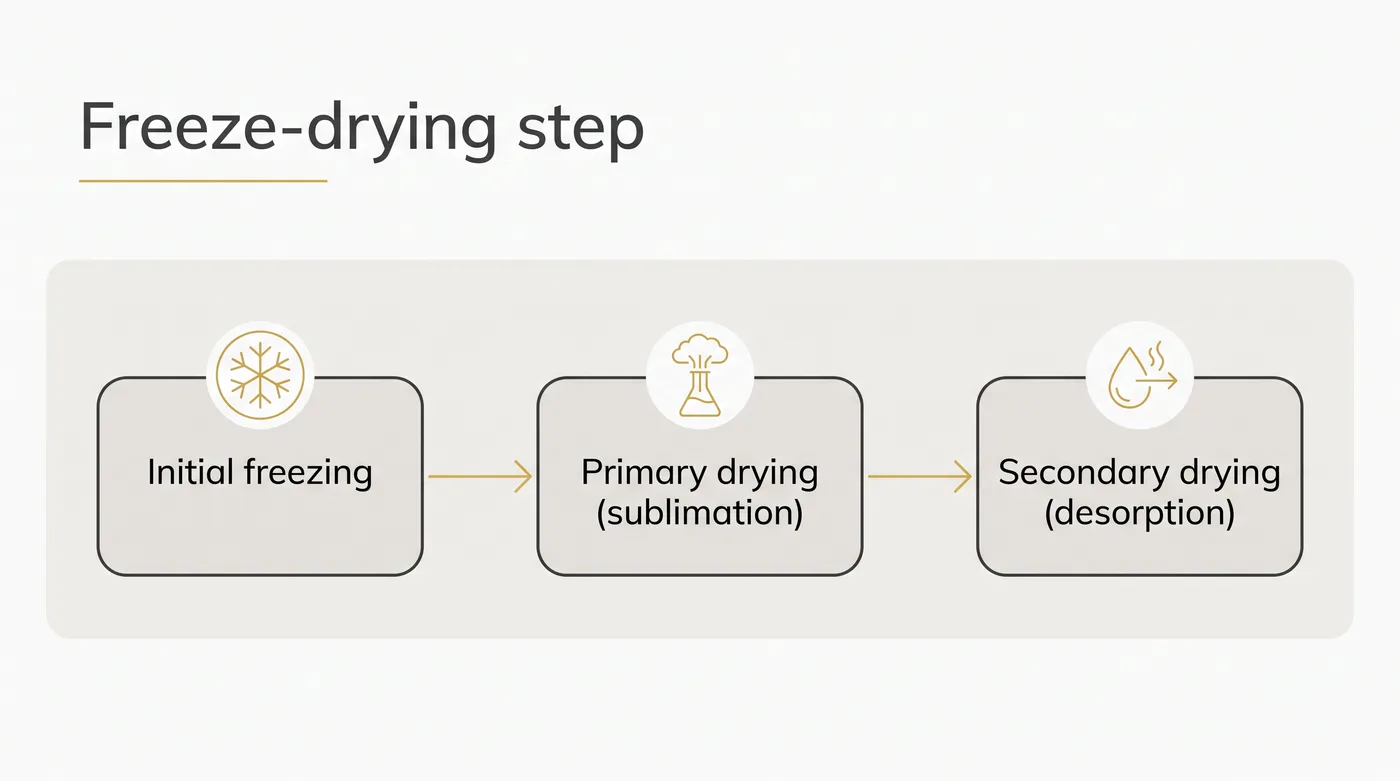
Before it ever reaches a laboratory balance, the peptide undergoes processing into a white, lyophilised powder for chemical stability. Lyophilisation, or freeze-drying, is an exercise in thermodynamic control that removes water from a purified liquid solution through sublimation. During the initial freezing stage, the water forms ice crystals, squeezing the peptide into a tight interstitial matrix. Primary drying then pulls the unbound ice away as a gas under a vacuum. The temperature has to stay below the formulation collapse point to maintain a neat, porous solid cake. Secondary drying follows, extracting the stubbornly bound residual moisture through desorption Freeze-drying processes.
Because the MT-2 sequence includes basic amino acid side chains, notably histidine and arginine, it is chemically eager to accept protons. During the final cleavage with TFA, these basic groups inevitably pair up with counterions Fmoc solid-phase peptide synthesis. As a result, the purification process isolates the material as a salt, typically an acetate or TFA salt. These counterions sit alongside the basic residues in the lyophilised solid. They leave the core molecular formula and sequence untouched, but they do add mass. The resulting lyophilised matrix is a package deal: the peptide base, the counterions, and residual moisture Freeze-drying processes.
Running the gauntlet for purity and mass
A serious laboratory never relies on just one test. Verifying a batch of MT-2 requires two distinct hurdles: chromatography to prove purity, and mass spectrometry to confirm identity. Reversed-phase high-performance liquid chromatography separates the intended peptide from synthesis mistakes like truncated sequences or deamidated byproducts. The method uses a stationary phase, usually a silica column coated with hydrophobic C18 alkyl chains.
The sample load is dissolved in a mobile phase and sent into the system. As the solvent gradient shifts from mostly water to a higher concentration of an organic solvent like acetonitrile, the sample components partition between the moving liquid and the stationary column. Ultraviolet absorbance at 218 nanometres spots the peptide bonds as they finally elute. The calculation is straightforward: purity is the area percent of the main chromatographic peak compared to all detectable peaks in the trace.
Chromatography shows how clean the sample is, but liquid chromatography coupled with tandem mass spectrometry proves what the sample actually is. Electrospray ionisation zaps the peptide from a liquid phase into a gas phase, applying a high voltage to create a fine aerosol of charged droplets. Thanks to those basic groups on arginine and histidine, MT-2 readily forms multiply charged ions. In tandem mass spectrometry with collision-induced dissociation, analysts frequently look for the doubly charged precursor ion at a mass-to-charge ratio of 513. They use it to verify the relative abundance ratios of fragment ions unique to the cyclic structure LC-MS validation. Matching those fragments against a reference standard is the only way to prove the material perfectly matches the target formula.
How to read an MT-2 laboratory certificate
A certificate of analysis translates all that laboratory machinery into a single piece of paper. If you have ever stared at a dense peptide lab report and wondered where the catch is, start at the very top. The certificate must name a lot, and that lot number must be printed on the vial. The document needs to come from a named laboratory and carry a recent test date. Check that the specification matches what was supposed to be in the vial, and scrutinise the measured purity. A single sharp peak on an HPLC trace proves synthesis errors are absent, but you still need the mass spectrometry data to confirm identity. A document worth your trust will always present both the HPLC chromatogram and the MS spectrum.
When sourcing material for laboratory analysis, settling for blurry documentation is a mistake. You can review the complete specifications and current analytical reports for this synthetic peptide by visiting the product page, where NuuVive's MT-2 tested at ≥99% purity (99.659% on Janoshik report #85194) and returned a measured amount of 10.34 mg per vial.
Questions
What does the 'Ac' in the sequence notation mean?
The 'Ac' stands for an acetyl group. This modification is attached to the N-terminus of the peptide sequence, essentially capping the front end of the molecule and changing its chemical properties compared to a raw free amine group.
Why is MT-2 supplied as an acetate or TFA salt?
The sequence contains basic amino acid residues, specifically histidine and arginine. During the final cleavage with TFA or subsequent preparative chromatography steps, these basic groups happily accept protons and associate with counterions, turning the final isolated material into a salt form.
What is the difference between average molecular weight and monoisotopic mass?
Average molecular weight calculates the mass using the natural isotopic distribution of all atoms in the molecule, giving 1024.2 g/mol for MT-2. Monoisotopic mass ignores the averages and uses only the single most abundant isotope of each element, yielding 1023.54 Da, which is the target figure used in high-resolution mass spectrometry.
Can chromatography alone prove the identity of a peptide sample?
A reversed-phase chromatography trace is excellent at separating compounds to measure chemical purity, but it cannot confirm molecular identity. A beautifully pure chromatographic peak still has to be backed by mass spectrometry to prove the sequence and mass match the target formula.
Sources
- Advances in Fmoc solid-phase peptide synthesis (Journal of Peptide Science). Wiley
- Design of freeze-drying processes for pharmaceuticals: practical advice (Pharmaceutical Research). Springer
- nih.gov. National Library of Medicine
- pubmed.ncbi.nlm.nih.gov. National Library of Medicine