
Reading lab reports
Retatrutide lab report: what to check
NuuVive Journal · · 5 min read

Short answer
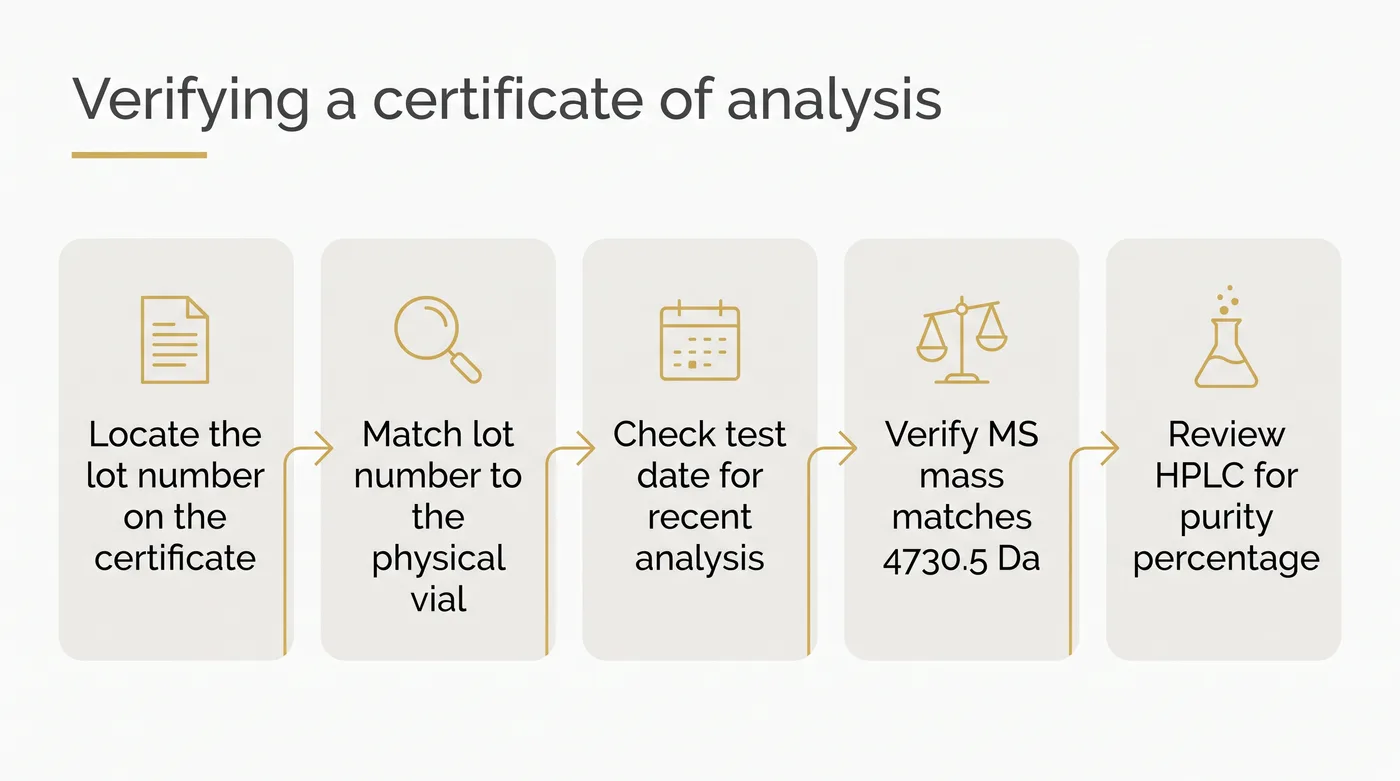
Reading a Retatrutide lab report requires checking three main data points: the lot number linking the document to the physical material, the mass spectrometry (MS) result confirming the exact 4730.5 Da molecular weight, and the reversed-phase high-performance liquid chromatography (RP-HPLC) chromatogram showing the purity percentage. A valid certificate must come from a named laboratory and specify both the analytical methods used and the date of testing.
Key takeaways
- A reliable lab report must include a specific lot number that matches the physical material.
- Mass spectrometry confirms the identity of the 39-amino-acid chain by matching its theoretical mass of roughly 4730.5 Da.
- High-performance liquid chromatography measures the purity of the protein matter but cannot confirm identity on its own.
- Net peptide content is entirely different from chromatographic purity and accounts for invisible salts and moisture.
- Trifluoroacetic acid (TFA) is a normal byproduct of solid-phase peptide synthesis and often appears as the counterion.
The paper trail before the data
Somewhere between clicking buy and a parcel landing on a desk, a PDF is doing a lot of heavy lifting. It is the only thing proving the white powder in a vial is actually the modified synthetic peptide Retatrutide. So before you fall for the big purity number at the top of a certificate of analysis, give the header thirty seconds. That is where most weak documents quietly give themselves away.
The first thing to look for is a lot number. Regulatory definitions define a lot number as a distinctive combination of letters or numbers from which the complete history of manufacture can be determined 21 CFR Part 210. If the certificate names no lot, it describes some material, somewhere, at some point, and nothing ties it to the specific solid being evaluated. Good manufacturing practice requires batch records and traceability, which rely entirely on that single code ICH Q7.
Next is the laboratory itself. A named lab with an address you could look up is the bare minimum. A vague claim of being tested by an independent laboratory sounds reassuring right up until you notice it names nobody at all. Competent laboratories follow standard procedures for reporting results and measurement uncertainty, meaning their documents look professional and specific ISO/IEC 17025:2017. If the test date is three years old, it is entirely irrelevant to a batch sold today.
Mass spectrometry: confirming the heavy machinery
Retatrutide is not a simple molecule. It is a highly engineered 39-amino-acid synthetic peptide with a chemical formula of C221H342N46O68. It contains non-proteinogenic modifications like 2-aminoisobutyric acid at positions 2 and 20, plus a heavy C20 fatty diacid moiety tethered to position 17. All of this extra molecular architecture makes the compound exceptionally large, clocking in with an exact mass of roughly 4730.5 Da.
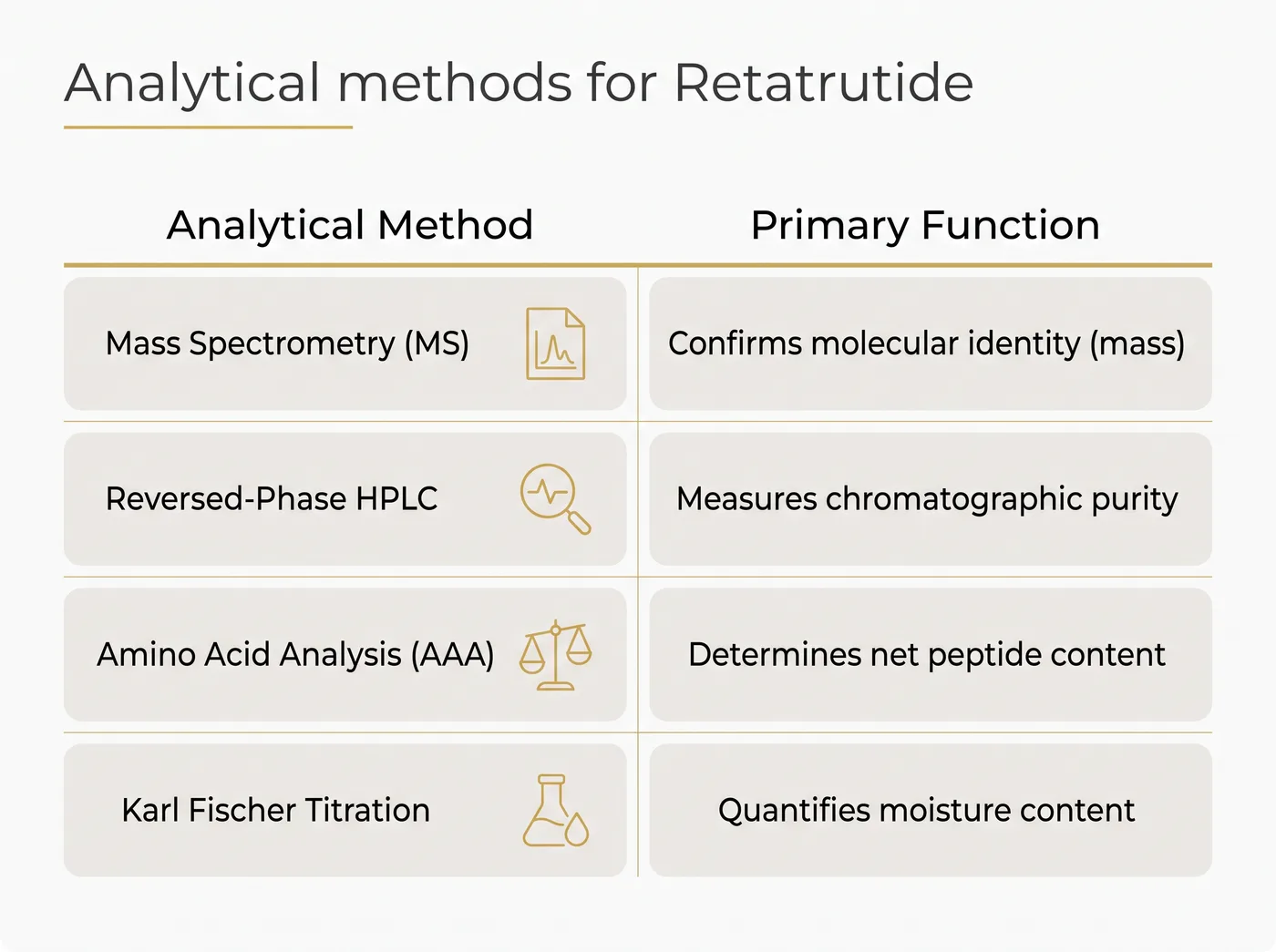
Mass spectrometry is the analytical method used to prove this complex structure is actually present. By ionising the sample in a vacuum, the instrument determines the mass-to-charge ratio of the intact peptide. The deconvoluted mass on the lab report must match that theoretical exact mass. If the number is off by more than a tiny fraction, the sequence is wrong, a modification is missing, or the substance is simply not Retatrutide.
However, mass spectrometry is not a quantitative tool for determining total purity. It cannot reliably detect isobaric impurities, which are molecules with the exact same mass but the wrong sequence order, such as a swapped leucine and isoleucine residue. It proves the right molecule is in the room, but it does not tell you how crowded the room is.
Chromatography: reading the purity race
To find out how crowded the room is, the laboratory turns to reversed-phase high-performance liquid chromatography. Think of a chromatogram as a race where every molecule in the sample has to cross the finish line in public. The sample is pushed through a specialised column, and molecules separate based on their hydrophobicity. The effect of the mobile phase and column chemistry is important for assessing true peptide purity Methods in Molecular Biology 386.
Retatrutide should appear as a single, massive, sharp peak on the graph. Smaller adjacent peaks represent synthesis-related impurities, such as truncated chains that stopped growing too early or sequences missing an amino acid. The purity percentage you see on the report is simply the area under the main Retatrutide peak divided by the total area of all peaks combined.
A standalone ultraviolet detector on an HPLC machine cannot definitively confirm that the main peak is Retatrutide. It only confirms that the sample contains one primary substance. This is why a trustworthy certificate of analysis must include both liquid chromatography for purity and mass spectrometry for identity.
The trap of net peptide content
A primary error in reading peptide lab reports is conflating chromatography purity with net peptide content. They measure entirely different things. A vial of Retatrutide may exhibit 99 percent purity on an HPLC report, but it will never be 100 percent peptide by mass. Lyophilised powders inherently contain invisible weight from the freeze-drying step.
Net peptide content determines the actual fraction of the solid powder that is the active molecule. It is typically determined via amino acid analysis or a mass balance calculation that subtracts water content and counterions. For synthetic peptides, this figure typically ranges from 70 percent to 85 percent. If a lab report shows 99 percent HPLC purity and 75 percent net peptide content, it means 99 percent of the protein matter is Retatrutide, but 25 percent of the total powder weight is just water and salts.
Invisible weight: moisture and counterions
The remaining weight in the vial is not a mystery. Solid-phase peptide synthesis uses trifluoroacetic acid to cleave the peptide from the synthesis resin. As a result, synthetic peptides usually elute as TFA salts. This counterion stays with the peptide through the freeze-drying step. Because TFA can interfere with certain cellular assays, laboratories often quantify it.
Moisture is the other main contributor. Retained water is quantified via Karl Fischer titration, measuring the water mass retained in the lyophilised powder. A residue on ignition test might also be performed to establish the presence of inorganic impurities. None of this weight means the product is impure; it is simply the physical reality of isolating a complex synthetic molecule into a stable solid form.
When you evaluate research materials, the documentation separates facts from marketing fiction. You can check the product page for Retatrutide's current price, stock availability and measured purity.
Questions
Why does the lab report mention a TFA salt?
Trifluoroacetic acid (TFA) is a standard chemical used to cleave synthetic peptides from the resin during manufacturing. The peptide binds to the acid, forming a salt that remains in the final freeze-dried powder.
Can liquid chromatography alone prove a peptide is Retatrutide?
No. Chromatography separates molecules and shows how many different substances are present, giving a purity percentage. Without mass spectrometry to weigh the molecule, you only know the sample is pure, not what the pure substance actually is.
What happens if a certificate has no lot number?
Without a lot number, the laboratory document is disconnected from the physical vial. It might be a real test of a real sample, but there is no traceable link to prove it is a test of the specific material being evaluated.
Is a 99% pure peptide actually 99% peptide by weight?
No, because purity and net peptide content are different metrics. The 99% figure means that out of all the protein molecules present, 99% are the correct sequence. The total weight of the powder also includes invisible moisture and counterions.
Sources
- ICH Q7: Good manufacturing practice guide for active ingredients. ICH
- ISO/IEC 17025:2017 General requirements for the competence of testing and calibration laboratories. ISO
- 21 CFR Part 210: Current good manufacturing practice, general. eCFR
- HPLC analysis and purification of peptides (Methods in Molecular Biology 386). Springer