
Peptide chemistry
Selank identity: structure, molecular weight and form
NuuVive Journal · · 6 min read
Short answer
Selank is a synthetic heptapeptide with the amino acid sequence Thr-Lys-Pro-Arg-Pro-Gly-Pro. Its free base molecular formula is C33H57N11O9, giving it a molecular weight of roughly 751.9 g/mol. In laboratory settings, it is supplied as a lyophilised white powder, typically as an acetate salt. Because solid-phase synthesis methods invariably produce structural impurities, researchers rely on reversed-phase high-performance liquid chromatography and mass spectrometry to verify the precise mass and chromatographic purity of the solid material.
Key takeaways
- Selank is a seven-amino-acid synthetic peptide weighing roughly 751.9 g/mol in its free base form.
- The sequence features a four-amino-acid core extended by a proline-glycine-proline tail.
- Laboratory material is almost universally supplied as a diacetate salt rather than a free base.
- Reversed-phase liquid chromatography evaluates the sample for synthesis errors and truncations.
- Mass spectrometry confirms the exact mass identity but cannot verify the amino acid sequence order alone.
The chemical blueprint
A solid white disc of lyophilised powder tells you absolutely nothing just by looking at it. It could be a highly pure synthetic peptide, it could be table salt, or it could be very expensive dust. The only way to know what you are looking at is to look closely at the molecular blueprint and the analytical data that confirms it.
Selank is not a random string of laboratory components. It is a specifically constructed sequence of seven amino acids: threonine, lysine, proline, arginine, proline, glycine, and proline (Thr-Lys-Pro-Arg-Pro-Gly-Pro). This makes it a synthetic heptapeptide. The first four residues mirror the core of a naturally occurring peptide, while the final three act as a specific synthetic extension 1.
This structural arrangement defines everything about how the molecule behaves in a solvent and how it interacts with analytical equipment. For instance, the presence of lysine and arginine is entirely intentional. These two basic amino acids dictate how the molecule holds onto electrical charge, which becomes the defining factor when you put a sample through an electrospray ionisation mass spectrometer.
The free base versus the diacetate salt
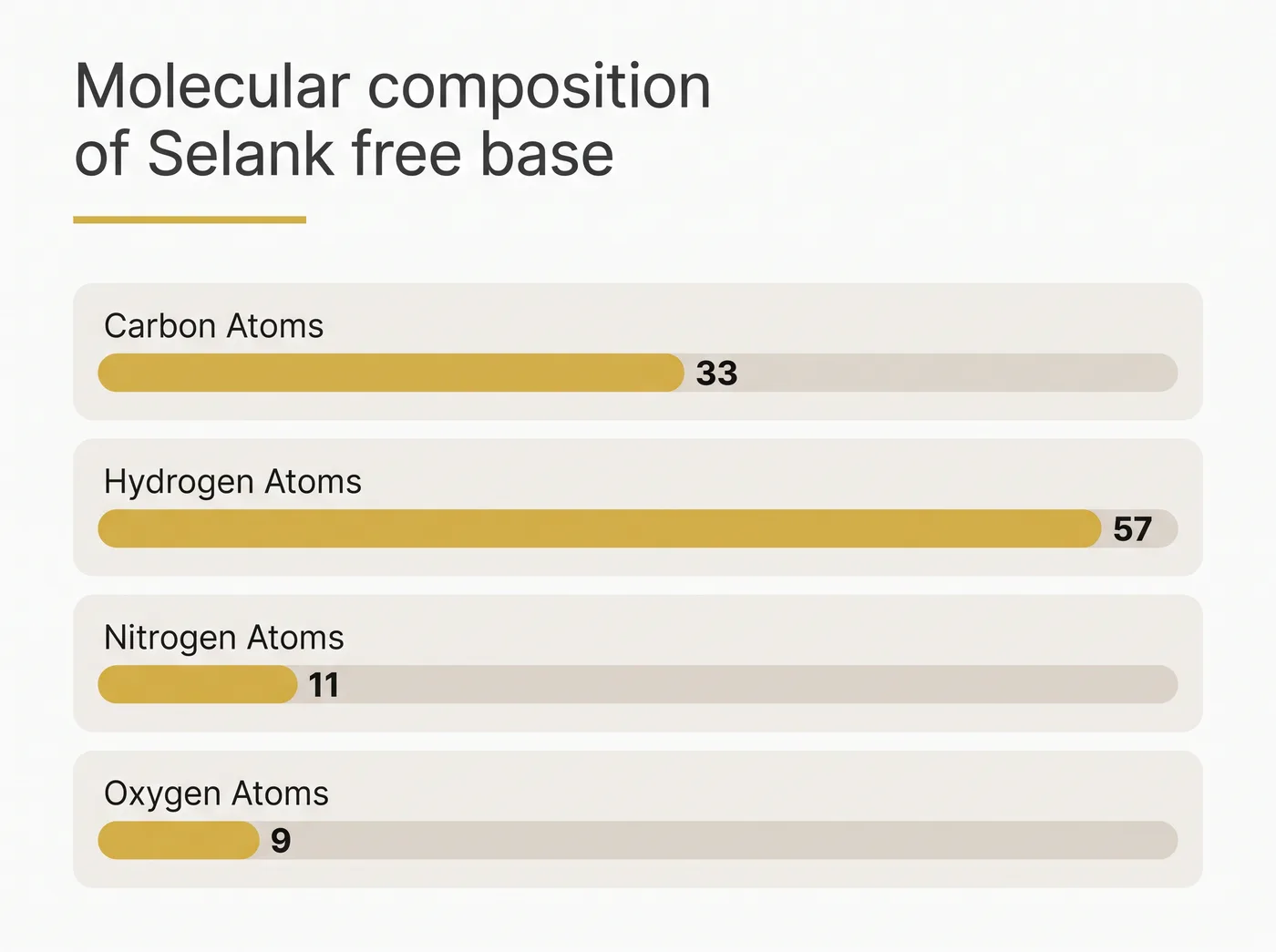
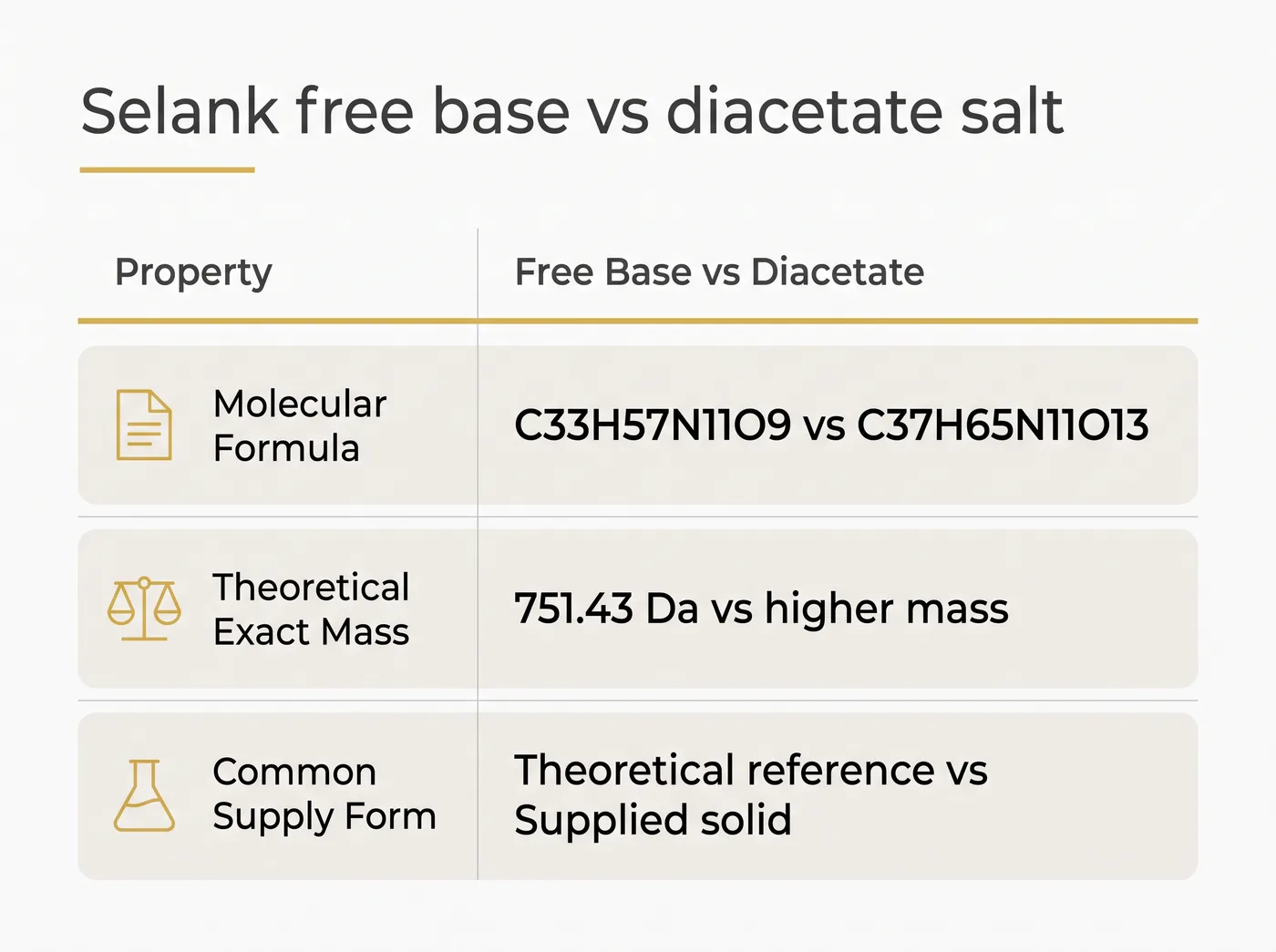
When you look up the compound on a chemical database, you will likely find the free base molecular formula: C33H57N11O9. This structural arrangement gives a theoretical exact mass of 751.43 Da 1. But you will rarely, if ever, find a vial of free base peptide sitting on a lab bench.
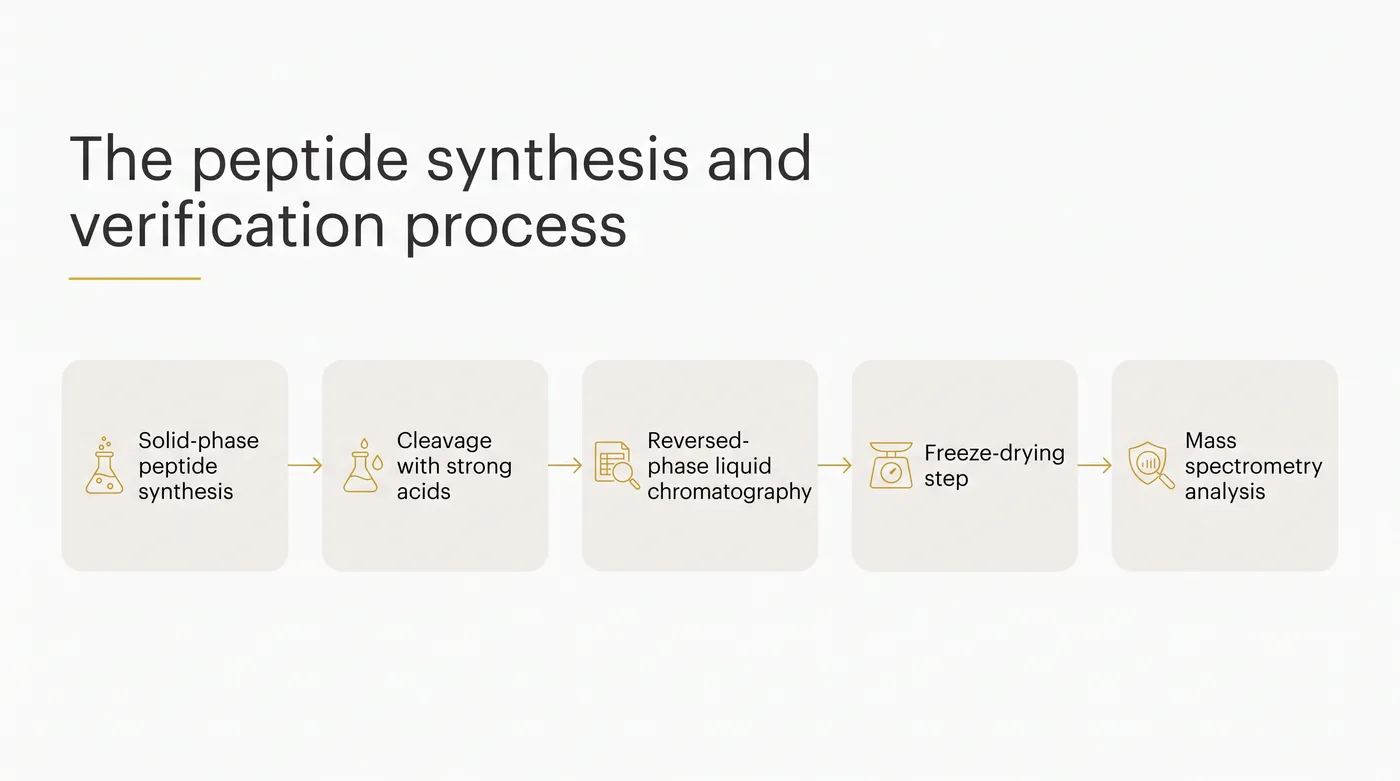
Synthetic peptides are assembled piece by piece. When the completed sequence is cleaved from the synthesis resin, the process requires strong acids. Because of those basic lysine and arginine residues, the peptide readily latches onto acidic counter-ions. In the final supplied material, it is almost always presented as an acetate salt, specifically Selank diacetate 2.
This chemical reality adds two acetic acid molecules to the structure. The formula expands to C37H65N11O13, and the total weight of the solid increases 2. If you skip this detail when calculating molar concentrations for a laboratory assay, the entire experiment starts with an invisible mathematical error. You end up calculating the weight of the pure peptide while actually weighing peptide plus salt.
The origins of the lyophilised solid
Before it ever reaches a glass vial, the material is built using Fmoc solid-phase peptide synthesis. This involves a repetitive series of chemical reactions. The very first amino acid is attached to a solid resin bead. Then, the protective Fmoc chemical group is stripped away, and the next amino acid is coupled to the growing chain 4. This happens seven times in total.
The final step involves a harsh cleavage cocktail, often based on trifluoroacetic acid (TFA), which violently cuts the finished peptide from the resin and strips away the side-chain protections 4. This is why downstream purification is mandatory. The raw product is a chaotic mixture of intact molecules and fragmented failures.
After it is purified, the liquid solution is subjected to a freeze-drying step. Lyophilisation involves freezing the material and lowering the pressure to remove the ice through sublimation 5. The primary drying phase pulls out the bulk of the solvent, while secondary drying gently coaxes out the more stubbornly bound water molecules. What is left behind is a highly hygroscopic white powder that will eagerly absorb moisture the moment the vial is opened.
Reading the chromatogram
Liquid chromatography is the undisputed gatekeeper of synthetic laboratory quality. A reversed-phase high-performance liquid chromatography (RP-HPLC) test is essentially a race where every molecule in the sample is forced to cross a finish line in public. You dissolve the sample and pump it through a stationary phase column, usually C8 or C18, using a gradient of water and acetonitrile mixed with a volatile ion-pairing agent 3.
The fully intact molecule will traverse the column at a specific, repeatable rate. An ultraviolet detector monitors the column exit at 214 nm or 220 nm, picking up the absorbance of the peptide bonds 3. A sharp, dominant peak on the resulting chromatogram represents the main sequence.
Minor secondary peaks represent the inevitable failures of the synthesis process: deletion sequences missing an amino acid, unremoved protecting groups, or oxidation products 4. A rigorous analytical report will typically define acceptable research-grade material as having a main peak area of ≥98% or ≥99%. If a laboratory is analysing a multi-compound reference standard, such as a Selank + Semax blend, the chromatography gradient must be carefully tuned to resolve both distinct peptide peaks from any background impurities.
The mass spectrometer's verdict
HPLC tells you how many different components are in the vial, but it cannot definitively tell you what those components actually are. For identity verification, the analytical laboratory couples the chromatograph to a mass spectrometer (LC-MS). The standard technique is electrospray ionisation, which bombards the eluting peptide with charge.
Because the molecule is packed with basic residues, it eagerly accepts protons, flying through the detector as a positively charged ion. The machine measures the mass-to-charge ratio. When the primary peak registers an exact mass matching the theoretical 751.43 Da 1, you have confirmation. The molecule weighs what it is supposed to weigh.
This limitation is why thorough laboratory scrutiny demands looking at both the purity percentage and the mass identity side by side. When you review a certificate of analysis, you are looking for the exact mass confirmation matched against a clean HPLC trace. You can check the current price, stock and measured purity of NuuVive's Selank directly in the catalogue.
Questions
What is the difference between Selank and N-acetyl Selank amidate?
N-acetyl Selank amidate is a modified derivative. The N-terminal alpha-amine of the threonine residue is capped with an acetyl group, and the C-terminal carboxylic acid is converted to a primary amide. This alters the molecular formula to C35H60N12O9 and increases the mass to approximately 793.9 Da.
Why is the exact mass different from the molecular weight?
The molecular weight (roughly 751.9 g/mol) is an average that accounts for the natural isotopic abundance of elements like carbon and nitrogen. The exact mass (751.43 Da) is the precise calculated mass of the molecule composed entirely of the most abundant isotopes, which is the specific number targeted during mass spectrometry.
Can liquid chromatography identify the sequence of the amino acids?
No. Liquid chromatography separates molecules based on their chemical properties and interactions with the stationary column. It determines chromatographic purity by measuring relative peak areas, but it cannot sequence the amino acids or identify the specific molecule.
Why must laboratory environments account for residual moisture?
Lyophilised peptides are highly hygroscopic. A freeze-dried solid always retains a small percentage of water, which adds to the gross weight of the powder. Failing to account for this moisture content leads to incorrect molarity calculations when dissolving the material for analytical assays.
Sources
- nih.gov. National Library of Medicine
- nih.gov. National Library of Medicine
- HPLC analysis and purification of peptides (Methods in Molecular Biology 386). Springer
- Advances in Fmoc solid-phase peptide synthesis (Journal of Peptide Science). Wiley
- Design of freeze-drying processes for pharmaceuticals: practical advice (Pharmaceutical Research). Springer