
Reading lab reports
Signs a certificate of analysis may not be genuine
NuuVive Journal · · 7 min read · Updated

Short answer
An authentic certificate of analysis traces a specific lot of material to a named laboratory and defines the analytical methods used to measure its properties. A certificate may be fabricated or manipulated if it lacks a distinct lot number, omits method parameters, reports chromatograms without retention times, or lacks traceability to an accredited testing facility. Detecting non-genuine documents requires verifying laboratory identities, checking physical mass data against theoretical models, and reviewing the mathematical precision of the reported measurements.
Key takeaways
- Every authentic laboratory report must include a specific lot number that links the testing data directly to the physical material.
- Trustworthy chromatography results show raw data with precise retention times rather than perfectly round numbers or a simple text summary.
- A claim that an impurity is absent means nothing unless the certificate defines the exact limit of detection for the analytical instrument used.
- Digital manipulation often reveals itself through chronological errors, mismatched template fonts, and invalid validation codes on the testing facility's portal.
Why batch traceability is the foundation of a report
Imagine buying a used car where the service history is just a sticky note saying it runs fine. You would laugh and walk away. Yet, in the world of synthetic peptides, researchers frequently accept the equivalent. A certificate of analysis is the single documentary link between a physical batch of material and its release specifications. To do its job, the document must contain a unique identifier linking the laboratory results to a specific production run. An authentic document features a distinct lot or batch number that matches the alphanumeric code printed on the physical container. Without this unique identifier, the laboratory results simply float in the ether, disconnected from the synthetic peptide sitting on the lab bench.
Regulatory frameworks exist because a batch is a specific quantity of material produced in a controlled process designed to be homogeneous within defined limits. According to the ICH Q7 guidelines, a certificate of analysis must state the batch number and establish this lot linkage. If you are looking at a certificate that lists a generic product name but leaves the batch number blank, you are reading a theoretical specification sheet. Relying on such a document introduces severe limitations for any subsequent laboratory analysis, as it merely describes what the material ought to be, rather than what the physical sample actually is.
Finding the ghost laboratories in the fine print
An analytical report must proudly identify the facility that performed the actual measurements. A document presenting results without naming the testing facility, providing a verifiable physical address, or listing clear contact information cannot be verified by anyone. Unnamed laboratories represent a documentation failure and serve as the most glaring indicator of potential fabrication. A genuine certificate features the complete details of the testing facility, inviting you to contact the laboratory directly to verify the report's authenticity. If a seller acts as though the laboratory location is a state secret, you should wonder why.
The international standard for testing laboratory competence is defined by ISO/IEC 17025:2017. Accreditation under this standard demonstrates that an independent external auditor has assessed the laboratory's metrological traceability, validated their analytical methods, and checked their equipment calibration. When a certificate claims such accreditation, it should feature the accreditation body's specific identifier and a verifiable certificate number. A massive red flag flies when a laboratory claims this impressive accreditation on a certificate, but the specific analytical test they performed falls outside their publicly listed accreditation scope.
Reading the raw chromatography data for red flags
A certificate reporting on synthetic compounds must bring receipts, which in this analytical world means retrievable raw data. Documents that lazily state a "Pass" result or list a numerical percentage without any contextual analytical data lack scientific validity. Authentic certificates always include the actual chromatogram from the purity analysis and the mass spectrum chart for identity confirmation. The omission of these distinct charts strongly suggests the document is entirely generic or actively manipulated.
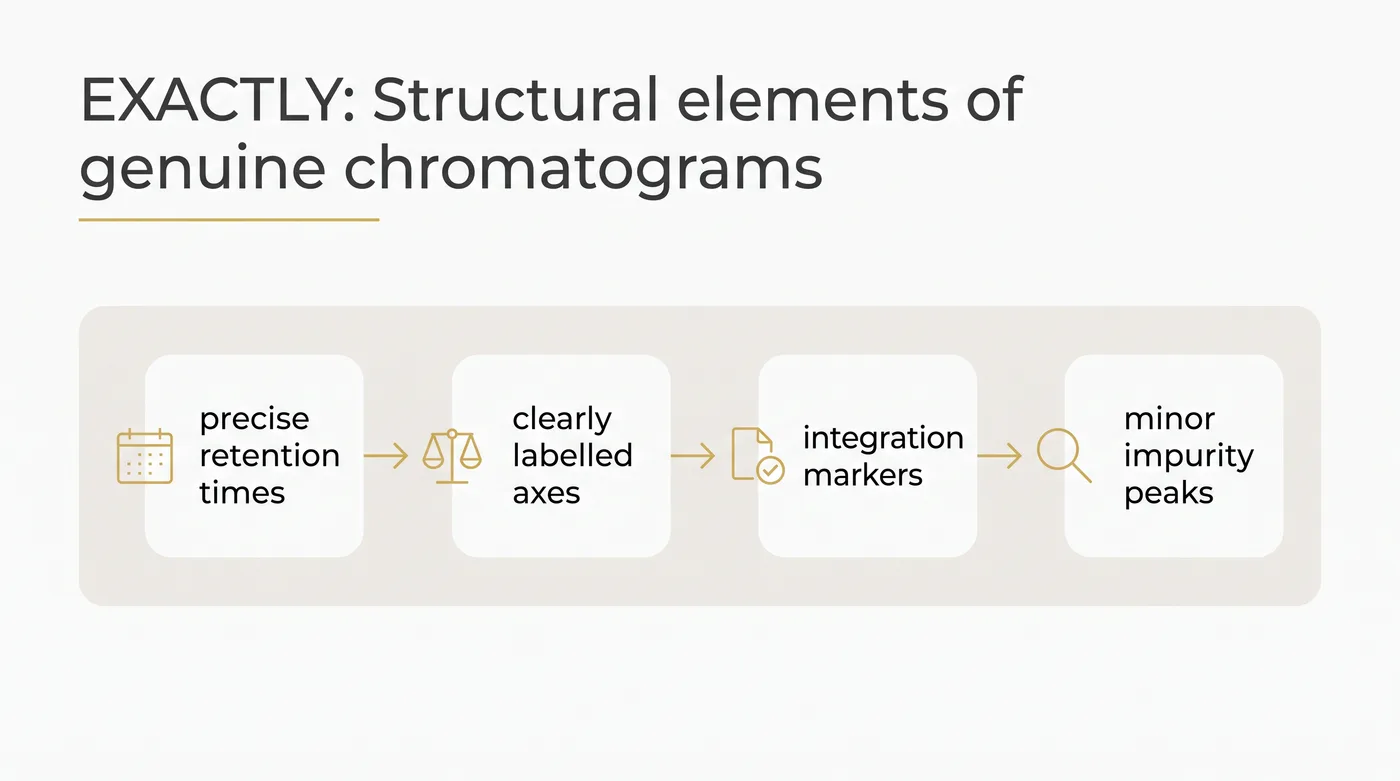
When chromatograms are present, you must evaluate their structural elements closely. A chromatogram is like a race where every impurity has to cross the finish line in public. Genuine chromatograms display precise retention times, clearly labelled axes for time and absorbance, and tiny integration markers indicating how the baseline was drawn to calculate the peak areas. A chromatogram lacking these standard features, or one presenting a suspiciously smooth baseline with absolutely no minor impurity peaks, screams of image manipulation. The specific analytical methods, including the precise wavelength, gradient conditions, and column specifications, must be detailed to demonstrate the test was sufficiently specific for the analyte.
Spotting statistically improbable analytical results
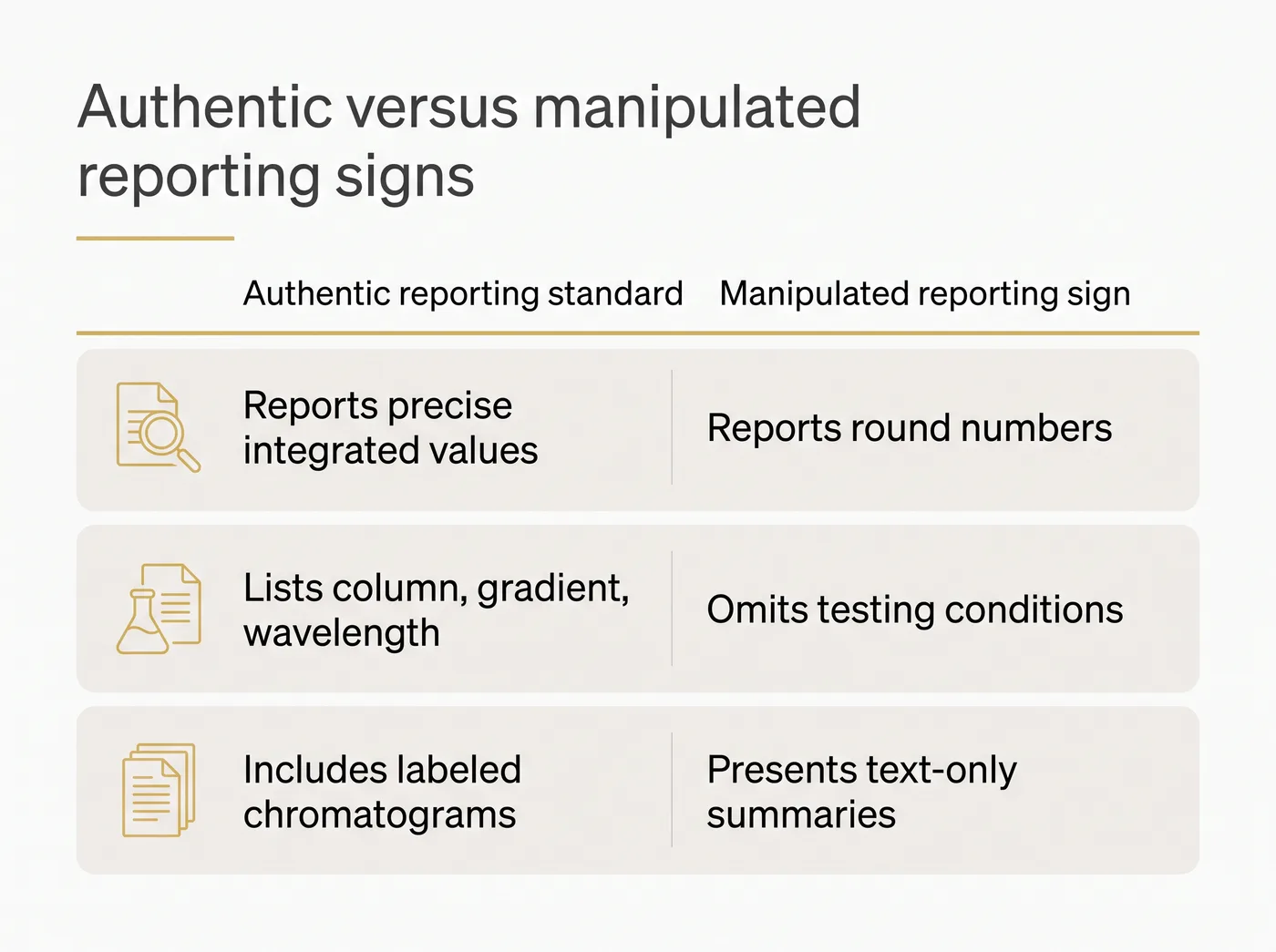
Real analytical instruments are complex machines, and they produce data with inherent statistical variance due to electronic noise, mobile phase fluctuations, and variable integration parameters. Consequently, purity values reported as perfectly round numbers without any decimal precision are highly suspicious. Authentic liquid chromatography results typically display precise, messy decimals derived from the complex mathematical integration of the main peak area versus minor impurity peaks. A result listing a perfectly round number strongly implies the data was typed manually on a keyboard rather than exported directly from specialised integration software.
Identity verification via mass spectrometry presents another excellent evaluation point. Fraudulent certificates occasionally substitute the target compound's name straight onto the analytical data of a different chemical. Verifying the molecular weight reported on the mass spectrometry section against the known theoretical mass of the intended chemical formula can expose this sloppy substitution immediately. If the observed mass ion does not match the expected mass within the specific instrument's stated tolerance, the chemical identity has been blatantly falsified.
Looking for limits when a report claims no impurities
During solid-phase synthesis and the subsequent cleavage processes, synthetic compounds meet various organic solvents and chemical reagents. Authentic certificates will carefully screen for these residual solvents and elemental impurities using clearly defined parameters. A certificate confidently reporting "Not Detected" across an entire panel of metals and solvents without ever defining the detection limits of the instrument indicates extrapolated or entirely fabricated data.
| Analytical parameter | Authentic reporting standard | Manipulated reporting sign |
|---|---|---|
| Measurement result | Reports precise integrated values | Reports round numbers |
| Trace impurities | States Limit of Detection (LOD) | States 'Not Detected' with no limit |
| Method description | Lists column, gradient, wavelength | Omits testing conditions |
| Data format | Includes labelled chromatograms | Presents text-only summaries |
Analytical methods require established numerical limits to provide meaningful negative results. According to the Eurachem guide, analytical method validation must establish both the limit of detection and the limit of quantification. Without clearly listing the limit of detection, a "Not Detected" result gives you no real information about whether the impurity was genuinely absent or merely fell below a highly insensitive instrument's detection threshold. An authentic certificate always explicitly states the quantitative limit of the specific assay used for trace impurities.
Catching digital artefacts and manipulated templates
A remarkably common form of certificate manipulation involves repurposing a legitimate analytical report from an old, high-quality batch and simply applying it to a new batch by editing the document text. This lazy manipulation often results in glaring chronological inconsistencies. A primary indicator is a test date that predates the listed manufacturing date of the lot in hand, or a date that falls far outside the standard stability window for the material in its stated storage conditions. Time travel is not a standard laboratory service.
Modern analytical reports increasingly rely on digital verification tools to prevent such clumsy alterations. These include report search codes or secure PDF hash tracking linked directly to the independent testing laboratory's internal software system. If a certificate features a validation code that returns a "not found" error on the issuing laboratory's secure portal, or returns a digital document displaying entirely different values than the physical copy, the certificate has been modified post-issuance. Visual template artefacts, such as misaligned fonts, varying text resolutions, or spelling errors in standard chemical nomenclature, further indicate a document generated in a standard text editor rather than an automated laboratory system. The fastest way to put all these checks into practice is to review a genuine set of documents, which you can do by visiting the lab reports.
Questions
Why does an authentic certificate require a lot number?
A lot number serves as the essential documentary link between the physical vial of material on the bench and the complex analytical testing performed. Without this specific identifier, the certificate merely describes a theoretical general specification rather than the exact material sitting in the laboratory.
What indicates a manipulated chromatogram?
Manipulated chromatograms frequently lack precise retention times, proper axes labels, or clear integration lines demonstrating how the baseline was established. A perfectly flat baseline missing normal instrument noise or minor trace peaks also strongly indicates potential artificial generation.
Why is a finding of 'Not Detected' problematic without further context?
A 'Not Detected' result simply means the substance concentration fell below the analytical instrument's measurement threshold. Without explicitly stating the specific Limit of Detection (LOD) for the assay, it remains impossible to know if the test was sufficiently sensitive to detect relevant trace impurities.
How can mass spectrometry data reveal a falsified certificate?
Mass spectrometry measures the specific mass-to-charge ratio of the molecules present in the sample. If the reported observed mass fails to match the theoretical calculated mass of the expected chemical formula, the certificate describes a different compound entirely.