
Reading lab reports
SS-31 lab report: what to check
NuuVive Journal · · 6 min read

Short answer
Reading an SS-31 lab report requires verifying the lot number matches the material in hand. You must check the high-performance liquid chromatography (HPLC) chromatogram for a relative purity figure, ensuring impurities are quantified. Finally, confirm the mass spectrometry (MS) result shows a peak at approximately 640.4 m/z to verify the sequence mass. A reliable certificate always names the testing laboratory and the analytical methods used.
Key takeaways
- A missing lot number instantly disconnects a laboratory report from the physical sample.
- High-performance liquid chromatography measures relative purity, not absolute net weight.
- Mass spectrometry confirms the chemical identity by identifying the specific mass-to-charge ratio of the sequence.
- Lyophilised samples contain necessary counter-ions and residual moisture, which explains why the measured peptide weight is lower than the total weight.
- A reliable certificate provides exact measured decimals rather than simply quoting catalogue specifications.
Traceability and the licence plate of chemistry
Staring at a certificate of analysis can feel like trying to read a foreign language without a dictionary. There is a number at the top that looks impressive, a few jagged lines at the bottom, and a vast amount of blind trust in between. But a laboratory report is just a map of chemical evidence. Once you know which landmarks to look for, the marketing fog lifts rather quickly.
The first landmark has nothing to do with chemistry at all. It is the lot number. A lot number is the licence plate of a manufactured batch. Federal regulations define a lot number as a distinctive combination of letters, numbers or symbols from which the complete history of manufacture can be determined 21 CFR Part 210. If the paperwork describes a pristine chemical sample but the lot number is missing, you have no way to prove the document belongs to the physical material sitting on the laboratory bench.
Good manufacturing guidelines insist that a certificate of analysis must explicitly state the batch number to maintain traceability ICH Q7. Without it, the document is an isolated piece of fiction describing some material, somewhere, at some point in time. It ceases to be evidence and becomes mere decoration.
High-performance liquid chromatography and the purity illusion
High-performance liquid chromatography separates a complex mixture into individual components. A chromatogram is like a turnstile at a busy train station. Every molecule has to pass through the detector one by one. The area under each peak tells you how much of that specific molecule crossed the line in front of the ultraviolet light.
For a synthetic tetrapeptide like SS-31, laboratories use reversed-phase chromatography with a mobile phase of water and acetonitrile, modified with trifluoroacetic acid to sharpen the peaks HPLC analysis and purification of peptides (Methods in Molecular Biology 386). The sequence contains D-arginine, 2',6'-dimethyltyrosine, lysine, and phenylalanine. The alternating aromatic and basic residues require precise gradient control to separate the target from truncated synthesis fragments.
The result is a relative purity figure. This number represents the main peptide peak divided by the total area of all integrated peaks. A strong report does not just show a single massive spike; it zooms in on the baseline to reveal the trace impurities that inevitably form during synthesis. International guidelines require analytical procedures to be validated for specificity, meaning they must successfully discriminate between the target compound and closely related impurities ICH Q2(R2). NuuVive's SS-31 tested at ≥99% purity (99.756%, Janoshik #85195), a figure derived from measuring these trace elements against the main peak. A certificate claiming perfection without showing the baseline noise is hiding something.
Mass spectrometry and confirming the sequence
Chromatography proves a sample is uniform, but it does not tell you what the substance actually is. That requires mass spectrometry. SS-31 has a molecular formula of C32H49N9O5 and an average molecular weight of 639.80 g/mol. When this sequence enters a mass spectrometer, the machine ionises the molecules and measures their mass-to-charge ratio.
Because the electrospray ionisation process typically adds a proton, you look for a primary signal around 640.4 m/z on the chart for the single protonated ion. You might also see doubly charged ions around 320.7 m/z. If those signals are missing, the sample is not SS-31.
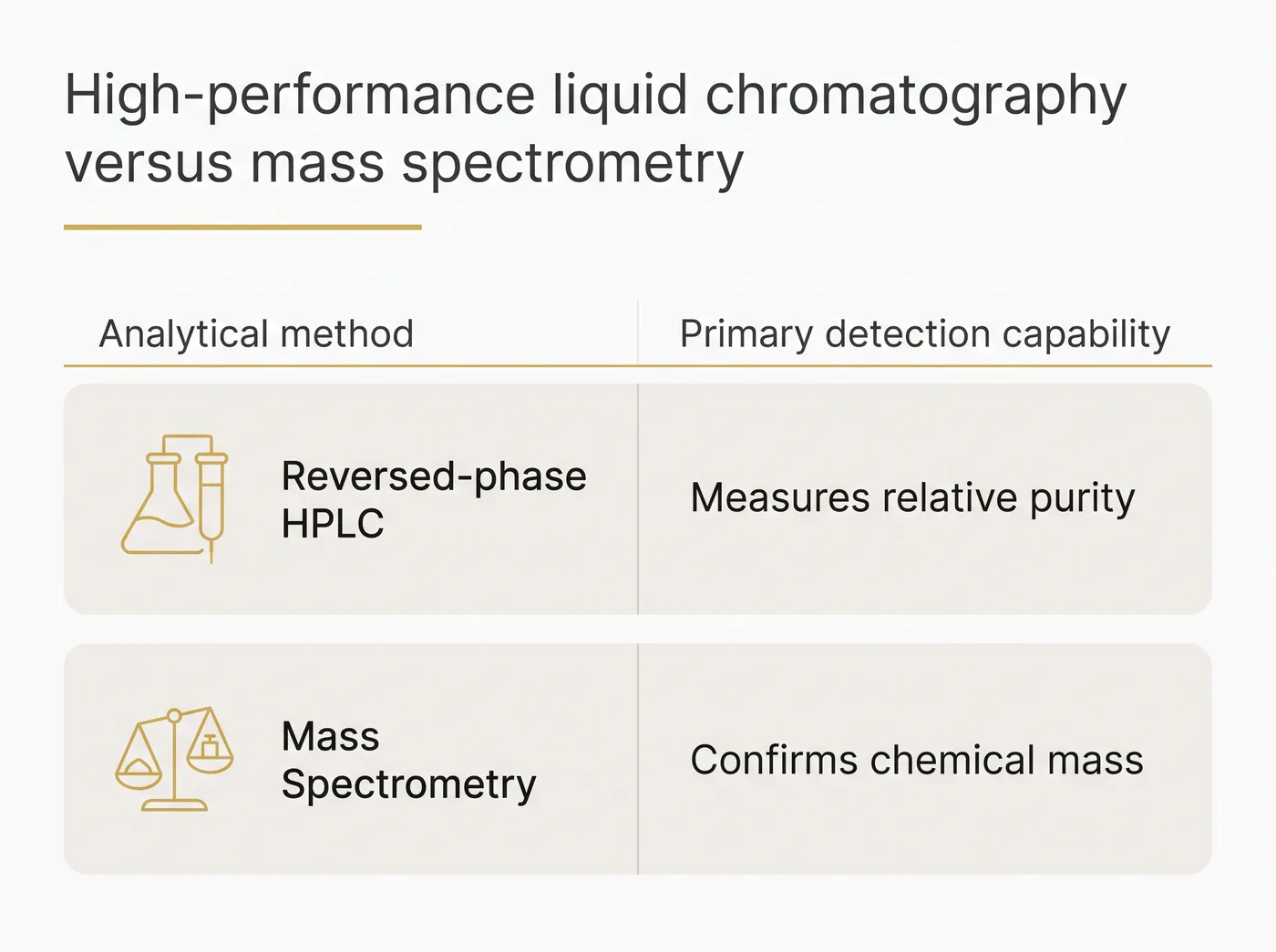
Some reports might show a clean mass spectrum and try to pass that off as a purity test. This is a bit like photographing a single clean plate and claiming the entire kitchen is spotless. An impurity could be present in large quantities but fail to ionise well, rendering it invisible to the detector. Mass spectrometry confirms identity, while chromatography handles the quantification. You always need both when reading a lab test.
The missing mass and net peptide content
A common source of confusion arrives when the numbers on the report do not match the weight printed on the label. A 50 mg sample of SS-31 rarely contains 50 mg of pure peptide. NuuVive's SS-31 showed a measured amount of 45.42 mg (Janoshik #85195). The missing mass did not vanish, nor is the sample underfilled.
The discrepancy comes down to the realities of peptide chemistry. Synthetic peptides are highly basic and require a counter-ion, usually trifluoroacetate or acetate, to form a stable salt during the freeze-drying step. Lyophilised powders are also hydrophilic, meaning they hold onto residual water from the atmosphere. A sample contains the peptide sequence, the salt, and the water.
| Component | Function in sample | Detection method |
|---|---|---|
| SS-31 peptide | Target peptide sequence | HPLC and Mass Spectrometry |
| Trifluoroacetate | Counter-ion for salt stability | Ion Chromatography |
| Residual moisture | Retained atmospheric water | Karl Fischer Titration |
The relative purity on an HPLC report ignores these invisible components because salts and moisture do not absorb ultraviolet light at the tested wavelengths. To find the absolute net peptide weight, a laboratory must perform amino acid analysis or separate moisture testing. Understanding the difference between relative optical purity and net peptide weight prevents a lot of unnecessary panic when reviewing a detailed chemical analysis.
Specifications versus measured values
Every reputable certificate divides its data into specifications and measured results. A specification is a predefined list of tests, analytical procedures, and appropriate acceptance criteria ICH Q6B. It establishes the numerical boundaries the material must fall within to be considered acceptable.
The measured result is the actual figure the machine produced on that specific day. A vendor document that only prints '≥99%' without supplying the exact measured decimal is just quoting the catalogue. It is the analytical equivalent of asking someone how much money they have and them answering, 'Some'.
Analytical testing requires a known working range and a calculated limit of quantification to ensure the numbers are mathematically sound. The difference between characterisation and routine testing matters when evaluating laboratory evidence.
Accreditation and independent testing
A piece of paper is only as reliable as the institution that prints it. A certificate of analysis should clearly identify the laboratory that performed the testing, complete with an address and contact information. Vague claims about independent accredited facilities mean nothing if the laboratory remains anonymous.
Real credibility comes from a recognised quality framework. An ISO 17025 accreditation demonstrates that a testing facility operates impartially, calibrates its equipment to national standards, and provides technically valid results ISO/IEC 17025:2017 General requirements for the competence of testing and calibration laboratories. When a laboratory holds this standard, you know the numbers are backed by rigorous metrological traceability.
When reviewing an SS-31 document, look for the signature of a qualified analyst, a clear test date, and explicit limits of detection for the instruments. A solid report shows the exact target, the method used to find it, and the precise mathematical outcome. You can verify the documentation for yourself by visiting the SS-31 product page for the current price, stock and measured purity.
Questions
Why is the measured amount less than the specification on the label?
Synthetic peptides are manufactured as salts and retain moisture during the freeze-drying step. A 50 mg sample includes the weight of the peptide sequence, the counter-ion, and residual water. The net peptide content will always be lower than the total lyophilised weight in the sample.
Can a lab report prove absolute chemical identity using only chromatography?
No. Chromatography separates a mixture and calculates relative purity by measuring peak areas, but it cannot identify the molecular structure of those peaks. Confirming the exact sequence of SS-31 requires mass spectrometry to measure the molecular weight.
What does a clean mass spectrometry peak actually mean?
A clean peak at the expected mass-to-charge ratio confirms the target molecule is present in the sample. However, it does not mean the sample is free from impurities, as some synthesis by-products may fail to ionise and remain invisible to the detector.
Why do laboratories test at specific ultraviolet wavelengths?
Different chemical bonds absorb light at different frequencies. Testing at 214 nm captures the absorbance of the peptide backbone, ensuring all related fragments are visible on the chromatogram, while 254 nm targets aromatic rings like those found in the phenylalanine residue.
Sources
- ICH Q2(R2): Validation of analytical procedures. ICH
- ICH Q6B: Specifications for biotechnological/biological products. ICH
- ICH Q7: Good manufacturing practice guide for active ingredients. ICH
- ISO/IEC 17025:2017 General requirements for the competence of testing and calibration laboratories. ISO
- 21 CFR Part 210: Current good manufacturing practice, general. eCFR
- HPLC analysis and purification of peptides (Methods in Molecular Biology 386). Springer