
Peptide chemistry
TB-500 identity: structure, molecular weight and form
NuuVive Journal · · 6 min read · Updated
Short answer
TB-500 is a synthetic peptide supplied as a lyophilised powder. In chemical supply, the name designates either a 43-amino acid sequence or a 7-amino acid fragment. The full-length sequence has a molecular weight of 4963.44 g/mol and a formula of C212H350N56O78S. The heptapeptide fragment has a molecular weight of 889.0 g/mol. Laboratories must confirm which structure corresponds to a specific lot before beginning analytical characterisation.
Key takeaways
- The label TB-500 points to either a full 43-amino-acid sequence or a short 7-amino-acid fragment, depending entirely on the supplier.
- Mass spectrometry easily resolves this chemical ambiguity by verifying a molecular weight of either 4963.44 Da or 889.0 Da.
- The full-length sequence contains a single methionine residue, leaving the compound uniquely susceptible to oxidation and a resulting 15.99 Da mass shift.
- Accurate molarity calculations demand subtracting the mass of counterions and residual moisture left behind by the final freeze-drying step.
The naming problem with chemical identity
You might open a chemical catalogue expecting absolute clarity, only to find the exact same name slapped casually onto two different molecules. In analytical chemistry and research peptide procurement, the designation TB-500 presents a widespread, frustrating nomenclature challenge. The term is frequently used interchangeably to refer to two distinct chemical entities of vastly different molecular sizes. According to chemical registries, the formal definition of TB-500 is a synthetic seven-amino-acid peptide fragment. However, commercial peptide synthesis laboratories and analytical references frequently apply the identical label to the full-length 43-amino-acid parent sequence.
Distinguishing between these two molecules through precise analytical characterisation is the mandatory first step in laboratory quality control. A laboratory evaluating a sample must force the chemical structure under investigation to align mathematically with the provided lot documentation. The product page lists the strict specification for the 43-amino-acid version of this peptide. Comparing a 43-residue target against specifications written for a 7-residue fragment results in an immediate, mathematically certain failure of identity verification, wasting both time and expensive reference standards.
Counting atoms in the full-length sequence and the fragment
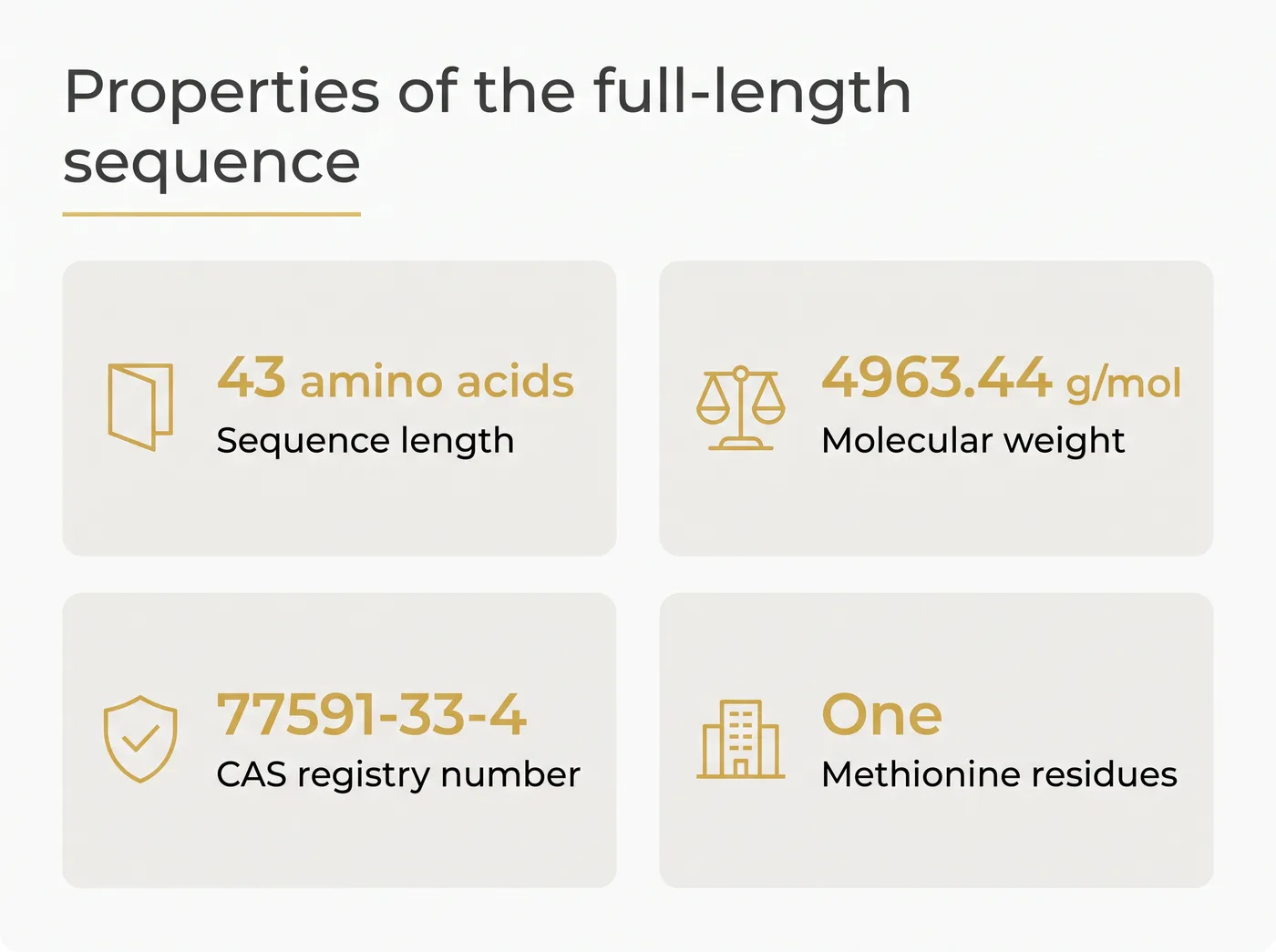
When supplied as the full-length protein, the chemical profile outlines a sprawling 43-amino-acid linear peptide. The sequence runs Ac-SDKPDMAEIEKFDKSKLKKTETQEKNPLPSKETIEQEKQAGES. This hulking structure demands a molecular formula of C212H350N56O78S and tips the scales with a molecular weight of 4963.44 g/mol. The full-length sequence is formally registered under CAS number 77591-33-4. It contains a single methionine residue sitting at position 6, making the entire compound highly susceptible to methionine oxidation. This specific degradation manifests on a lab report as a stubborn 15.99 Da mass shift and must be monitored relentlessly during stability testing and quality control.
The alternative chemical structure sold under this exact same name is a brief N-terminally acetylated heptapeptide. The truncated sequence is simply Ac-LKKTETQ. This fragment carries a molecular formula of C38H68N10O14 and a molecular weight of 889.0 g/mol to the analytical bench. It is registered separately under CAS number 885340-08-9. The N-terminal acetylation serves as a structural capping modification in the synthetic fragment, sealing off the short chain to prevent unwanted side reactions in the vial.
| Property | Full-length sequence | Heptapeptide fragment |
|---|---|---|
| Sequence length | 43 amino acids | 7 amino acids |
| Molecular weight | 4963.44 g/mol | 889.0 g/mol |
| CAS registry number | 77591-33-4 | 885340-08-9 |
| Methionine residues | One | None |
How solid-phase peptide synthesis builds the chain
Both the heptapeptide fragment and the 43-amino-acid full-length peptide emerge from the glass vessels of solid-phase peptide synthesis. This step-wise chemical synthesis builds the peptide chain backwards, coupling amino acids from the C-terminus to the N-terminus on a porous resin support. Standard Fmoc solid-phase synthesis chemistry involves endlessly repeated coupling and deprotection steps. During these reactive stages, side reactions such as aspartimide formation, racemisation, deletion and truncation sequences threaten the integrity of the batch. Long sequences like the 43-residue structure accumulate far more synthesis errors, resulting in a complex crude mixture that requires punishing purification runs.
Once the full sequence finally sits fully assembled on the resin, the peptide is cleaved with TFA Advances in Fmoc solid-phase peptide synthesis. This concentrated acid step aggressively shears the peptide from the solid support and simultaneously strips away the temporary side-chain protecting groups. The resulting crude material is then subjected to high-pressure reversed-phase chromatography. The target sequence must move through the column to isolate itself from the truncated impurities trailing closely behind it.
Trapping the solid through the freeze-drying step
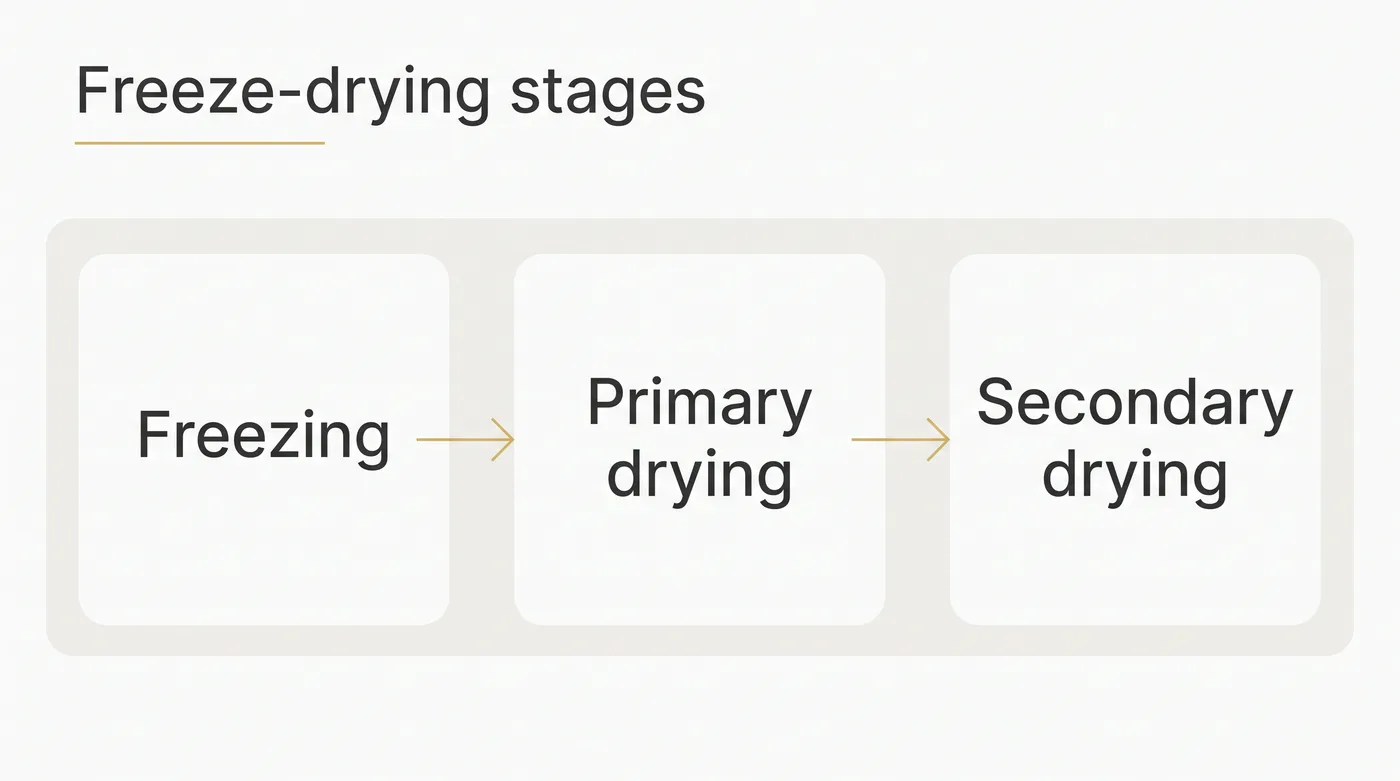
In standard laboratory supply, these peptides arrive exclusively as lyophilised powders to ensure long-term stability in storage. The complex manufacturing process involves distinct freeze-drying stages including freezing, primary drying, and a final secondary drying. During primary drying, the outright sublimation of ice removes the bulk of the frozen solvent without ever passing through a liquid phase. The chamber temperature must be kept below the collapse temperature of the matrix to maintain a beautifully porous cake structure instead of an unusable glassy puck.
Secondary drying forces the desorption of tightly bound water molecules clinging to the peptide. The residual moisture left after this step has a direct, measurable effect on the stability of the dried solid Design of freeze-drying processes for pharmaceuticals: practical advice. Because cleavage and purification require specific, harsh acids, the final solid is almost universally supplied as a salt rather than a raw free base. Typical counterions incorporated into the lyophilised cake are acetate or trifluoroacetate, adding hidden mass to the final powder.
Reading analytical characterisation parameters
Establishing the absolute identity and purity of a vial requires an uncompromising combination of liquid chromatography and mass spectrometry. A mass spectrometer does not care what the vendor printed on the glossy label; it establishes molecular identity instantly and resolves the naming ambiguity with cold mathematical precision. Electrospray ionisation mass spectrometry will yield easily distinguishable, wildly different spectra for the two species. The authentic heptapeptide fragment will exhibit a neat molecular ion corresponding to a mass of approximately 888.5 Da. By stark contrast, the full-length 43-residue protein will typically present as a sprawling, multiply charged envelope across the detector array.
Identity verification via high-resolution instruments requires the observed mass to fall within incredibly tight ppm-level tolerances of the theoretical mass Manganese-Catalyzed N-Formylation of Anilines Using Oxalic Acid as CO Surrogate. Purity is established using reversed-phase chromatography, typically forcing the sample introduction over a C18 stationary phase to separate the molecules. Liquid chromatography separates the main target peptide from truncated synthesis failures, allowing the software to determine the exact area under the curve.
Why calculating net peptide content matters
Calculations of net peptide content must rigorously account for the invisible mass of the counterions and residual moisture trapped in the vial. The macroscopic weight of the white powder is always greater than the mass of the actual active peptide chain. The active peptide fraction must be calculated mathematically from the total powder mass to ensure standard solutions contain the intended molarity of the target peptide. Assuming the bulk powder mass equals the pure peptide mass is the easiest way to ruin a calibration curve.
Failing to account for these non-peptide components causes molarity calculations to be mathematically incorrect from the very first step. Net peptide content is determined independently of chromatographic purity through the brute force of amino acid analysis. This technique measures the exact molar ratio of the constituent amino acids following complete acid hydrolysis of the sample.
- Chromatographic purity tracks the percentage of the target sequence against related synthesis impurities.
- Moisture analysis measures the water fraction still trapped in the powder after the freeze-drying step.
- Amino acid analysis confirms the actual mass of the peptide chain inside the solid sample.
To review the specifications for the full-length sequence, inspect the laboratory details at TB-500.
Questions
Why do certificates of analysis for TB-500 show different molecular weights?
The name designates two different chemical structures depending entirely on the supplier. One is a full 43-amino acid sequence tipping the scales at 4963.44 g/mol, while the other is a short 7-amino acid fragment weighing just 889.0 g/mol.
What causes the 16 Da mass shift in a mass spectrometry report?
A shift of approximately 16 Da typically indicates methionine oxidation. The 43-amino acid sequence contains a single methionine residue at position 6, which remains susceptible to oxidation during synthesis or long-term storage of the solid.
How does residual moisture affect the lyophilised powder?
Residual water lingering after the final freeze-drying step dictates the stability of the dried solid. High moisture levels actively promote degradation, such as oxidation or hydrolysis of the peptide bonds within the vial.