
Peptide chemistry
Tesamorelin identity: structure, molecular weight and form
NuuVive Journal · · 5 min read

Short answer
Tesamorelin is a synthetic 44-amino acid peptide. It is distinguished by the addition of a trans-3-hexenoic acid group at the N-terminus. The theoretical average molecular weight of its free base form is 5135.9 g/mol. In the laboratory, it is supplied as a white lyophilised acetate salt powder.
Key takeaways
- Tesamorelin is a 44-amino acid synthetic peptide with a specific trans-3-hexenoic acid modification.
- Its molecular weight is 5135.9 Da for the free base form.
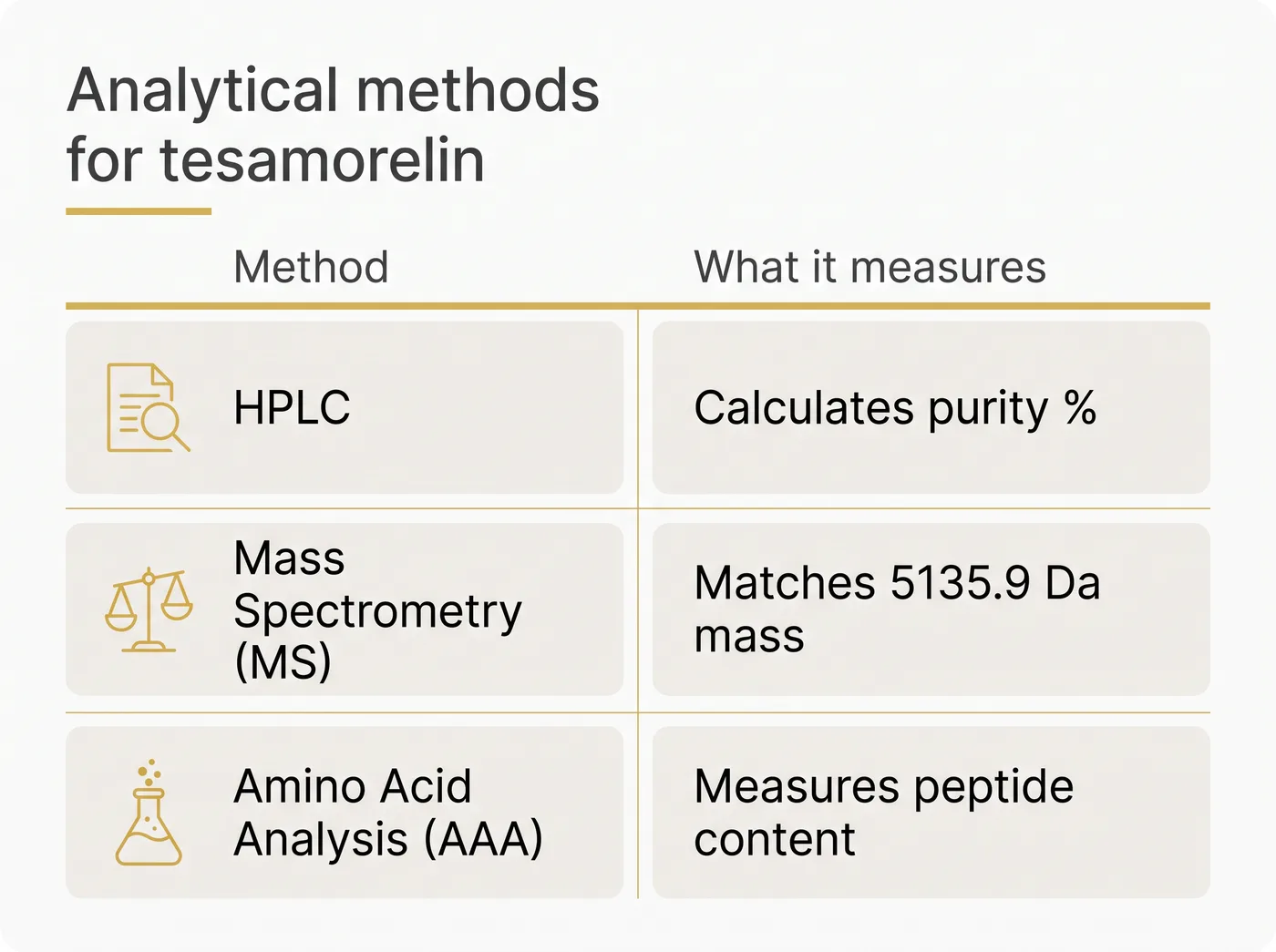
- Identity is confirmed using mass spectrometry, which matches the mass of the intact chain.
- High-performance liquid chromatography (HPLC) separates the peptide from impurities to establish purity.
- It is supplied as a freeze-dried acetate salt powder, which must be handled properly to preserve its structure.
Building the sequence
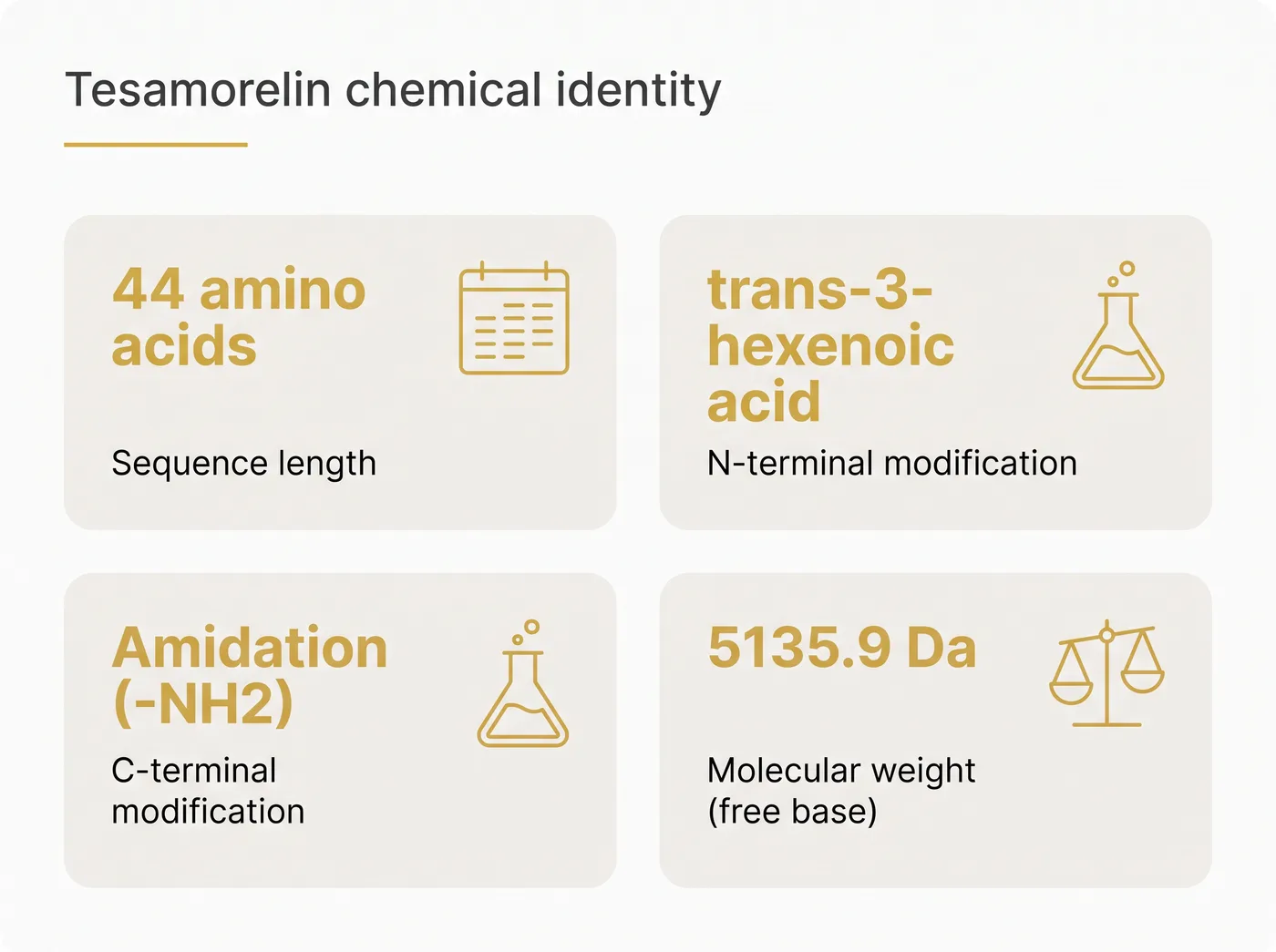
When you look at the structure of tesamorelin, you are looking at a very deliberate piece of chemistry. Tesamorelin is a synthetic peptide containing 44 amino acids. But the sequence itself only tells part of the story.
The defining characteristic of tesamorelin is a modification at its N-terminus. Chemists attach a *trans*-3-hexenoic acid group to the first amino acid in the chain, a tyrosine residue. This is not a trivial addition; it requires precise conditions during Fmoc solid-phase peptide synthesis (SPPS), where the chain is built one amino acid at a time from the C-terminus to the N-terminus Advances in Fmoc solid-phase peptide synthesis (Journal of Peptide Science). The C-terminal end also receives an modification: it is amidated, meaning it ends in an -NH2 group rather than a free carboxylic acid.
These additions change the mass of the molecule and how it behaves analytically. The molecular formula for the tesamorelin free base is $C_{221}H_{366}N_{72}O_{67}S$, with the single sulfur atom coming from a methionine residue positioned at the 27th slot in the chain.
The weight of the matter
The theoretical average molecular weight of the tesamorelin free base is 5135.9 g/mol (or Daltons, Da). That figure is non-negotiable. If a lab is characterising a sample and the mass does not match 5135.9 Da, the sample is not intact tesamorelin.
The *trans*-3-hexenoyl group adds a specific amount of mass to the molecule. This is what an analytical chemist is looking for when they place a sample into a mass spectrometer. Mass spectrometry (MS), particularly Electrospray Ionisation (ESI-MS), measures the mass-to-charge ratio of the molecules in the sample. For a peptide as large as tesamorelin, ESI-MS will typically display multiply charged ions, such as the $[M+4H]^{4+}$ state. The software deconvolutes these peaks to find the total mass.
However, mass spectrometry has its limits. It confirms the total mass of the molecule, which proves the 44 amino acids and the modifications are present. It does not prove the order in which they are arranged. Standard MS cannot tell the difference between two amino acids with identical masses (isobaric substitutions), nor can it sequence the entire chain without further techniques like tandem mass spectrometry (MS/MS).
Proving purity on paper
Before you can trust the mass, you have to ensure the sample is mostly one substance. This is the job of High-Performance Liquid Chromatography (HPLC). An HPLC chromatogram is essentially a footrace for molecules, where the finish line is a detector and the track is a column packed with a stationary phase HPLC analysis and purification of peptides (Methods in Molecular Biology 386).
In reversed-phase HPLC, the column holds back hydrophobic molecules. Tesamorelin, with its *trans*-3-hexenoyl group, is quite hydrophobic. The sample is pushed through the column using a mobile phase that gradually increases in organic solvent concentration, typically acetonitrile with 0.1% trifluoroacetic acid (TFA). The TFA acts as an ion-pairing agent, keeping the peptide moving cleanly HPLC analysis and purification of peptides (Methods in Molecular Biology 386).
The resulting graph shows peaks. The largest peak is ideally the target peptide. The area under the curve (AUC) of this main peak, compared to the total area of all peaks, gives the chromatographic purity. Synthesis is never perfect. A good HPLC run will separate the intact tesamorelin from common impurities, such as truncated sequences where an amino acid was missed during synthesis, or deamidated variants.
Why the solid form matters
Tesamorelin is almost exclusively supplied as an acetate salt in a lyophilised (freeze-dried) powder. The acetate salt form is a consequence of the purification process, where the crude peptide is cleaved from the synthesis resin using strong acids like TFA, and later exchanged for acetate to make it more stable.
Lyophilisation removes water from the sample while it is frozen, a process requiring precise control over temperature and pressure Design of freeze-drying processes for pharmaceuticals: practical advice (Pharmaceutical Research). The resulting solid is a white to off-white cake. This solid form matters because a 44-amino acid chain is susceptible to degradation if left in an aqueous state for long periods.
Sometimes, the lyophilised powder contains more than just the peptide salt. Excipients like mannitol are frequently added to act as a bulking agent, helping the cake form properly and remain stable. When reviewing documentation, it is worth knowing that the gross weight of the solid in a vial includes the peptide free base, the acetate counterions, any residual moisture, and any excipients.
For a clear view of how these documents translate to a product you can check, review NuuVive's Tesamorelin for current stock, pricing and lot-specific laboratory reports.
Questions
Does mass spectrometry sequence the peptide?
No, standard mass spectrometry only measures the total mass of the intact molecule. While it confirms the 44 amino acids and modifications are present by weight, it requires tandem mass spectrometry (MS/MS) to break the peptide apart and prove the exact order of the sequence.
What is the difference between free base and acetate salt?
The free base refers to the pure peptide molecule alone, which has a mass of 5135.9 Da. The acetate salt is the stable solid form actually supplied, where the basic amino acids in the peptide are paired with acetate molecules, adding weight to the overall solid.
Why is the peptide freeze-dried?
Lyophilisation (freeze-drying) removes water to create a stable solid powder. A 44-amino acid peptide like tesamorelin is prone to breaking down if left in a liquid state, so removing moisture extends its stability for transport and storage.