
Policy and economics
The gray market for unapproved peptides: how regulators respond
NuuVive Journal · · 5 min read

Short answer
The FDA is actively scrutinizing unapproved peptide products sold online. The agency issues warning letters to vendors selling compounds labeled as "research purposes only," rejecting this labeling when website evidence suggests human consumption. As official drug shortages for patented formulas resolve, regulators end grace periods for compounders, while excluding key ingredients from approved lists.
Key takeaways
- With the official shortages resolved in early 2025, the FDA has ended grace periods for pharmacies compounding copies of patented drugs.
- The FDA has rejected the "research use only" loophole, issuing coordinated warning letters to online vendors when website marketing suggests human consumption.
- Regulators are tracking safety reports linked to unapproved products, with measurement errors from unregulated vials being a primary concern.
- Major pharmaceutical companies are pursuing civil litigation against retail businesses and pharmacies selling adulterated or misbranded products.
The end of the legal shortage
For a brief, strange period in American pharmacy law, the simplest way to sidestep a patent was to wait for a shortage. During the peak of drug shortages starting in 2022, large quantities of products were manufactured by outsourcing compounding pharmacies. It was perfectly legal, provided the drug remained on the FDA's shortage list. At the height of this boom in 2024, nearly 1 in 3 Americans purchasing a specific class of drug were sourcing it from a compounding pharmacy Stanford Medicine magazine.
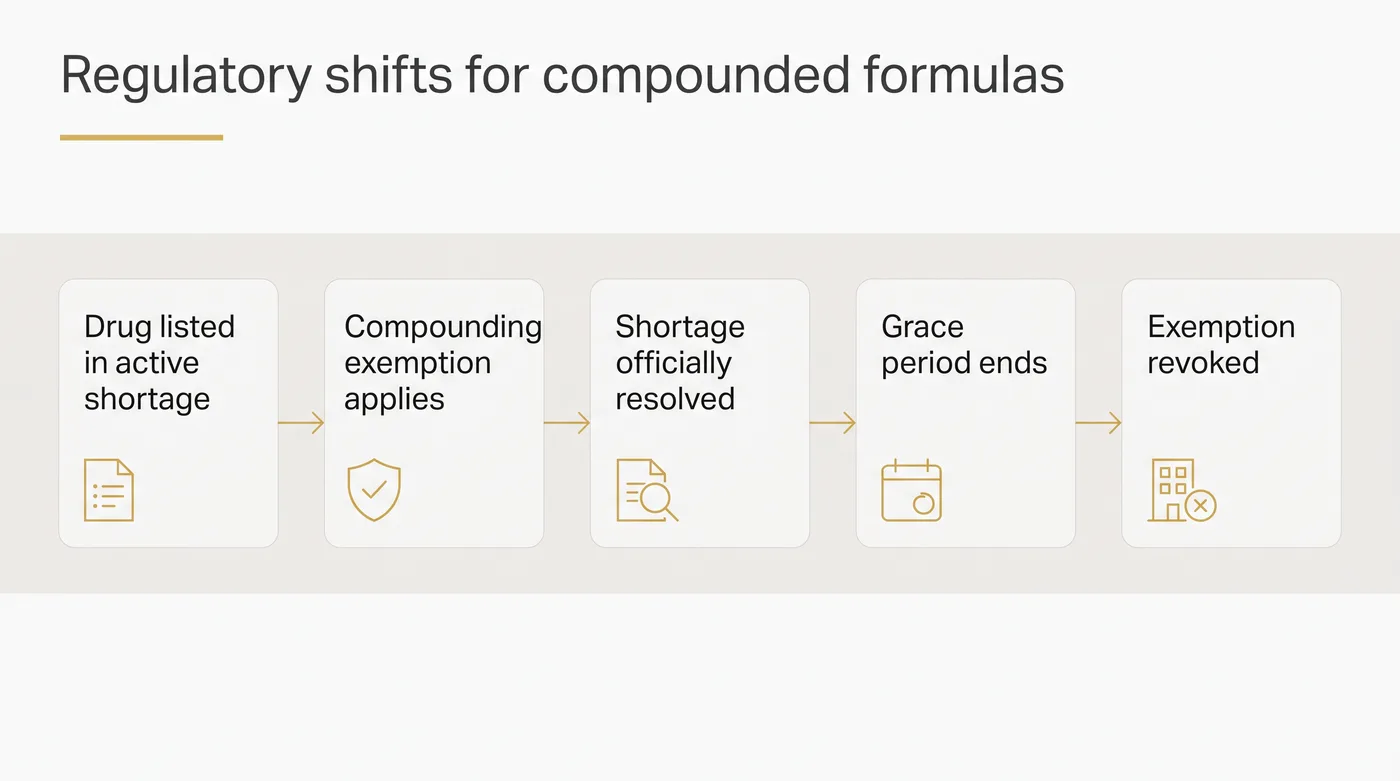
But a shortage is a condition, not a permanent loophole. The FDA officially announced that the tirzepatide shortage was resolved in December 2024, followed shortly by the resolution of the semaglutide shortage in February 2025. This resolution legally removed the standard pathway that permitted compounding pharmacies to create routine copies of these patented drugs.
The transition was not immediate. Rather than halting compounding overnight, the FDA provided grace periods for pharmacies to phase out compounded semaglutide and tirzepatide. By May 2025, those grace periods had completely ended, officially stripping the exemption for compounding under normal circumstances. For patients and pharmacies relying on this pathway, the legal foundation vanished.
The "research use only" loophole closes
With traditional pharmacy compounding restricted, the gray market stepped up to fill the void. An online industry proliferated, selling unapproved versions of peptides labeled "for research purposes only" or "not for human consumption." It is a classic legal fiction: if you print a disclaimer on a vial, perhaps the FDA will view it as a laboratory chemical rather than a drug.
The FDA, unsurprisingly, did not agree. The agency has actively rejected this legal loophole and issued multiple waves of enforcement actions targeting these peptide vendors. In an August 2026 crackdown, the FDA issued a coordinated wave of warning letters to five distinct online peptide vendors selling semaglutide, tirzepatide, and retatrutide.
The FDA explicitly rejected the companies' labeling disclaimers. In footnotes to the letters, the agency stated: "Despite statements on your product labelling marketing your products 'for research use only' and 'not for human or veterinary use,' evidence obtained from your website establishes that your products are intended to be drugs for human use." You cannot sell a product for "research" while simultaneously highlighting physical changes on the checkout page.
The target list is expanding, too. In its October 2026 consumer update, the FDA confirmed it was warning companies for illegally selling unapproved versions of newer pipeline drugs, specifically naming retatrutide, survodutide, and mazdutide, alongside semaglutide and tirzepatide fda.gov. If you want to understand how retatrutide stands in FDA trials, you can read the guide.
Safety reports and scrutiny
Regulators do not act in a vacuum; they act when incidents start adding up. Federal law does not strictly require state-licensed pharmacies to submit incident reports to the FDA. However, the agency actively tracks safety issues explicitly associated with compounded formulas Compounded GLP-1s: Why doctors worry and the FDA is cracking down.
According to the FDA, a primary concern involves patient measurement errors resulting from unregulated vials. When a product is not delivered in a pre-measured format, the math is left to the consumer, and the margin for error is substantial.
The FDA reported in October 2026 that it is actively investigating fraudulent compounded semaglutide and tirzepatide containing false pharmacy information fda.gov. In some instances, the compounding pharmacies listed on the labels did not actually exist. In other cases, legitimate pharmacy names were fraudulently printed on vials they did not manufacture. It is the pharmaceutical equivalent of a stolen license plate.
Lobbying, pressure, and the "Green List"
The pressure on regulators is not just coming from internal data; it is coming from well-funded external organizations. On July 22, 2025, a Congressional briefing hosted by The Obesity Society spotlighted a report authored by Peter J. Pitts, the President of The Center for Medicine in the Public Interest and a former FDA Associate Commissioner.
The report condemned regulators for allowing a black market of unverified knockoffs to thrive. To choke off the supply of unverified research peptides and active pharmaceutical ingredients, the FDA implemented a "green list" import alert. Ingredients lacking verification on this green list are now subjected to detention without physical examination by border authorities. The machinery of regulation is slow, but once it starts moving, it controls the ports.
Drug manufacturers have also joined regulators in cracking down on unauthorized sales. The makers of tirzepatide and semaglutide have sued compounding pharmacies, medical spas, and retail businesses for producing adulterated or misbranded products. For an understanding of what goes into these legal documents, you can review the guide on reading a lab test. To explore thoroughly tested materials, visit the shop.
Questions
Why is the FDA sending warning letters to research peptide vendors?
The FDA has determined that many vendors use "research purposes only" labels as a legal loophole. When website marketing highlights effects like physical changes, the FDA views the products as unapproved drugs intended for human use, which violates interstate commerce laws.
What happens when a drug is no longer on the shortage list?
When the FDA officially declares a drug shortage resolved, compounding pharmacies lose the legal exemption that permitted them to produce routine copies of the patented drug. The FDA typically provides a grace period, after which normal compounding restrictions apply.
How is the FDA stopping raw ingredients at the border?
The FDA implemented a "green list" import alert. Active pharmaceutical ingredients that are not verified on this list are subject to detention without physical examination by border authorities, severely restricting the supply of unregulated materials.
Sources
- Compounded GLP-1s: Why doctors worry and the FDA is cracking down. stanford.edu
- Stanford Medicine magazine: From musculoskeletal development to peak performance. stanmed.stanford.edu
- fda.gov. U.S. FDA