
Compounds explained
What is ARA-290? What it has been studied for
NuuVive Journal · · 4 min read

Short answer
ARA-290 is an 11-amino-acid synthetic peptide engineered from the helix B surface region of human erythropoietin. It was designed to bind to the innate repair receptor without involving red blood cell production. It has been investigated in animal models of tissue damage and in small Phase 2 human trials for conditions like sarcoidosis-associated neuropathy and type 2 diabetes, but it is an investigational compound and not an approved drug.
Key takeaways
- ARA-290 is an 11-amino-acid synthetic peptide engineered from a specific region of human erythropoietin.
- It has been investigated in small Phase 2 human trials for neuropathy and metabolic control.
- There is no Phase 3 clinical data, and no active trial program is currently registered.
- It is an investigational compound, sits in Category 3 of the FDA bulk drug substances list, and is not an approved drug.
- Independent analytical testing is the only reliable way to verify the identity and purity of a research vial.
The origin of ARA-290
Look up a research peptide online and you usually find a tug-of-war between marketing departments and quiet laboratory data. ARA-290 is no different. To understand what this compound actually is, you have to look at the molecule it was built from: erythropoietin.
Erythropoietin (EPO) is a large, naturally occurring glycoprotein studied for its role in red blood cell production Erythropoietin: a review. But researchers noticed it was also being studied in models of tissue damage and ischemia The Many Facets of Erythropoietin Physiologic and Metabolic Response. The problem for scientists was that investigating EPO for tissue protection in animal models also invariably drove up red blood cell counts, which clouded the data.
Around 2008, researchers engineered a workaround. They isolated a specific sequence from the aqueous face of the helix B surface region of human EPO. The result was ARA-290, a microscopic 11-amino-acid fragment featuring an N-terminal pyroglutamic acid pubchem.ncbi.nlm.nih.gov. It was explicitly designed to target the innate repair receptor selectively, skipping the classical EPO receptor entirely.
What ARA-290 has been studied for
Research on ARA-290 involves a mix of cell models, animal studies, and a handful of small, completed human trials. It has been investigated in Phase 2 pilot studies for sarcoidosis-associated small-fiber neuropathy, measuring corneal nerve fiber density and self-reported pain scores over 28-day periods Erythropoietin and its derivatives: from tissue protection to immune regulation.
It was also evaluated in Phase 2 trials looking at neuropathy and metabolic control in people with type 2 diabetes ARA 290, a nonerythropoietic peptide engineered from erythropoietin.... Other highly exploratory Phase 1 and Phase 2 trials looked at diabetic macular edema and cognitive function. In preclinical settings, it has been evaluated extensively in rodent models of stroke, retinal edema, and renal ischemia-reperfusion.
Here is the reality check: that is where the human evidence stops. There is no Phase 3 clinical trial data for ARA-290. There are no large-scale, long-term human studies. The most recently registered human trial began in 2016, and there is no active clinical trial program ongoing today. Anyone claiming this compound is a standard, established intervention is simply ignoring the trial registry.
ARA-290 vs Erythropoietin (EPO)
Because it was engineered from EPO, the two are often mentioned together. However, structurally and functionally, they are fundamentally different molecules.
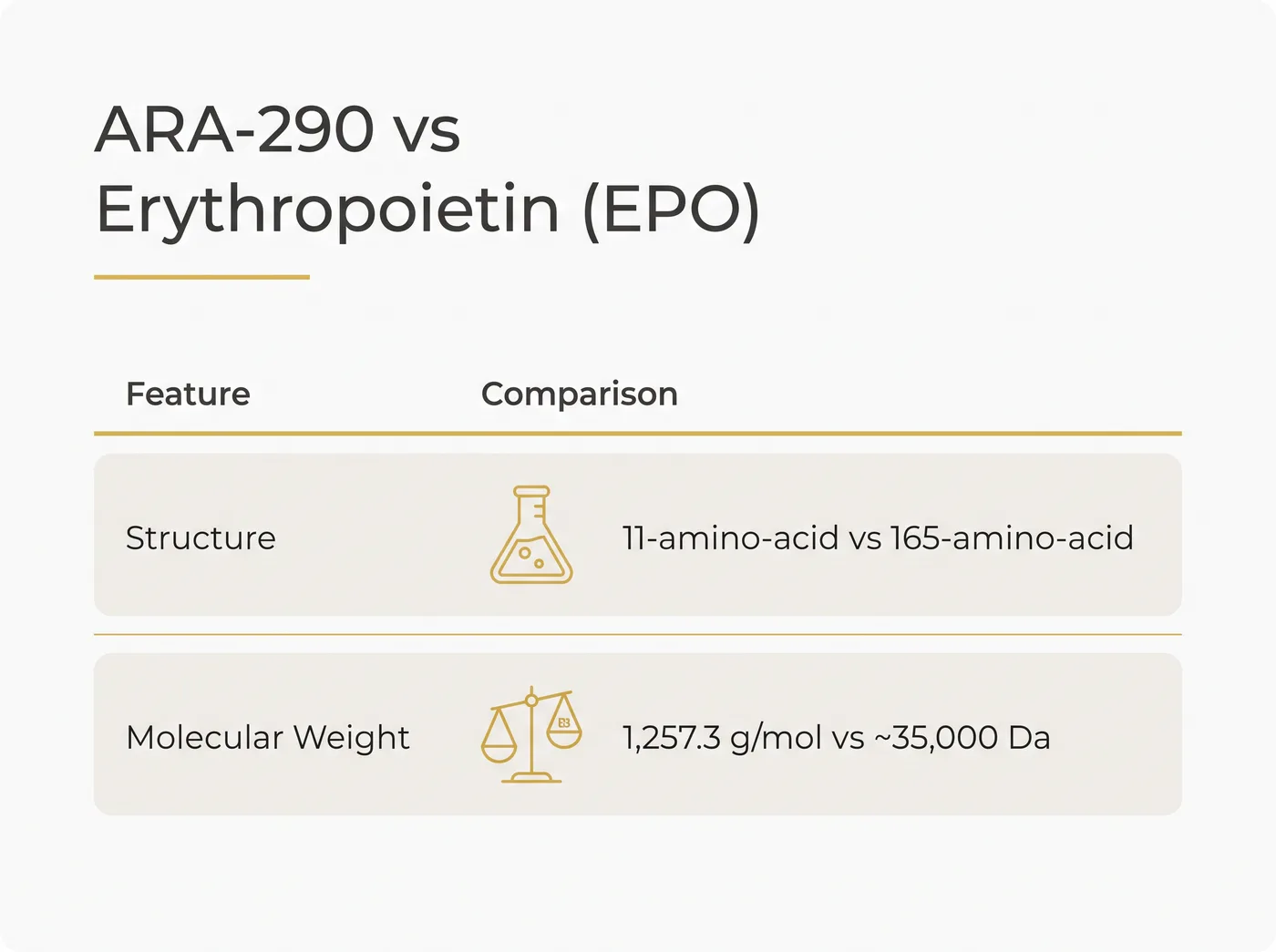
EPO is a massive 165-amino-acid glycoprotein hormone with a molecular weight of up to 35,000 Da. ARA-290 is a tiny, unglycosylated 11-amino-acid synthetic peptide weighing just 1,257.3 g/mol. While EPO binds to the EPOR homodimer, ARA-290 was strictly designed to be non-erythropoietic.
| Feature | ARA-290 | Erythropoietin (EPO) |
|---|---|---|
| Structure | 11-amino-acid peptide | 165-amino-acid glycoprotein |
| Molecular Weight | 1,257.3 g/mol | ~30,000 to 35,000 Da |
| Target Receptor | Innate repair receptor | EPOR homodimer |
The regulatory reality
The regulatory status of ARA-290 is blunt: it is an investigational compound. It is not an FDA-approved drug for any indication and is not legally marketed for human consumption.
If you follow compounding pharmacy regulations, you might be familiar with the FDA bulk drug substances list. In the May 14, 2026 update, it was placed in Category 3. That means it was nominated for pharmacy compounding, but the agency determined the nomination lacked sufficient supporting information to evaluate it.
It is not included in the October 30, 2026 HHS draft enforcement-discretion policy. It sits firmly in the research-only category, a fact that vague online sellers often conveniently forget to mention.
Reading an ARA-290 lab report
A vial of white powder is a mystery until an analytical chemist runs it through a high-performance liquid chromatography (HPLC) machine. When you are sourcing compounds for a laboratory, a certificate of analysis is the vial's passport. It is the only document that actually matters.
You are looking for two specific numbers on that sheet. The first is purity, which should be clearly stated as a percentage. A chromatogram is a race where every impurity has to cross the finish line in public; if the line is not flat and clean, the purity is low. The second number is the measured mass. A commercial label might say 10 mg, but the independent lab report tells you exactly how much material actually made it into the vial.
For example, the ARA-290 lab results for NuuVive's current batch show a purity of 99.822% and a measured mass of 11.00 mg, verified by independent testing (Janoshik #110953). That is the level of concrete, verifiable data you should demand before acquiring NuuVive's ARA-290.
Questions
Is ARA-290 the same as erythropoietin?
No. While it is engineered from a specific region of erythropoietin, ARA-290 is an 11-amino-acid synthetic peptide. It is designed to bind to a different receptor and lacks involvement in red blood cell production.
Is ARA-290 FDA approved?
No. ARA-290 is an investigational compound and is not an FDA-approved drug for any indication.
Can pharmacies compound ARA-290?
Under the FDA's bulk drug substances list updated in May 2026, it sits in Category 3. This means it was nominated for compounding but lacked adequate supporting information for the agency to evaluate it.
Sources
- Erythropoietin: a review. National Library of Medicine
- Frontiers | The Many Facets of Erythropoietin Physiologic and Metabolic Response. Frontiers
- pubchem.ncbi.nlm.nih.gov. National Library of Medicine
- pubmed.ncbi.nlm.nih.gov. National Library of Medicine
- pubmed.ncbi.nlm.nih.gov. National Library of Medicine