
Compounds explained
What is DSIP? What it has been studied for
NuuVive Journal · · 6 min read
Short answer
Delta Sleep-Inducing Peptide (DSIP) is a naturally occurring nine-amino-acid neuropeptide first isolated from the blood of sleeping rabbits in the 1970s. It has been investigated in animal models and small human studies evaluating sleep architecture, EEG delta rhythms, and substance withdrawal. DSIP sits entirely outside the FDA drug approval pathway, and its exact cellular receptor remains unknown. It is not currently permitted for pharmacy compounding under recent federal policies.
Key takeaways
- DSIP is a 9-amino-acid peptide originally isolated from the cerebral blood of rabbits undergoing induced slow-wave sleep.
- Research evaluates its role in sleep architecture, EEG delta rhythms, and alcohol or opioid withdrawal in early, small-scale models.
- There are no large randomized controlled trials for DSIP, and its exact cellular mechanism of action has never been definitively identified.
- The molecule is not an FDA-approved drug and was explicitly excluded from the October 2026 HHS compounding enforcement discretion policy.
- Authentic DSIP requires a lab report showing a molecular weight of 848.8 g/mol and a clear high-performance liquid chromatography trace.
The 1970s rabbit experiments and what DSIP actually is
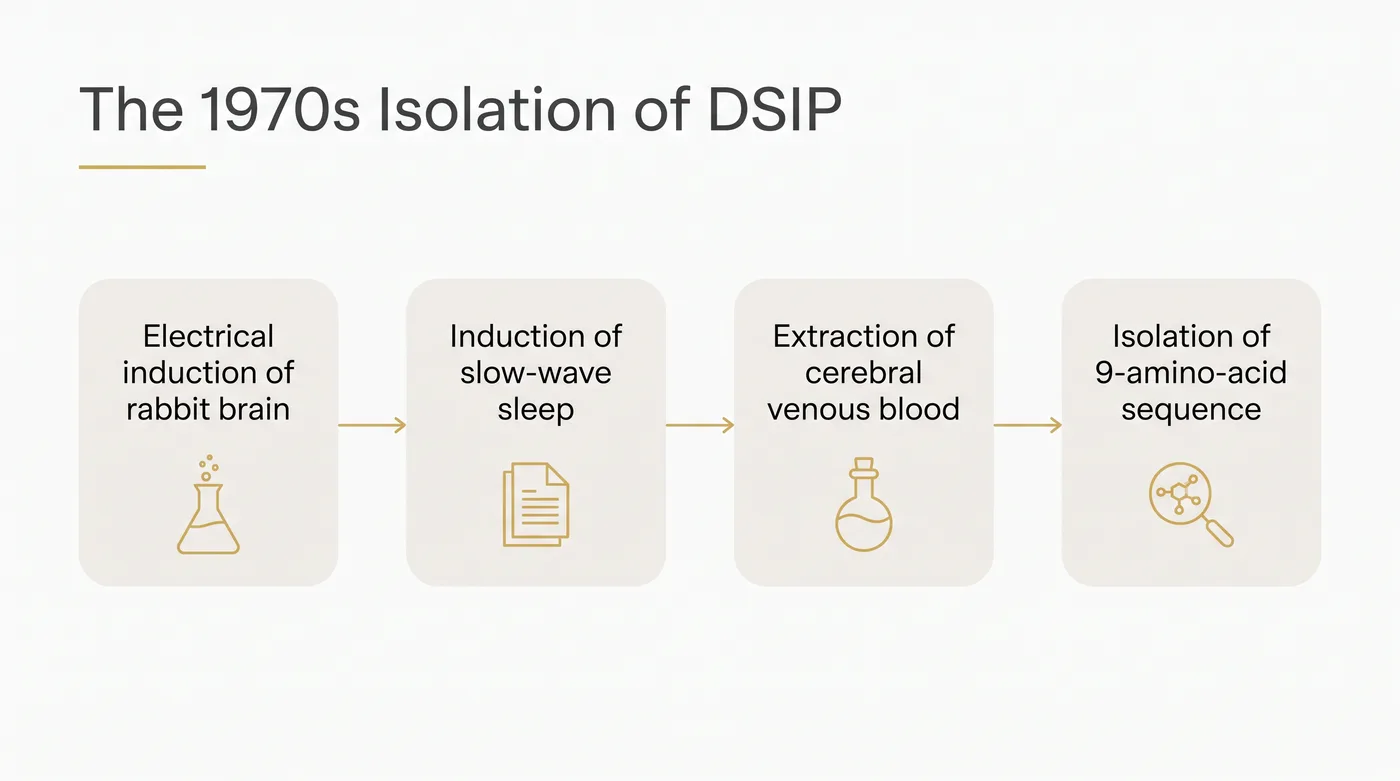
Imagine trying to isolate the exact chemical signal that tells a mammal to go to sleep. In the mid-1970s, a Swiss research group led by Schoenenberger and Monnier in Basel attempted exactly that. They electrically induced slow-wave sleep in rabbits, collected their cerebral venous blood, and hunted for whatever molecules spiked during the process. What they found and synthesized by 1977 was a linear chain of nine amino acids National Library of Medicine.
The researchers named it "delta sleep-inducing peptide" based entirely on the experimental conditions of its discovery, rabbits in induced delta-wave sleep. That name stuck, even though it describes a laboratory scenario rather than a universal physiological function.
Chemically, DSIP is an endogenous neuropeptide and neuromodulator. Its sequence is Trp-Ala-Gly-Gly-Asp-Ala-Ser-Gly-Glu, completely lacking the complex folded disulfide bonds seen in larger proteins. Because it is a straightforward nonapeptide, it has a precise molecular weight of 848.8 g/mol National Library of Medicine. That exact mass is the fingerprint you look for when analyzing the raw material today.
The hunt for the delta wave: what DSIP has been studied for
Search for DSIP online and you will find marketing copy writing checks the actual research has never cashed. The scientific reality is a fascinating, if narrow, collection of early laboratory investigations spanning several physiological domains.
The primary focus has always been sleep architecture. DSIP was investigated in animal models, including rabbits, rats, mice, and cats, evaluating electroencephalogram (EEG) delta rhythms and motor activity. In the 1980s and 1990s, the compound moved into small-scale laboratory settings in humans. Researchers used double-blind, matched-pairs studies and open-label human studies involving small cohorts of volunteers and chronic insomniacs. These studies assessed parameters like sleep efficiency, sleep latency, and time spent in specific sleep stages using polysomnography National Library of Medicine.
Beyond sleep, researchers investigated the molecule in the context of addiction and stress. Small, open, uncontrolled clinical assessments evaluated cohorts of individuals undergoing acute alcohol or opiate withdrawal, with clinicians tracking the progression of withdrawal. However, these observational assessments lacked randomization or placebo controls. In animal models, DSIP was investigated for antinociceptive and analgesic responses in rodents, as well as the incidence and duration of fits in rats with chemically induced epilepsy.
There are also scattered in vitro assays and small human studies evaluating neuroendocrine secretion, specifically looking at the release of adrenocorticotropic hormone (ACTH), luteinizing hormone (LH), growth hormone (GH), and cortisol in response to stress or metabolic challenges. Finally, very limited human data exists in the form of isolated case reports assessing sleep attacks and bioelectrical activity in narcolepsy.
The missing pieces in the evidence base
If a compound has been studied since 1977, you might expect a mountain of conclusive data. With DSIP, the mountain is missing. The evidence base relies heavily on older, small-scale models. No clinical trials have progressed to Phase 3, and there are no registered phase trials with active numbers on clinicaltrials.gov driving it toward pharmaceutical approval.
The most glaring scientific mystery is the mechanism. Despite decades of investigation, the precise endogenous receptor, the precursor gene or protein, and the exact cellular mechanism of action for DSIP have never been definitively isolated or identified in either animals or humans. Researchers know the sequence exists in mammalian blood, but exactly how it interfaces with the nervous system remains a black box.
DSIP vs. Epitalon: comparing the research models
In the sometimes chaotic catalog of research compounds, DSIP is frequently grouped next to Epitalon. Both are categorized in longevity and bioregulator research, but the two compounds feature concrete chemical, evidentiary, and regulatory differences.
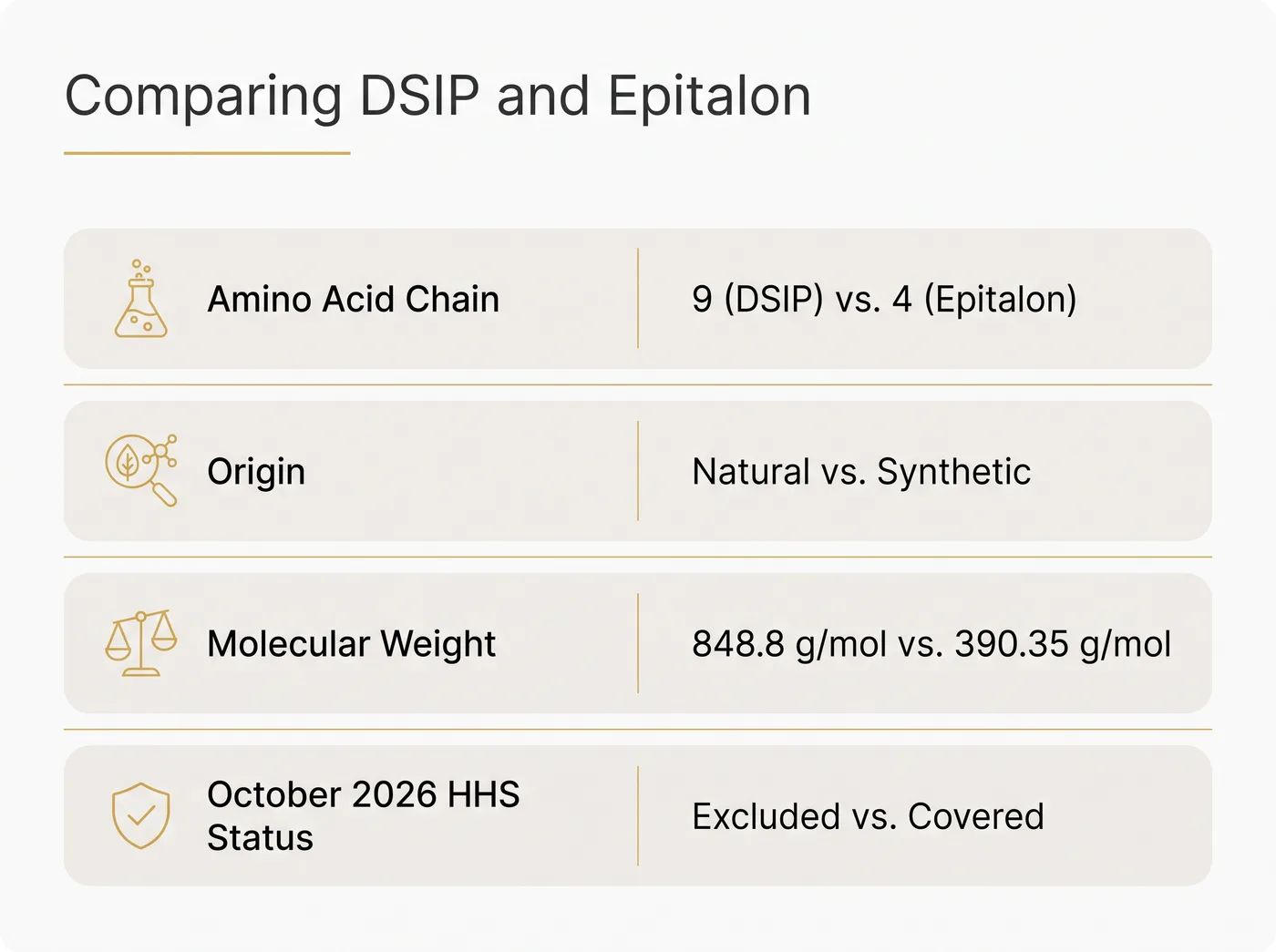
While DSIP is a naturally occurring nine-amino-acid peptide isolated from mammalian blood, Epitalon is a strictly synthetic four-amino-acid tetrapeptide (Ala-Glu-Asp-Gly). Epitalon does not occur naturally; it was engineered in Russia based on the amino acid composition of epithalamin, a crude bovine pineal gland extract National Library of Medicine. The research focuses are completely distinct: DSIP investigations evaluate sleep architecture and withdrawal, while Epitalon research anchors on cellular aging, investigating telomerase enzyme activation and circadian melatonin rhythm models in vitro and in animal models National Library of Medicine.
| Feature | DSIP | Epitalon |
|---|---|---|
| Origin | Natural endogenous peptide | Synthetic tetrapeptide |
| Structure | 9 amino acids (Linear) | 4 amino acids (Linear) |
| Molecular Weight | 848.8 g/mol | 390.35 g/mol |
| Primary Research Focus | Sleep architecture, EEG delta waves | Cellular senescence, telomerase activity |
| Human Evidence Level | Small early laboratory studies | Virtually absent (mostly in vitro/animal) |
Regulatory status and the 2026 HHS compounding policy
Neither DSIP nor Epitalon is an FDA-approved drug for any medical indication. They sit in the gray area of research compounds, but their paths diverged sharply in recent regulatory meetings.
In July 2026, the FDA's Pharmacy Compounding Advisory Committee (PCAC) evaluated DSIP for potential inclusion on the Section 503A Bulks List. This list determines which bulk drug substances state-licensed pharmacies are permitted to compound. The committee voted against recommending DSIP.
The consequences of that vote materialized a few months later. In October 2026, the HHS published an interim enforcement discretion policy permitting pharmacies to compound certain peptide bulk drug substances while formal FDA rulemaking continues. Epitalon made the cut, granting it temporary compounding pathways under specific medical supervision. DSIP was explicitly denied this status. It remains strictly a chemical for laboratory research, unavailable through prescription compounding.
Reading a DSIP lab report
If a compound sits outside the pharmaceutical supply chain, the only thing separating rigorous research from a wasted experiment is the analytical documentation. A legitimate reading a lab test protocol requires checking two specific instruments on the Certificate of Analysis.
First, find the mass spectrometry (MS) result. This identifies the exact weight of the molecule in the vial. For DSIP, the mass must register at 848.8 g/mol. If that number is missing or wrong, the vial does not contain DSIP. Period.
Second, check the high-performance liquid chromatography (HPLC) trace. This measures purity by separating the main compound from manufacturing byproducts. A clean chromatogram is a race where every impurity has to cross the finish line in public. Look for a single sharp peak demonstrating high measured purity. Vague vendor claims mean nothing without a third-party report backing them up. You can view the exact lab documentation, molecular mass verification, and current measured purity for NuuVive's DSIP directly in the catalog.
Questions
Is DSIP an approved drug?
No. DSIP is not approved by the FDA for any medical indication. It remains an experimental research chemical.
Can pharmacies compound DSIP?
No. Under the October 2026 HHS enforcement discretion policy, DSIP is excluded from the list of peptides that state-licensed 503A pharmacies are temporarily permitted to compound.
How was DSIP discovered?
It was isolated between 1974 and 1977 by a Swiss research team who extracted cerebral venous blood from rabbits undergoing electrically induced slow-wave sleep to find the responsible chemical messenger.
What is the difference between DSIP and Semax?
DSIP is a nine-amino-acid peptide studied for sleep architecture and substance withdrawal. Semax is a distinct research peptide with different structural characteristics and research focuses.
Sources
- pubmed.ncbi.nlm.nih.gov. National Library of Medicine
- pubmed.ncbi.nlm.nih.gov. National Library of Medicine
- pubchem.ncbi.nlm.nih.gov. National Library of Medicine
- pubchem.ncbi.nlm.nih.gov. National Library of Medicine
- pubmed.ncbi.nlm.nih.gov. National Library of Medicine