
Reading lab reports
What is in a CJC-1295 + Ipamorelin vial?
NuuVive Journal · · 7 min read · Updated
Short answer
A CJC-1295 + Ipamorelin vial contains a physical mixture of two distinct synthetic peptides freeze-dried into a single solid cake. A laboratory verifies this blend by running the sample through reversed-phase high-performance liquid chromatography. This process separates the two compounds to measure their individual purities. Analysts then use high-resolution mass spectrometry to confirm the exact molecular weight of each peptide sequence, proving the correct variants are actually present in the glass.
Key takeaways
- A dual-peptide vial contains two separate molecules freeze-dried together, not a single bonded compound.
- Mass spectrometry is required to identify which variant of CJC-1295 is present in the sample.
- Liquid chromatography separates the blend to measure the individual purity of each peptide.
- The reported mass on a vial typically includes bound water and counterions, requiring amino acid analysis to determine net peptide content.
- A reliable certificate of analysis must include a specific lot number and test methods for both compounds.
Roommates in a glass house, not a chemical hybrid
When you pick up a vial holding a blend of two synthetic peptides, it is easy to imagine some complex new molecule sitting at the bottom. The reality is far less dramatic, though chemically elegant. The solid white powder is purely a physical mixture. The materials have not reacted to form a new chemical entity, nor are they bonded together. Instead, they are co-lyophilised. This simply means a manufacturer dissolved both distinct compounds into the exact same solution and then sent them through a freeze-drying step together.
The result is a single uniform cake that looks like a solitary peptide. In a standard laboratory research supply context, the mass stated on the label refers to the nominal mass of each individual component. A 20 mg vial actually holds 10 mg of one peptide and 10 mg of the other. Because synthetic peptides are usually synthesised using trifluoroacetic acid (TFA) to cleave them from their resin, the resulting powder exists as a TFA salt. It stays that way unless the laboratory runs an additional ion-exchange chromatography step to strip away the TFA and convert the material to a more stable acetate salt.
The great naming crisis in laboratory supplies
Knowing what sits in the vial begins with demanding precise chemical identity. Ipamorelin makes this relatively easy. It is a synthetic pentapeptide with a neat sequence of five amino acids and a molecular weight of approximately 711.9 g/mol. Its structure is straightforward and highly stable. When an analytical chemist runs a reference standard, Ipamorelin behaves consistently every single time.
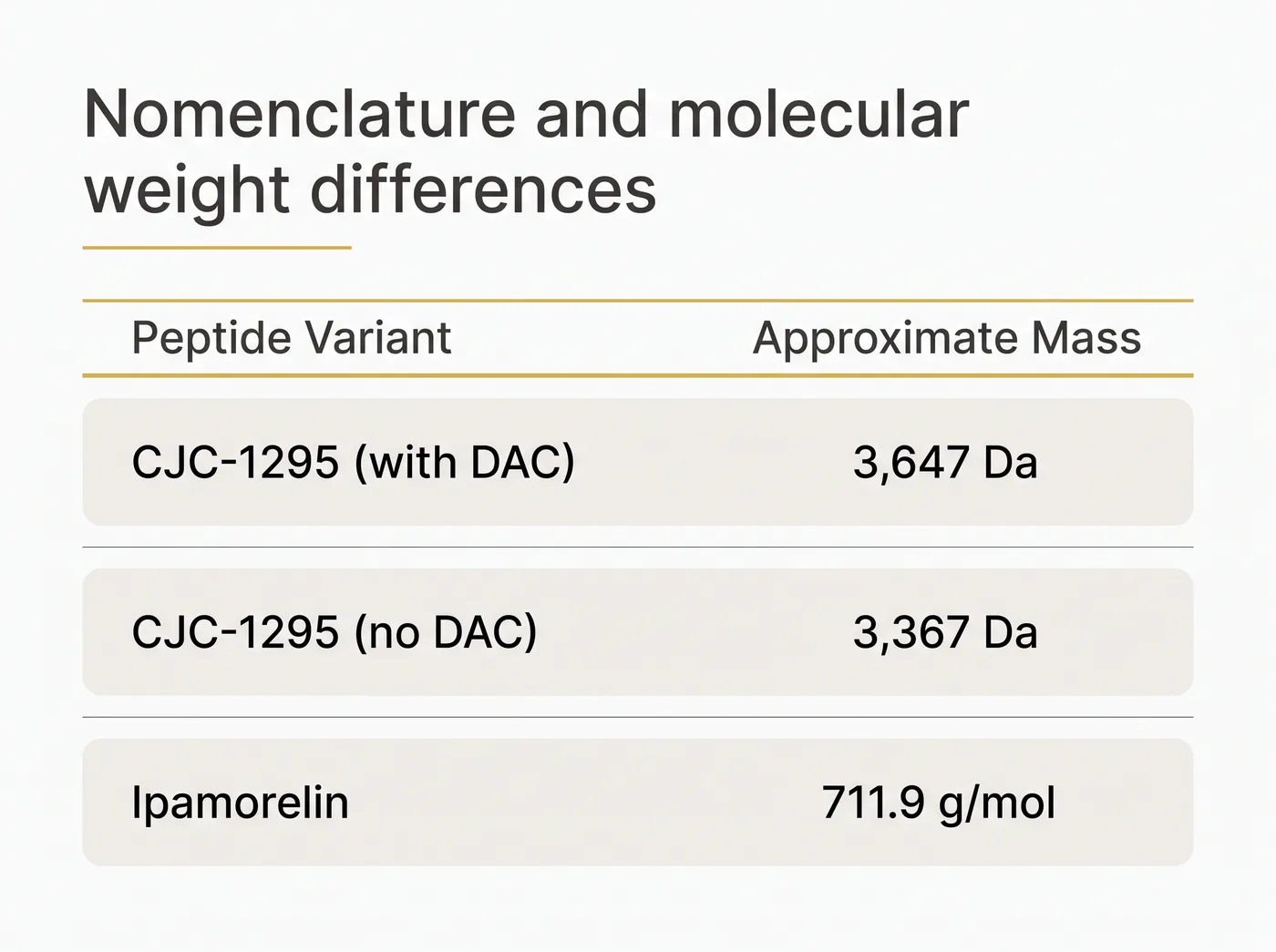
The other half of the vial is where the laboratory supply sector frequently embarrasses itself. In analytical literature, the name CJC-1295 belongs to a specific 30-amino-acid peptide that contains a reactive maleimido group known as DAC. That specific molecule has a molecular weight of approximately 3,647 Da. Yet sellers routinely slap that exact name on a different molecule, known as CJC-1295 (no DAC). That second compound lacks the DAC group entirely. It consists of only 29 amino acids and has a molecular weight of approximately 3,367 Da.
This careless distinction ruins laboratory testing. If an analytical chemist sets up an assay expecting the DAC variant but the sample actually contains the no-DAC variant, the molecular weights will instantly clash. The test fails, money is wasted, and the documentation becomes useless. Proper characterisation means establishing exact specifications for the material actually present. This foundational rule is clearly outlined in the International Council for Harmonisation guidelines for biotechnological products. It is the only way to keep the paperwork honest.
Making them run the chromatography obstacle course
To verify the purity of a mixed vial, an analytical chemist first has to pull the two peptides apart. Reversed-phase high-performance liquid chromatography (RP-HPLC) handles this separation. The analyst dissolves a sample in a liquid mobile phase and introduces it into a steel column packed with a solid stationary phase. Think of the column as an obstacle course where every impurity has to cross the finish line in public.
Because the two peptides have different structures and polarities, they stick to the stationary phase differently. They travel through the column at distinct speeds. An ultraviolet detector waits at the end, typically reading at a wavelength of 214 nm to spot the peptide bonds as they exit. The machine prints a chromatogram showing a separate peak for each peptide. The area of each peak, compared to the total area of all the peaks recorded, gives you the relative purity of that specific component.
| Analytical Feature | What it reveals | What it cannot reveal |
|---|---|---|
| Main peak area | Uniformity and relative purity | Exact molecular structure |
| Minor secondary peaks | Synthetic impurities or degradation | Source of synthesis |
| Retention time | Consistency across batches | Definitive identity without standards |
Why high-resolution scales catch the fakes
Liquid chromatography tells you how uniform a sample is, but it is entirely blind to what the molecules actually are. A beautifully sharp peak on a PDF only proves that the material eluting at that exact second is highly consistent. It could be pure peptide, or it could be pure table salt. To prove chemical identity, the laboratory must drag the sample over to a mass spectrometer.
Mass spectrometry breaks the suspense by measuring the exact mass-to-charge ratio of the ionised molecules in a vacuum. By checking the observed mass against the theoretical monoisotopic mass of the known peptide sequence, the analyst knows immediately if the manufacturer shipped the right powder. For Ipamorelin, the primary ion appears near 712.9 m/z. For the troublesome CJC-1295 variant, high-resolution mass spectrometry immediately reveals the truth. You either see the DAC group clearly present with a mass near 3,647 Da, or you see its absence with a mass near 3,367 Da. There is no hiding from the physics of molecular weight.
Weighing the salt, the water and the actual peptide
The large number printed on a vial label generally refers to the total weight of the lyophilised powder inside the glass. It does not mean you have that exact weight of pure, active peptide sequence. The powder in a freshly opened vial includes bound moisture pulled from the environment and counterions left over from the synthesis process. To find the actual amount of active material, a laboratory runs an amino acid analysis or quantitative elemental nitrogen testing to determine the Net Peptide Content (NPC).
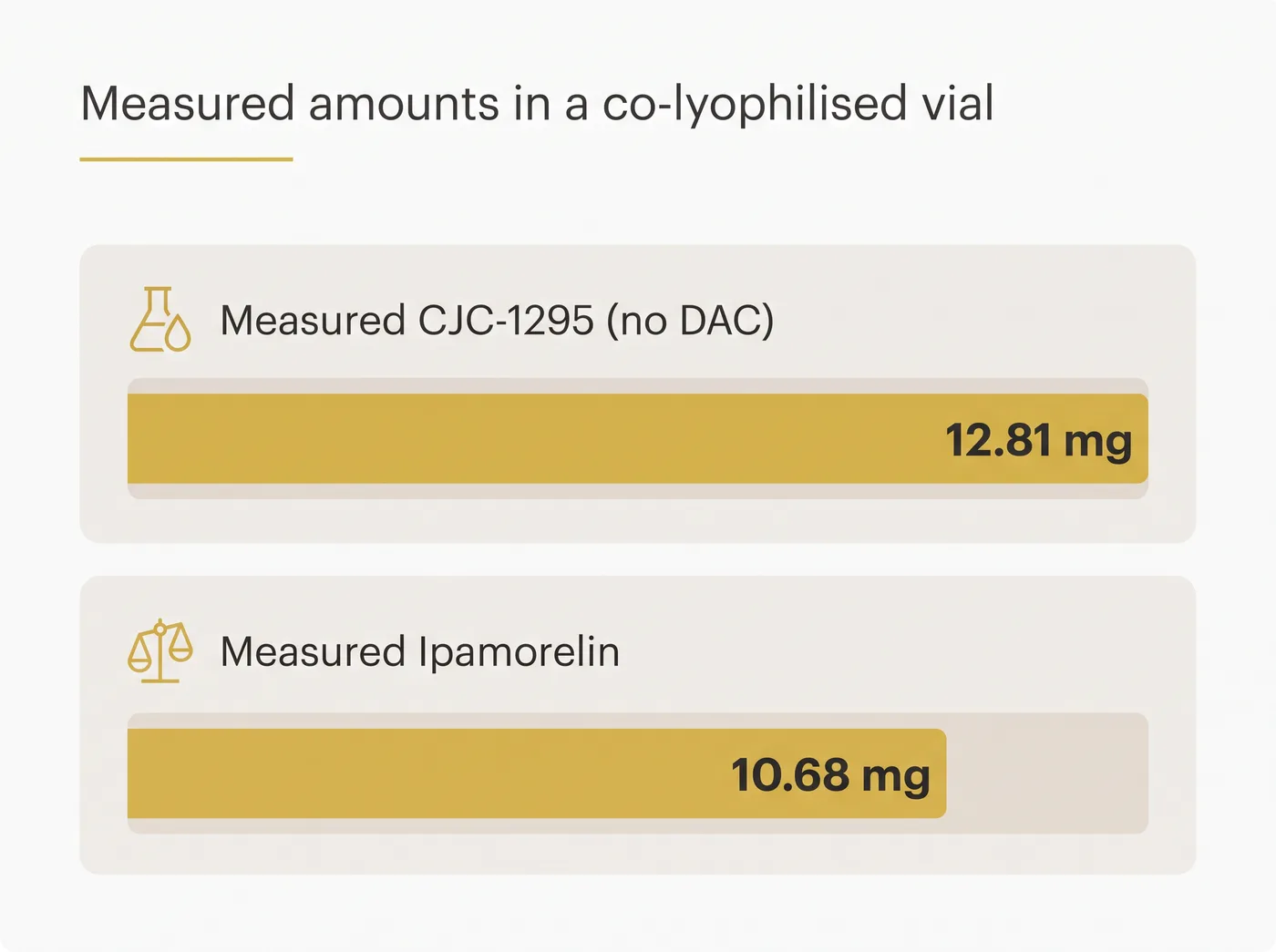
Manufacturing variations happen in every facility on earth, so the measured mass rarely matches the nominal label claim. NuuVive tests its co-lyophilised product to verify the exact mass of each component so researchers know what they are holding. For instance, on Janoshik report #93613, the measured amount for the CJC-1295 (no DAC) component came in at 12.81 mg. The measured amount for the Ipamorelin component was 10.68 mg. Finding these exact measurements on a report assures an analyst that the vial holds the required quantity of starting material for their bench work.
How to read a blend certificate without getting fooled
When you open a certificate of analysis for a blended product, it needs to show individual purity results for both compounds. A combined purity score is a mathematical fiction designed to hide a messy synthesis. A serious report lists a specific lot number, matching the sequence printed on the glass. This is not just good manners. It is a strict regulatory expectation under 21 CFR Part 210 to ensure a complete, unbroken history of the material from synthesis to final testing.
The document must also name the testing laboratory and show that they operate under recognised standards for analytical competence, such as ISO/IEC 17025:2017. When you check the lot number, verify the test methods and match the dates, you can be confident the PDF actually describes the tested material.
If you are tired of vague paperwork and want fully verified materials, you can view the complete specifications, latest lot numbers and independent test reports demonstrating ≥99% purity based on the lowest component (CJC-1295 (no DAC) 99.314%, Janoshik #215319; Ipamorelin 99.730%, Janoshik #86679) on the CJC-1295 + Ipamorelin product page.
Questions
Why are these two peptides combined in one vial?
Co-lyophilising two synthetic peptides into a single vial simplifies laboratory storage and sample handling. Researchers can process a single uniform cake rather than weighing and preparing two separate materials for analytical runs. It cuts down on the physical steps required before sample introduction.
Does the freeze-drying process change the peptides?
No. The lyophilisation step removes the solvent to create a stable solid under vacuum, but it does not cause the two peptides to bond or react with one another. They remain physically mixed but chemically distinct.
How can a laboratory confirm if a vial has the DAC or no-DAC version?
The only definitive way to confirm which version is present is by looking at a mass spectrometry report. The exact mass-to-charge ratio cleanly differentiates the 3,367 Da no-DAC variant from the 3,647 Da DAC variant. An ultraviolet detector alone cannot make this distinction.
What does a purity of ≥99% mean for a blend?
When a blend claims a specific minimum purity, that figure typically reflects the lowest measured purity of its individual components. If liquid chromatography shows one peptide at 99.7% and the other at 99.3%, the overall specification is supported at ≥99%.