
Reading lab reports
What is in a KLOW vial?
NuuVive Journal · · 7 min read · Updated

Short answer
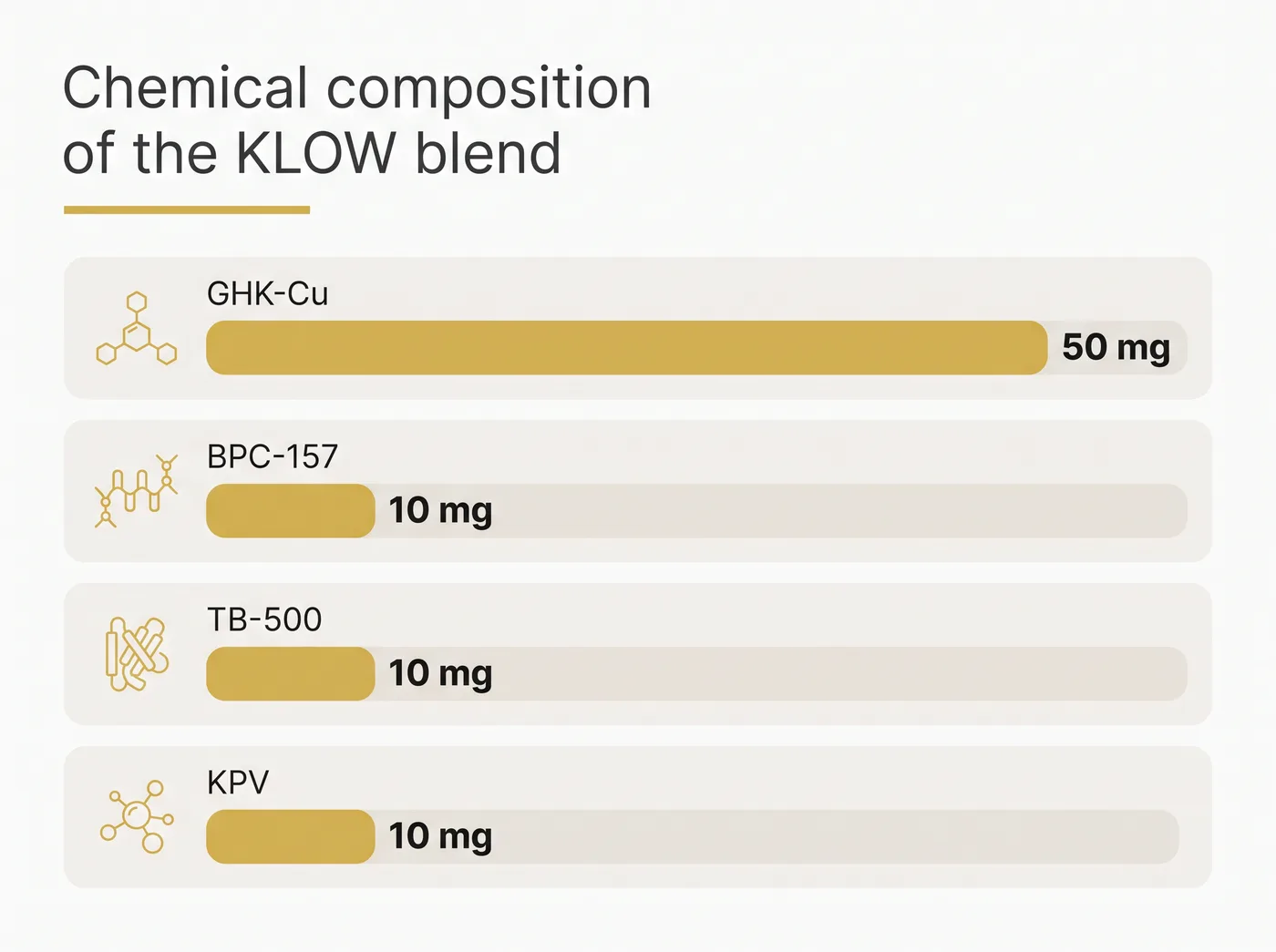
A KLOW vial contains 80 milligrams of total synthetic peptide material. The blend consists of 50 milligrams of GHK-Cu, 10 milligrams of BPC-157, 10 milligrams of TB-500, and 10 milligrams of KPV. Each component must be resolved and identified individually on a certificate of analysis. Laboratory reports use reversed-phase chromatography to establish the purity of the four distinct peaks, and mass spectrometry to confirm the theoretical mass of each linear chain.
Key takeaways
- The vial holds 80 milligrams of total material, split between four specific synthetic peptide sequences.
- GHK-Cu provides the distinct blue colour because of how the chelated copper ion absorbs light.
- Mass spectrometry must be calibrated to detect both the heavy 15-amino acid chains and the light 3-amino acid sequences simultaneously.
- Chromatography separates the four peptides to measure individual purity independently of the others.
- Proper traceability requires a lot number matching the vial to a specific laboratory certificate.
The chemical makeup of the blend
When four different chemical chains share the same glass space, laboratory analysis turns into a juggling act. You are no longer just looking for one clean signal, but four distinct targets overlapping in a freeze-dried solid. The KLOW product page outlines a formulation totalling 80 milligrams of material. By weight, the dominant component is the copper-peptide complex, accounting for 62.5 percent of the total mass. The remaining mass is distributed equally among three other linear peptides.
Each component possesses a defined sequence, molecular formula, and theoretical molecular weight. None of the four peptides in the blend contain cysteine residues, meaning the solid lacks disulfide bridges. The components are assembled via standard solid-phase peptide synthesis and subsequently co-lyophilised into a single matrix. A competent certificate of analysis must characterise the physiochemical properties of all four targets simultaneously without them obscuring one another.
| Component | Sequence length | Molecular weight | Specified mass |
|---|---|---|---|
| GHK-Cu | 3 residues (chelate) | 403.9 g/mol | 50 mg |
| BPC-157 | 15 residues | 1419.55 g/mol | 10 mg |
| TB-500 | 7 residues | 889.0 g/mol | 10 mg |
| KPV | 3 residues | 342.43 g/mol | 10 mg |
That unmistakable blue tint
The lyophilised powder exhibits a distinct blue colour that usually catches the eye first. This hue is a primary structural property of the GHK-Cu coordination complex rather than a clever manufacturing trick or an added dye. The tripeptide sequence glycyl-L-histidyl-L-lysine chelates a single copper(II) ion tightly. The geometry of this specific binding arrangement causes the molecule to absorb light in the red-orange spectrum, which naturally reflects visual light back to you in the blue range.
The intensity of the colour correlates directly with the concentration of the chelate within the matrix. Because GHK-Cu constitutes the clear majority of the material in a KLOW vial, the blue tint permeates the entire freeze-dried solid. The other three components, BPC-157, TB-500, and KPV, are entirely colourless in their purified, unchelated forms. Consequently, any casual measurement of colour intensity serves as a visual indicator of the copper complex.
Weighing the chains via mass spectrometry
Testing laboratories confirm the identity of the four components using mass spectrometry, which essentially functions as a highly precise molecular scale. Electrospray ionisation mass spectrometry measures the mass-to-charge ratio of the intact parent ions floating in the vacuum. A standard laboratory report prints four distinct spectral signals corresponding to the exact theoretical masses of GHK-Cu, BPC-157, TB-500, and KPV. The technical guidelines for analytical procedures detailed in ICH Q2(R2) require laboratories to demonstrate the specificity of their methods to ensure accurate identification.
Intact mass analysis confirms that the molecular weight of the synthesised chains matches the theoretical design. However, an intact mass reading does not inherently confirm the correct sequence order, as isomers or sequence-scrambled truncated impurities can share identical masses. Advanced characterisation may require specific mass spectrometry fragmentation techniques to verify the amino acid sequence structure.
The sheer complexity of the co-lyophilised blend demands very specific ionisation parameters. The mass spectrometer must selectively ionise the heavy 15-amino acid chain of BPC-157 without missing the much lighter 3-amino acid chain of KPV hiding in the background. The laboratory must state the chosen ionisation mode directly on the certificate of analysis to allow external review of the testing parameters.
Purity and the chromatographic race
Reversed-phase high-performance liquid chromatography separates the components of the KLOW vial based purely on their hydrophobicity. The sample introduction deposits the dissolved material onto a stationary phase column, while a gradient mobile phase elutes the peptides at varying retention times. Think of it as an obstacle course where every molecule runs at a different speed. The resulting chromatogram must demonstrate clear resolution between the four primary peaks and any synthesis-related impurities trailing behind.
The Pharmacopeial Discussion Group harmonised chapter on chromatography sets clear system suitability parameters for resolution, peak tailing, and column plate number. If the four peptides happen to co-elute simultaneously, the integration software simply cannot accurately measure the area under the curve for each specific target. An analytical report prints the retention time and the percentage of total peak area assigned to GHK-Cu, BPC-157, TB-500, and KPV entirely independently.
Chromatographic purity limits evaluate the presence of truncated sequences, incomplete deprotection byproducts, and unexpected epimers. Standard specification parameters for complex peptide blends typically require each analyte to register independent purity metrics, separate from the other constituents. The method parameters, including the column type, wavelength, and run time, must be published alongside the results to provide context for the measurement.
The invisible weight of salts
Chromatography has a blind spot: it measures only ultraviolet-absorbing species. It does not measure non-ultraviolet impurities such as residual trifluoroacetic acid salts or atmospheric moisture clinging to the powder. Synthetic peptides naturally possess basic sites along their carbon backbones. The lysine and histidine side chains in GHK-Cu, alongside the lysine residues in BPC-157 and KPV, eagerly bind counter-ions during the final purification phases of solid-phase synthesis.
A remarkably common analytical misinterpretation conflates chromatographic purity with net peptide content. A KLOW vial may return a chromatography result showing brilliant baseline separation and minimal structural impurities, yet possess a net peptide content hovering below 85 percent by weight. The remaining invisible mass consists entirely of the associated counter-ions and water bound tightly to the hydrophilic peptide chains.
To determine the actual mass of the active peptide sequences, laboratories employ orthogonal techniques. Quantitative amino acid analysis or elemental nitrogen analysis measures the fundamental building blocks of the peptide chain, independent of the frustrating salt fraction. Moisture content is typically profiled via Karl Fischer titration. These metrics ensure that the 80 milligrams of total material correspond closely to the specified mass of the synthetic sequences.
Tying the paperwork to the vial
A laboratory report floating around the internet is meaningless unless it maps its results to a specific batch of material. Regulatory definitions outlined in 21 CFR Part 210 require a distinctive combination of letters, numbers, or symbols from which the complete history of manufacture can be easily determined. A certificate of analysis lacking a matching lot number provides no traceability to the KLOW vial held in a laboratory.
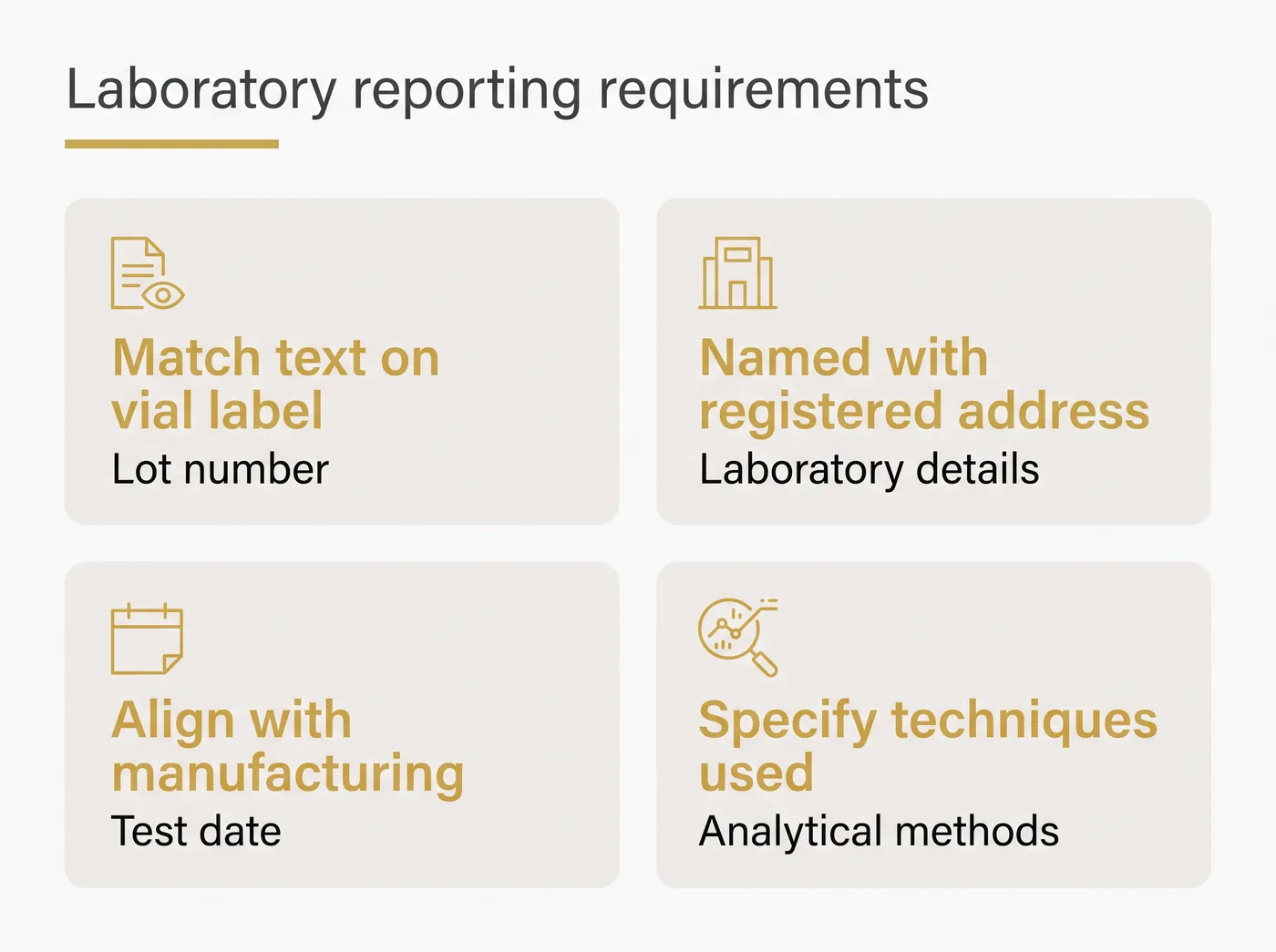
- Lot number: Must match the text printed on the vial label.
- Laboratory details: The testing facility must be named clearly with a registered physical address.
- Test date: Must align logically with the manufacturing timeframe of the lot.
- Analytical methods: Must specify the distinct techniques used to measure mass and purity.
Competent analytical execution relies on standardised frameworks. The requirements for measurement uncertainty, method validation, and metrological traceability are established securely by ISO/IEC 17025:2017. Reports issued by laboratories lacking adherence to these structural testing requirements simply cannot confirm that the four components of the KLOW blend are measured accurately without chemical interference.
Cold storage for the solid matrix
Peptide molecules are inherently vulnerable to hydrolysis and oxidation in the presence of ambient moisture and heat. Distributing the KLOW blend as a lyophilised powder curtails these degradation reactions by removing the aqueous environment necessary for hydrolysis. The solid phase preserves the structural integrity of the amino acid chains over extended laboratory periods.
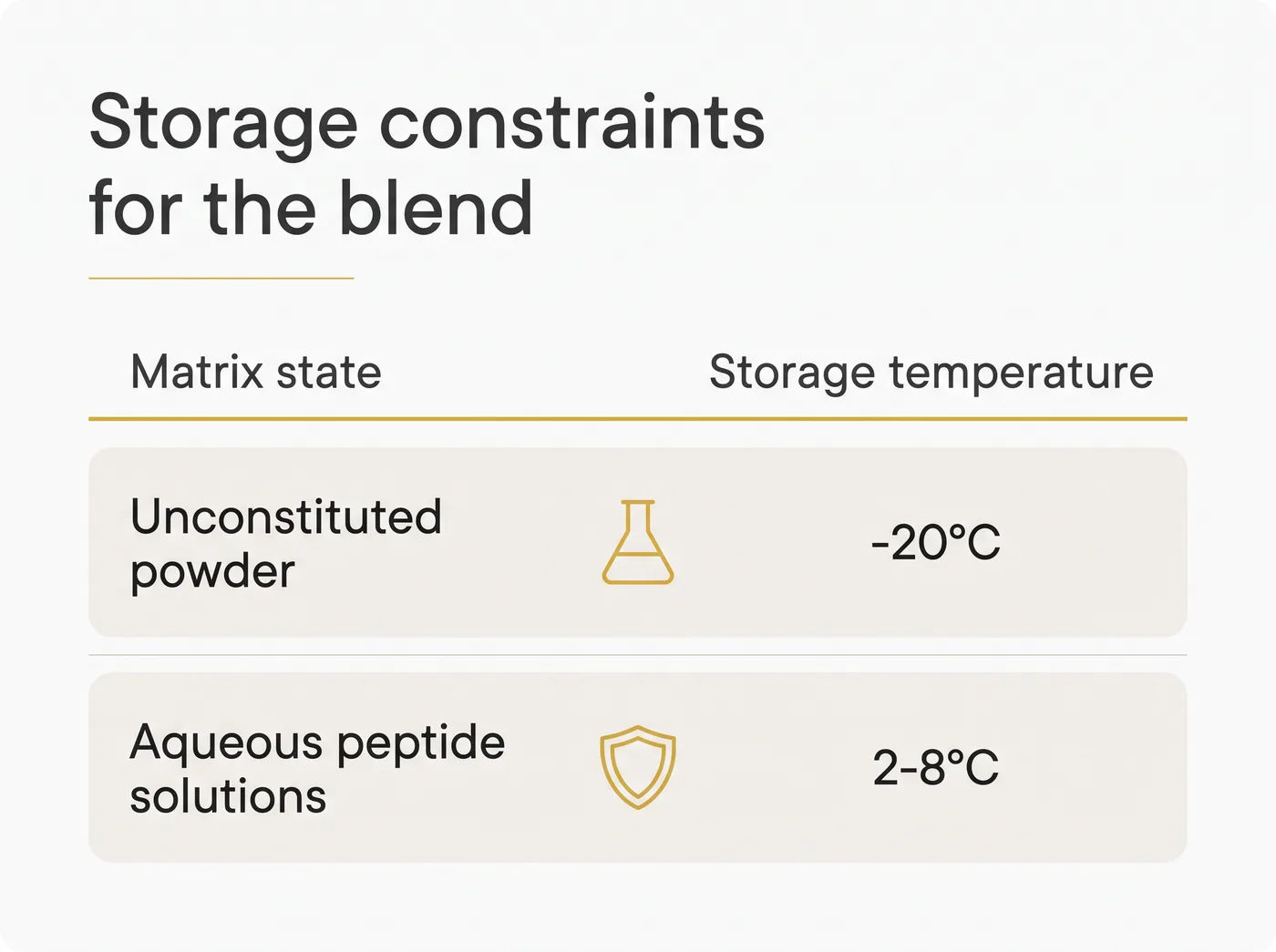
The unconstituted powder demands rigorous thermal control to prevent premature molecular breakdown. Standard storage parameters require the sealed vial to remain at -20°C until the laboratory is actually ready to draw a sample. Wild fluctuations in temperature can introduce condensation within the vial if the seal is compromised, leading to rapid degradation of the BPC-157 and TB-500 components.
Once a solvent is introduced to the solid matrix, the chains immediately resume standard chemical kinetics. Aqueous peptide solutions must be stored at 2-8°C and handled within strict timeframes to preserve the structural composition defined on the original certificate of analysis. Prolonged exposure to ambient conditions inevitably alters the mass profile of the mixture. To verify the analytical history of a specific lot, always consult the lab reports.
Questions
Why does the KLOW powder have a blue colour?
The blue colour originates directly from the GHK-Cu component in the mixture. The binding geometry between the glycyl-L-histidyl-L-lysine chain and the copper ion causes the molecule to absorb red-orange light, naturally reflecting blue. It is an inherent structural property of the chelate, not an added dye.
Can mass spectrometry verify the purity of the four peptides?
Mass spectrometry accurately verifies the exact molecular weight and identity of the parent ions, but it does not quantify purity percentages. Reversed-phase chromatography is definitively required to resolve and measure the relative abundance of any synthesis-related impurities.
Does a high purity result mean the vial contains no salts?
No, it certainly does not. Chromatographic purity only measures species that actively absorb ultraviolet light during the test. It misses non-ultraviolet impurities like trifluoroacetic acid salts or residual moisture, which are undeniably present in all synthesised peptides.
How is the KLOW solid stored prior to analysis?
The unconstituted lyophilised powder must be stored at -20°C. Maintaining this exceptionally low temperature preserves the structural integrity of the linear sequences by halting hydrolysis and severely restricting oxidative degradation over time.
Sources
- ICH Q2(R2): Validation of analytical procedures. ICH
- ISO/IEC 17025:2017 General requirements for the competence of testing and calibration laboratories. ISO
- 21 CFR Part 210: Current good manufacturing practice, general. eCFR
- Pharmacopeial Discussion Group: harmonised general chapter on chromatography. USP