
Reading lab reports
What is in a Wolverine (BPC-157 + TB-500) vial?
NuuVive Journal · · 7 min read · Updated

Short answer
A Wolverine vial contains a lyophilised blend of two distinct synthetic peptides: BPC-157 and TB-500. NuuVive's Wolverine supplies 5 mg of BPC-157 and 5 mg of full-length TB-500 in a single vial, yielding a total active peptide mass of 10 mg. Because it is a solid mixture, a valid laboratory report must employ high-resolution mass spectrometry and liquid chromatography to independently confirm the molecular weight and purity of both sequences without signal overlap.
Key takeaways
- Wolverine is a specific blend containing 5 milligrams of BPC-157 and 5 milligrams of TB-500 in a single vial.
- Laboratory analysis must demonstrate separate mass and purity verifications for both molecules.
- BPC-157 is a 15-amino-acid sequence with a target mass near 1418.70 Da.
- NuuVive's TB-500 uses the full-length 43-amino-acid sequence, requiring a target mass of approximately 4963 Da.
Why putting two peptides in one vial doubles the homework
Mixing two complex molecules into a single glass vial is a bit like dumping two different jigsaw puzzles into the same box. Wolverine is a pre-mixed, solid combination of two synthetic peptides, manufactured via solid-phase peptide synthesis. The laboratory builds these raw materials amino acid by amino acid, requiring repeated steps of coupling and deprotection. Every time a new link joins the chain, a minor side reaction can happen.
When a facility combines two separate sequences into one lyophilised powder, the analytical burden instantly doubles. A valid certificate of analysis must account for the unique impurity profiles of both synthesis chains at once. Solid-phase synthesis occasionally leaves behind amino acid deletions, incomplete deprotection fragments or unwanted condensation products. When an analyst receives this solid, they cannot simply run a standard single-molecule method, because the background noise of one peptide can easily obscure the faint signals of the other.
Once synthesised and purified, the facility combines the two sequences in equal mass ratios and subjects them to a freeze-drying step. The result is a stable solid. Evaluating this final material means an analyst has to establish the chemical identity and chromatographic purity of each component while the other one is sitting right there in the sample matrix. If a laboratory cuts corners on the separation methods, the entire report becomes a work of fiction.
The structural math behind BPC-157
The first component of this mixture is BPC-157 (CAS 137525-51-0). This molecule is a linear pentadecapeptide, meaning it consists of 15 amino acids strung together in the sequence GEPPPGKPADDAGLV. It features free N-termini and C-termini, making it structurally straightforward to map. Analytical characterisation of any synthetic peptide relies on its mass, and the free base form of this sequence possesses a molecular formula of C62H98N16O22. That translates to an average molecular weight of roughly 1419.54 g/mol, alongside a calculated neutral monoisotopic mass of 1418.7042 Da.
Structurally, this specific chain contains no cysteine or methionine residues. That is a fortunate detail for the person running the laboratory tests. The absolute absence of sulfur in the molecule means it is not susceptible to typical methionine oxidation or disulfide scrambling. This narrows the expected degradation patterns an analyst has to look for when running stability testing on the solid, leaving less room for analytical ambiguity.
Getting the full sequence for TB-500
The second component is TB-500, a name that suffers from a persistent identity crisis in the open market. In synthetic peptide analysis, this label sometimes refers to an abbreviated 7-amino-acid fragment that barely resembles the parent structure. NuuVive's Wolverine bypasses the confusion by containing full-length synthetic TB-500 (CAS 77591-33-4). This is a 43-residue linear peptide equipped with an acetylated N-terminus. Because it is substantially larger, this full-length sequence has a molecular formula of C212H350N56O78S and a hefty molecular weight of approximately 4963.44 g/mol.
Unlike its smaller vial companion, this large molecule contains a single sulfur atom. That atom comes from a methionine residue sitting conspicuously at position 6 in the sequence. The presence of methionine introduces a highly specific vulnerability to oxidation. Any liquid chromatography method used to evaluate this solid must be calibrated to detect and cleanly separate that specific oxidized impurity from the main peak.
Weighing the molecules with mass spectrometry
Identity testing of a solid mixture is not a guessing game. It relies on high-resolution mass spectrometry acting as a highly precise set of molecular scales. Establishing standard quality attributes for complex molecules follows formal frameworks, such as the ICH Q6B: Specifications for biotechnological/biological products guideline, which outlines expectations for physicochemical characterisation. For a blend, an intact-mass analysis must independently confirm both primary masses without the signals overlapping and masking a defect.
The laboratory instrument needs to detect a distinct monoisotopic mass near 1418.70 Da for BPC-157, alongside a separate, prominent mass of approximately 4963 Da for the full-length TB-500. Intact-mass results that are consistent with the calculated formula provide hard evidence of the molecular composition. They also elegantly reveal synthesis errors like missing residues, even though mapping the sequence of the peptide chains from start to finish would require tandem mass spectrometry.
Running the chromatographic race
Once a laboratory confirms identity, it assesses the purity of the sample using reversed-phase high-performance liquid chromatography. Think of this process as a foot race where every molecule has to cross a detector line in public. Purity testing requires the analytical method to separate the two primary molecules from each other, and from any manufacturing impurities trailing behind. Because BPC-157 and TB-500 possess different masses, polarities and isoelectric points, they interact differently with the stationary phase of the chromatography column. This ensures they elute, or cross the finish line, at distinctly different times.
The ICH Q2(R2): Validation of analytical procedures guideline defines this capability as specificity or selectivity. It is the ability to unequivocally assess the analyte in the presence of expected components. System suitability parameters, such as peak resolution and symmetry, have to meet the standards defined by the Pharmacopeial Discussion Group: harmonised general chapter on chromatography to prove the method is actually fit for purpose.
A highly common analytical trap is confusing high chromatographic purity with absolute chemical identity. An HPLC trace showing a clean, sharp peak merely indicates that the UV-absorbing material forms a single band under those specific solvent conditions. Without accompanying mass spectra, the chromatogram is just drawing pretty lines, totally incapable of identifying the molecule. A trustworthy laboratory demonstrates that the UV detectors capture a clear, flat baseline between the BPC-157 peak and the TB-500 peak. That flat line ensures no smaller impurity bands are hiding comfortably beneath the primary signals.
How to read a blend's certificate of analysis
Reading a certificate of analysis for a mixed vial means demanding distinct test results for each active ingredient. A reliable report leads with a clearly defined lot number that traces the history of manufacture, following definitions established in 21 CFR Part 210: Current good manufacturing practice, general. NuuVive's Wolverine provides a pre-mixed, single vial containing a measured target of 5 mg of BPC-157 and 5 mg of TB-500.
Standard laboratory reports quantify the relative purity of the peptide peaks, but they often conveniently omit the mass of the counter-ions. Synthetic peptides require salts like acetate or trifluoroacetate to remain stable as a solid, along with residual hydration water. Because these necessary components form part of the solid matrix, the actual active peptide content by weight will always be slightly less than the total weight of the freeze-dried powder inside the vial. Testing quantifies the active sequence mass present, ensuring the solid actually meets the label claim rather than just filling space.
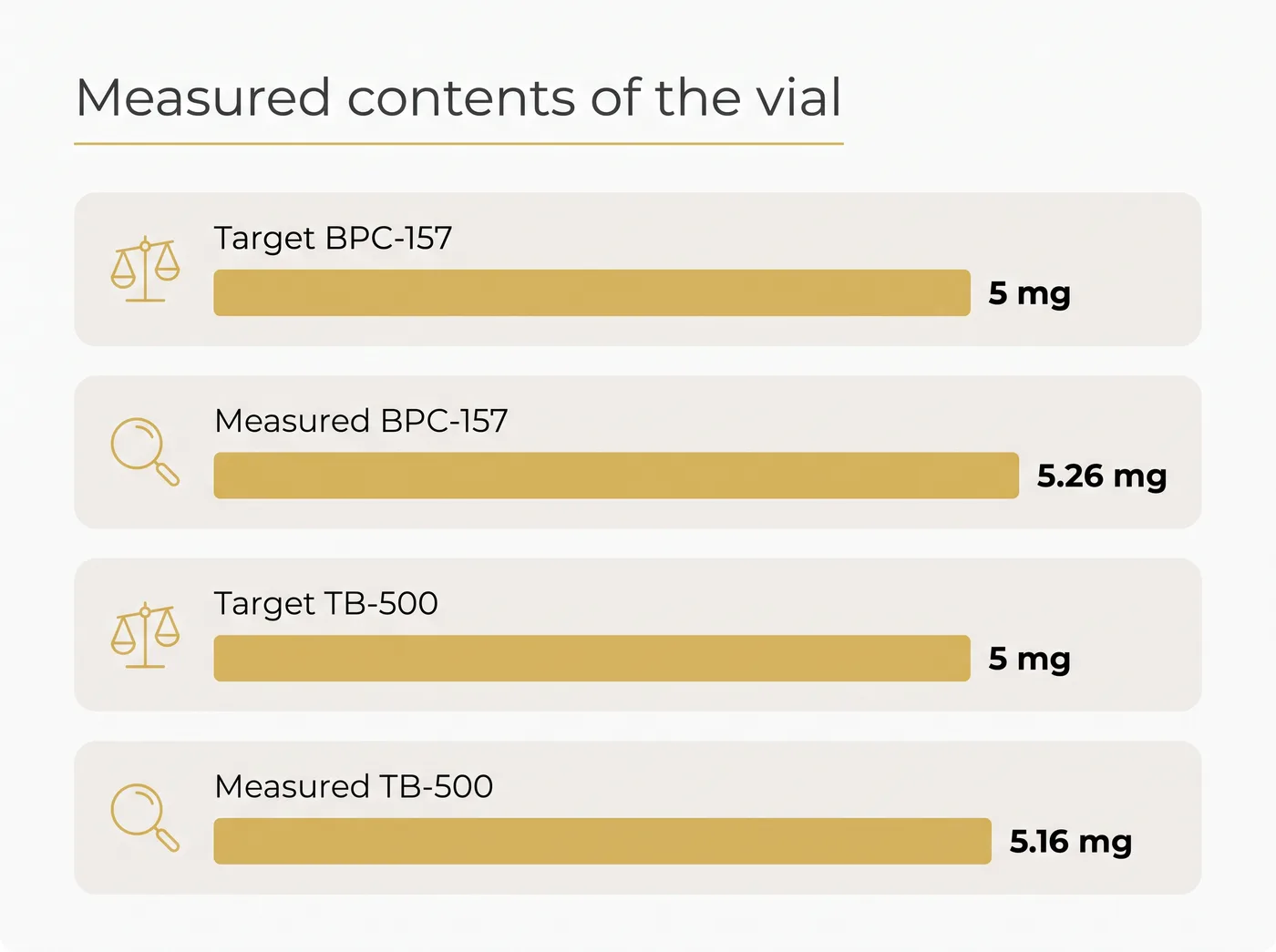
The specification requires ≥97% purity, based on the lowest of its components. For this specific material, the measured purity figures are 99.815% for BPC-157 (Janoshik report #215322) and 97.489% for TB-500 (Janoshik report #215317). Interlaboratory comparison and quantitative amino acid analysis determine the net peptide content. The measured amounts for this lot are 5.26 mg of BPC-157 and 5.16 mg of TB-500 (Janoshik report #85185). You can view the full documentation, including the independent lab reports, on the Wolverine (BPC-157 + TB-500) product page.
Questions
Why do BPC-157 and TB-500 require distinct mass targets on a certificate?
They are entirely distinct molecules with radically different molecular weights. BPC-157 is a 15-amino-acid sequence, while full-length TB-500 contains 43 amino acids. A single test cannot map both structures simultaneously unless the mass spectrometry equipment captures distinct, non-overlapping signals for each one.
How does a laboratory separate the two peptides for analysis?
Analysts run the sample through reversed-phase high-performance liquid chromatography. Because BPC-157 and TB-500 possess distinct polarities, sizes and isoelectric points, they interact differently with the chromatography column. This forces them to elute at separate retention times, creating two distinct peaks on the readout.
What does the total mass of 10 mg refer to in a Wolverine vial?
The 10 milligrams refers exclusively to the combined target mass of the active peptide sequences, being 5 mg of BPC-157 and 5 mg of TB-500. The total weight of the solid inside the vial is always higher, because it includes necessary counter-ions like acetate or trifluoroacetate and residual hydration water.
Why does NuuVive list two separate purity figures for one vial?
A mixed sample contains two separate active ingredients, meaning a single aggregate purity figure is analytically useless. A rigorous laboratory report characterises the purity of each component independently against its specific reference standard, establishing a baseline specification from the lower of the two figures.