
Compounds explained
What is MT-2 (Melanotan II)? What it has been studied for
NuuVive Journal · · 5 min read

Short answer
MT-2 (Melanotan II) is a synthetic cyclic heptapeptide originally developed in the 1980s as an analogue of alpha-MSH. It acts as a non-selective melanocortin receptor agonist. The compound has been studied in animal models and small human trials for skin pigmentation and sexual arousal, and is currently being investigated in a phase 2 trial for vitiligo. It is not an approved drug.
Key takeaways
- MT-2 is a synthetic seven-amino-acid peptide that binds to multiple melanocortin receptors.
- It has been studied in small human trials for skin pigmentation and sexual arousal, and in animal models for appetite regulation.
- There is no large-scale human evidence for the compound, and it remains an unapproved substance.
- Since late 2026, it falls under a specific HHS enforcement discretion policy for pharmacy compounding.
- A credible lab report for MT-2 will show a purity of 99 percent or higher alongside a measured mass.
The origins and structure of MT-2
Look up MT-2 online and you will find a bizarre split screen. On one side, a loud chorus of forum posts making wild promises. On the other, a quiet trail of chemistry papers dating back to the 1980s. The chemistry papers are the ones telling the truth.
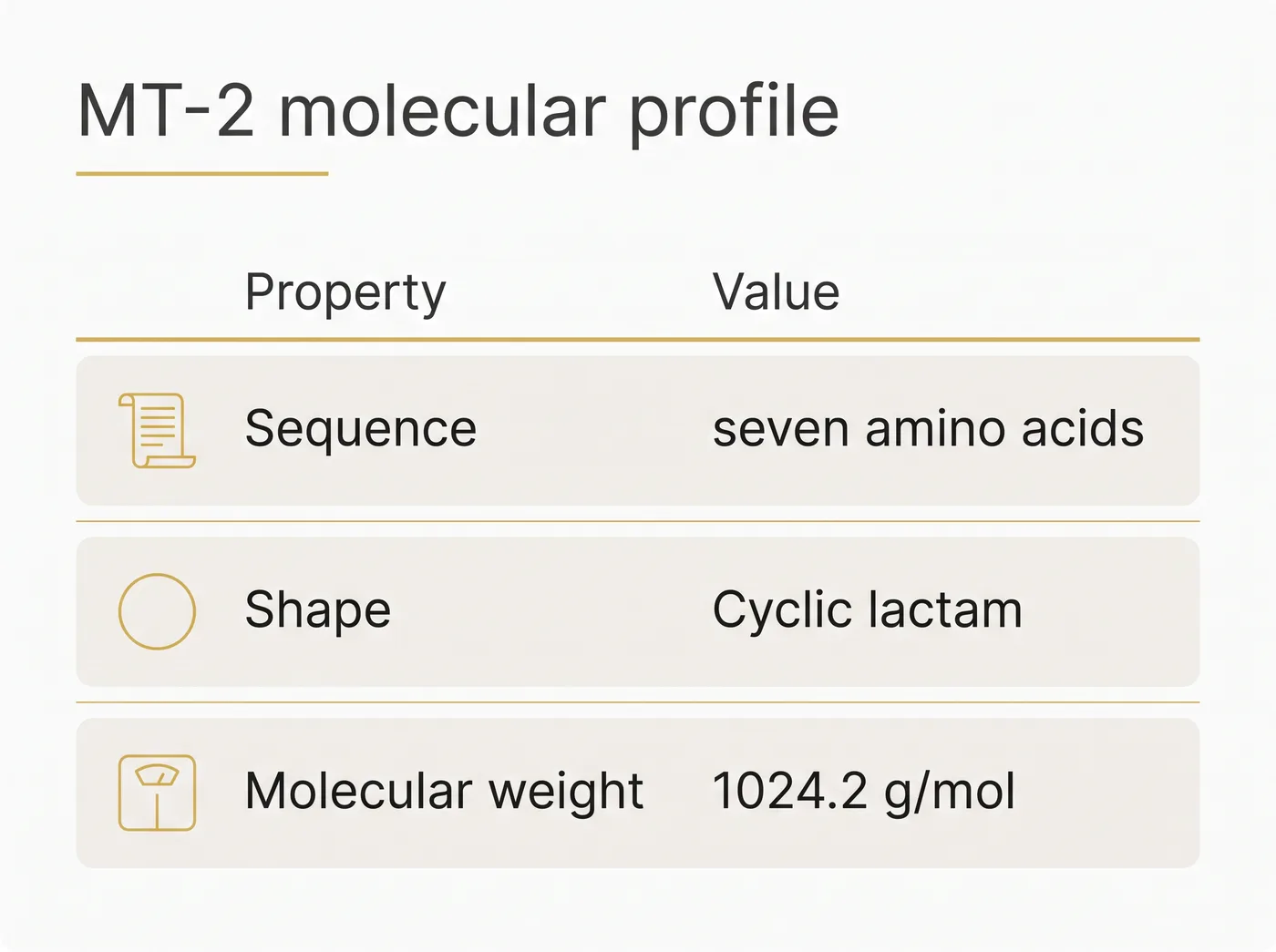
MT-2, or Melanotan II, is a synthetic cyclic heptapeptide. In structural terms, it is a ring-shaped chain of exactly seven amino acids with a molecular weight of 1024.2 g/mol National Library of Medicine. Researchers at the University of Arizona first synthesized it while looking for stable analogues of alpha-MSH, a naturally occurring peptide.
The defining structural feature of MT-2 is its shape. The sequence is closed by a lactam bridge between specific side chains. This bridge locks the molecule into a rigid conformation. In peptide chemistry, cyclization is often used to prevent enzymes from rapidly degrading a compound.
However, this rigid cyclic structure has a secondary effect: it makes MT-2 a non-selective melanocortin receptor agonist. Instead of binding to a single target, it binds broadly to the MC1, MC3, MC4, and MC5 receptors. That lack of selectivity explains the wide variety of research models the compound has appeared in.
The melanocortin receptor system
To understand why MT-2 has been studied in such wildly different models, you have to look at the receptors it targets. The melanocortin system is a network of receptors that handle everything from pigmentation to energy balance.
The MC1 receptor is found primarily on melanocytes, the cells responsible for pigmentation. When an agonist binds to MC1, it signals the cell to produce melanin. This pathway is the focus of the current vitiligo trials.
The MC3 and MC4 receptors are located largely in the central nervous system. In animal models, researchers study these pathways to understand energy homeostasis, feeding behaviour, and sexual arousal.
Finally, the MC5 receptor is expressed in various exocrine glands. Because MT-2 is a non-selective agonist, putting it into a biological model is like throwing a master switch that turns on all these pathways at once. That broad activation is useful for initial discovery, but it is precisely why pharmaceutical companies eventually moved toward highly selective analogues.
What MT-2 has been studied for
Because it binds to four different melanocortin receptors, MT-2 has been investigated across several distinct, and sometimes surprising, research areas.
- Skin pigmentation: The earliest research focused on the MC1 receptor, which governs melanogenesis. A pilot phase 1 study in 1996 evaluated the compound in three human males. After a long quiet period, it recently entered a phase 2 clinical trial investigating its use alongside narrow-band UV-B phototherapy for repigmentation in adults with stable nonsegmental vitiligo clinicaltrials.gov.
- Sexual arousal: Following investigation of non-selective binding to the MC4 receptor in animal models of arousal, researchers pivoted. Small phase 2 crossover trials in the late 1990s and 2000 evaluated MT-2 in men with erectile dysfunction and subjects with altered sexual desire National Library of Medicine. This specific research path was eventually abandoned by drug developers in favour of a different, separate derivative.
- Appetite and energy: The compound has been studied extensively in animal and cell models exploring energy homeostasis, weight, and appetite regulation. This research primarily tracks how the molecule interacts with the MC3 and MC4 receptor pathways in the central nervous system.
The difference between MT-2 and PT-141
The early human trials for arousal yielded an interesting data point for researchers, but MT-2 was deemed too non-selective for focused development. This led chemists back to the drawing board to modify the structure.
The result was Bremelanotide, widely known in research contexts as PT-141. PT-141 was developed as a distinct, separate drug derivative from early MT-2 research, intended to be a more targeted compound for the pathways involved in arousal.
In pharmaceutical development, selectivity is everything. PT-141 was subsequently pursued as a separate targeted compound, while MT-2 remained behind in the laboratory as an experimental chemical.
The 2026 compounding rules and legal status
MT-2 is not an FDA-approved drug. It is an unapproved, unregulated substance in the general market, and the FDA has previously issued warning letters and import alerts regarding gray-market unapproved products containing the compound.
However, the regulatory status shifted slightly in late October 2026. MT-2 is now covered by a specific HHS interim enforcement discretion policy regarding Section 503A compounding Federal Register.
Under this framework, the FDA does not intend to pursue enforcement action against state-licensed pharmacies, federal facilities, or licensed physicians who compound patient-specific medications using MT-2 bulk drug substances, provided strict conditions are met.
This policy grants conditional access while the agency formally reviews the compound for the official 503A bulks list, but it does not equate to FDA approval. Compounders operating under this policy must use an FDA-registered manufacturer and verify a valid certificate of analysis.
Reading an MT-2 lab report
If you are sourcing MT-2 for laboratory research, the vendor's documentation is the only thing standing between your budget and a vial of mystery powder. A lot number is the vial's passport. If the test report does not list the exact batch number printed on the vial, the document belongs to a different batch.
Analytical chemists use High-Performance Liquid Chromatography to verify purity. A chromatogram is a race where every impurity has to cross the finish line in public. Look for a single, sharp peak demonstrating a purity of at least 99 percent.
Purity alone is not enough; the report must also state the measured mass, confirming the vial actually contains the stated amount rather than other substances.
Transparency means making these figures public and verifiable. For example, independent testing by Janoshik (report #85194) confirms 99.659% purity and 10.34 mg of measured compound for NuuVive's MT-2 (Melanotan II).
Questions
Is MT-2 FDA approved?
No. MT-2 is not approved by the FDA for any medical or cosmetic use. While it is covered by a 2026 HHS enforcement discretion policy for specific pharmacy compounding, it remains an unapproved substance.
What is the molecular weight of Melanotan II?
The molecular weight of MT-2 is 1024.2 g/mol. This is relatively small owing to its condensed seven-amino-acid cyclic structure.
How does MT-2 differ from PT-141?
PT-141 (Bremelanotide) is a distinct drug derivative developed from early MT-2 research to target arousal pathways more specifically. PT-141 was pursued as a targeted compound, while MT-2 remained an unapproved experimental substance.
What should I look for on an MT-2 certificate of analysis?
You should look for an exact lot number match, a high-resolution chromatogram showing a purity of 99 percent or greater, and a measured mass confirming the net peptide content in the vial.
Sources
- pubchem.ncbi.nlm.nih.gov. National Library of Medicine
- ClinicalTrials.gov. clinicaltrials.gov
- Federal Register :: Enforcement Discretion Policy Regarding 503A Compounding Using Certain Peptide Bulk Drug Substances. Federal Register
- pubmed.ncbi.nlm.nih.gov. National Library of Medicine