
Policy and economics
Who pays for peptide research? Money, lobbying and the research gap
NuuVive Journal · · 10 min read · Updated

Short answer
In the United States, large late-stage trials are almost exclusively funded by companies expecting to sell a patented product. Public funders like the NIH focus on basic science, meaning compounds nobody owns rarely get large trials. The pharmaceutical industry also spends more on federal lobbying than any other sector. As a result, unowned research compounds sit in a gap where no one has a financial incentive to fund their approval, leaving quality verification entirely up to the buyer.
Key takeaways
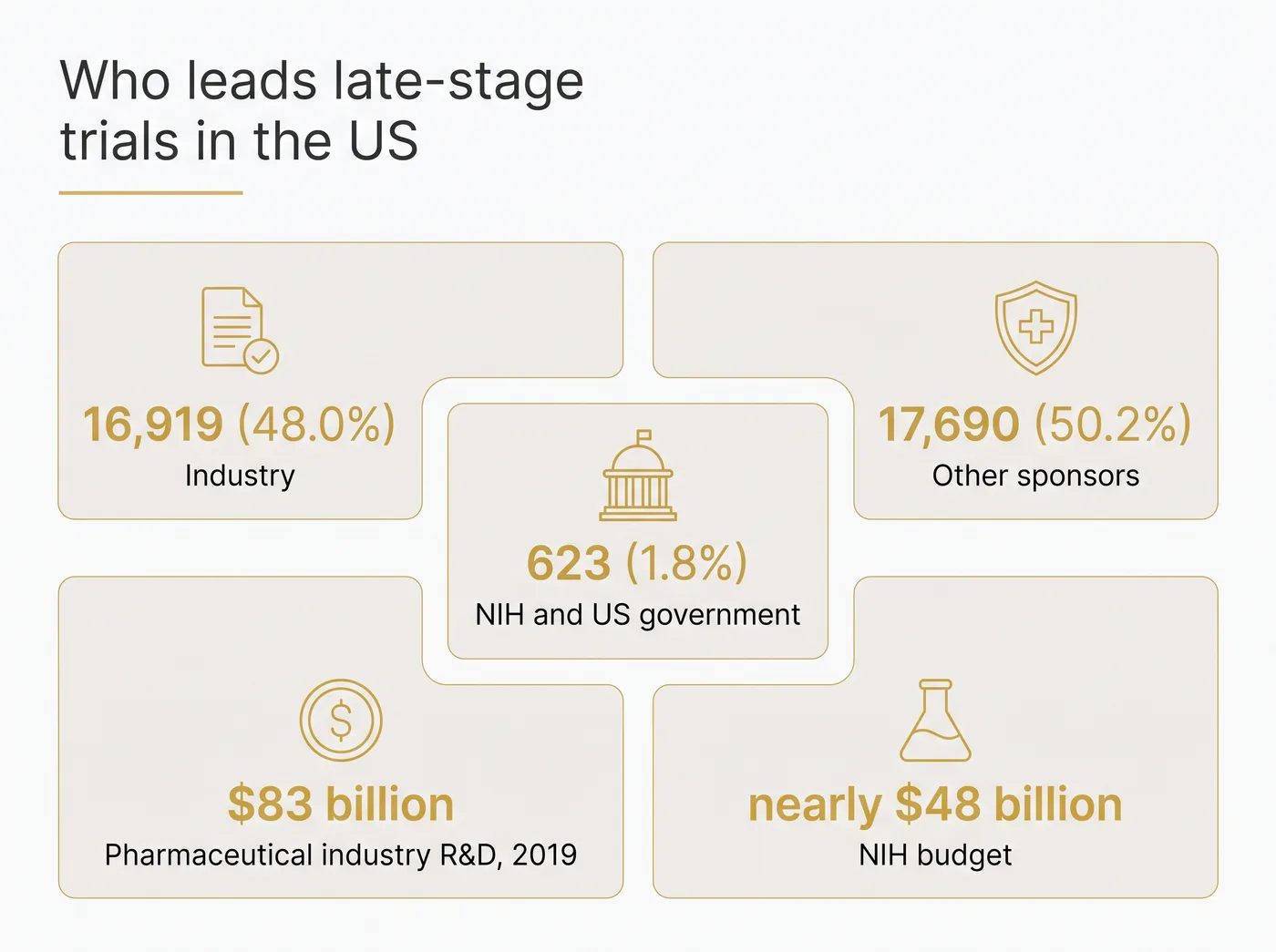
- Late-stage trials in the US are mostly run by companies expecting to sell a patented product, with industry leading 16,919 completed phase 3 to 4 trials from 2000 to 2019, against 623 for the NIH and US government.
- Public money concentrates on early research, and the Congressional Budget Office calls the federal government the primary funder of basic biomedical science.
- A compound nobody can own has a free-rider problem, because whoever pays for a trial cannot stop competitors from using the results for free.
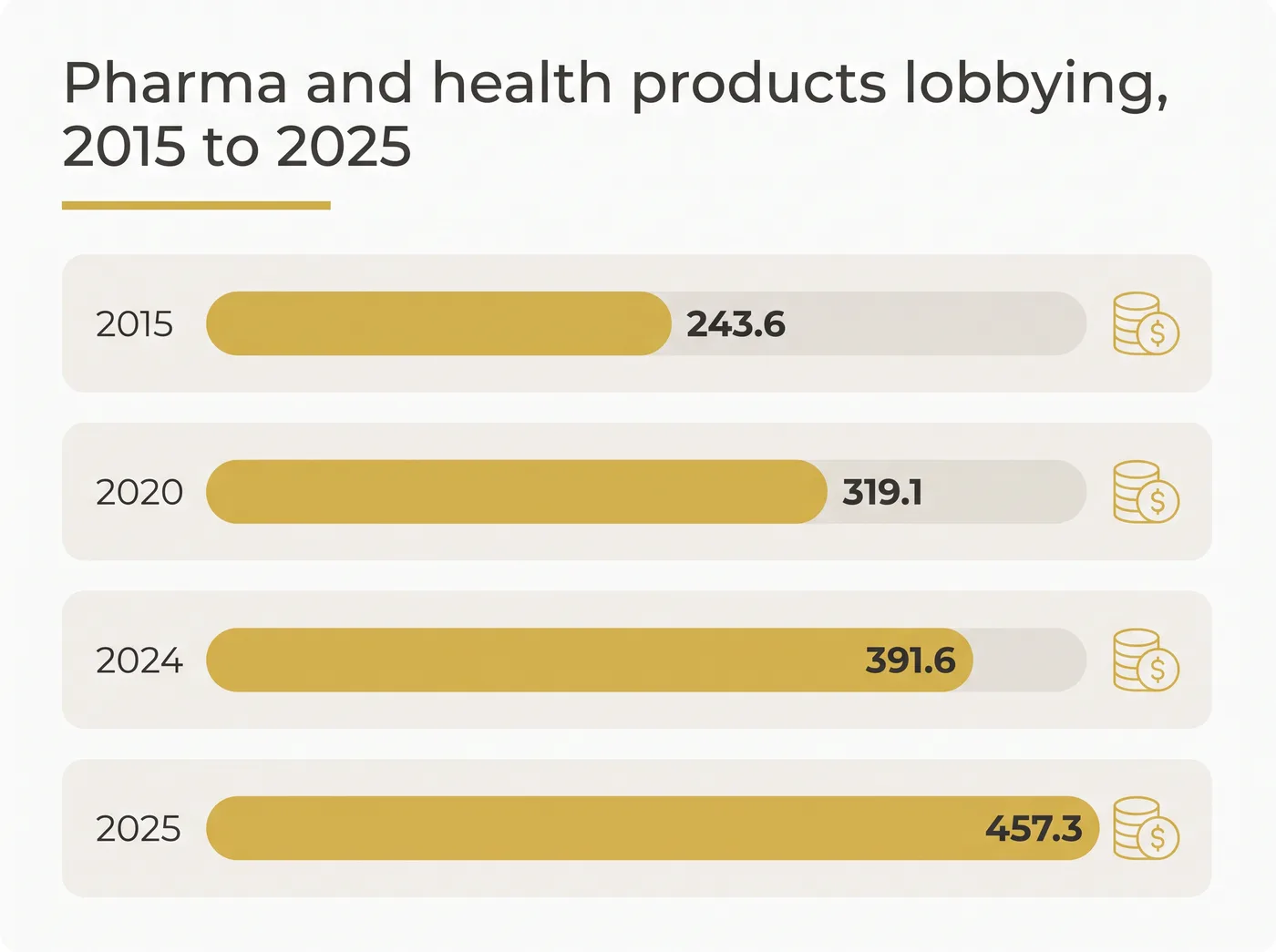
- The pharmaceutical and health products industry reported $457.3 million in federal lobbying in 2025, up from $243.6 million in 2015, according to OpenSecrets.
- Without an approval trial, the only quality evidence for a research compound is its lab report, meaning verification sits entirely with the buyer.
Following the money to a rather expensive gap
When you stare at a chemical structure that has been in the public domain for twenty years, you might wonder why it never crossed the finish line. It is tempting to imagine a grand conspiracy keeping good science down. The truth is much plainer and revolves around a simple rule of economics: someone has to write a very large cheque to turn a molecule into an approved product.
In the United States, that someone is almost always a corporation expecting a monopoly. This article tracks where the money comes from, why compounds nobody owns get left behind, and what the drug industry spends shaping the rules in Washington. It looks at why the FDA demands exactly what it does, and what this financial machinery means for you when you buy research materials.
Who writes the cheques for each stage of research
Science moves in stages, and the price tag grows at every step. Basic research asks how a system actually works. Early trials check safety and hunt for a signal in small groups. Late-stage trials require thousands of people and generate the mountain of data the FDA demands before it clears a product for sale. The funding for each hurdle comes from completely different pockets.
The public pays for the foundation. The Congressional Budget Office calls the federal government the primary funder of basic biomedical research. The NIH says it spends most of its nearly $48 billion budget on this work, awarding roughly 82 percent to outside institutions through almost 50,000 competitive grants. Industry relies on this public groundwork entirely, and the CBO notes that every drug approved by the FDA between 2010 and 2016 rested in some way on NIH-funded science.
Then the private sector takes over. The CBO reports that the pharmaceutical industry spent $83 billion on research and development in 2019, which ate up about a quarter of its net revenues. That cash flows strictly towards things a company can sell. Patents and exclusivity rules create a window where competition is banned by law, allowing a company to maintain higher prices on a patented product than it otherwise could.
| Stage | Who mostly pays | What the numbers say |
|---|---|---|
| Basic research | NIH and other federal agencies | NIH budget of nearly $48 billion, about 82% awarded to outside institutions (NIH) |
| Early trials (phase 1 to 2) | A mix of industry, government and universities | 59.2% of completed NIH and US government-led trials from 2000 to 2019 were phase 1 to 2 (JAMA Network Open) |
| Late-stage trials (phase 3 to 4) | Mostly industry, plus university and hospital sponsors | Completed 2000 to 2019: industry 16,919 (48.0%), other sponsors 17,690 (50.2%), NIH and US government 623 (1.8%) (JAMA Network Open) |
| Getting a new drug approved | Companies that expect to sell it | Estimated R&D cost per new drug, failures included: less than $1 billion to more than $2 billion (CBO) |
The free ride and why unowned compounds stall
Imagine a fascinating compound like BPC-157 or TB-500 that appeared in academic journals decades ago. Because the structure is public knowledge, no one can patent the molecule itself. If a company spends tens of millions of dollars pushing it through a late-stage trial, any competitor can immediately sell the exact same chemical and cite those expensive results for free. Economists call this the free-rider problem, and it is the main reason an unowned molecule stays in the laboratory.
The government knows this perfectly well. When explaining its Repurposing Generic Drugs challenge, the NIH points out that the market has more than 32,000 FDA-approved generic drugs covering over 1,300 active ingredients. Yet it sees little incentive for the pharmaceutical industry to invest in studies of new uses once generic versions exist. A 2019 workshop hosted by the NIH, the FDA and the Reagan-Udall Foundation cited non-existent financial incentives for drug developers as a major barrier. If that is true for approved generics, it is doubly true for compounds that never had a patent to begin with.
The calendar is just as ruthless. A patent has a fixed expiry date, and the timer usually starts ticking before a trial even begins. Economists Eric Budish, Benjamin Roin and Heidi Williams looked at cancer research and found that the private market steers money away from long-term projects. Finding answers for early-stage cancer requires longer trials, so it attracts less private investment than late-stage research where the studies finish faster.
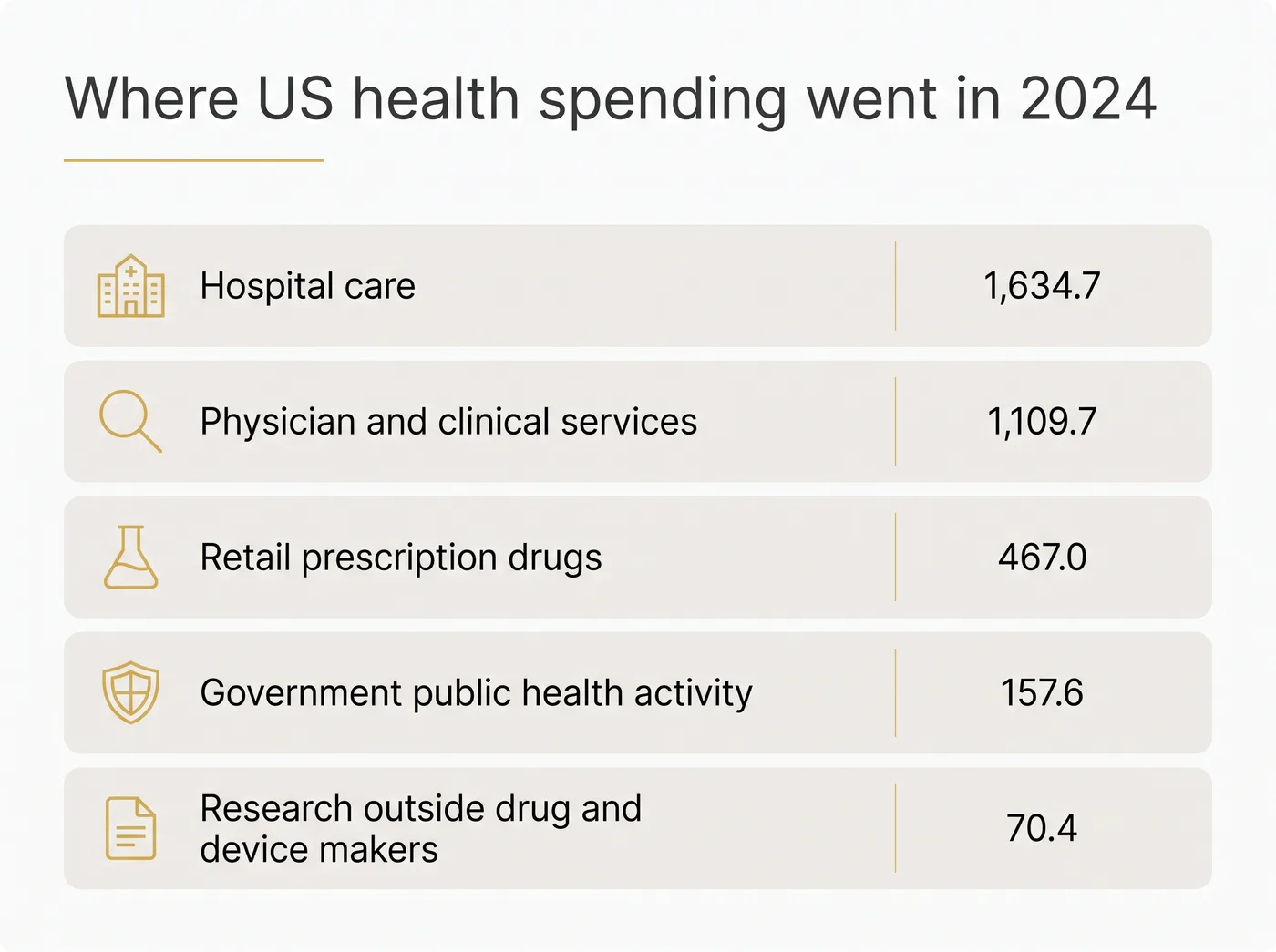
Look at the whole economy and the picture stays the same. National health expenditure data from CMS shows US health spending hit $5.3 trillion in 2024. Of that, hospital care accounted for $1,634.7 billion, physician and clinical services claimed $1,109.7 billion, and retail prescription drugs absorbed $467.0 billion. Government public health activity scraped by on $157.6 billion, roughly 3 percent of the total, while health research outside drug and device companies sat at $70.4 billion. The American system is a giant machine for billing sick people, leaving very little spare change for unowned research.
The price of making the rules in Washington
Rules do not write themselves, and money helps draft them. Companies must report their federal lobbying to Congress, and OpenSecrets tallies the receipts. The pharmaceuticals and health products category reported $243.6 million in lobbying in 2015, $319.1 million in 2020, and $391.6 million in 2024. By 2025 that figure hit $457.3 million, an 88 percent jump over ten years. In just the first three months of 2026, the sector spent $132.0 million and deployed 1,571 registered lobbyists, about half of whom used to work for the government.
This is not a new habit. A peer-reviewed study in JAMA Internal Medicine calculated that the industry spent $4.7 billion on federal lobbying between 1999 and 2018. That is an average of $233 million a year in 2018 dollars, beating every other industry on the map. The researchers also noted that of the 20 senators and 20 representatives who received the most campaign cash from the sector, 39 held seats on committees that controlled health legislation.
Lobbying is perfectly legal. The issue is not that companies talk to politicians, but rather whose voices echo in the room. A business built on exclusive rights will naturally ask for more exclusive rights, and it has the bank account to ask every day. There is no equivalent lobby for a molecule that nobody owns, simply because nobody gets rich enough selling it to hire former government employees.
The limits of the public funding alternatives
You might wonder why the government does not just step in and fund the trials the market ignores. In theory, it does, and the tools already exist on paper.
- NIH-funded trials. The NIH certainly runs clinical studies, but its grants lean heavily toward basic science. Out of 35,232 phase 3 to 4 trials completed between 2000 and 2019, the NIH and other US government agencies acted as lead sponsor on exactly 623.
- The 21st Century Cures Act. This law channelled extra money to the agency, and the NIH budget page lists $1.085 billion from Cures Act allocations within its $47.7 billion total.
- ARPA-H. The Advanced Research Projects Agency for Health exists to fund bold, high-risk projects. Its operating plan earmarks $1.5 billion for fiscal 2025 and the same amount for fiscal 2026.
- Prizes. The NIH ReGen challenge put up $4 million in total, split into 40 prizes of $100,000, for data packages supporting new uses for generic drugs.
All of these programmes are real, but the maths refuses to cooperate. That entire ReGen prize purse covers about a fifth of the roughly $19 million median cost of a single late-stage trial, according to the JAMA Network Open authors. The entire annual budget for ARPA-H is less than 2 percent of what the drug industry spent on research and development in 2019. Public money also chases defined policy goals, and a bare molecule with no corporate champion simply falls off the radar.
Why the massive trials actually matter
You might conclude that the FDA is the enemy here, but the strict rules exist for a very good reason. The modern approval framework was born from an absolute tragedy. In 1961, the hypnotic thalidomide was exposed as a cause of severe birth defects. Thanks to FDA reviewer Dr. Frances Kelsey, who had flagged concerns, the drug never reached the US market. As an FDA history of clinical drug trials details, the 1962 Kefauver-Harris Amendments followed quickly, demanding substantial evidence of safety and efficacy through adequate and well-controlled studies. Congress defined that as random allocation, control groups and strict rules to defeat bias.
Massive trials are necessary because small, hopeful studies are notorious liars. The CBO points out that only about 12 percent of drugs that start clinical trials ever earn approval. Most bright ideas fail when subjected to a ruthless, blinded test, which is exactly why the test has to happen. A regulator that waved products through based on a few optimistic papers would be a disaster for everyone.
The standard is entirely correct, but the funding model is flawed. The system demands expensive evidence, and the only entities willing to buy that evidence are corporations holding patents. Compounds that cannot be patented fall into a void that the market refuses to acknowledge.
Buying research materials in the gap
The practical reality of this system is blunt. Because these compounds have bypassed the approval machine, the only quality evidence for a vial is its laboratory report. An unverified certificate is just an expensive piece of paper, so the burden of checking it falls squarely on your shoulders. A transparent supplier makes this verification painless, and steps cover the essentials.
- Match the lot or batch number on the report directly to the vial in your hand.
- Check for HPLC purity to see how much of the detected material is your target, and demand a mass spectrometry result to confirm identity.
- Ensure the testing laboratory is named clearly, and verify the report ID independently with that lab.
You can find independent data on the lab reports page, which pairs each product with a verifiable report ID and the testing facility's name, while the sourcing page lays out where the materials originate. When you are ready to move forward, browse the shop with the chemistry laid bare in front of you. Good science leaves nothing to trust.
Questions
Does the NIH ever fund large late-stage trials?
Yes, but it is exceptionally rare. Looking at ClinicalTrials.gov data between 2000 and 2019, the NIH and US government agencies acted as lead sponsor on just 623 completed phase 3 to 4 trials, compared to 16,919 led by industry. The vast majority of government funding supports basic science and early research.
How much does the pharmaceutical industry spend on lobbying?
The numbers are staggering. OpenSecrets logged $457.3 million in federal lobbying by the pharmaceuticals and health products sector in 2025, with another $132.0 million spent in just the first quarter of 2026. An earlier JAMA Internal Medicine study found the industry spent $4.7 billion from 1999 to 2018, outspending every other sector.
Why would a company not fund a trial on a compound nobody owns?
It all comes down to the free-rider problem. Without a patent to lock out the competition, any rival can sell the exact same unowned molecule and point to the published trial data. The company that wrote the massive cheque gets no exclusive return on its investment.
Is the FDA being too cautious?
Not at all. The strict evidence standards established by the 1962 Kefauver-Harris Amendments followed the thalidomide tragedy and are designed to prevent harm. Given that only about 12 percent of drugs entering trials survive to approval, the rigorous testing is necessary, but the reliance on private funding leaves unpatented compounds behind.
What should a researcher check before buying a research compound?
You must verify that the lab report matches your specific batch and lists a third-party testing facility. Look for HPLC purity, mass spectrometry for identity, and a report ID you can verify yourself. The lab reports page provides a perfect example of what to demand.
Sources
- Pharmaceuticals/Health Products: Lobbying Profile (annual totals 1998-2026). OpenSecrets
- Lobbying Expenditures and Campaign Contributions by the Pharmaceutical and Health Product Industry in the United States, 1999-2018 (Wouters, JAMA Internal Medicine, 2020). National Library of Medicine (PubMed)
- Research and Development in the Pharmaceutical Industry (April 2021). Congressional Budget Office
- Assessment of Trends in the Design, Accrual, and Completion of Trials Registered in ClinicalTrials.gov by Sponsor Type, 2000-2019 (Gresham et al., JAMA Network Open, 2020). National Library of Medicine (PMC)
- Do Firms Underinvest in Long-Term Research? Evidence from Cancer Clinical Trials (Budish, Roin and Williams). National Bureau of Economic Research
- FDA and Clinical Drug Trials: A Short History (Junod). U.S. Food and Drug Administration
- Repurposing Generic (ReGen) Drugs Evidence Package Challenge. National Institutes of Health
- Budget. National Institutes of Health
- Historical National Health Expenditure Data (NHE Tables, 1960-2024). Centers for Medicare & Medicaid Services
- Operating Plan for FY 2026. Advanced Research Projects Agency for Health (ARPA-H)