
Policy and economics
Why GLP-1 drugs are patented and research peptides are not
NuuVive Journal · · 7 min read

Short answer
The U.S. Supreme Court ruled that naturally occurring sequences cannot be patented. To secure market exclusivity and justify the massive cost of clinical trials, pharmaceutical companies must modify sequences synthetically. GLP-1 compounds like semaglutide are heavily altered to pass this strict legal test, earning patents and massive corporate investment. Meanwhile, unpatentable natural sequences remain available exclusively through the laboratory supply market because no single corporation can monopolise them.
Key takeaways
- Naturally occurring amino acid sequences are legally classified as products of nature and cannot be patented.
- Pharmaceutical companies must synthetically alter a sequence to make it legally distinct and secure market exclusivity.
- Without an exclusive patent, corporate developers have no financial incentive to fund multi-million-dollar clinical trials.
- Manufacturers extend their monopolies by patenting mechanical delivery devices alongside the chemical compounds.
- The federal government sets strict regulatory pathways based on whether a chain exceeds 40 amino acids.
The legal boundary for claiming ownership of nature
Imagine finding a remarkably shaped stone in a river, picking it up, and asking the government for the exclusive right to sell all rocks of that exact shape. The patent office would politely show you the door. In 2013, the legal framework for biotechnology went through exactly this kind of reckoning. The U.S. Supreme Court ruled unanimously that naturally occurring substances cannot be patented.
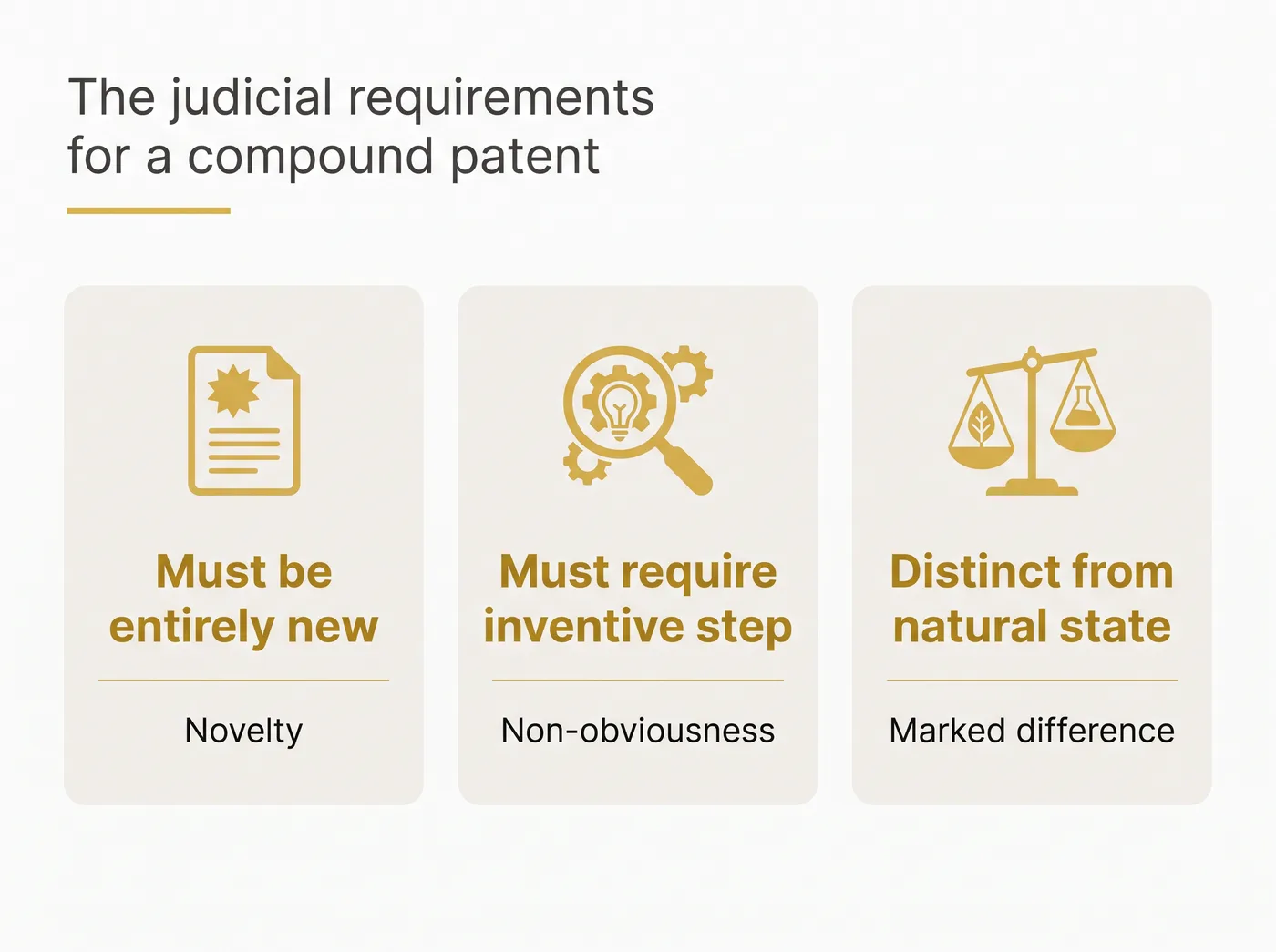
This decision established a clear reality: simply isolating a compound from its natural environment does not make it intellectual property. If a sequence of amino acids exists in nature, it is legally classified as a product of nature. It automatically fails the strict statutory tests for novelty and non-obviousness required by the authorities.
The reasoning is wonderfully straightforward, as a corporation cannot claim to have invented something that already exists. This legal barrier fundamentally shapes what enters the pharmaceutical pipeline. It explains exactly why familiar laboratory materials like BPC-157 or TB-500 sit completely outside the scope of commercial corporate development.
Patent law relies on a strict analytical framework to grant exclusive rights. An inventor must demonstrate that their creation is entirely new, which the law defines as novelty. They must also demonstrate that the invention would not be immediately obvious to a trained analytical chemist.
Natural sequences fail both of these legal tests simultaneously. Even if a laboratory discovers a highly efficient new way to synthesise a natural chain, they can only patent their specific manufacturing method, not the chain itself. A competitor could simply set up a different synthesis method to produce the exact same sequence.
This lack of inherent protection is a fatal flaw in the eyes of corporate finance. Without total ownership of the chemical entity, corporate investment halts immediately. The sequence is left for the public domain and independent researchers, completely ignored by multinational capital.
Creating a patentable asset by changing the math
To secure a patent, a pharmaceutical chemist must submit a compound that is markedly different from any natural counterpart. They achieve this by synthetically altering the sequence in the laboratory. GLP-1 compounds like semaglutide and tirzepatide feature heavy synthetic modifications that change their core molecular structure.
These specific alterations satisfy the patent office, transforming an unpatentable natural concept into an exclusive commercial asset. The modifications are precisely documented, formally filed, and heavily defended in court. Once the patent is granted, the company secures the exclusive right to sell the compound.
This legally enforced monopoly is the primary product that pharmaceutical companies present to their shareholders. It is the sole reason they are willing to open their chequebooks for the next stages of development. Without a synthetic tweak to the sequence, the entire financial model collapses.
The financial burden of a clinical marathon
The process of securing the legal label of "safe and effective" begins with Phase 1 safety evaluations. These initial studies focus entirely on basic safety metrics and chemical tolerability in a highly controlled environment. Even at this early stage, the financial cost is immense, requiring pristine documentation and rigorous oversight.
The company must produce massive quantities of the active pharmaceutical ingredient to exact legal specifications. If the compound passes this expensive hurdle, it moves to Phase 2 trials, which expand the scope to measure precise chemical profiles and application parameters across a wider sample.
Phase 3 trials represent the ultimate financial barrier in the regulatory framework. These studies require enrolling thousands of participants across multiple clinical sites to gather statistically unassailable safety and efficacy data. The logistical costs, administrative overhead, and massive data analysis require funding that only multinational corporations can provide.
If a compound successfully navigates this final phase, the sponsor submits a colossal application to the federal government for review. The entire system is built on the assumption that the final approved product will generate massive exclusive revenue to pay back the initial gamble.
Unpatented materials will never enter this formal process, regardless of their laboratory profile. The total absence of a patent makes a Phase 3 investment an act of financial self-destruction for a public company, which is why natural sequences remain strictly in the research sector.
Defining the regulatory pathway at the federal level
Beyond the patent office, the federal government sets strict rules on how compounds are classified. The agency uses a clear size-based threshold to determine the regulatory pathway for amino acid polymers. This classification dictates the complexity and expense of the legal approval process.
According to finalised guidance, an alpha amino acid polymer with a defined sequence of 40 or fewer amino acids is classified as a peptide and regulated as a traditional drug under the Food, Drug, and Cosmetic Act. Conversely, polymers containing more than 40 amino acids are generally classified as proteins and regulated as biological products under the Public Health Service Act.
| Polymer length | Regulatory classification | Primary legal framework |
|---|---|---|
| 40 or fewer amino acids | Peptide (Traditional drug) | FD&C Act |
| More than 40 amino acids | Protein (Biological product) | PHS Act |
| Up to 99 amino acids (chemical synthesis) | Chemically synthesised polypeptide | FD&C Act |
The exception for controlled chemical synthesis
The finalised guidance includes a specific historical exception that highlights the importance of laboratory manufacturing methods. Even if a chain exceeds the strict 40-amino-acid limit, the agency looks closely at how it was made. A chemically synthesised polypeptide made entirely by chemical synthesis and composed of up to 99 amino acids is regulated as a drug, not a biologic.
Biological products typically require complex living systems, such as recombinant DNA technology in bacteria, to produce their large structures. Chemical synthesis, by contrast, builds the sequence amino acid by amino acid in a highly controlled setting, avoiding the unpredictable variables of living organisms.
This distinction is profound for a developing company. It dictates the exact legal pathway a corporation must navigate, heavily influencing the timeline and the ultimate cost of bringing a new entity to the market.
Building a fortress of plastic around a chemical
Securing a primary compound patent is only the first step in the pharmaceutical economic model. Companies routinely build dense walls of secondary patents around their most profitable assets. This strategy is commonly referred to as a patent thicket, and it is a masterpiece of modern legal engineering.
- Primary patents on the active chemical compound itself.
- Secondary patents on the plastic mechanical delivery devices.
- Process patents on the specific manufacturing and formulation methods.
A detailed review of GLP-1 compounds revealed that 54 percent of all listed patents covered the delivery devices rather than the active chemical ingredient. By patenting the plastic delivery devices and the formulation methods, manufacturers create a maze of legal barriers against generic competitors.
The duration of these overlapping monopolies ensures maximum financial return. The deliberate strategy of layering patents pushes the median duration of expected market protection to 18.3 years after initial approval. That is nearly two decades of absolute control.
For nearly twenty years, a single corporation can dictate the price and availability of a specific compound. When generic competitors attempt to enter the market, they must litigate against dozens of individual patents simultaneously, fighting over everything from the chemical structure to the specific springs in the plastic hardware.
This immense legal burden often forces competitors to abandon their efforts entirely or agree to delayed entry settlements. The system ensures that the initial investment in clinical trials is returned exponentially, and perfectly explains the intense corporate focus on delivery hardware over raw chemical innovation.
Public policy and the laboratory supply market
These economic and legal realities split the world of amino acid chains entirely in two. On one side are heavily modified, patented compounds that attract immense corporate funding, endless clinical trials, and massive public attention. They exist in a world defined by legal thickets and engineered exclusivity.
On the other side are unpatentable natural sequences that belong permanently to the public domain. Because large corporations cannot monopolise these natural sequences, they remain exclusively in the laboratory supply sector. Independent analytical chemists and private research facilities rely heavily on this sector for their ongoing work, completely bypassing the pharmaceutical patent system.
Understanding these financial incentives gives you a clearer view of why the industry operates exactly the way it does. You can source unpatented, high-purity materials for your own laboratory by visiting the shop.
Questions
Why can pharmaceutical companies patent a sequence that mimics nature?
They do not patent the exact natural sequence. Instead, they structurally modify the chain so it no longer perfectly matches the naturally occurring version, satisfying the legal requirement for novelty.
Are naturally occurring sequences illegal to produce?
No. They are simply unpatentable under federal law. Because no single corporate entity can own them, they are produced and sold as laboratory reagents by analytical suppliers rather than commercial developers.
How does the 40-amino-acid rule affect costs?
The regulatory pathway for biological products is typically much more complex than the traditional drug pathway. Staying under the 40-amino-acid limit allows an altered sequence to be regulated as a drug, streamlining the legal and financial process.
What is a patent thicket?
It is a deliberate legal strategy of layering dozens of secondary patents over a single product. By patenting the mechanical delivery devices and formulation processes, a company creates a maze of barriers against generic competitors.
Sources
- Making sure you're not a bot!. columbia.edu
- Regulations.gov. Regulations.gov
- pmc.ncbi.nlm.nih.gov. National Library of Medicine
- jamanetwork.com. JAMA Network