
Sourcing
Why most online peptide vendor rankings cannot be trusted
NuuVive Journal · · 6 min read · Updated

Short answer
Online vendor rankings are rarely reliable because they rely on subjective reviews rather than independent chemical analysis. Without raw instrument data from an accredited testing facility, a ranking cannot prove the identity or purity of a synthetic peptide. To verify a material, you must bypass internet reviews and directly check a batch-specific certificate of analysis issued by a recognised third-party laboratory.
Key takeaways
- Online rankings rarely rely on chemical analysis, making them unreliable for verifying synthetic materials.
- True independent verification requires testing by a facility holding specific international accreditation.
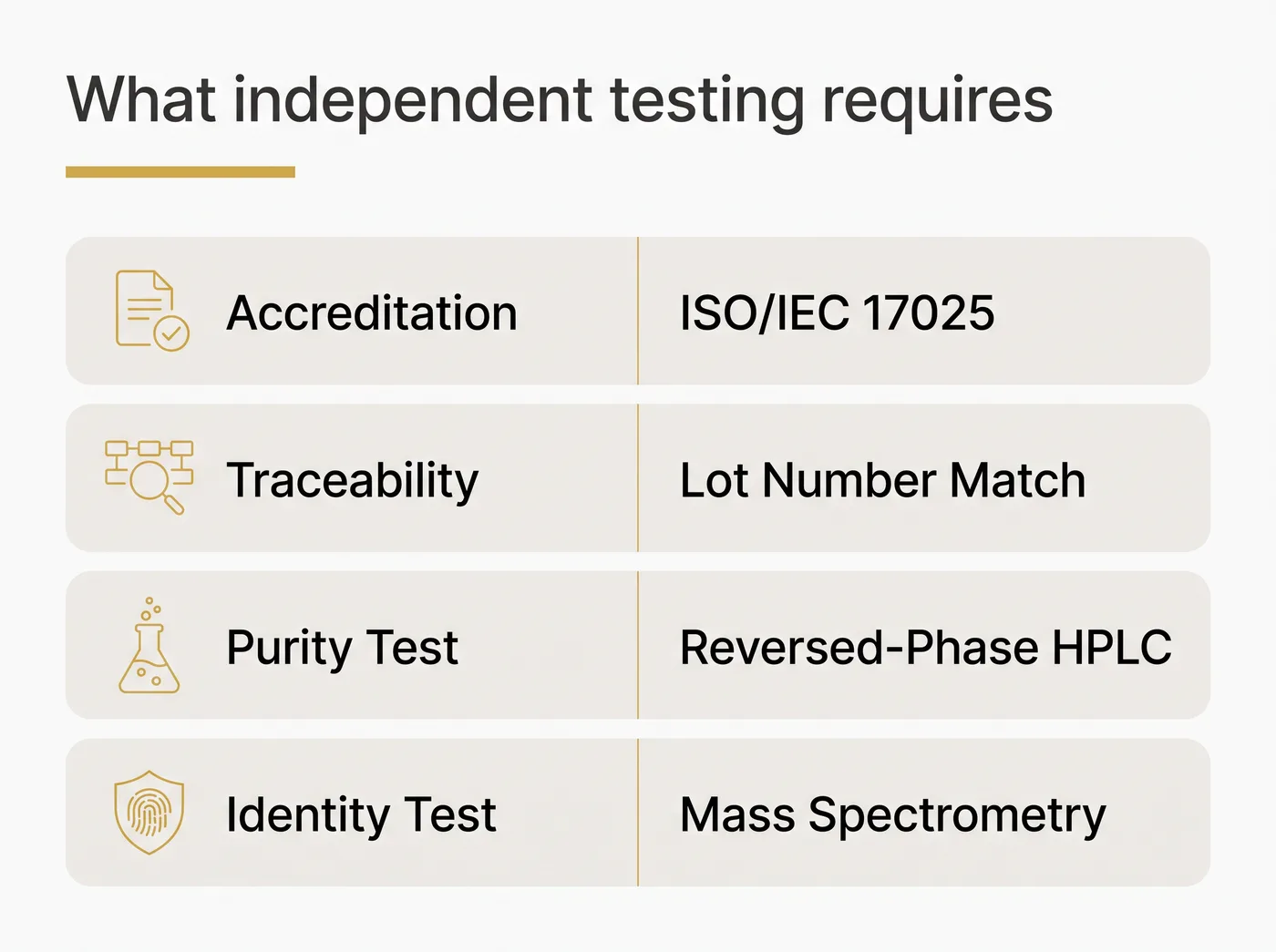
- A valid certificate of analysis must include both relative purity from liquid chromatography and identity confirmation from mass spectrometry.
- Laboratory documents must tie directly to the physical solid through a specific batch or lot number.
The illusion of the top ten list
Search for a synthetic peptide online, and you will inevitably trip over a neatly formatted list claiming to rank the top suppliers. These pages look reassuringly objective, complete with shiny star ratings and confident verdicts. But look closer at how those conclusions are reached, and you will usually find a glaring absence of chemistry. Many of these rankings function purely as marketing materials, driven by affiliate relationships rather than rigorous laboratory testing. Evaluating a supplier properly requires systematic evaluation and qualified objective evidence, which is the foundational approach used in professional material qualification guidelines.
The fundamental flaw in judging a supplier by internet reviews is that lyophilised peptide powders look identical regardless of their actual chemical composition. A solid material sitting in a vial might be highly pure, degraded by light and heat, or entirely composed of the wrong substance. To the naked eye, it will always appear as a plain, unassuming white disc. Without verifying the material through objective testing, assessing the actual quality of the compound is a guessing game.
For any evaluation to hold actual weight, it must incorporate batch-specific testing data showing consistent reproducibility. It must also disclose the analytical techniques, the instruments, and the mobile phases used to verify the peptides. Finally, it requires a clear chain of custody demonstrating that the data was produced by an independent laboratory, rather than cooked up in a spreadsheet by the marketing department.
Why accreditation is the only metric that matters
An independent ranking of a supplier is only as good as the laboratory backing it up. That means relying on data from third-party analytical facilities holding ISO/IEC 17025 accreditation. This globally recognised standard establishes the strict requirements for testing laboratory competence, impartiality and consistent operation internationally. It is the system that ensures a laboratory produces accurate and reproducible results every single time they power on their instruments.
Unlike general corporate management certifications that just check paperwork, this specific standard zeroes in on technical competence. It ensures that laboratory equipment is properly calibrated against known standards and that testing methods are fully validated. When a laboratory operates under this standard, the measurement uncertainty is defined, and the metrological traceability of the results is securely anchored.
When you open a certificate of analysis, identifying the testing laboratory should always be your first move. A document proudly claiming to come from an independent facility means little if the facility cannot be named or its accreditation cannot be verified. Recognised laboratories provide straightforward ways to verify their reports directly, allowing you to bypass the supplier's website entirely.
The chromatography race and relative purity
Purity is determined by reversed-phase high-performance liquid chromatography. Think of this process as a molecular obstacle course. The peptide sample is dissolved in a mobile phase and pumped through a stationary phase column. Because different compounds interact with the stationary phase in distinct ways, they separate and cross the finish line at different retention times. These emerging compounds are typically detected using ultraviolet absorbance, which targets the peptide bond directly.
The resulting purity is expressed as an area percent. If a certificate lists a purity of 98 percent, it simply means that the primary peptide peak accounts for 98 percent of the total integrated area of all ultraviolet-absorbing peaks in that specific chromatogram. High-resolution liquid chromatography provides a measure of relative chromatographic cleanliness.
However, liquid chromatography has a massive blind spot: it cannot actually identify the molecule. A sample consisting entirely of the wrong synthetic peptide could still show a single beautiful peak on a chromatogram if it is highly pure. It also cannot account for impurities that lack ultraviolet absorbance, which is why it must be paired with other analytical methods before you can trust the material.
Weighing the evidence with mass spectrometry
While liquid chromatography tells you how clean the sample is, mass spectrometry confirms what the sample actually is. Following the separation step, the sample undergoes ionisation and is drawn into the mass spectrometer. The instrument measures the mass-to-charge ratio of the flying ions, providing absolute mass determination for the compounds present in the sample.
The laboratory report must present both the theoretical monoisotopic mass, calculated from the molecular formula, and the observed mass from the instrument. Modern testing methods often rely on specific ion-pairing reagents, such as formic acid, to ensure accurate mass detection without suppressing the instrument signal unintentionally.
| Analytical Method | What it Measures | What it Cannot Show |
|---|---|---|
| Reversed-Phase HPLC | Relative chromatographic cleanliness and area percent. | Molecular identity or absolute mass. |
| Mass Spectrometry | Mass-to-charge ratio and molecular identity. | Detailed separation of all impurities without chromatography. |
| Amino Acid Analysis | Absolute quantification and net peptide content. | The sequence or order of the amino acids. |
The trap of net peptide content
A common point of confusion when reading laboratory reports is the vast difference between relative purity and net peptide content. A sample may test highly pure by liquid chromatography, but that percentage tells you nothing about the absolute mass of the peptide in the vial. Because synthetic peptides are isolated as salts and eagerly retain bound moisture, the solid powder you see never consists entirely of the active compound.
To determine the absolute mass, laboratories are required to use absolute quantification methods. Techniques such as amino acid analysis determine the molar ratios of amino acids after the material is hydrolysed. This rigorous process provides the absolute mass of the target peptide, mathematically confirming the total amount present in the container.
Tying the paper to the powder
A thorough analytical document is useless if it cannot be securely linked to the material sitting in front of you. Certificates of analysis must include explicit definitions of the batch or lot number, ensuring complete traceability back to the source. Without a specific lot number printed on both the laboratory report and the vial itself, the testing data is entirely disconnected from the physical solid.
Instead of relying on vague online rankings, the most reliable approach is to act as your own auditor and examine the testing documentation provided by the supplier. Look for a named, accredited laboratory, a specific lot number, high-resolution chromatograms, and matching mass spectrometry data. When these elements align perfectly, you finally have the objective evidence required to verify the material.
You can examine how rigorous testing data is presented by reviewing the independent lab tests for current batches.
Questions
Why do lyophilised powders all look the same?
The freeze-drying step removes the solvent, leaving behind a solid structure that usually appears as a plain white disc or powder. This physical appearance gives no indication of the chemical composition, identity, or purity of the synthetic peptide.
Can a laboratory report be faked?
Yes, PDF documents can be easily altered in minutes to change purity percentages, lot numbers, or laboratory names. This is why verifying the report directly with the accredited third-party testing facility is essential for confirming the raw data.
What does a purity of 99 percent actually mean?
It simply means that 99 percent of the area integrated by the ultraviolet detector during liquid chromatography belongs to the primary compound. It does not mean the vial contains only the synthetic peptide, as moisture and salts are always naturally present in the solid.