
Policy and economics
Why most peptides can't be patented, and why pharma passes on them
NuuVive Journal · · 11 min read · Updated

Short answer
Most research peptides are short natural sequences or fragments that were published years ago. US law forbids patenting products of nature, and anything previously published is considered prior art. Because the molecule itself cannot be legally owned, no company can expect to recoup the billion-dollar cost of securing an FDA approval. Consequently, these natural compounds remain entirely outside pharmaceutical development pipelines and are supplied strictly as laboratory research materials instead.
Key takeaways
- A US patent ends 20 years after filing and needs something new: a natural sequence is a product of nature, and anything published first is prior art.
- Going from the first FDA filing to approval has a median of about 8.3 years for standard programmes, and the patent was already running before that.
- FDA exclusivity (5 years for a new active ingredient, 7 years for a rare-condition approval) starts only at approval and is short next to a median R&D bill of about $1.14 billion.
- Engineered analogues with deliberate, non-natural changes can be patented, which is why they are the peptides that attract big investment.
- Research peptides have no approval file behind them, so lot-level lab reports are the evidence a buyer has.
The billion-dollar price of admission
Nobody builds a billion-dollar skyscraper on land they cannot own. That single rule of economics explains why the vast majority of natural peptides will never see the inside of a commercial pharmacy. Many of the compounds sold for laboratory research have sat patiently in the scientific literature for years, and sometimes for decades. Their absence from the commercial market rarely has anything to do with their chemistry.
The real barrier is pure, unyielding finance. A company that cannot own the exclusive rights to a molecule has absolutely no way to earn back the astronomical cost of an approval file. When the accountants run the numbers and realise the patent office will not grant a monopoly, the development programme simply does not start.
Understanding this machinery requires looking at how the rules are written. Below is exactly what a patent demands, why the courts refuse to hand out monopolies for nature or old papers, and why the official patent clock is far shorter than it appears. It also explains why so much of this market remains strictly a research-grade supply, where checking the paperwork falls squarely on the buyer.
What the patent office actually asks for
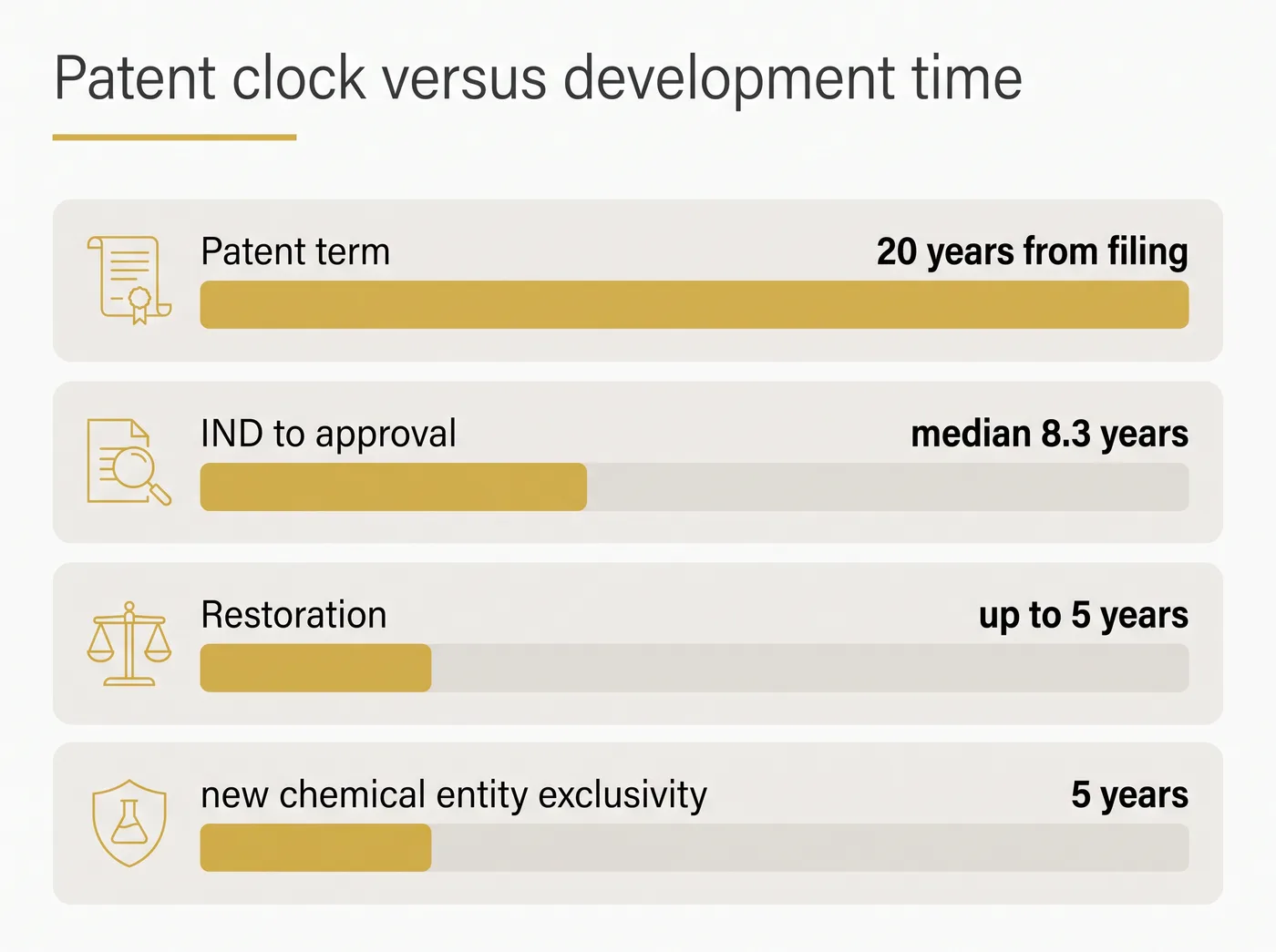
A patent is essentially a property right granted by the US Patent and Trademark Office. Its holder generally gets the exclusive right to make, use, sell and import the invention. According to a primer from the Congressional Research Service, which serves as Congress's in-house research arm, the monopoly is strict but temporary. The FDA notes the standard term runs exactly 20 years from the date the application was filed in the United States.
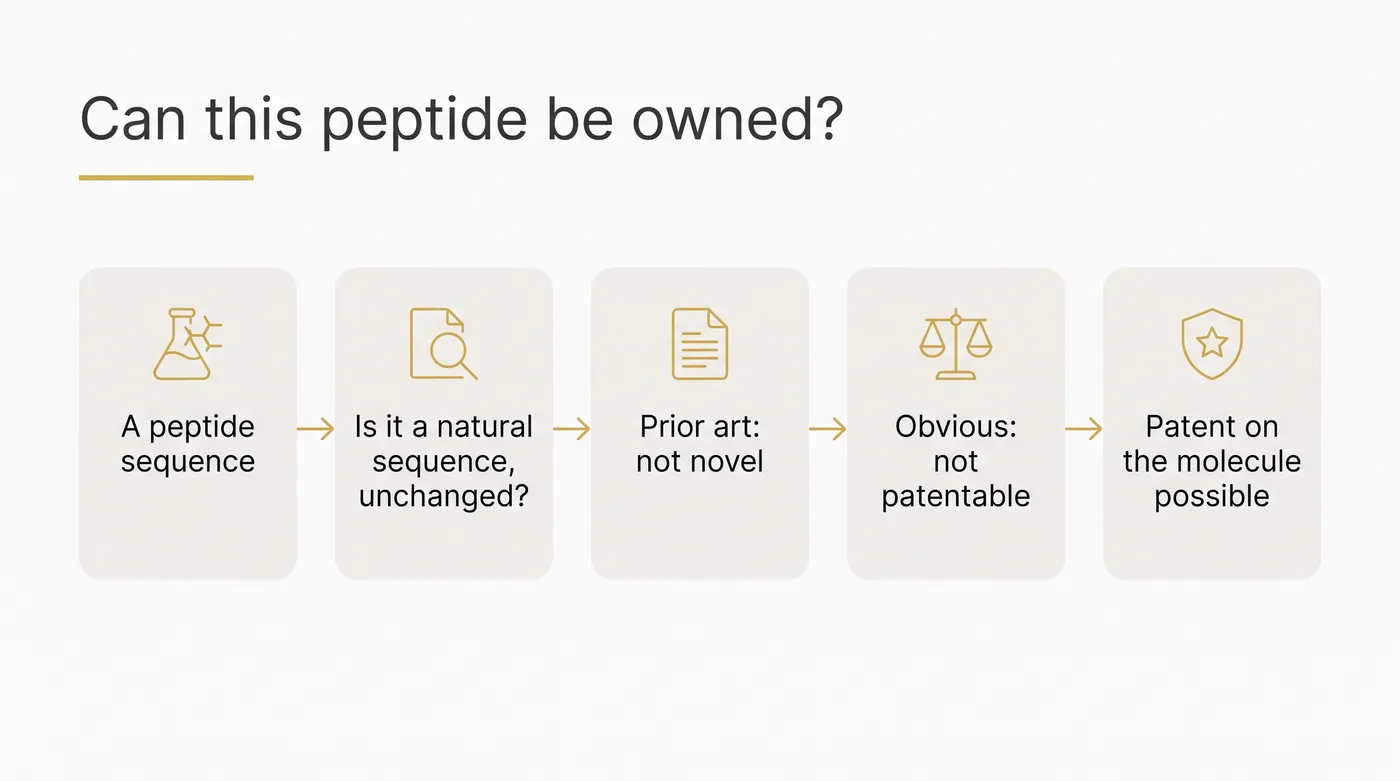
To earn that golden ticket, an invention must clear three massive hurdles. First, it must be eligible subject matter, an intentionally strict category that excludes "laws of nature, natural phenomena, and abstract ideas." You cannot patent gravity, and you cannot patent a chemical sequence you simply found. Second, it must be entirely novel. Nothing counts as new if it was described in a printed publication, used in public or sold before the filing date. Finally, it must be non-obvious to a skilled person working in that field.
Everything already public at the time of filing is grouped together as prior art. As the CRS quotes from the Supreme Court, an applicant who tries to claim only what the prior art discloses "has added nothing to the total stock of knowledge." For a short natural peptide first reported in a university journal decades ago, that novelty hurdle is completely fatal. Because the sequence is printed in a paper anyone with a library card can read, the molecule itself is prior art. A clever chemist might patent a new salt form or a novel manufacturing route, but the fundamental chain of amino acids belongs permanently to the public.
Why you cannot claim a product of nature
The rule against patenting nature got its clearest modern boundary drawn on June 13, 2013. The Supreme Court handed down a massive ruling in a gene-patent case brought by the Association for Molecular Pathology. The court held firmly that "a naturally occurring DNA segment is a product of nature and not patent eligible merely because it has been isolated." The company involved had indeed found two highly important genes. But the justices decided that "separating that gene from its surrounding genetic material is not an act of invention." Interestingly, the exact same ruling allowed patents on lab-made cDNA, simply because that specific molecule does not occur in nature.
While that case was strictly about DNA, the patent office applies the same logic to every nature-based product crossing its desk. The official rulebook, the Manual of Patent Examining Procedure, tells its examiners to compare any claimed product with its natural counterpart. If the proposed product lacks "markedly different characteristics," the claim just recites a product of nature and needs something extra before it can be allowed. The CRS sums up the court's line neatly: naturally occurring source material is generally not eligible, whereas material "otherwise modified by man into a non-naturally occurring form" generally is.
Replicating a natural sequence perfectly on a laboratory synthesiser does not change the sequence itself. Whether an indistinguishable lab-made copy can be claimed has drawn its own complex legal analysis, which the CRS cites extensively. However, corporate boards do not like ambiguity, and absolutely nobody wants to risk a billion-dollar development programme on an open legal question. When the patent is uncertain, the funding vanishes.
The countdown timer starts too early
Even for a molecule that clears the patent hurdles, time is a brutal enemy. Companies are forced to file their patents at the moment of discovery, because waiting even a month invites a rival laboratory to publish or file first. Economists Eric Budish, Benjamin Roin and Heidi Williams showed what follows from this rush. Inventions with a long lag between discovery and first commercial sale suffer a substantially reduced patent term in practice, and in extreme cases none at all. Their stark conclusion was that the patent system provides "very little incentive for private firms to engage in long-term research."
Exactly how long is that lag? A 2023 JAMA Network Open study looked at 340 novel FDA approvals from 2015 to 2022. It found a median of 8.3 years just from the investigational new drug (IND) application to final approval for standard programmes, and 7.0 years for those using an expedited pathway. The IND is the massive filing that must happen before a single trial can start, which means the patent was already ticking away through all the preliminary lab work before the FDA even saw a page of it.
Congress eventually noticed this absurdity and tried to soften it in 1984. The Hatch-Waxman Act allows a company to restore a portion of lost time on one patent. They get back half the period between the IND and the marketing application, plus all of the agency's review time. This is strictly capped at five extra years and at 14 years of remaining term after approval, according to a CRS primer. The catch for natural peptides remains glaringly simple. Restoration extends an existing patent, and with no patent on the molecule in the first place, there is absolutely nothing to extend.
The flimsy alternatives to molecular ownership
A corporate sponsor that cannot patent a molecule will desperately look for other options. The CRS lists the secondary patents a product might carry: novel formulations, methods of using the product for a particular purpose, bespoke delivery devices, manufacturing processes, and related forms such as specific salts or crystal structures. Yet the CRS also notes a harsh reality. The core patent on the active ingredient is the one that is hard, "if not impossible," to invent around. A generic applicant can easily seek approval for uses that are not specifically claimed in a listed secondary patent, effectively sidestepping the protection entirely.
The only other remaining route is regulatory exclusivity, which is a strict period the FDA enforces after approval where competing applications are blocked or delayed. This is completely separate from patents. The FDA states that some products "have both patent and exclusivity protection while others have just one or neither." Under data exclusivity, a competitor cannot simply point to the FDA's findings from the original sponsor's hard work; they would have to generate their own massive data pile. Marketing exclusivity is even stronger, meaning the FDA cannot approve the same product for the same use at all, even if the competitor brings completely new data.
| Protection | Granted by | Length | What it covers | Catch for a natural peptide |
|---|---|---|---|---|
| Patent on the molecule | USPTO | 20 years from filing, up to 5 years restored | The compound itself, hard to design around | Usually unavailable: product of nature or prior art |
| Use, formulation or process patent | USPTO | 20 years from its own filing | One use, one formulation or one process | Narrow; other uses and forms stay open |
| New chemical entity exclusivity | FDA | 5 years from approval (patent challenges may be filed after 4) | No copy application relying on the original data | Starts only after the full development bill is paid |
| New clinical investigation exclusivity | FDA | 3 years | The change, such as a new use or formulation, that needed new studies | Covers the change, not the molecule |
| Orphan exclusivity | FDA | 7 years | Same product for the same rare condition (under 200,000 Americans) | Limited to small markets by definition |
| Pediatric exclusivity | FDA | 6 months added | Extends existing patents and exclusivity | Needs something to extend |
Why the engineered analogues get all the funding
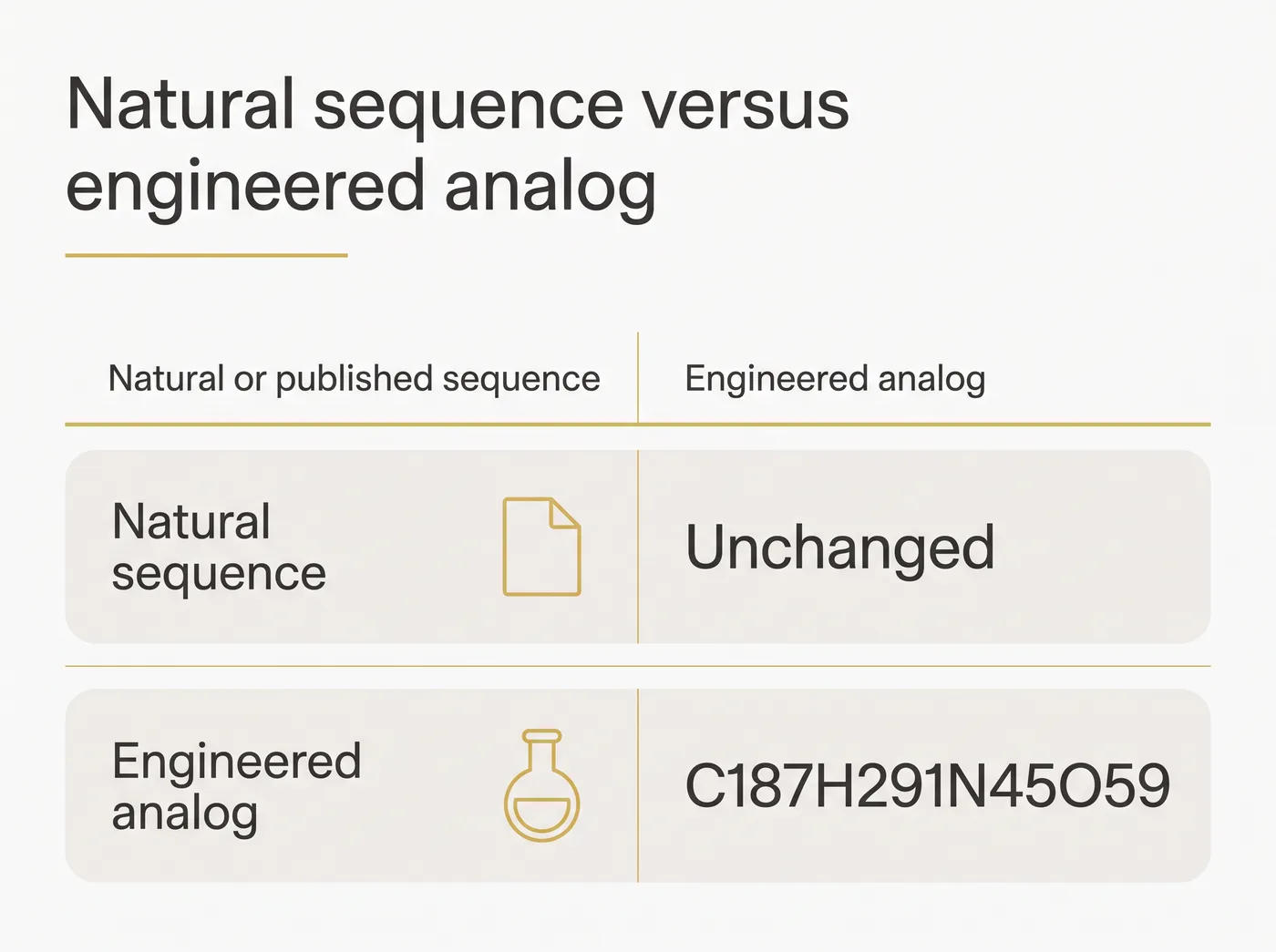
The peptide programmes that actually manage to attract massive corporate funding look incredibly different on paper. Semaglutide is a beautifully clear example, precisely because its FDA label spells out the intense chemistry required. Its peptide backbone is made by yeast fermentation, but then the chemists take over. The lysine at position 26 carries a hydrophilic spacer and a C18 fatty di-acid. The amino acid at position 8 is modified. A final "minor modification" at position 34 makes absolutely sure only one fatty di-acid attaches. The finished molecule boasts the staggering formula C187H291N45O59 and a molecular weight of 4113.58 g/mol.
Deliberate structural changes like these are made entirely in a lab, never found naturally in the wild. When a specific combination of them is both new and non-obvious, the end result is a genuinely new composition of matter. This creates exactly the kind of man-made, non-naturally occurring form that the CRS describes as generally patent-eligible. Securing that ironclad ownership is what makes a colossal development bill financeable in the first place.
And that final bill is spectacularly large. A major JAMA study tracking 63 products approved between 2009 and 2018 estimated a median capitalised R&D investment of $1,141.7 million per new product once failed trials were counted (these figures were corrected in 2022). Capitalised means the accountants include the steep cost of money tied up for years with zero return. Another JAMA study discovered that top-selling products that eventually faced generic competition enjoyed a median of 12.5 years on the market before the rivals finally arrived. A billion-dollar programme makes financial sense when planned around a decade or more of protected sales. A mere five years from approval is an impossible sell in any boardroom.
What this reality means for laboratory buyers
None of this administrative headache is a verdict on the chemistry of any particular peptide sequence. It simply answers the far narrower question of who will step up to pay for an FDA approval file. For the vast majority of naturally occurring sequences, the stark answer is nobody at all. That economic reality leaves the market with a strictly research-grade supply, produced entirely for laboratory work, operating without an approved commercial product to benchmark it against.
Without the safety net of an agency approval file, the only real evidence a buyer holds is the raw laboratory work conducted on the material itself. You need a clearly named testing laboratory, a specific lot number matching the vial, the exact methods deployed, and the precise figures those instruments produced. That shifts the heavy burden of verification entirely onto the buyer in a way you would never experience at a retail pharmacy counter. Because the government will not check the paperwork for natural sequences, the responsibility falls to the researcher to review the full range available in the shop.
Questions
Can a company patent a natural peptide by making it synthetically?
Generally not for the molecule itself. Examiners strictly ask whether the claimed product has markedly different characteristics from its natural counterpart, and a synthetic copy with the exact same sequence usually does not. The 2013 Supreme Court ruling turned on precisely this point: isolating a natural molecule is not an act of invention, while making a novel one that does not occur in nature can be.
If a peptide cannot be patented, can it still get FDA exclusivity?
In principle, yes. A product whose active ingredient the FDA has never approved before can receive five years of new chemical entity exclusivity, and securing an approval for a rare condition brings seven years for that specific condition. However, both protections only start functioning at approval, meaning the company must still fund the entire massive development programme without any certainty of protection.
How long does a drug patent last in the US?
The official term ends exactly 20 years after the application was originally filed. The Hatch-Waxman Act can restore up to five years of time lost on one patent to make up for testing and agency review delays. Even with that grace period, the restored patent cannot legally run more than 14 years past the final approval date.
What actually counts as prior art?
Prior art encompasses anything that made the invention known to the public before the filing date, such as an earlier patent, a university journal article, public use or a commercial sale. If every element of a proposed claim is already sitting in the public record, no valid patent can issue. A very narrow exception exists that covers an inventor's own disclosure, provided it falls within one year of filing.
Sources
- Association for Molecular Pathology v. Myriad Genetics, Inc., 569 U.S. 576 (2013). Legal Information Institute, Cornell Law School
- MPEP 2106: Patent Subject Matter Eligibility (2106.04(c), markedly different characteristics analysis). United States Patent and Trademark Office
- Frequently Asked Questions on Patents and Exclusivity. U.S. Food and Drug Administration
- Drug Prices: The Role of Patents and Regulatory Exclusivities (R46679, February 10, 2021). Congressional Research Service
- The Hatch-Waxman Act: A Primer (R44643, September 28, 2016). Congressional Research Service
- Do firms underinvest in long-term research? Evidence from cancer clinical trials (American Economic Review, 2015). Budish, Roin and Williams, via PubMed Central
- Expedited regulatory programs and development times for FDA-approved novel products, 2015-2022 (DOI 10.1001/jamanetworkopen.2023.31753). JAMA Network Open (Wong et al., August 31, 2023)
- Estimated Research and Development Investment Needed to Bring a New Medicine to Market, 2009-2018. JAMA (Wouters, McKee and Luyten, 2020; corrected 2022)
- Variations in Time of Market Exclusivity Among Top-Selling Prescription Drugs in the United States. JAMA Internal Medicine (Wang, Liu and Kesselheim, 2015)
- Label for NDA 209637, section 11 (Description). U.S. Food and Drug Administration