
Policy and economics
Why most research peptides are not FDA-approved: follow the money
NuuVive Journal · · 11 min read · Updated
Here's the part that surprises most people: for most of the peptides you hear about, the FDA has never said no. Nobody ever asked it to. A single approval costs around a billion dollars, and no company spends that on a molecule it can't own. Follow the money and the whole peptide world starts to make sense.

Short answer
Most peptides sold for research are not FDA-approved because no company has paid for an approval. The FDA does not test compounds on its own. A sponsor must fund lab studies, three phases of human trials and a review fee of about $4.6 million, a path that often runs past a decade and is estimated at $0.9 billion to $2.8 billion per approved drug. Companies spend that only when a patent or exclusivity lets them earn it back, and old, public peptide sequences rarely offer that.
Key takeaways
- FDA approval is something a sponsor applies for and pays for. The agency reviews evidence; it does not go looking for compounds to approve.
- Published estimates put the cost of one approved drug at about $879 million to $2.8 billion (2018 dollars), counting failures and the cost of capital.
- Companies earn that back through patents (20 years from filing) and FDA exclusivity (5 years for a new chemical entity). Old, public peptide sequences rarely give anyone that ownership.
- For most research peptides, "not approved" means "never applied for", not "tested and rejected".
- In July 2026 an FDA advisory panel voted to recommend BPC-157 and several other peptides for compounding, against FDA staff advice. The FDA has the final word.
Approval starts with an application, and someone has to pay
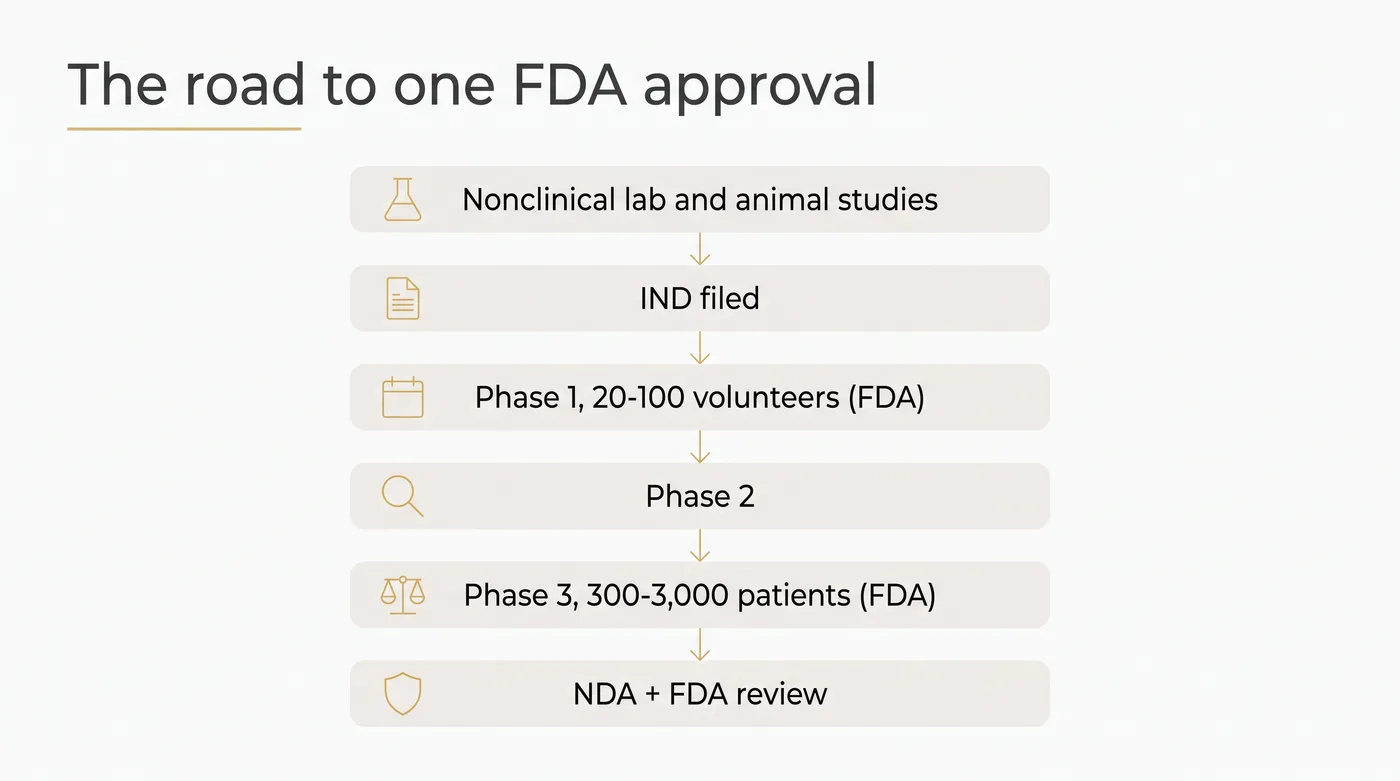
It is a comforting thought to imagine a giant federal laboratory somewhere, filled with government scientists in white coats methodically testing every powder on earth and sorting them into approved or rejected bins. The reality is far drier. Since 1938, U.S. law has required new drugs to be tested for safety before marketing, and the results must arrive neatly packaged in a new drug application (NDA) (FDA).
Someone has to run those studies, write that application and pay for both. The FDA calls that someone the sponsor. Usually, the sponsor is a pharmaceutical company with very deep pockets. Before testing in people even begins, this sponsor files an investigational new drug application (IND) packed with animal and toxicity data, manufacturing details and trial plans. The FDA has exactly 30 days to review these documents and can put the trials on hold (FDA). Only then do the three phases of human trials begin.
| Stage | What happens | Average length | Average cost |
|---|---|---|---|
| Nonclinical | Lab and animal studies answer basic safety questions | 31.2 months | 11.8 million |
| Phase 1 | 20 to 100 volunteers; first look at safety | 27.8 months | 7.1 million |
| Phase 2 | Up to several hundred patients; early evidence of effect and safety | 34.0 months | 21.0 million |
| Phase 3 | 300 to 3,000 patients; confirms effect and watches for adverse reactions | 38.0 months | 89.3 million |
| FDA review | The FDA reviews the NDA and decides | 16.2 months | 2.6 million, plus the user fee |
Add those average stage lengths end to end and you get a little over 12 years, according to an analysis in JAMA Network Open. Most candidates never see the finish line. The same study puts the odds of moving on at about 60% after phase 1, 36% after phase 2, 66% after phase 3 and 88% at review. Multiply all those fractions together, and you learn that roughly 1 in 8 candidates that start human trials actually earns an approval.
Then the sponsor has to pay the admission fee just to have the paperwork read. Under the Prescription Drug User Fee Act, created by Congress in 1992, sponsors pay the FDA to review applications. For fiscal year 2027 (October 2026 to September 2027), the fee for an application with clinical data is $4,600,753, plus a recurring annual program fee of $416,857 (FDA). The system does not test things out of curiosity. It tests them because someone wrote a massive cheque.
One approval costs about a billion dollars
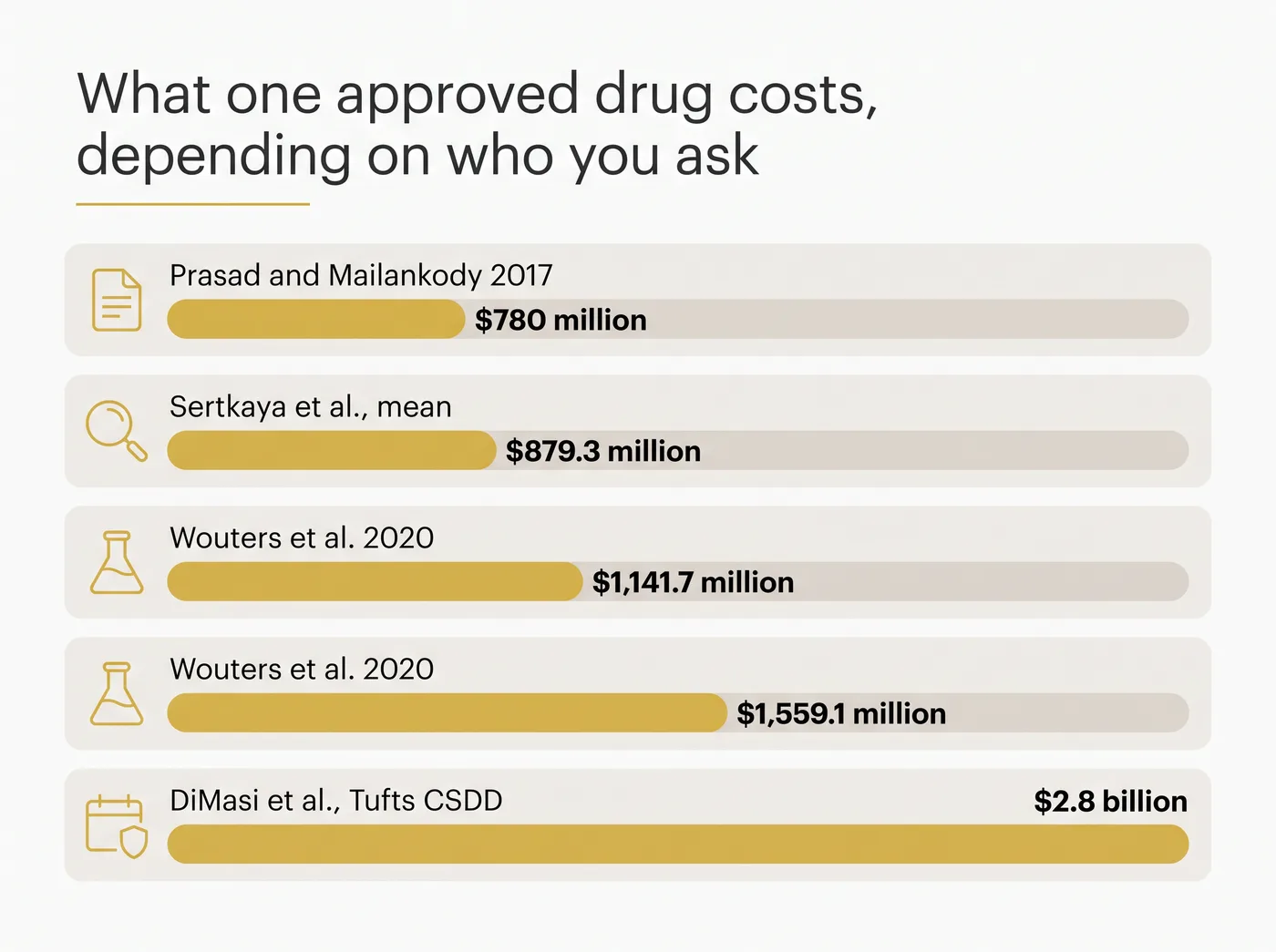
Those stage costs in the table are just for one candidate. But if you are an investor, you do not care about the cost of one candidate. You care about the cost per approved drug. The one winner has to pay for the seven failures that crashed out along the way. Money locked up in a laboratory for a decade has a steep price of its own, known as the cost of capital. When economists try to calculate the true total, serious estimates differ by a factor of three.
| Study | What it measured | Estimate |
|---|---|---|
| Sertkaya et al., JAMA Network Open | Modeled costs across 13 therapeutic areas, 2000 to 2018 | 879.3 million (mean) |
| Prasad and Mailankody, 2017, restated by Wouters et al. | Cancer drugs from companies bringing their first drug to market | 780 million (median) |
| Wouters et al., JAMA, 2020 (corrected 2022) | Public company filings on 63 drugs from 47 companies, approved 2009 to 2018 | 1,141.7 million (median); $1,559.1 million (mean) |
| DiMasi et al., Tufts Center for the Study of Drug Development, restated by Wouters et al. | Confidential cost data volunteered by anonymous companies | 2.8 billion (mean) |
Why is the spread so wide? The JAMA authors point to the mix of products studied, how little cost data is actually public, and different assumptions in the math, such as failure rates and the cost of capital. The type of drug alone changes the cost dramatically. In their study, the median for some drug classes was $2,771.6 million, against $765.9 million for nervous system drugs.
You can pick any row you like, and the lesson remains identical. Securing one approval is a bet of roughly a billion dollars or more, placed over more than a decade, with most of the chips lost along the way. Nobody plays at this table just for fun.
No patent, no payday
Nobody stakes a billion dollars without a clear plan to win it back. In the pharmaceutical world, the only way back to profitability is a long stretch of time with the market entirely to yourself as a single sponsor. That temporary monopoly comes from two distinct legal paths (FDA):
- Patents, issued by the U.S. Patent and Trademark Office, last 20 years from filing. Companies file early, so development eats a large share of that term before the first sale.
- Exclusivity, granted by the FDA at approval, blocks or delays competing approvals: 5 years for a new chemical entity, 7 years for an orphan drug (one for a rare disease) and 3 years for certain new clinical investigations.
Now picture a typical research peptide. These are short chains of amino acids whose sequences have sat untouched in the scientific literature for decades. BPC-157, for example, is reported to be 15 amino acids long (FDA briefing). Patents go to inventions that are genuinely new. A sequence anyone can look up in a dusty journal is incredibly hard to own, and any early patents on the original discovery have usually run out. A company could try to patent a modified version or a completely new formulation, but that legal shield protects only the new thing, not the old sequence itself.
A first approval for a plain sequence would still earn 5 years of new chemical entity exclusivity from the FDA. Five years is a painfully short window to recover a bill floating near a billion dollars. The moment that window closes, competitors can flood in with generic versions, having paid absolutely nothing for the trials. Every company sitting around the boardroom table does the same math, and decides to let someone else go first. So nobody goes, and the compound simply stays in the lab.
There is no grand conspiracy here. Nothing sinister is needed to explain why these lists of letters never make it to the pharmacy counter. The regulatory system answers a question only when someone stands to profit from the answer, and the raw sequences researchers ask about tend to fall right through that economic gap.
"Not approved" usually means nobody applied
Because the entire approval machinery starts with a sponsor's application, the phrase "not approved" usually describes a missing filing, rather than a verdict of failure. The FDA is a judge that rules only on the cases brought before it. A compound that nobody submitted has never been judged either way.
The FDA's own review of BPC-157, prepared for a July 2026 advisory meeting, shows exactly what an empty tray looks like. Agency staff found no United States Pharmacopeia monograph (an official quality standard) for the sequence, noted that it is not an ingredient in any FDA-approved drug, and found a single registered phase 1 study with no posted results (FDA briefing). That tells a story of a compound nobody has carried through the billion-dollar path, rather than a dangerous chemical the agency tested and turned down.
Of course, this logic runs strictly both ways. Never rejected also means never established. Without a wealthy sponsor's massive trials, there is no FDA finding on safety or effectiveness for any use whatsoever. This total lack of regulatory clearance is precisely why these materials are sold strictly for laboratory research and not as drugs.
The side door: compounding, and the July 2026 BPC-157 vote
If a billion-dollar NDA is the front door, compounding pharmacies sometimes operate a heavily regulated side door. Section 503A of the federal Food, Drug, and Cosmetic Act exempts qualifying compounded drugs from the standard approval requirement. However, a pharmacy cannot just mix up whatever it likes. Each bulk ingredient must pass one of three strict legal tests (FDA briefing):
- It meets an official USP or National Formulary monograph.
- It is an ingredient of an FDA-approved drug.
- It is on the FDA's 503A bulks list, which the agency builds through formal regulations.
Most research peptides pass precisely none of these tests. While reviewing outside nominations for the bulks list, the FDA sorts substances into interim categories, using category 2 for those with potential significant safety risks. On September 29, 2023, the agency added several peptides to category 2, ipamorelin acetate among them (FDA). BPC-157 also sat quietly in category 2 until its original nominators withdrew it, after which the FDA took up the evaluation on its own initiative.
The process can be contentious. In July 2026, the FDA's Pharmacy Compounding Advisory Committee reviewed seven peptides. The FDA staff formally proposed adding none of them to the approved bulks list. The panel decided to back most of them anyway, voting 8 to 6 in favour of BPC-157, and narrowly rejected emideltide (STAT). These votes are interesting, but they are not binding. The FDA always has the final word and will publish its ultimate decision as a proposed rule open to public comment.
Notice what is entirely missing from this pharmacy drama: an NDA. A favourable compounding decision merely lets licensed pharmacies prepare a specific substance under very set conditions. It does not magically mean anyone proved safety and effectiveness to the FDA standard.
Why the bar is so high
It is entirely fair to look at the billion-dollar price tag and ask whether the bar is simply set too high. The FDA's answer is written in history. In the early 1960s, an FDA medical officer named Frances Kelsey flatly refused to let the U.S. application for a drug called thalidomide take effect, arguing that the submitted safety data were suspiciously thin. She was right. By late 1961, the drug's severe harm to newborns abroad was widely known. In 1962, Congress passed the Kefauver-Harris Amendments, which explicitly required drug makers to prove to the FDA that their products are both safe and effective before marketing (FDA).
That protective logic still holds up today. Small, short studies can easily mislead a researcher. Massive, controlled trials involving hundreds or thousands of patients are how regulators separate a real effect from random noise, and how they catch rare adverse reactions before a population is exposed. It is exactly why FDA staff advised against all seven peptides in July 2026, pointing to insufficient safety and efficacy data across the board (STAT).
Rigour is what makes an approval worth trusting. Unfortunately, rigour costs an astonishing amount of money, and money rigidly follows ownership. Together, those facts neatly explain the vast shelf of unpatented compounds that science keeps asking about, and no sponsor will ever fund.
Where that leaves you: check the vial
When an unowned research material sits completely outside the regulatory machinery, the buyer desperately needs a way to check it. A lot number is the vial's passport; a chromatogram is a race where every impurity has to cross the finish line in public. That is the exact job a lab report does. NuuVive publishes the independent laboratory reports on file for its catalogue on the lab reports page, each featuring a report ID anyone can look up at the laboratory itself, and clearly shows the measured purity from those reports on product pages in the shop. Where a product has no report on file, the page plainly says so.
For an honest look at what a report can and cannot tell you, see how to read a lab report and the quality standards page. The ruthless economics of drug approval are entirely out of any single seller's hands. Checking what is actually in the vial is not, and you can start verifying batches over in the shop.
Questions
Does the FDA ever approve a compound on its own initiative?
No. A drug approval answers an application. A sponsor runs the costly studies and submits them, and the FDA decides based on that specific evidence. While the agency does evaluate some substances on its own for the compounding pharmacy 503A bulks list, that process is not a drug approval.
Could a university or nonprofit sponsor an approval instead of a company?
In principle, yes. The FDA explicitly counts research institutions and other organizations among possible trial sponsors. The real obstacle is simply the massive bill. The process demands the same expensive trials, the same user fee and the same lost decade, with absolutely no patent or market window to repay the academic funders.
Is a compounded drug the same as an FDA-approved drug?
No. Section 503A is a strict legal exemption from the approval requirement for licensed pharmacists and physicians who meet its specific conditions. A compounded product has not been through an NDA review, even when its active ingredient is successfully listed on the bulks list.
Do user fees mean companies pay the FDA for a yes?
They pay strictly for the review of the paperwork, not for the final outcome. The final decision rests entirely on the submitted clinical evidence, and rejection remains incredibly common even after millions are spent on fees.
Sources
- Step 3: Clinical Research. U.S. Food and Drug Administration
- Prescription Drug User Fee Amendments. U.S. Food and Drug Administration
- Frequently Asked Questions on Patents and Exclusivity. U.S. Food and Drug Administration
- A Brief History of the Center for Drug Evaluation and Research. U.S. Food and Drug Administration
- Estimated Research and Development Investment Needed to Bring a New Medicine to Market, 2009-2018 (Wouters, McKee, Luyten). JAMA
- Costs of Drug Development and Research and Development Intensity in the US, 2000-2018 (Sertkaya, Beleche, Jessup, Sommers). JAMA Network Open
- Certain Bulk Drug Substances for Use in Compounding that May Present Significant Safety Risks. U.S. Food and Drug Administration
- FDA Briefing Document, Pharmacy Compounding Advisory Committee, July 23-24, 2026 (overview). U.S. Food and Drug Administration
- FDA Briefing Document, Pharmacy Compounding Advisory Committee, July 23-24, 2026 (BPC-157 evaluation). U.S. Food and Drug Administration
- FDA advisory panel narrowly rejects compounding of one peptide, backs two others. STAT