
Peptide chemistry
ARA-290 identity: structure, molecular weight and form
NuuVive Journal · · 5 min read
Short answer
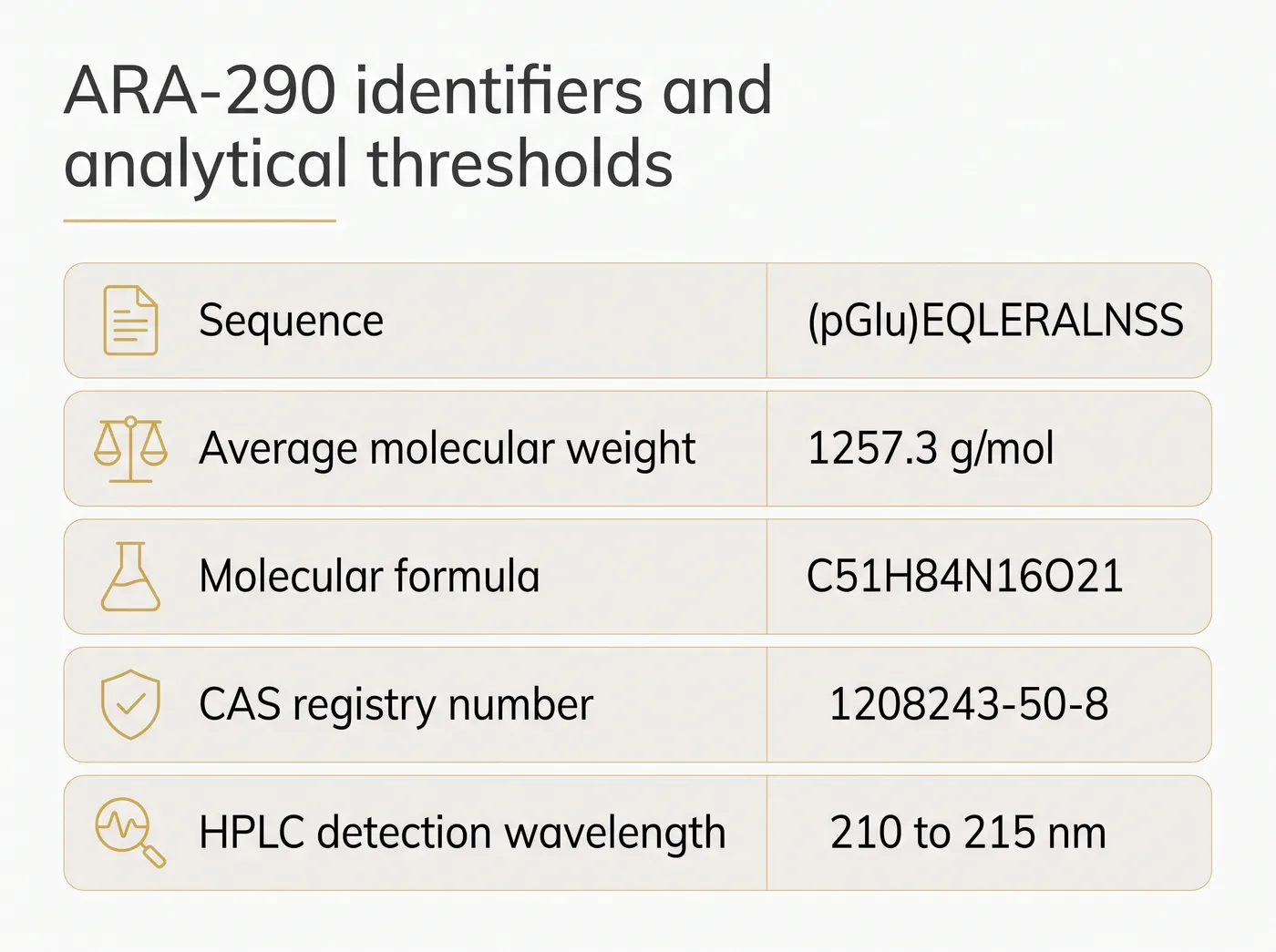
ARA-290 is a synthetic eleven-amino-acid peptide with the molecular formula C51H84N16O21 and an average molecular weight of 1257.3 g/mol. Registered under CAS number 1208243-50-8, its sequence is derived from the helix B domain of a parent glycoprotein. It is defined by a unique cyclised pyroglutamate residue at the N-terminus. It is supplied for laboratory analysis as a white lyophilised powder, requiring high-performance liquid chromatography and mass spectrometry to verify identity and purity.
Key takeaways
- ARA-290 is a linear synthetic undecapeptide with an average molecular weight of 1257.3 g/mol.
- The sequence features a closed pyroglutamate ring at the N-terminus, rendering it invisible to standard colorimetric ninhydrin tests.
- Because it lacks aromatic amino acids, high-performance liquid chromatography must evaluate the peptide bonds directly at 210 to 215 nanometres.
- The material is supplied as a lyophilised powder, where a failure in the freeze-drying step leaves residual moisture that skews net peptide mass calculations.
- Laboratory mass spectrometry must confirm a mass of 1257.3 Daltons; an 18-Dalton deviation indicates a failed cyclisation during synthesis.
The closed circle: unpicking the sequence
Before you open a lab report, it pays to know what the mass spectrometer is supposed to be looking for. ARA-290 is an eleven-amino-acid chain engineered to mimic the solvent-exposed spatial configuration of a specific section of a parent glycoprotein. But unlike that massive parent protein with its complex glycosylation and disulfide bridges, ARA-290 is a discrete synthetic fragment. Its primary sequence is defined as pGlu-Glu-Gln-Leu-Glu-Arg-Ala-Leu-Asn-Ser-Ser.
The defining feature of this sequence is right at the start. The N-terminus is capped by a pyroglutamate residue, often written as pGlu or Pyr. This is not a standard building block pulled off a shelf. It is formed by an intramolecular dehydration reaction where an N-terminal glutamine or glutamic acid closes its nitrogen into a pyrrolidone ring. This little ring changes everything about how the molecule behaves in an analytical laboratory.
Because the N-terminus is cyclised, the peptide lacks a free primary amine at the first position. If you send a sample of ARA-290 to a sequencing lab asking for a classic Edman degradation, they will return a blank report. The reagent cannot attach to a closed ring. Without that free amine, the peptide will not turn purple in a standard ninhydrin colour test. This "N-terminally blocked" structure is the reason why identity verification relies entirely on advanced mass spectrometry. If a seller provides a certificate claiming they chemically sequenced the sequence residue by residue, they are simply bluffing.
The molecular maths: formula and weight
The empirical molecular formula for the free base of ARA-290 is C51H84N16O21, carrying an average molecular weight of 1257.3 g/mol PubChem. This number is the anchor point for every legitimate certificate of analysis.
Mass spectrometry must establish that the dominant peak in the vial matches this theoretical mass. When looking at a mass spectrum, you are checking whether the synthesis machinery did its job. The formation of the pyroglutamate ring requires the loss of a small molecule, typically water, which weighs about 18 Daltons. If the N-terminal residue fails to undergo this intramolecular cyclisation during synthesis or when cleaved with TFA, the resulting chain remains open. An open-ring peptide has a mass of 1275.3 g/mol. A certificate showing a dominant peak at 1275 Daltons is not demonstrating an acceptable margin of error; it is describing a different molecule representing a process impurity.
The mass spectrometer evaluates the observed mass-to-charge ratio. In positive ion mode, a clean sample typically presents the singly charged ion near 1257.6 and the doubly charged ion near 629.3. If those numbers are missing from the report, the document is nothing more than decoration.
Surviving the freeze: the lyophilised powder
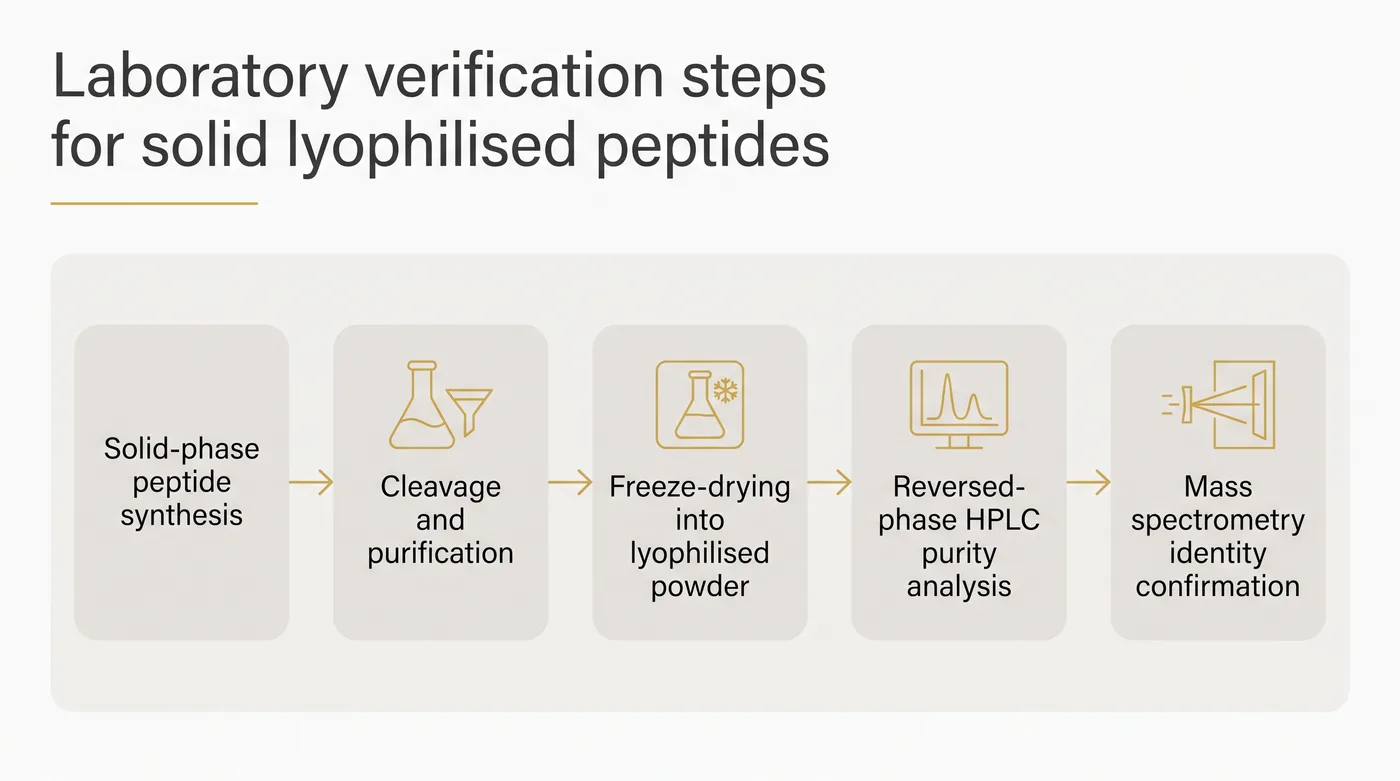
Laboratory ARA-290 is manufactured using solid-phase peptide synthesis, where amino acids are coupled sequentially onto a resin support Advances in Fmoc solid-phase peptide synthesis. Following synthesis, cleavage and purification, the peptide is supplied as a white lyophilised powder. It looks uniform and static in the vial, but the freeze-drying step is a controlled process.
The liquid solution is frozen and subjected to a deep vacuum, allowing the ice to sublimate directly into vapour without passing through a liquid phase. This primary and secondary drying determines the residual moisture left in the solid cake Design of freeze-drying processes for pharmaceuticals: practical advice. Residual moisture is not just a storage concern; it directly impacts the net peptide mass. A vial containing 10 milligrams of solid material never contains 10 milligrams of the pure ARA-290 sequence.
Synthesised peptides are recovered as salts to ensure solubility. Because the single arginine residue provides a basic site, ARA-290 is usually supplied as a trifluoroacetate or acetate salt. When you weigh the powder to prepare a molar solution, the mass includes the peptide, the counterions and the bound water. The actual net peptide content typically hovers between 70 percent and 85 percent of the total powder mass. Nitrogen determination or amino acid analysis is required to correct for this weight when precision is the goal.
Chromatograms and the analytical truth
While mass spectrometry confirms identity, high-performance liquid chromatography determines purity. A chromatogram is a race where every synthesis truncation, deletion sequence and degradation product has to cross the finish line in public. Reversed-phase chromatography separates these molecules based on their interaction with a stationary phase, usually under an acetonitrile and water gradient HPLC analysis and purification of peptides.
ARA-290 presents a unique challenge for standard chromatography. The sequence contains no aromatic amino acids like tryptophan or phenylalanine. As a result, it does not absorb ultraviolet light at the common 280-nanometre wavelength. An analyst running the column must evaluate purity by reading the absorbance of the peptide bonds themselves, typically monitored at 210 to 215 nanometres. If a vendor supplies a chromatogram tracked only at 280 nanometres, they are measuring a flat line and calling it perfect purity.
| Analytical target | Method required | Expected ARA-290 result |
|---|---|---|
| Molecular mass | Mass Spectrometry | 1257.3 g/mol |
| Chromatographic purity | RP-HPLC (210-215 nm) | Single dominant peak ≥99% |
| N-terminal identity | MS fragmentation | Confirmation of pyroglutamate ring |
| Endotoxin absence | LAL Assay | Below detection threshold |
For demanding laboratory applications, purity specifications are defined. The independent testing for NuuVive's ARA-290 verified the material at ≥99% purity (99.822%, Janoshik #110953) with a measured amount of 11.00 mg of solid material in the vial. You can verify the current lot specification, third-party lab reports and pricing directly on the ARA-290 catalogue page.
Questions
Why does ARA-290 lack a free primary amine?
The N-terminus of the sequence consists of a pyroglutamate residue. This residue is formed when the starting glutamine or glutamic acid cyclises during synthesis, turning its nitrogen into a closed pyrrolidone ring. This ring eliminates the free primary amine entirely.
Can Edman degradation sequence ARA-290?
No. Edman degradation requires a free primary amine to attach its chemical reagent and cleave the first amino acid. Because the N-terminus is blocked by the pyroglutamate ring, the reagent cannot bind, rendering the method useless for this sequence.
Why is UV detection set to 210 nm for this peptide?
The eleven-amino-acid sequence contains no aromatic residues, meaning it lacks the structures that absorb ultraviolet light at 280 nanometres. The chromatogram must be read at lower wavelengths like 210 to 215 nanometres, which directly detect the absorbance of the peptide bonds forming the backbone.
What does a mass of 1275 Daltons indicate on a lab report?
The theoretical average molecular weight is 1257.3 Daltons. An observed mass of 1275 Daltons is 18 Daltons too heavy, indicating a failure to shed a water molecule during synthesis. This proves the pyroglutamate ring failed to close, leaving an open-chain process impurity rather than the target material.
Sources
- HPLC analysis and purification of peptides (Methods in Molecular Biology 386). Springer
- Advances in Fmoc solid-phase peptide synthesis (Journal of Peptide Science). Wiley
- Design of freeze-drying processes for pharmaceuticals: practical advice (Pharmaceutical Research). Springer
- nih.gov. National Library of Medicine