
Peptide chemistry
DSIP identity: structure, molecular weight and form
NuuVive Journal · · 5 min read

Short answer
DSIP is a linear synthetic nonapeptide with the sequence Trp-Ala-Gly-Gly-Asp-Ala-Ser-Gly-Glu. It has a molecular formula of C35H48N10O15 and an average molecular weight of 848.81 g/mol. The peptide is highly soluble in aqueous media and is supplied as a lyophilised acetate or trifluoroacetate salt.
Key takeaways
- DSIP is a linear sequence of nine amino acids, free of disulfide bridges.
- The presence of tryptophan at the start of the chain provides a distinct ultraviolet signature for laboratory analysis.
- The solid powder in a vial is a peptide salt, meaning the gross weight includes counterions and residual moisture.
- High-performance liquid chromatography determines the relative purity of the sample, while mass spectrometry confirms its molecular weight.
The nine-letter molecular password
You open a package, unwrap the layers of protection, and stare at a small glass vial containing a white puck of lyophilised powder. It is supposed to be DSIP. To the naked eye, however, it looks like every other synthetic peptide on the market. Without laboratory equipment, a vial of high-purity nonapeptide is visually indistinguishable from a vial of baking soda. The only thing separating expensive dust from a verified reference material is the documentation proving its molecular structure.
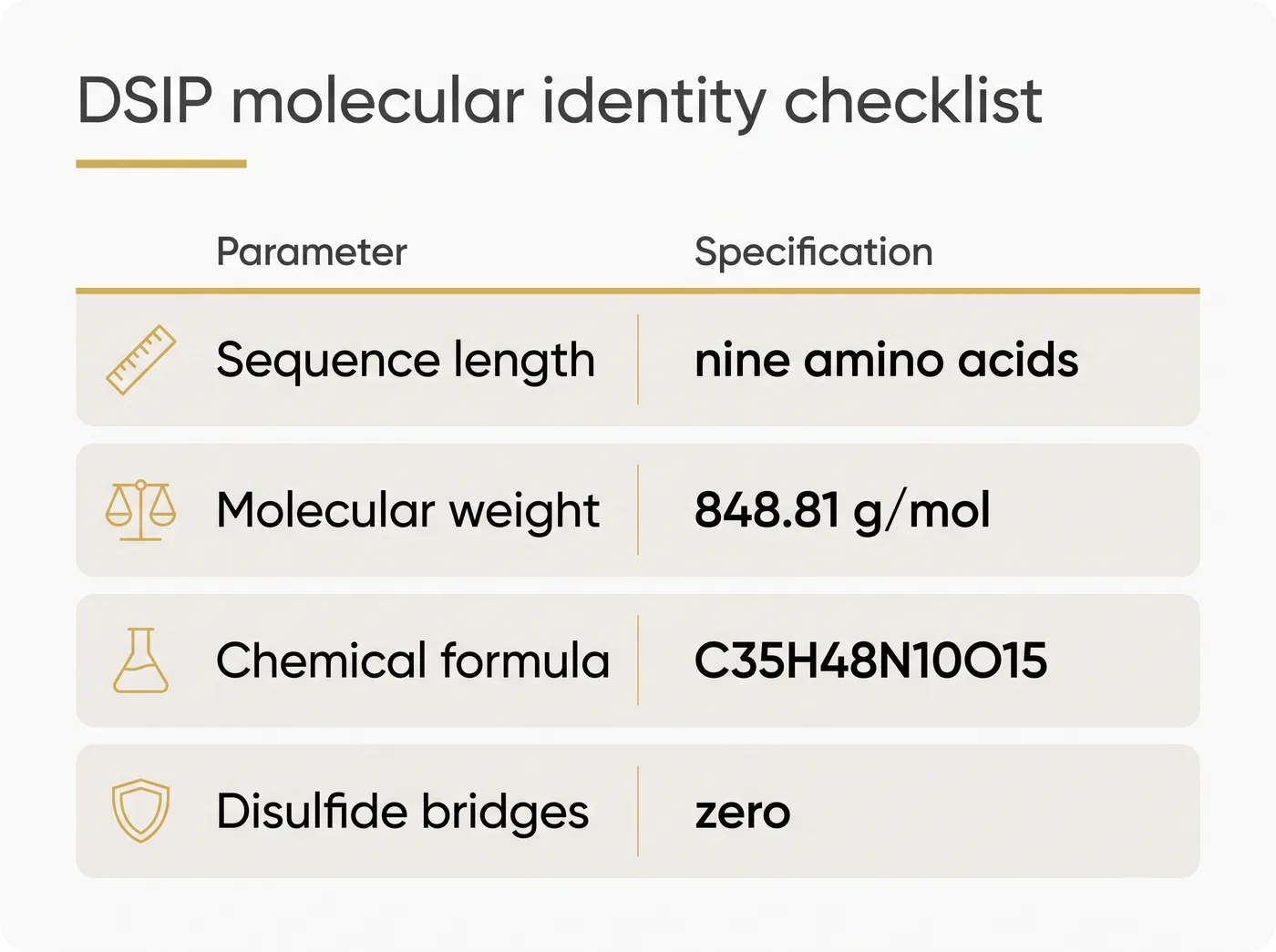
The structure of DSIP is famously straightforward. It is a linear nonapeptide, meaning it consists of nine amino acids strung together like beads on a wire. The sequence is tryptophan, alanine, glycine, glycine, aspartic acid, alanine, serine, glycine, and glutamic acid. In the shorthand of peptide chemistry, this is written as WAGGDASGE.
Unlike more complex molecules that fold into intricate three-dimensional shapes or feature circular structural loops, DSIP is linear. It contains zero cysteine residues, meaning it cannot form disulfide bridges. The ends of the molecule are also left unmodified, with a free amino terminus and a free carboxyl terminus. This arrangement gives the free peptide base a molecular formula of C35H48N10O15 and an average molecular weight of 848.81 g/mol. If you want to see how this unmodified chain compares to sequences built with custom tails, explore the structural differences between Selank and Semax.
Solubility and the tryptophan signature
The sequence of those nine amino acids dictates how the molecule behaves when you handle it in the laboratory. Three of the nine positions are occupied by glycine, the smallest and most flexible amino acid. This gives the peptide backbone a high degree of flexibility, avoiding the rigid, clunky structures that sometimes complicate solid-phase peptide synthesis.
More importantly, the sequence features two acidic residues. Aspartic acid sits at position five, and glutamic acid anchors the end at position nine. Under standard laboratory conditions, these residues give the molecule a net negative charge, making the peptide highly soluble in aqueous media. You do not need harsh organic solvents to dissolve it for liquid chromatography; purified water handles the job.
The most interesting feature for analytical chemists, however, is the very first amino acid in the chain. Tryptophan is a bulky molecule featuring an indole ring, and it acts as a powerful intrinsic chromophore. When you shine ultraviolet light on it, tryptophan absorbs the energy brilliantly. This allows analysts to track the peptide with high precision during purity testing, giving DSIP a built-in optical signature.
The freeze-drying step and salt mass
Synthetic peptides are rarely isolated as pure, floating chains of amino acids. They are almost always manufactured and supplied as salts. During the final stages of production, the peptide is cleaved with TFA to remove protective groups from the amino acid side chains Advances in Fmoc solid-phase peptide synthesis. Following purification, the liquid solution undergoes a freeze-drying step to remove the solvents under a vacuum, leaving behind the stable solid you see in the vial.
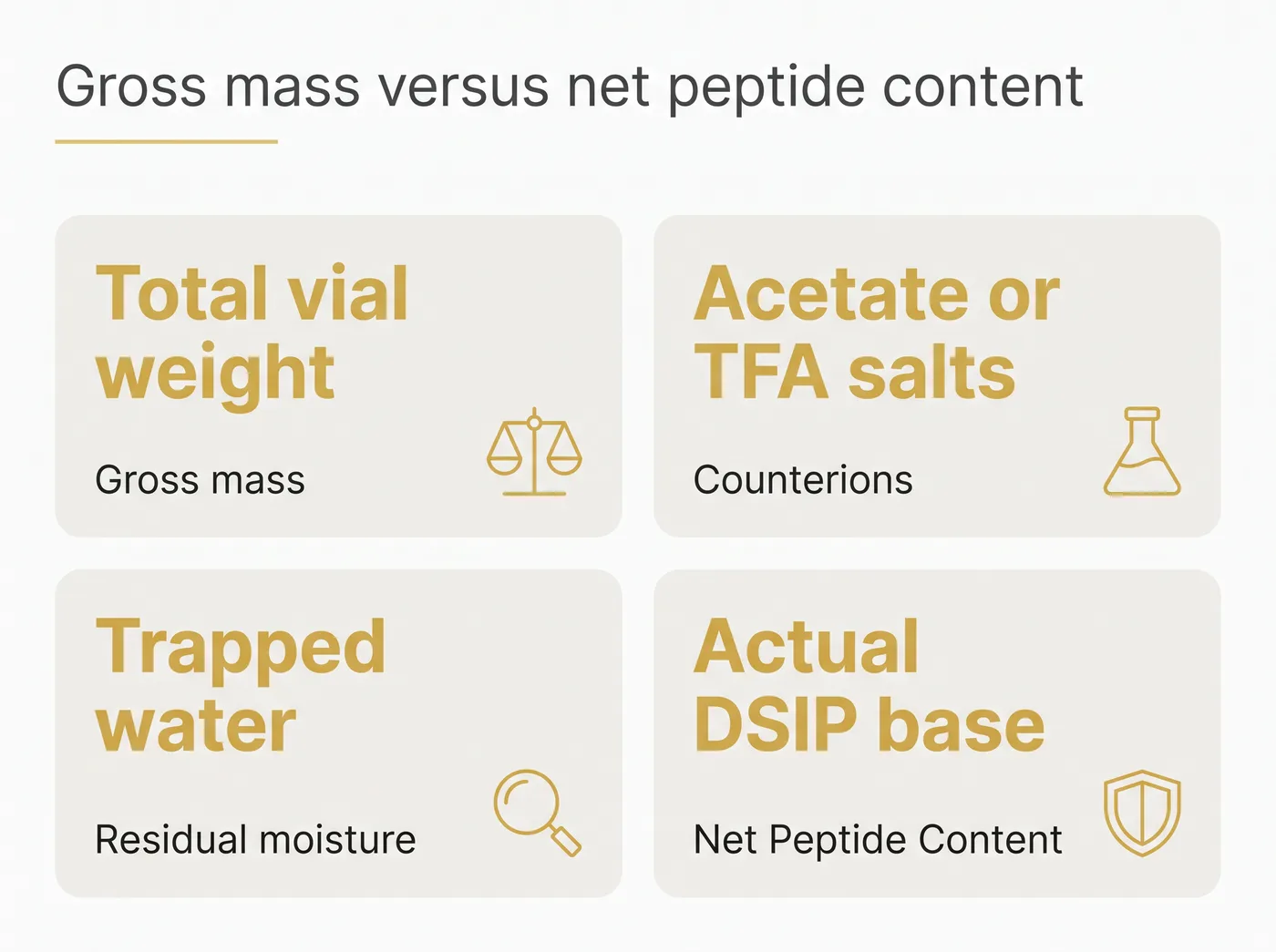
This process means the final white cake is a combination of the active peptide sequence, attached counterions like acetate or trifluoroacetate, and a small amount of residual moisture trapped in the solid matrix Design of freeze-drying processes for pharmaceuticals: practical advice. The total weight of that solid puck is the gross mass.
The distinction between gross mass and Net Peptide Content is where careless mathematics ruins laboratory measurements. The actual mass of the DSIP base is mathematically lower than the listed gross mass. The counterions and moisture can account for ten to thirty percent of the total weight. To calculate molar concentrations for a liquid chromatography sample load, you must use the Net Peptide Content from the analytical report, not the gross weight of the solid.
Catching synthesis errors in the chromatogram
Proving that a sample is highly pure requires a race, and Reversed-Phase High-Performance Liquid Chromatography (RP-HPLC) is the track. A dissolved sample is pushed through a tightly packed analytical column using a mobile phase, typically a gradient of water and acetonitrile containing an ion-pairing agent to keep the peak shapes sharp HPLC analysis and purification of peptides.
Because every molecule interacts with the column differently, they cross the finish line at different times. The main DSIP molecule will elute at a specific retention time, registering as a massive spike on the detector. Any synthesis errors, such as sequences missing an amino acid or chains that failed to properly detach from the solid resin, will cross the finish line slightly before or after the main peak.
Thanks to that bulky tryptophan residue at the start of the sequence, analysts can monitor the race at two distinct wavelengths. Monitoring at 214 nanometres catches the peptide bonds, while monitoring at 280 nanometres specifically highlights the tryptophan. A clean lab report will show a single, sharp mountain on the graph, confirming that the manufacturing process left virtually no process-related impurities behind.
Why purity is not identity
A chromatogram with a single peak is reassuring, but it carries a fatal blind spot. HPLC measures relative purity, not absolute chemical identity. A sample could be free of impurities and still be the wrong molecule. To prove that the white powder is actually DSIP, the laboratory must weigh the molecule.
Mass spectrometry is the definitive tool for molecular identity. By ionizing the sample and passing it through a magnetic field, the instrument measures the mass-to-charge ratio of the compound. For DSIP, the primary mass peak must align with the expected molecular weight of 848.81 g/mol.
If a certificate of analysis hands you a 99% purity score but omits the mass spectrometry data, the document is only telling you half the story. You know the material is pure, but you have to guess what it is. True transparency requires both orthogonal methods working together. To see what properly validated documentation looks like in practice, check NuuVive's DSIP for the current price, stock and measured purity.
Questions
Why does DSIP have a free N-terminus and C-terminus?
Unlike some synthetic peptides that are modified with acetyl or amide groups to alter their stability in solution, the standard DSIP sequence remains unmodified at both ends. This matches the original linear structure catalogued under its CAS registry number.
Can you visually confirm the quality of the lyophilised powder?
No. The appearance of a freeze-dried cake provides no chemical information. A solid white puck and a slightly fragmented, powdery cake can both be highly pure DSIP, as the visual texture depends on the freezing rate and the counterion present.
Why is the tryptophan residue important for laboratory analysis?
Tryptophan contains a large indole ring that acts as an intrinsic chromophore. This allows the molecule to absorb ultraviolet light strongly at 280 nanometres, giving analytical chemists a secondary, highly specific wavelength to monitor during chromatography.
What happens if you ignore the salt mass?
If you assume the gross weight of the powder is pure peptide base, the calculated molarity will be artificially high. You must subtract the mass of the acetate or trifluoroacetate counterions and any residual moisture to determine the true Net Peptide Content.