
Compounds explained
Selank vs Semax: what is the difference?
NuuVive Journal · · 5 min read
Short answer
Selank and Semax are synthetic seven-amino-acid peptides developed by the same Russian institute. Both share a C-terminal Pro-Gly-Pro sequence to improve stability. The difference lies in their parent molecules and research focus: Selank is derived from the immunomodulator tuftsin and is studied in animal models of anxiety and stress, while Semax is derived from an adrenocorticotropic hormone fragment and is studied in animal models of stroke and cognitive deficits.
Key takeaways
- Selank (751.89 g/mol) is a tuftsin analogue investigated primarily in animal models of anxiety and stress.
- Semax (813.93 g/mol) is derived from ACTH(4-10) and is researched in animal models of ischemic stroke.
- Neither compound has been evaluated in large-scale human clinical trials in the West, nor are they FDA-approved drugs.
- Semax was included in the 2026 HHS interim enforcement discretion policy for compounding pharmacies, while Selank was not.
- Laboratory supply vials must report separate purity and mass figures for each active ingredient when the two are blended.
Two peptides, one stabilizing tail
When you read about these two compounds side by side, the similarities are hard to miss. Both were developed in the late 1990s and early 1990s respectively, by the same research group at the Institute of Molecular Genetics of the Russian Academy of Sciences. Both are synthetic heptapeptides (seven amino acids long). And both end in the exact same sequence: Pro-Gly-Pro.
That shared tail is not a coincidence. It is an engineering choice. Small peptides break down quickly when exposed to the enzymes that act as the body's cleanup crew. The Russian researchers found that attaching the Pro-Gly-Pro sequence to the end of a peptide molecule provided a structural shield, delaying degradation. This shared structural feature is why the two compounds are often grouped together, even though their functions differ entirely.
The difference between them is found in the first four amino acids. Selank 1 is built on a fragment of tuftsin, an endogenous peptide associated with immune function. Semax 2 is built on a fragment of adrenocorticotropic hormone (ACTH 4-10), completely stripped of its hormonal activity. They are different molecules carrying the same protective armour.
What Selank has been studied for
Selank's research profile is anchored in the modulation of neurotransmitters and stress responses. In laboratory cell models, it has been investigated for its ability to inhibit enkephalin-degrading enzymes, essentially studying whether it can slow the breakdown of the brain's natural regulatory peptides 8.
In animal studies, researchers frequently use rodent models of chronic stress and anxiety. For example, Wistar rats evaluated in novel object recognition tests and Barnes mazes have been used to track how the peptide influences monoamine neurotransmitters like serotonin and GABAergic signalling pathways.
Human clinical evidence is confined to small-scale trials conducted primarily in Eastern Europe. One active-comparator trial studied 62 patients with generalized anxiety disorder and neurasthenia, evaluating the peptide against the benzodiazepine medazepam. Another study used fMRI imaging on 52 participants to map which distinct brain networks were engaged 3. However, no large, multi-center, placebo-controlled clinical trials have evaluated it for Western regulatory bodies.
What Semax has been studied for
If Selank's literature focuses on anxiety and stress models, Semax's literature focuses on models of stroke and cognitive deficits. In cell models, investigations often monitor the upregulation of brain-derived neurotrophic factor (BDNF) and its receptor TrkB, proteins critical for neuron survival and growth 4.
Animal research is heavily weighted toward models of cerebral ischemia (stroke) and cognitive deficits. Researchers track endpoints such as neurological performance, nitric oxide regulation, and performance on memory tests after induced injuries or oxidative stress.
Like Selank, human studies are limited and regional. One 110-patient cohort in Russia measured plasma BDNF levels and neurological function in post-stroke patients. A resting-state fMRI study has also observed Semax's modulation of networks in human brains. Despite decades of study, large-scale Phase III clinical trials evaluating Semax in the US do not exist. If you want the whole story on this molecule, check out the complete guide to Semax research and policy.
Comparing the compounds
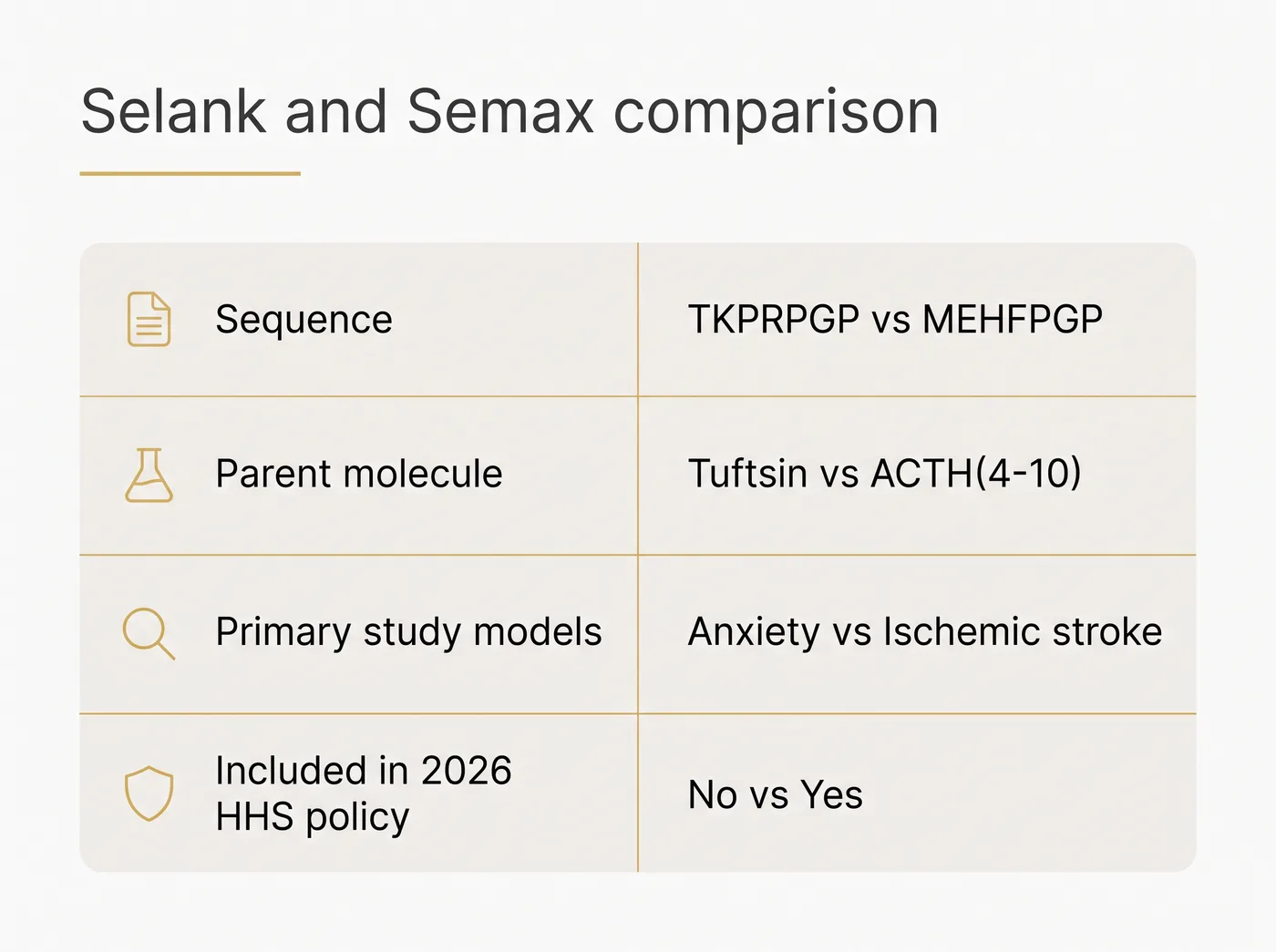
While the structural similarities are clear, the origins and primary research models separate the two distinct heptapeptides.
| Feature | Selank | Semax |
|---|---|---|
| Sequence | TKPRPGP | MEHFPGP |
| Parent molecule | Tuftsin analogue | ACTH(4-10) analogue |
| Molecular weight | 751.89 g/mol | 813.93 g/mol |
| Primary animal models | Anxiety, chronic stress, behavioural tests | Ischemic stroke, cognitive deficits |
| Cellular targets studied | Enkephalinase inhibition, GABAergic genes | BDNF upregulation, TrkB activation |
The 2026 HHS policy divide
Neither compound is an FDA-approved drug. Both are considered investigational or unapproved compounds in the United States. For years, neither could be legally compounded by 503A pharmacies because they lacked a United States Pharmacopeia (USP) monograph and were not components of an FDA-approved drug.
That regulatory status shifted slightly in late 2026. Following reviews by the FDA Pharmacy Compounding Advisory Committee (PCAC) 6, HHS announced a draft interim enforcement discretion policy 5.
This policy created a divide between the two compounds. Semax was listed as a substance subject to compounding enforcement discretion (under specific conditions, such as single-ingredient formulation and patient-specific prescriptions) while formal rulemaking is pending 7. Selank, however, was not favourably reviewed and is absent from the policy 9. It remains entirely unapproved and outside the bounds of the enforcement discretion framework.
What to check on a blended lab report
In laboratory supply, these two compounds are sometimes sold together in a single vial. When evaluating a certificate of analysis (COA) for a blend, the rules of analytical chemistry require specificity. A single purity percentage for the entire vial is meaningless.
A proper lab report for a blended product like Selank + Semax must list the compounds separately. The high-performance liquid chromatography (HPLC) test separates the molecules based on their distinct properties (like their differing molecular weights). The resulting chromatogram will show distinct peaks for Selank and Semax, and the report must state the purity of each.
The same applies to the net peptide content (the actual mass of the active ingredient). A blended vial claiming 10 mg of each compound must have lab results confirming both figures. For example, a recent independent test of NuuVive's Selank + Semax blend (Janoshik #93614) measured 11.97 mg of Selank (at 99.682% purity) and 11.86 mg of Semax (at 99.248% purity). If a vendor only provides one purity figure or one mass figure for a dual-ingredient vial, the report is incomplete.
Questions
Are Selank and Semax approved by the FDA?
No. Neither Selank nor Semax is an FDA-approved drug in the United States. They are investigational compounds lacking large-scale Phase III clinical trial data.
Why do both peptides end in the same sequence?
Both end in the amino acids Pro-Gly-Pro. This sequence was attached by the developing researchers to improve structural stability and delay degradation by enzymes.
Can compounding pharmacies make both peptides?
Under a draft HHS policy announced in late 2026, Semax is subject to enforcement discretion allowing compounding under strict conditions. Selank is not covered by this policy and remains ineligible for legal compounding.
How can you verify the contents of a blended vial?
A reliable laboratory report must provide separate purity percentages and measured mass figures for each individual peptide in the blend, as HPLC analysis separates the distinct molecules.
Sources
- pubchem.ncbi.nlm.nih.gov. National Library of Medicine
- pubchem.ncbi.nlm.nih.gov. National Library of Medicine
- pubmed.ncbi.nlm.nih.gov. National Library of Medicine
- pubmed.ncbi.nlm.nih.gov. National Library of Medicine
- HHS Issues Interim Enforcement Discretion Policy for Compounding of 6 Peptides | Insights | Holland & Knight. hklaw.com
- fda.gov. U.S. FDA
- HHS Announces Draft Enforcement Discretion Policy Paving Way for Pharmacies to Compound Certain Peptides While FDA Rulemaking Is Pending | Advisories | Arnold & Porter. arnoldporter.com
- pubmed.ncbi.nlm.nih.gov. National Library of Medicine
- www.fda.gov. U.S. FDA