
Legal status
Is KPV legal in the US? Origin, research and FDA status
NuuVive Journal · · 6 min read
Short answer
KPV is legal to purchase and possess as a research compound for laboratory use in the US. It is not an FDA-approved drug. Following a July 2026 advisory committee vote, the compound was included in the HHS October 2026 draft enforcement discretion policy for pharmacy compounding. However, the FDA has explicitly stated that there are no registered human clinical trials and insufficient human exposure data for the compound.
Key takeaways
- KPV is a three-amino-acid fragment derived from the naturally occurring hormone alpha-MSH.
- The compound has been studied exclusively in cell cultures and animal models, with zero registered human clinical trials.
- Preclinical research focuses primarily on its interaction with inflammatory signaling pathways in murine models of intestinal and skin injury.
- While not FDA-approved, an October 2026 HHS draft policy placed KPV under temporary enforcement discretion for specific compounding pharmacies.
- Valid laboratory testing must confirm its identity and purity using high-performance liquid chromatography and mass spectrometry.
The molecule at the end of the chain
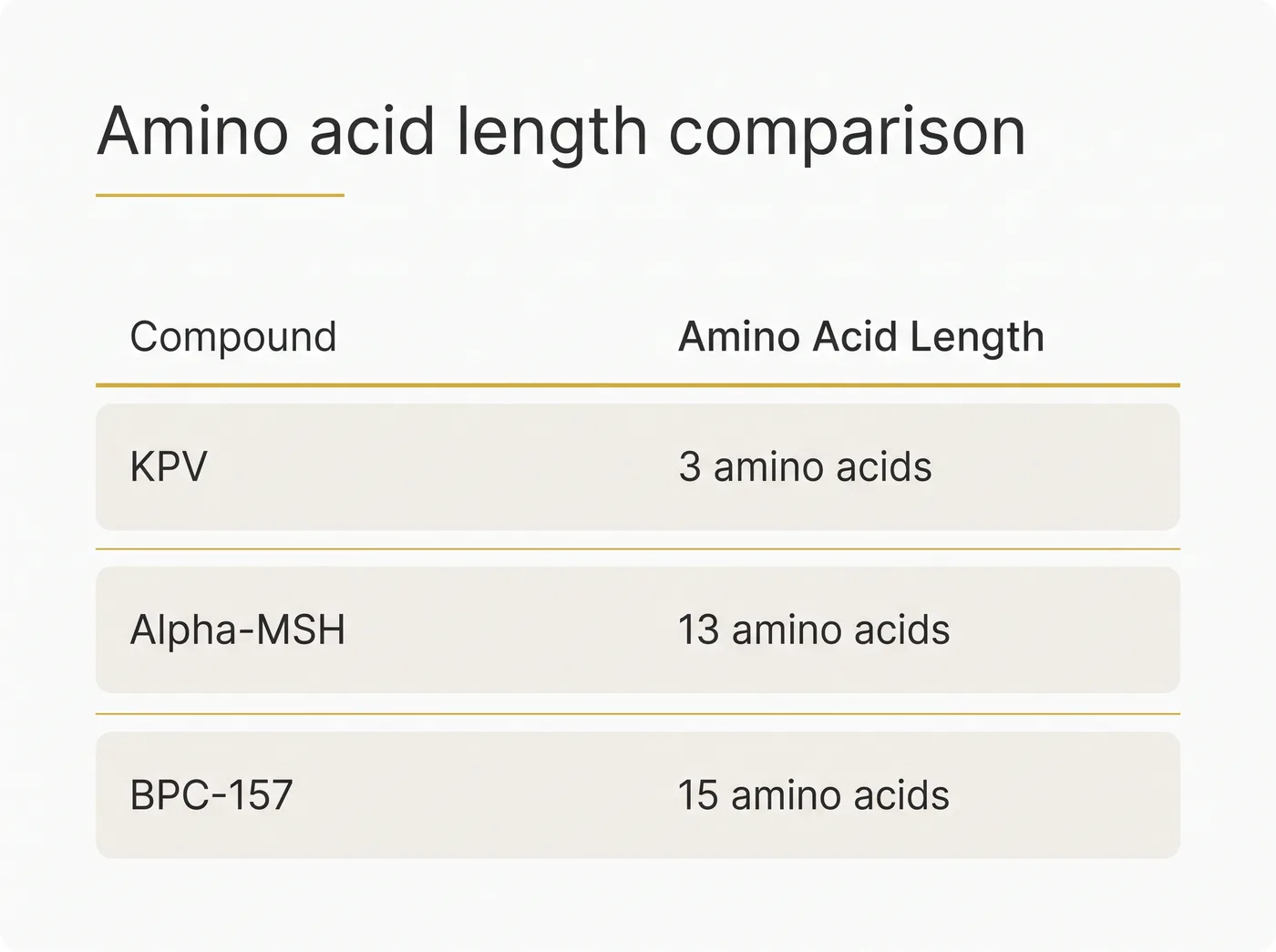
Look around the peptide research space long enough and you will notice a trend: researchers love isolating the tiny fragments of larger molecules that actually do the biochemical heavy lifting. KPV is the poster child for this approach. It is just three amino acids, lysine, proline, and valine, strung together. That makes it a tripeptide. With a molecular weight of exactly 342.43 g/mol, it is remarkably small National Library of Medicine.
Its origin story starts with a much larger, 13-amino-acid hormone called alpha-melanocyte-stimulating hormone, or alpha-MSH. Alpha-MSH is a naturally occurring peptide that binds to a variety of melanocortin receptors in animal models. When scientists wanted to understand exactly which parts of that 13-link chain were responsible for different receptor interactions, they started snipping it into pieces.
They discovered that the very end of the alpha-MSH chain, positions 11 through 13, contained the KPV sequence. By isolating this specific tripeptide, researchers created a compound that could be studied entirely on its own, separate from the parent hormone's broader receptor profile. It is a classic reductionist approach: strip away the parts of the molecule you are not studying to get a clearer look at the parts you are. For another clear example of scientists isolating a small fragment from a massive hormone, you can explore the ARA-290 research and origin story.
Snipping the hormone: KPV vs Alpha-MSH
To understand why researchers bother with a three-amino-acid fragment when the full hormone exists, you have to look at what alpha-MSH actually binds to. The parent hormone interacts with a broad range of melanocortin receptors National Library of Medicine. In animal models, some of those receptors modulate inflammatory signaling, while others trigger melanogenesis, which is the biological process of pigmentation.
If a laboratory is strictly interested in studying inflammatory pathways, the pigmentation receptors are a confounding variable. KPV lacks the specific sequence motif required to bind to the receptors that cause pigmentation. By using the isolated fragment, researchers can investigate the inflammatory signaling pathways without triggering the melanotropic effects associated with the full hormone.
It is the biochemical equivalent of removing the radio and air conditioning from a race car to focus entirely on the engine. You lose the luxury features, but you get a much cleaner look at the mechanics of the drivetrain. This precision is exactly what laboratories mapping cellular pathways require.
The BPC-157 comparison
If you spend any time reading about KPV, you will inevitably see it mentioned alongside BPC-157. They are often grouped together in research discussions, but chemically and biologically, they are entirely different entities.
KPV is a naturally derived fragment of a pituitary hormone, consisting of just three amino acids. Its research focus is heavily skewed toward intracellular inflammatory signaling pathways, specifically the NF-kB cascade, and it is frequently studied in models of mucosal inflammation National Library of Medicine.
BPC-157, on the other hand, is a 15-amino-acid synthetic peptide based on a sequence originally isolated from human gastric juice National Library of Medicine. The research surrounding BPC-157 is predominantly focused on angiogenesis, the formation of new blood vessels, and broad tissue models, such as tendon and ligament injury National Library of Medicine. They belong to different classes, originate from different biological systems, and are investigated for entirely different mechanisms of action.
The research reality: mice, cells and missing human trials
Here is the part where the marketing fog usually thickens, but the actual data clarifies it. The entire evidence base for KPV consists strictly of in vitro cell culture studies and in vivo animal models.
In the laboratory, KPV has been studied in murine chemically induced colitis models, which are essentially mice with laboratory-induced intestinal inflammation. Researchers evaluate how the tripeptide is transported into cells via the PepT1 di/tripeptide transporter, and how it interacts with inflammatory signaling cascades like the MAP kinase pathways. It has also been evaluated in cell culture models of inflammatory skin conditions and mucosal injury. Preclinical research has even investigated targeted delivery systems, such as hyaluronic-acid functionalized nanoparticles and hydrogel matrices designed to direct the compound to colonic cells.
What you will not find are human trials. There are no published, large-scale, controlled human clinical trials evaluating KPV for any condition. If you search the federal database for registered trials, the results are completely empty clinicaltrials.gov. The FDA's own 2026 scientific review explicitly stated that there is a lack of clinical studies and human exposure data regarding the compound. Anyone claiming this is an established human intervention is simply inventing facts.
The 2026 regulatory showdown
The legal and regulatory status of KPV in the US is a masterclass in bureaucratic complexity. First, the simple part: KPV is not an FDA-approved drug. It has never gone through the new drug application process to establish manufacturing quality or clinical outcomes. It sits entirely outside the standard pharmaceutical approval pathway.
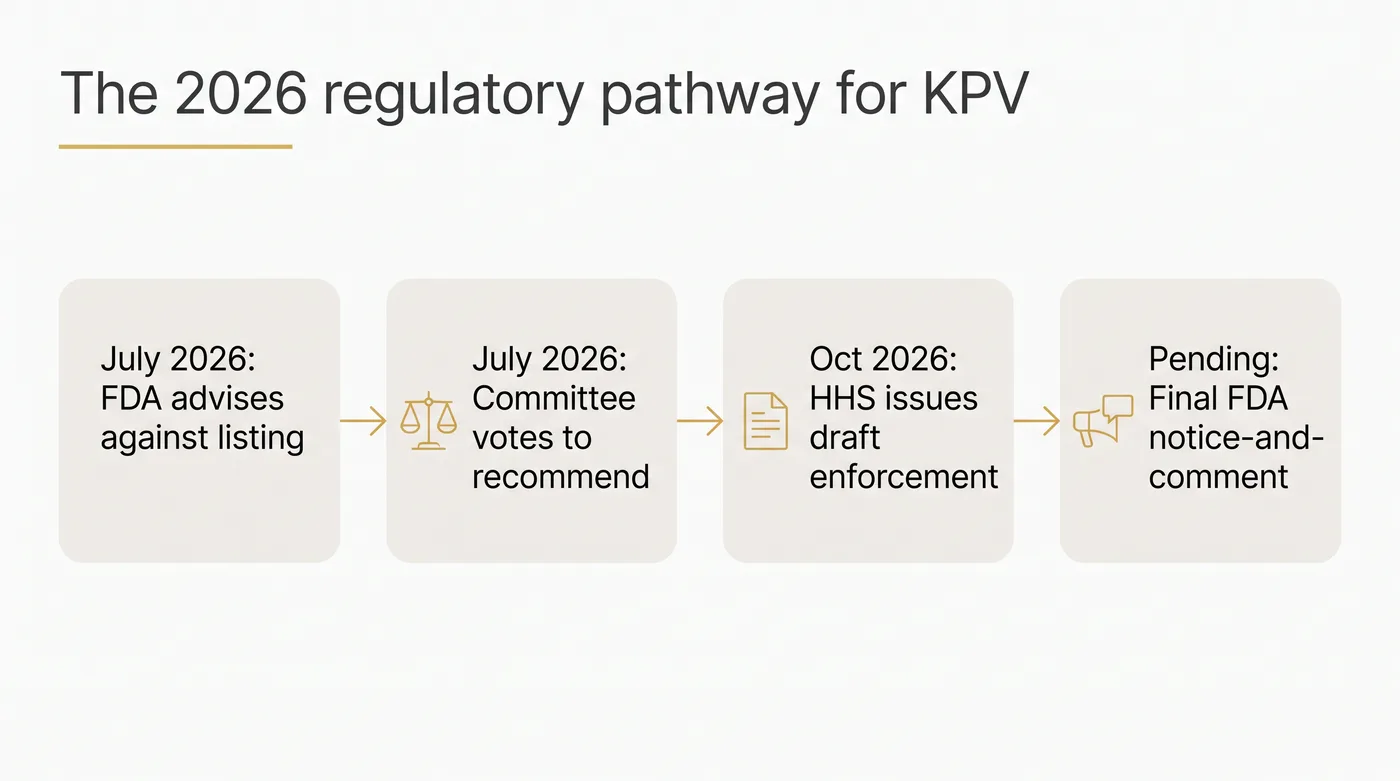
The complexity comes from the pharmacy compounding side. Under Section 503A of the Food, Drug, and Cosmetic Act, compounding pharmacies can sometimes prepare medications using bulk drug substances that are not FDA-approved, provided those substances appear on a specific federal list. On July 23 and 24, 2026, the FDA's Pharmacy Compounding Advisory Committee met to review KPV U.S. FDA.
The meeting was a stark split. FDA scientific reviewers recommended against adding KPV to the 503A Bulks List, citing the glaring lack of human exposure and outcome data. The advisory committee, however, voted to recommend adding it. Because the committee's vote is non-binding, the FDA still has to complete a formal rulemaking process before anything is finalized.
In the meantime, HHS published a draft enforcement discretion policy in October 2026. KPV was named in Appendix A, Category II of this draft policy. This means it is subject to specific compounding restrictions and enforcement discretion while the FDA finishes its review. It is a temporary regulatory waiting room, not a stamp of approval.
Verifying the powder
When a compound exists in this regulatory gray area, the burden of verifying what is actually in the vial falls entirely on the buyer. A label with a chemical name is just a piece of paper; the only thing that matters is the analytical chemistry.
For a molecule as small as KPV, you need to see two specific pieces of data on a certificate of analysis. The first is high-performance liquid chromatography, which separates the contents of the vial to show you the purity. A chromatogram is essentially a race where every impurity has to cross the finish line in public. You want to see a single, sharp peak indicating that the vast majority of the powder is the target compound.
The second is mass spectrometry, which confirms the identity of that peak. Since KPV has a molecular weight of 342.43 g/mol, the mass spectrometer must show a corresponding mass-to-charge ratio. If a vendor cannot produce a recent, third-party lab report showing both of these tests, they are asking you to fund their mystery chemistry experiment. Always check the batch's measured purity and the exact report number on NuuVive's KPV page before making a decision.
Questions
Is KPV a controlled substance?
No. KPV is not scheduled under the Controlled Substances Act. It is legal to purchase and possess as a research chemical for laboratory use, though it is not approved for human consumption.
Can KPV be patented?
Because KPV is a naturally occurring sequence fragment of alpha-MSH, the basic molecule itself generally cannot be patented. Pharmaceutical companies typically focus on patenting novel delivery mechanisms, such as the hydrogel matrices currently being studied in preclinical models, rather than the raw peptide.
Why did the FDA scientists advise against compounding KPV?
During the July 2026 advisory committee meeting, FDA reviewers pointed to the complete absence of registered human clinical trials. Without controlled human exposure data, the agency's scientists concluded there was insufficient evidence to establish a clear clinical profile for widespread compounding.
Does KPV require cold storage?
Like most lyophilized research peptides, KPV is generally stable at room temperature for short periods during shipping. However, for long-term laboratory storage, it should be kept in a freezer to prevent degradation of the amino acid bonds.
Sources
- pubchem.ncbi.nlm.nih.gov. National Library of Medicine
- pubchem.ncbi.nlm.nih.gov. National Library of Medicine
- pubchem.ncbi.nlm.nih.gov. National Library of Medicine
- pubmed.ncbi.nlm.nih.gov. National Library of Medicine
- pubmed.ncbi.nlm.nih.gov. National Library of Medicine
- ClinicalTrials.gov. clinicaltrials.gov
- www.fda.gov. U.S. FDA