
Peptide chemistry
SNAP-8 identity: structure, molecular weight and form
NuuVive Journal · · 6 min read

Short answer
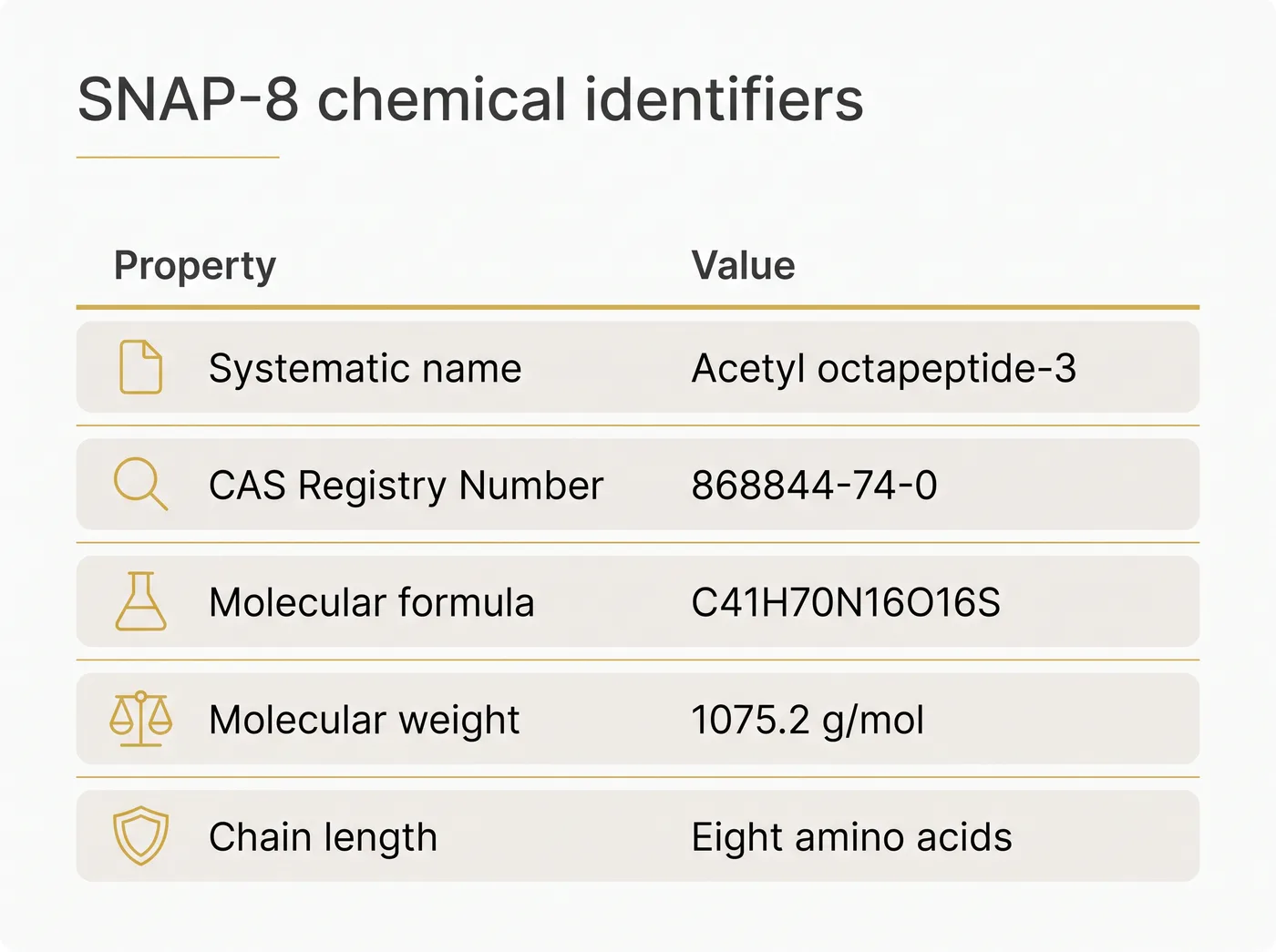
SNAP-8 (CAS 868844-74-0), also catalogued as acetyl octapeptide-3, is a synthetic linear peptide with the molecular formula C41H70N16O16S and a molecular weight of 1075.2 g/mol. Its eight-amino-acid sequence is Ac-Glu-Glu-Met-Gln-Arg-Arg-Ala-Asp-NH2. Manufactured via solid-phase peptide synthesis, it is supplied as a lyophilised powder, typically isolated as a trifluoroacetate salt, and requires reversed-phase high-performance liquid chromatography alongside mass spectrometry to verify its chromatographic purity and molecular mass.
Key takeaways
- SNAP-8 is a linear octapeptide featuring specific terminal modifications that remove free electrical charges from the chain ends.
- The sequence contains a single methionine residue, making the molecule highly sensitive to atmospheric oxidation if mishandled.
- Solid-phase synthesis leaves behind residual trifluoroacetate counter-ions, meaning the freeze-dried powder is a salt rather than a pure free base.
- Verifying a sample requires checking both the 1075.2 g/mol intact mass via spectrometry and the chromatographic purity via reversed-phase chromatography.
The chemical passport of an octapeptide
You hand over a laboratory budget, open the parcel, and stare at a tiny glass vial containing a white puck of freeze-dried powder. It looks like every other synthetic peptide on the market. The only thing separating a precise analytical reference material from an expensive vial of sweepings is the documentation backing it up. Without a verified chemical identity, you are working entirely in the dark.
SNAP-8 has a chemical passport that is highly specific. Systematically catalogued as acetyl octapeptide-3, it carries the CAS registry number 868844-74-0. It is a linear molecule with the molecular formula C41H70N16O16S. Because it lacks cysteine residues, it forms no internal disulfide bridges, leaving it as a flexible, straight chain of eight amino acids.
Dissecting the eight-residue chain
The sequence itself is written as Ac-EEMQRRAD-NH2, or Ac-Glu-Glu-Met-Gln-Arg-Arg-Ala-Asp-NH2. Before looking at the amino acids, notice the chemical bookends. An acetyl group (Ac-) caps the N-terminus, while a primary amide (-NH2) locks down the C-terminus. These synthetic modifications eliminate the free electrical charges that normally sit at the ends of a severed protein chain. By masking those charges, the overall charge distribution of the molecule shifts entirely, altering how it behaves in an analytical solvent.
Between those caps sits a crowded party of competing chemical personalities. You have two acidic glutamic acid residues and one acidic aspartic acid residue positioned near two fiercely basic arginine residues. The basic arginine groups influence the molecule's tendency to accept protons in a mass spectrometer.
Then there is the single methionine. Methionine is the high-maintenance guest of the peptide world. Because it contributes the only sulfur atom in the C41H70N16O16S formula, it is acutely vulnerable to oxidation. Expose the solid to air for too long, or store a solution improperly, and that sulfur quickly grabs an oxygen atom to form methionine sulfoxide. In a mass spectrometer, that degradation shows up as a frustrating +16 Da mass shift, ruining a clean baseline and complicating the analysis.
Solid-phase synthesis and the lyophilised solid
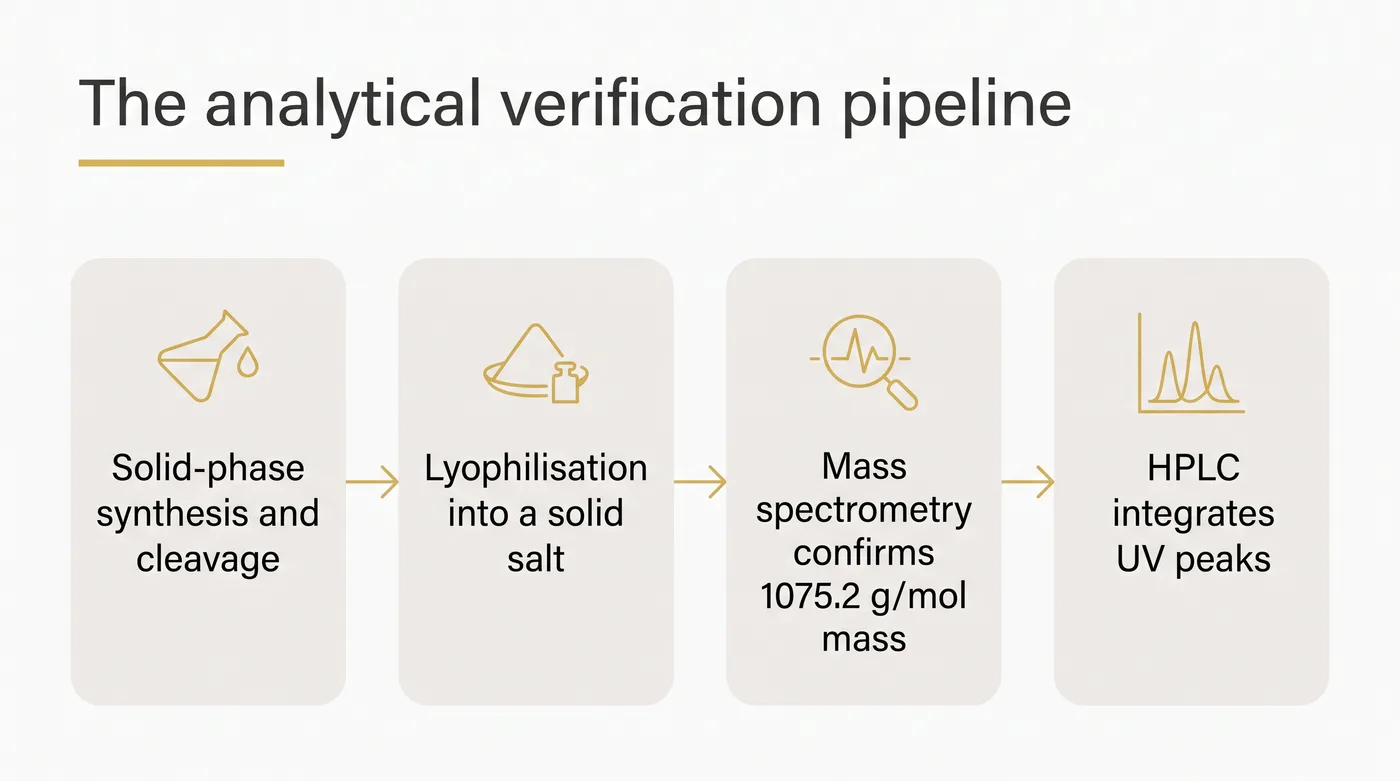
Nobody extracts SNAP-8 from a natural source. It is built synthetically from the ground up using solid-phase peptide synthesis. Chemists anchor the first amino acid to a porous resin bead and attach the remaining seven one by one. After each amino acid is attached, the temporary protecting groups are stripped away so the next block can bind Advances in Fmoc solid-phase peptide synthesis. Every incomplete coupling step during this process leaves behind a truncated sequence, generating a deletion error that will haunt the final purification run.
Once the octapeptide is fully assembled, it is cleaved from the resin bed using harsh acids, predominantly trifluoroacetic acid (TFA). This introduces a reality that commercial labels rarely mention: the resulting powder is almost certainly a salt. The strongly basic arginine residues in the sequence pair up with negative trifluoroacetate counter-ions from the cleavage and purification steps. When you measure a sample of powder on a laboratory balance, you are weighing the target peptide, trapped residual moisture, and those invisible TFA ions.
To isolate the material into the neat white puck seen in the vial, the liquid solution undergoes a freeze-drying step. The temperature is dropped severely to freeze the matrix, and a deep vacuum pulls the solid ice straight into a gas Design of freeze-drying processes for pharmaceuticals: practical advice. The chemist must map the collapse temperature perfectly; if the vacuum is too aggressive, the porous cake melts into a sticky film. Done correctly, it leaves behind a fragile, porous solid that dissolves instantly when a mobile phase is introduced.
Proving identity through chromatography and mass
Proving a vial actually contains the C41H70N16O16S structure requires two pieces of heavy analytical machinery working together. First, mass spectrometry confirms the molecular identity. The spectrometer ionises the sample and measures the mass-to-charge ratio of the resulting ions. For SNAP-8, the instrument searches for a theoretical intact mass of 1075.2 g/mol. If the detector registers that mass, you know the correct sequence is present. However, identity is not purity. A sample could contain the correct molecule alongside a chaotic mess of synthesis errors, and the mass spectrometer might still highlight the primary target.
That is where reversed-phase high-performance liquid chromatography steps in. A chromatogram is a race where every impurity has to cross the finish line in public HPLC analysis and purification of peptides (Methods in Molecular Biology 386). The sample is pumped under pressure through a tightly packed C18 column. The target octapeptide separates from structural analogues based on how it interacts with the stationary phase and the acidic mobile phase gradient. An ultraviolet detector, typically set at 214 nm to catch the absorption of the peptide bonds, monitors the molecules as they exit the column.
The final purity is calculated by measuring the area of the main SNAP-8 peak against the combined area of everything else that absorbed ultraviolet light. For example, NuuVive's SNAP-8 lists a ≥99% purity specification, backed by a measured 99.945% purity on Janoshik report #110956. That tells the analyst that 99.945% of the ultraviolet-absorbing material in the loaded sample was the intact target peptide, leaving almost zero room for truncation errors.
Where sample analysis goes wrong
Even with an immaculate certificate of analysis, handling errors can ruin a sample before it ever reaches the instrument autosampler. The most persistent mistake is conflating chromatographic purity with net peptide content. A vial of high-purity peptide does not contain that same percentage of the target molecule by weight. Because of the invisible TFA salts and residual water bound in the freeze-dried cake, the actual peptide content is usually between 70% and 85% of the total mass. To correct for this, reputable suppliers calculate the mass balance. NuuVive's specific lot actually measured at 10.18 mg of SNAP-8 on Janoshik #110956, meaning the vial was deliberately overfilled by weight to ensure the researcher has the full target amount of the actual peptide base.
The other classic laboratory trap is sequence confusion. Acetyl octapeptide-3 (SNAP-8) is constantly mixed up with a shorter synthetic peptide analogue in hurried inventory logs. The names look identical at a glance, but they are different sequences. SNAP-8 is an octapeptide, meaning it possesses two extra terminal residues (alanine and aspartic acid) that alter its molecular weight and analytical profile.
Relying purely on a vague label instead of verifying the 1075.2 g/mol mass on a third-party certificate is a reliable way to waste a month of laboratory time tracking the wrong compound. When precision matters, checking NuuVive's SNAP-8 provides the current price, stock and the measured purity figures for the lot you are evaluating.
Questions
Why is SNAP-8 supplied as a lyophilised salt?
During solid-phase synthesis, the peptide is cleaved from the resin using strong acids like trifluoroacetic acid. The basic arginine residues in the sequence bind to the trifluoroacetate ions, meaning the final freeze-dried powder is isolated as a TFA salt rather than a pure free-base molecule.
How does SNAP-8 differ from shorter structural analogues?
The difference is the chain length. SNAP-8 (acetyl octapeptide-3) contains eight amino acids, featuring an extra alanine and aspartic acid residue at the C-terminal end compared to a shorter six-amino-acid synthetic peptide analogue. This difference gives the octapeptide its specific molecular weight of 1075.2 g/mol.
How does the methionine residue affect handling?
Methionine contains a sulfur atom that is highly susceptible to oxidation when exposed to atmospheric oxygen. If the solid or solution is mishandled, the sulfur forms methionine sulfoxide, creating a +16 Da mass shift that ruins the integrity of the analytical sample.
Does a 99% HPLC purity mean the vial is 99% peptide by weight?
No. High-performance liquid chromatography only measures impurities that absorb ultraviolet light at the tested wavelength. It cannot see the invisible counter-ions and residual moisture trapped in the solid, meaning the actual net peptide content by weight is always lower than the gross powder weight.