
Reading lab reports
SNAP-8 lab report: what to check
NuuVive Journal · · 6 min read

Short answer
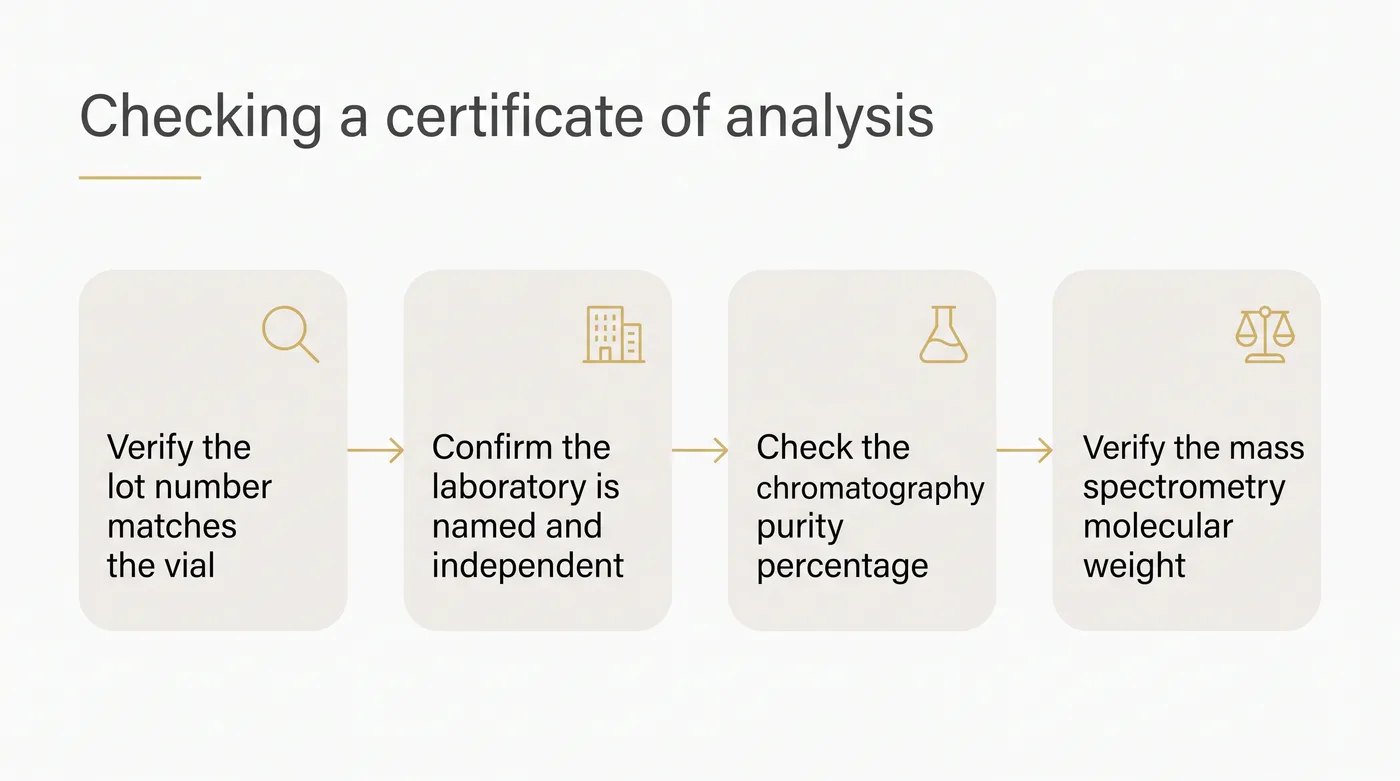
To read a SNAP-8 lab report, first verify that the lot number on the certificate matches the vial and that the testing laboratory is named and accredited. Next, check the high-performance liquid chromatography chromatogram to ensure the main peak meets the required purity threshold. Finally, confirm the identity using the mass spectrometry result, which must show an experimental mass matching the theoretical molecular weight of 1075.2 g/mol.
Key takeaways
- The lot number on the certificate must match the label on the vial to ensure traceability.
- High-performance liquid chromatography reveals the purity percentage but cannot confirm the chemical identity of the powder.
- Mass spectrometry is required to prove the material has the correct molecular weight of 1075.2 g/mol.
- A reliable report comes from a named, independent laboratory rather than an anonymous internal quality check.
The paperwork baseline
Somewhere between completing an order and a parcel landing on a desk, a PDF is doing a lot of heavy lifting. It is the only thing telling you the white powder in that vial is what the label claims. Before looking at the big purity number at the top, give the header thirty seconds. That is where weak certificates quietly give themselves away.
The certificate should name a lot, and it should match the number printed on the vial. Regulatory guidelines define a lot number as a distinctive combination of letters, numbers or symbols from which the complete history of manufacture can be determined 5. Without it, the report describes some material, somewhere, at some point, and nothing ties it to the physical sample.
A named laboratory with an address you can look up is equally important. Good manufacturing practice guides require rigorous laboratory controls and transparent batch records 3. An independent accredited laboratory sounds reassuring right up until you notice it names nobody at all. A date must be present and recent. A three-year-old report on a batch sold today is a bit like a restaurant proudly framing a hygiene inspection from the last decade.
The structural fingerprint of SNAP-8
What is the laboratory looking for? SNAP-8 is a synthetic octapeptide, meaning it comprises eight amino acids. The primary sequence is Ac-EEMQRRAD-NH2. It features an N-terminal acetyl group and a C-terminal primary amide. These are common synthetic modifications used to cap the ends of the peptide chain and remove the free alpha-amino and alpha-carboxyl charges.
The chain contains two glutamic acid residues, one methionine, one glutamine, two adjacent arginines, one alanine, and a C-terminal aspartic acid. The single methionine residue provides the only sulfur atom in the structure, presenting a potential site for oxidation during storage. It contains no cysteine residues, so there are no disulfide bonds to complicate the analysis.
The molecular formula is C41H70N16O16S, which gives a theoretical molecular weight of 1075.2 g/mol. Much like GHK-Cu, it is typically supplied as a white to off-white lyophilised powder. It forms a salt, most commonly as a trifluoroacetate or acetate salt, depending on the purification method. If a laboratory does not know these parameters, they cannot design a valid test.
High-performance liquid chromatography and the purity percentage
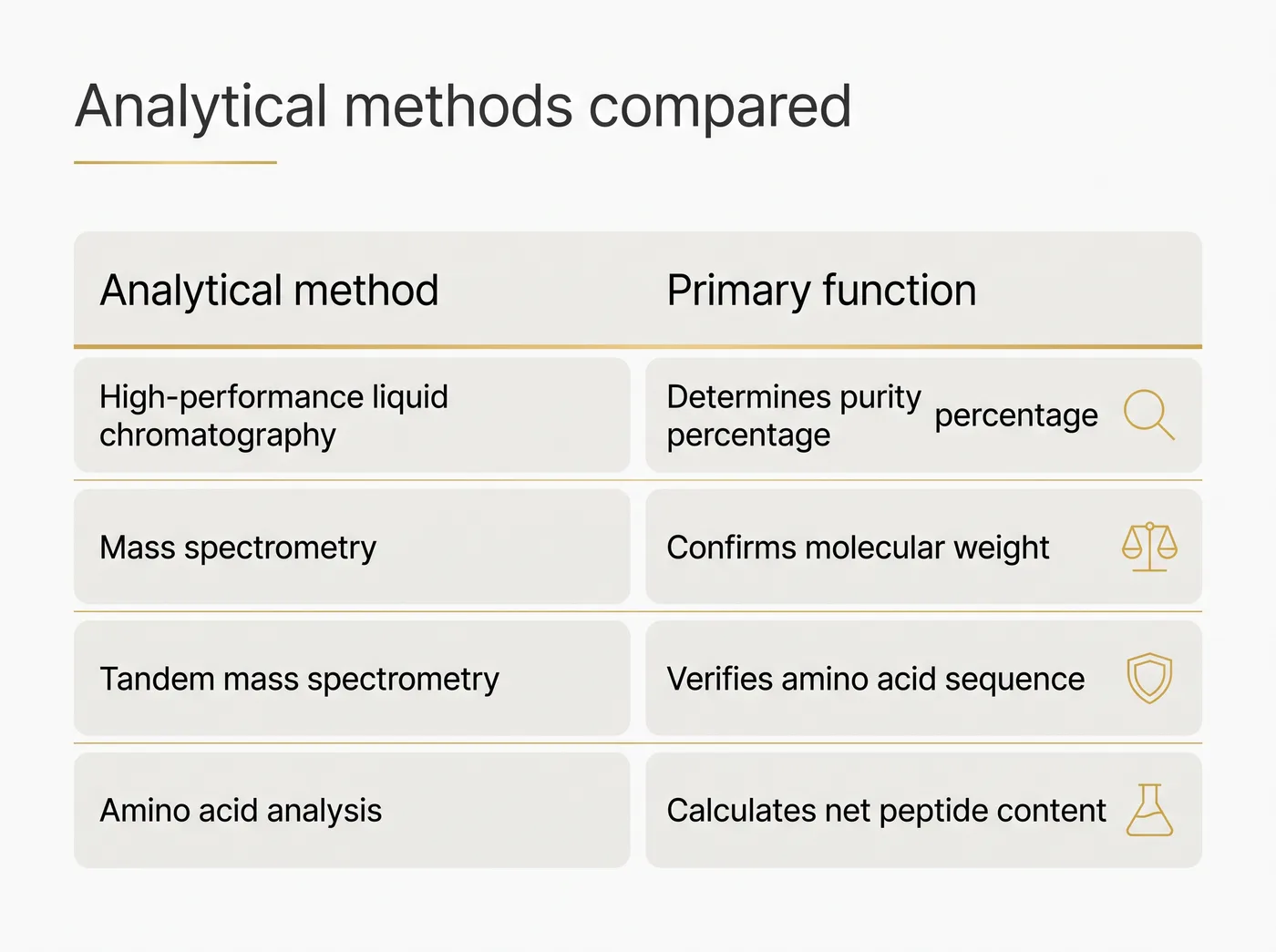
High-performance liquid chromatography is the workhorse of peptide analysis. It separates the contents of a sample based on hydrophobicity. Think of a chromatogram as a race where every impurity has to cross the finish line in public. The main peak represents the target peptide, and the area under that curve, relative to everything else, gives the purity percentage. Typical research-grade purity specifications are 98.0% or 99.0% and above.
Ultraviolet detection is typically monitored at 210 to 220 nm, the range where the peptide bond exhibits strong absorbance. A flat baseline with sharp, symmetrical peaks indicates a well-run method. A wandering baseline or broad, asymmetrical peaks suggest analytical problems. The method must demonstrate specificity, proving it can accurately measure the analyte in the presence of expected impurities 1.
However, chromatography has strict limits. It solely separates compounds; it cannot identify the chemical structure or the absolute mass of the main peak. If the mobile phase gradient is poorly designed, closely related impurities might co-elute 6. A co-eluting impurity hides under the main peak, artificially inflating the purity reading. This is why relying on a single gradient that fails to separate insertion sequences or des-acetyl variants is a frequent analytical shortcoming. A high purity number is only as good as the separation method behind it.
Mass spectrometry to confirm the identity
If chromatography tells you how pure a powder is, mass spectrometry tells you if it is actually SNAP-8. Electrospray ionisation mass spectrometry is coupled with the chromatography system to verify the molecular weight of the eluting peptide. The report should show an experimental mass peak corresponding to the theoretical mass of 1075.2 g/mol, or its multiply charged ion species.
Tandem mass spectrometry goes a step further by fragmenting the peptide into product ions, establishing the precise order of amino acids to prove the correct sequence was synthesised. Thorough characterisation relies on these orthogonal techniques to confirm physicochemical properties, which is a different process from simple routine release testing 2.
Mass spectrometry is generally not a quantitative tool for determining overall sample purity because different impurities ionise at different efficiencies in the instrument. It confirms identity, leaving the quantification work to the chromatography.
Amino acid analysis and net peptide content
Amino acid analysis determines the exact composition and the net peptide content of the lyophilised powder. The peptide undergoes harsh acid hydrolysis to break it down into free amino acids. The analysis then verifies the ratios of the constituent amino acids, detecting two glutamic acids and two arginines for SNAP-8.
This technique is the gold standard for calculating net peptide content, which measures the actual mass fraction of the peptide exclusive of counterions and residual moisture. Values typically range from 70% to 85% of the total powder mass. Because acid hydrolysis destroys the sequence order, it cannot prove the arrangement of the amino acids. It also cannot detect structural modifications like acetylation or amidation, as these are cleaved during the harsh preparation step.
Chiral amino acid analysis using gas chromatography can detect racemisation, the undesired conversion of L-amino acids to D-amino acids that may have occurred during the synthesis process. A complete analytical profile uses this method to fill the blind spots left by mass spectrometry.
Putting the numbers into practice
Five things make a certificate worth trusting: a named lot, a named lab, a named method, a date and a specification. Lose any one of them and the document slides from evidence into decoration. Synthetic peptides require a rigorous control strategy to monitor unintended insertions or deletions generated during solid-phase synthesis.
No single analytical technique can answer every question about a sample. Chromatography isolates the fractions, mass spectrometry confirms the molecular weight, and amino acid analysis verifies the building blocks. When you open a lab report, look for the intersection of these methods.
For a transparent example of how these documents should look, check the current pricing, stock and laboratory results for NuuVive's SNAP-8, which tested at 99.945% purity on Janoshik report #110956.
Questions
Why does the mass spectrometry result show a number different from 1075.2?
Electrospray ionisation often adds protons to the molecule during analysis. You will typically see a [M+H]+ peak around 1076.2 or a multiply charged peak, rather than the exact neutral mass.
What is the difference between purity and net peptide content?
Purity measures the target peptide relative to other absorbing impurities in the sample. Net peptide content measures the actual mass fraction of the peptide in the solid powder, excluding counterions and moisture.
Can high-performance liquid chromatography confirm the amino acid sequence?
No. Chromatography only separates compounds based on hydrophobicity. Tandem mass spectrometry is required to fragment the peptide and confirm the precise order of amino acids.
Why is a lot number so important on a certificate?
A lot number provides metrological traceability. Without it, the laboratory report describes an isolated sample tested at some point in the past, with no verifiable link to the specific material in the vial.
Sources
- ICH Q2(R2): Validation of analytical procedures. ICH
- ICH Q6B: Specifications for biotechnological/biological products. ICH
- ICH Q7: Good manufacturing practice guide for active ingredients. ICH
- 21 CFR Part 210: Current good manufacturing practice, general. eCFR
- HPLC analysis and purification of peptides (Methods in Molecular Biology 386). Springer