
Compounds explained
What is semaglutide? What it has been studied for
NuuVive Journal · · 5 min read

Short answer
Semaglutide is a synthetic analogue of the human GLP-1 hormone, modified with a fatty acid chain to extend its survival in the bloodstream. Discovered around 2002, it has been heavily investigated in phase 3 human clinical trials for type 2 diabetes, obesity, and cardiovascular outcomes, and holds several full FDA approvals. For laboratory supply, it is sold as a research chemical requiring stringent purity testing.
Key takeaways
- Semaglutide is a modified GLP-1 analogue designed to bind to albumin, giving it a much longer half-life than the natural hormone.
- It has been extensively studied in phase 3 clinical trials tracking diabetes markers, weight changes, and cardiovascular outcomes in human cohorts.
- The FDA fully approves semaglutide under different brands for type 2 diabetes, chronic weight management, and cardiovascular risk in specific adult populations.
- Since April 2026, state-licensed 503A pharmacies are no longer permitted to compound it under temporary shortage exemptions.
- Lab reports for semaglutide should show high purity, confirmed by liquid chromatography and mass spectrometry.
The origin and structure of semaglutide
The discovery of GLP-1 hormones in the late 1980s set off a long hunt for a stable version. The natural hormone experiences rapid enzymatic breakdown, which is not ideal if you are trying to design a stable test molecule. Semaglutide is the product of that hunt. It is a synthetic peptide analogue of the human GLP-1 hormone, engineered by a team at Novo Nordisk starting around 2002 3.
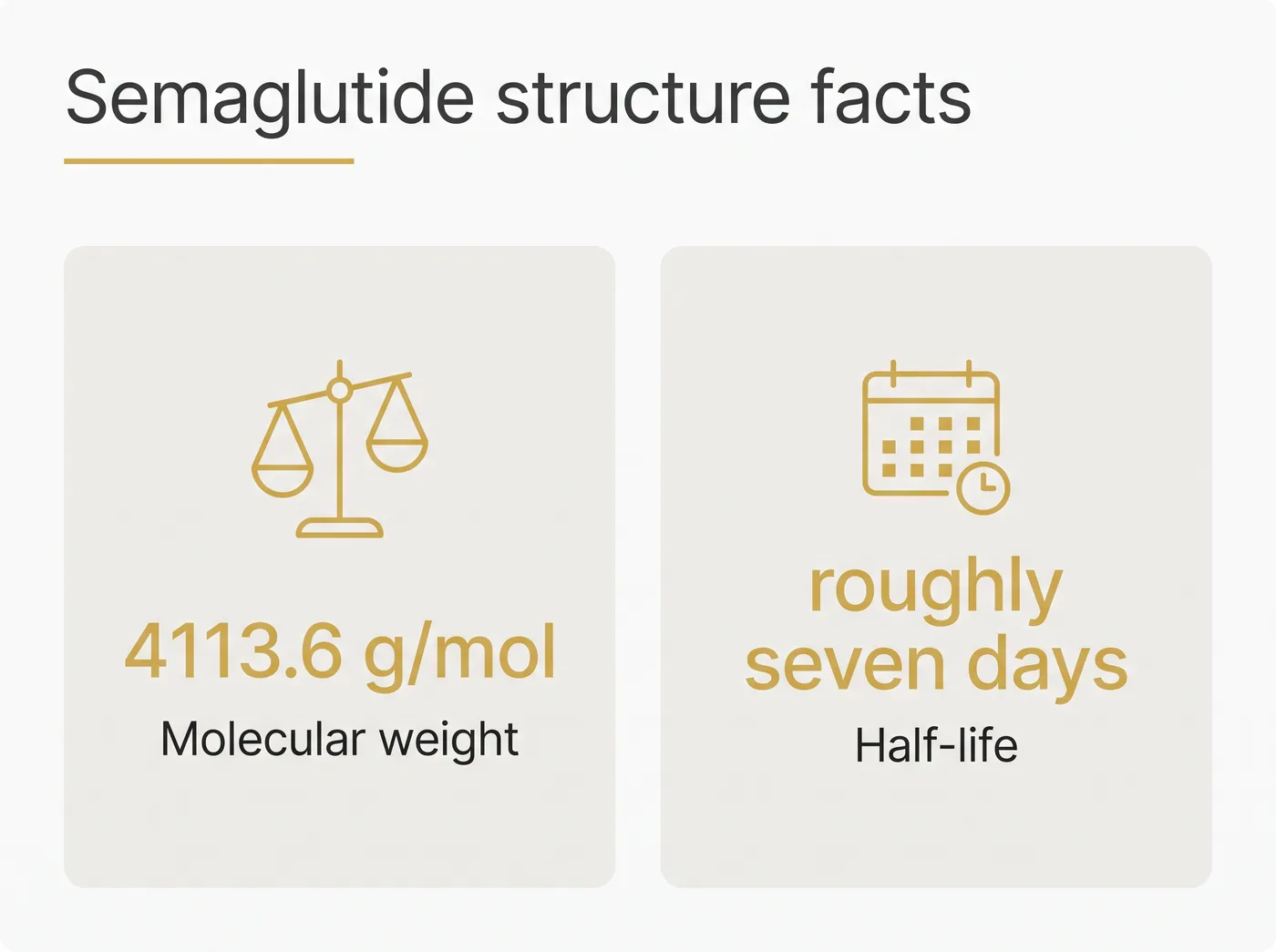
The critical modification was attaching a fatty acid side chain to the molecule. This acts like a chemical grappling hook, allowing the peptide to bind to albumin, a protein in the blood. Bound to albumin, the molecule is shielded from rapid enzymatic destruction. This one structural change, creating a molecule with a weight of 4113.6 g/mol 3, is the reason semaglutide has an extended half-life of roughly seven days.
How semaglutide interacts with the GLP-1 receptor
To understand why scientists study this molecule, you have to look at the receptor it binds to. The GLP-1 (glucagon-like peptide-1) receptor is evaluated in several systems, notably the pancreas, the liver, and the gastrointestinal tract.
When semaglutide binds to these receptors in laboratory models, it mimics the action of the endogenous hormone. Researchers observe how this binding triggers intracellular signalling cascades. In pancreatic studies, the focus is often on mapping glucose-dependent insulin secretion and the corresponding suppression of glucagon 6. It is a precise lock-and-key mechanism that makes the compound a cornerstone for metabolic research.
Because it relies entirely on this single receptor pathway, semaglutide is classified as a pure GLP-1 receptor agonist. This sets it apart from earlier GLP-1 compounds, which researchers evaluate for different pharmacokinetic properties 4.
What semaglutide has been studied for
Semaglutide is arguably the most scrutinised peptide in modern science. It has passed through massive phase 3 human clinical trials, starting with its investigation for type 2 diabetes in the mid-2010s 5.
- Type 2 Diabetes: In the SUSTAIN trial programme, researchers tracked semaglutide's interaction with pancreatic beta cells, its effect on hepatic glucose generation, and changes in gut transit time. They even evaluated an oral formulation in the separate PIONEER trial programme 5.
- Obesity and Weight Management: The STEP trials investigated the compound in adult cohorts with a body mass index (BMI) of 30 or greater 5. These phase 3 trials also included adolescent models.
- Cardiovascular Outcomes: The SUSTAIN 6 and SELECT trials examined major adverse cardiovascular events (MACE), tracking the incidence of cardiovascular death, non-fatal myocardial infarction, and non-fatal stroke in high-risk adult cohorts 1.
- Liver and Renal Function: The molecule is currently being investigated in ongoing phase 2 and 3 human trials, as well as animal models, for metabolic-associated steatohepatitis (MASH), liver cirrhosis, and chronic kidney disease in diabetic cohorts 5.
When comparing it to earlier GLP-1 compounds in head-to-head clinical models, researchers evaluated the compounds directly against each other to track differences in glycemic markers and weight metrics 6.
FDA status and the end of compounding exemptions
Semaglutide sits at the top of the regulatory ladder. It holds full FDA approval under different brand names for type 2 diabetes (2017), chronic weight management (2021), and cardiovascular risk in specific adult populations (2024) 1.
Because it is an approved, patented drug, its legal status outside the main manufacturer is tightly controlled. For a few years, state-licensed 503A compounding pharmacies were allowed to make it due to national shortages. That ended on April 22, 2026, when the FDA's enforcement discretion period officially closed following a court ruling 7.
A recent HHS draft policy listing peptides that compounders can still legally make (like MOTS-c and TB-500) explicitly does not cover semaglutide 8. If you see a clinic selling "compounded semaglutide" today, they are operating outside current regulatory allowances. If you want to see the regulatory and trial history of a different peptide fragment, you can review the explainer on AOD-9604.
Reading a lab report for semaglutide
For laboratory research, the only thing that separates a useful sample from expensive dust is the Certificate of Analysis (CoA). A real CoA is a highly specific technical document issued by a third-party analytical lab, not a vague promise of quality from a vendor.
You are looking for two specific tests. High-Performance Liquid Chromatography (HPLC) separates the contents of the vial; the resulting chromatogram is a chart where every peak is an impurity having to cross the finish line in public. The main peak should be towering, representing the peptide itself. The second test is Mass Spectrometry (MS), which confirms the molecular weight matches semaglutide's 4113.6 g/mol exactly 3. If a seller will not show you the chromatogram, find a seller who will.
For the current batch data, pricing, and independent lab results showing ≥99% purity, check NuuVive's Semaglutide.
Questions
Is semaglutide a peptide?
Yes, it is a synthetic peptide analogue. It is built from a chain of amino acids structurally based on the human GLP-1 hormone, but modified to resist rapid breakdown in the body.
Can pharmacies still compound semaglutide?
No. The FDA's temporary enforcement discretion period allowing 503A pharmacies to compound it during national shortages ended in April 2026.
How is semaglutide for laboratory research different from the prescription drug?
The active molecule is identical, but semaglutide for laboratory research is sold strictly as a lyophilised powder for laboratory testing and in-vitro analysis, not as a finished medical product for human use.
Sources
- fda.gov. U.S. FDA
- pubchem.ncbi.nlm.nih.gov. National Library of Medicine
- pubchem.ncbi.nlm.nih.gov. National Library of Medicine
- Safety of Semaglutide. National Library of Medicine
- Regulation of Glucose Homeostasis by GLP-1. National Library of Medicine
- www.fda.gov. U.S. FDA
- Federal Register :: Enforcement Discretion Policy Regarding 503A Compounding Using Certain Peptide Bulk Drug Substances. Federal Register