
Compounds explained
What is AOD-9604 and what it has been studied for
NuuVive Journal · · 7 min read

Short answer
AOD-9604 is a 16-amino-acid synthetic peptide derived from the tail end of human growth hormone, modified with an added tyrosine residue for stability. First developed in the 1990s as an oral anti-obesity candidate, it was studied in animal models of fat metabolism and reached phase 2b human trials before commercial development stopped in 2007. It is not an approved drug and is excluded from lawful pharmacy compounding by the FDA.
Key takeaways
- AOD-9604 is a synthetic 16-amino-acid peptide analogue corresponding to the C-terminal region of human growth hormone.
- It was investigated in a large phase 2b human trial as an oral anti-obesity candidate before the sponsor terminated the clinical program in 2007.
- The published human clinical record evaluated the oral compound, leaving a complete absence of human data for any other route.
- Under recent FDA and HHS policy updates, state-licensed pharmacies are prohibited from legally compounding it.
What exactly is AOD-9604?
Look up this compound online and you will immediately hit a divide: loud forums selling magic, and a quiet handful of scientific papers tracking a 16-amino-acid chain. The science is the only part that matters. AOD-9604 is a hexadecapeptide, which is just chemistry shorthand for a chain of exactly 16 amino acids. To understand its structure, you have to look at its parent molecule. Human growth hormone is a massive structure of 191 amino acids. If you chop off the very end of that chain, residues 177 through 191, you get a 15-amino-acid sequence.
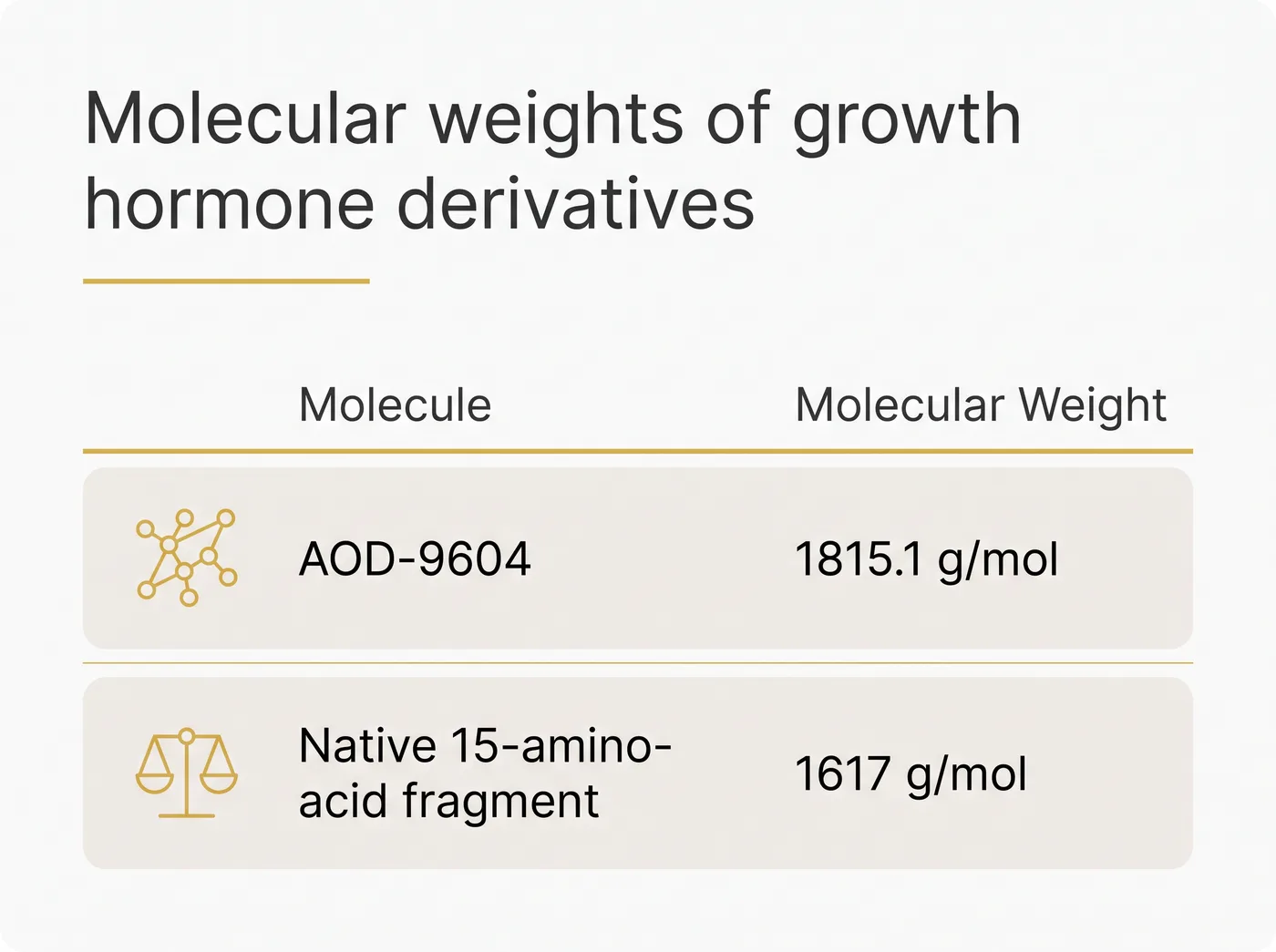
AOD-9604 is that exact 15-amino-acid fragment with one synthetic modification: an extra tyrosine residue bolted onto the N-terminal end to enhance stability National Library of Medicine. The native fragment has a molecular weight of 1617 g/mol, but that single tyrosine addition bumps the molecular weight up to 1815.1 g/mol and gives the molecule its specific identity National Library of Medicine. The peptide retains a specific structural quirk from the original hormone: an intrachain disulfide bridge between two cysteine residues (Cys6 and Cys14), which forces the molecule into a tiny loop. That loop is the architectural core of the peptide; without it, the molecule behaves completely differently under analytical testing.
| Feature | AOD-9604 | Native 15-amino-acid fragment |
|---|---|---|
| Amino Acid Length | 16 amino acids | 15 amino acids |
| Molecular Weight | 1815.1 g/mol | 1617 g/mol |
| Sequence Modification | N-terminal Tyrosine added | None (native sequence) |
In the laboratory, this structure is completely distinct from the full-length recombinant growth hormone. Full-length growth hormone is studied for its binding to primary receptors all over the system, its role in driving insulin-like growth factor 1 (IGF-1) production, its influence on carbohydrate metabolism, and its promotion of tissue growth National Library of Medicine. AOD-9604 was engineered specifically to avoid those systemic receptors and isolate a single metabolic function.
Origin and commercial development
The compound was not discovered in a vacuum. It was deliberately engineered in the early 1990s by a research team led by Professor Frank Ng at Monash University in Australia. The underlying question was strictly mechanical: could researchers isolate the fat-mobilising properties of human growth hormone without triggering the hormone's broader growth-promoting and insulin-interfering pathways? To answer this, researchers needed a stripped-down version of the molecule.
This premise caught the attention of an Australian biotechnology firm called Metabolic Pharmaceuticals. They licensed the peptide and developed it specifically as an oral candidate for obesity. For over a decade, AOD-9604 moved through the standard pipeline of pharmaceutical development, transitioning from isolated cells into animal models, and eventually into human clinical trials. It is rare for a research peptide to make it that far, which is why the paper trail on this compound is unusually thick. But the corporate timeline had a firm endpoint: in 2007, Metabolic Pharmaceuticals terminated the clinical development program entirely.
Research areas: from cell models to phase 2b trials
Because it was on a commercial drug track, AOD-9604 was evaluated in a rigid sequence of models. To understand how peptides are studied, you have to look at the microscopic accounting that takes place before animals are involved. In cell studies, researchers used transfected BaF-BO3 cells expressing human growth hormone receptors to measure binding affinity. They also looked at isolated adipose tissue to evaluate lipid handling and antilipogenic activity, the inhibition of new fat cell formation National Library of Medicine. Unlike newer metabolic targets such as Retatrutide which are studied for their activity at multiple incretin receptors, AOD-9604 was strictly designed around isolating the lipid-mobilizing domain of growth hormone.
The preclinical animal work involved wild-type obese mice, obese Zucker rats, and a very specific model known as beta-3 adrenergic receptor knockout mice. In these animal subjects, investigators tracked energy expenditure, fat oxidation, and the trajectory of the animals' mass. They continuously monitored blood glucose, insulin sensitivity, and serum IGF-1 levels. The goal of measuring these specific markers was to confirm whether the peptide interfered with broader hormonal systems in the manner studied for full-length growth hormone.
Then came the human trials. The compound was evaluated in six randomized, double-blind, placebo-controlled clinical trials, enrolling roughly 900 participants in total. This included a 12-week phase 2a study and a massive 24-week phase 2b oral obesity trial with over 500 randomized subjects. Researchers tracked changes in participant mass and fat composition, monitored carbohydrate metabolism using oral glucose tolerance tests, and screened the participants for the formation of anti-AOD9604 antibodies National Library of Medicine. The trials did not meet their primary endpoints, halting the commercial project.
The missing evidence for other routes
The 2026 HHS policy and compounding status
AOD-9604 is not an approved drug for any indication. It currently sits in a very specific, tightly regulated category managed by the FDA and the HHS. When a compound is not approved, the only way a state-licensed pharmacy can legally prepare it is if it appears on a specific list under Section 503A of the Federal Food, Drug, and Cosmetic Act.
AOD-9604 is not on that list. It was initially nominated, but the FDA evaluated it and placed it in Category 2, a list of substances excluded from lawful compounding U.S. FDA. The agency pointed to the severe lack of human data for routes other than oral, potential risks regarding peptide impurities, and concerns about immunogenicity. In December 2024, the Pharmacy Compounding Advisory Committee (PCAC) voted 12-0 against adding it to the 503A bulks list. Consequently, it is strictly off-limits for legal compounding. Unsurprisingly, the World Anti-Doping Agency (WADA) also prohibits it at all times under the category of growth hormone fragments.
Reading an AOD-9604 lab report
When you are evaluating a supplier for laboratory research, the only document that matters is the certificate of analysis (COA) from an independent, third-party analytical laboratory. A vendor's promise means exactly nothing. A proper COA is a technical document that proves two things: identity and purity. Reading a lab test is the only way to ensure the vial contains what the label claims.
Identity is confirmed by mass spectrometry. The report must show a measured mass of 1815.1 g/mol. If the mass is off, the laboratory has synthesized the wrong peptide, perhaps skipping the N-terminal tyrosine modification and supplying the standard 15-amino-acid fragment instead. Purity is measured using High-Performance Liquid Chromatography (HPLC). A chromatogram is a race where every impurity has to cross the finish line in public. You want to see one sharp, isolated peak, indicating that the synthesized peptide dominates the sample without excessive byproducts.
Do not accept a COA that lacks a visible lot number, a recent date, or the name of the testing facility. A lot number is the vial's passport; without it, the document could belong to any batch synthesized in the last five years. If you are preparing for your next study and want to see what a transparent, fully verifiable lab report looks like, you can review the current third-party documentation, current pricing, and measured purity for NuuVive's AOD-9604.
Questions
Is AOD-9604 the same as the native 15-amino-acid fragment?
No. While they share the same 15-amino-acid base sequence from human growth hormone, AOD-9604 includes an additional synthetic tyrosine residue at the N-terminal end. This modification changes its molecular weight to 1815.1 g/mol and distinguishes it chemically.
Did the FDA approve AOD-9604?
AOD-9604 is not an FDA-approved drug for any indication. The commercial clinical development program for obesity was terminated by the sponsor in 2007 after phase 2b trials did not meet their primary endpoints.
Can a compounding pharmacy provide AOD-9604?
No. Under the FDA's enforcement policies regarding Section 503A, AOD-9604 is explicitly excluded from lawful pharmacy compounding. This follows a unanimous 12-0 vote against it by the Pharmacy Compounding Advisory Committee.
How do researchers store AOD-9604?
AOD-9604 is handled according to standard laboratory practices to maintain the stability of its synthetic amino acid sequence. Specific handling and storage requirements are provided on the supplier's laboratory documentation.
Sources
- fda.gov. U.S. FDA
- pubchem.ncbi.nlm.nih.gov. National Library of Medicine
- pubmed.ncbi.nlm.nih.gov. National Library of Medicine
- pubchem.ncbi.nlm.nih.gov. National Library of Medicine
- pubmed.ncbi.nlm.nih.gov. National Library of Medicine