
Compounds explained
What is SS-31? The origin, research and regulatory facts
NuuVive Journal · · 7 min read

Short answer
SS-31, generically known as elamipretide, is a synthetic tetrapeptide belonging to the Szeto-Schiller family of mitochondria-targeting compounds. It consists of four amino acids with an alternating aromatic-cationic sequence that allows it to cross cell membranes. Research models have focused on its ability to bind reversibly to cardiolipin in the inner mitochondrial membrane. It has been investigated in animal models of kidney and tissue ischemia, as well as in human clinical trials for primary mitochondrial myopathy and Barth syndrome.
Key takeaways
- SS-31 is a highly targeted four-amino-acid peptide designed to localize directly within the inner mitochondrial membrane.
- It was discovered serendipitously when researchers studying opioid analogs noticed certain synthetic structures accumulating inside mitochondria without active transport.
- The compound has been evaluated in phase 3 human clinical trials for specific genetic and mitochondrial conditions.
- In late 2025, the generic sequence elamipretide became the active ingredient in an approved commercial drug, restricting how pharmacies may compound it.
- There are currently no human clinical trials evaluating the compound for systemic longevity in general adult populations.
The accidental origin of a mitochondrial peptide
You might assume from the stark, alphanumeric name that SS-31 was born out of a classified government bioenergetics programme. The reality is much quieter and slightly accidental. The initials simply stand for pharmacologist Hazel Szeto and peptide chemist Peter Schiller. In the early 2000s, they were not looking for a novel way to target the mitochondria at all; they were busy synthesising opioid peptide analogs to study pain signalling pathways in the nervous system.
Biology occasionally throws a curveball, and a strange thing happened during their lab assays. The researchers noticed that certain structural iterations of their compounds completely ignored the usual rules of cellular entry. Instead of relying on complex protein transport machinery to pull them inside the cell membrane, these specific peptides wandered right through the lipid bilayer and parked themselves directly inside the mitochondria. In cellular biology, bypassing the transport bouncers like that is highly unusual.
By tweaking the structural chemistry over several iterations, the scientists successfully stripped away the opioid receptor affinity entirely. What remained was a pure, targeted delivery vehicle. This alternating sequence of aromatic and cationic components zeroed in on the mitochondria with remarkable specificity. SS-31 emerged as the particular sequence that ultimately advanced into major clinical development, moving from a curious laboratory observation to a heavily funded pharmaceutical candidate.
Structure and the cardiolipin connection
At a molecular level, SS-31 is a synthetic tetrapeptide, meaning it is a very short chain of just four amino acids. Its specific sequence is D-Arg-Dmt-Lys-Phe-NH2. At physiological pH, the molecule carries a 3+ cationic charge, which is the chemical key that lets it slip through lipid bilayers so effortlessly. According to the database records, it has a precise molecular weight of 639.8 g/mol PubChem. If you are curious how this tiny synthetic chain contrasts with a longer, naturally encoded sequence, explore the research differences between MOTS-c and SS-31.
Once it breaches the outer defences and enters the mitochondria, SS-31 has one primary target: a unique anionic phospholipid called cardiolipin. You can think of cardiolipin as the structural scaffolding for the inner mitochondrial membrane. It is responsible for keeping the electron transport chain organised so that cellular respiration happens efficiently without leaking damaging electrons into the surrounding tissue.
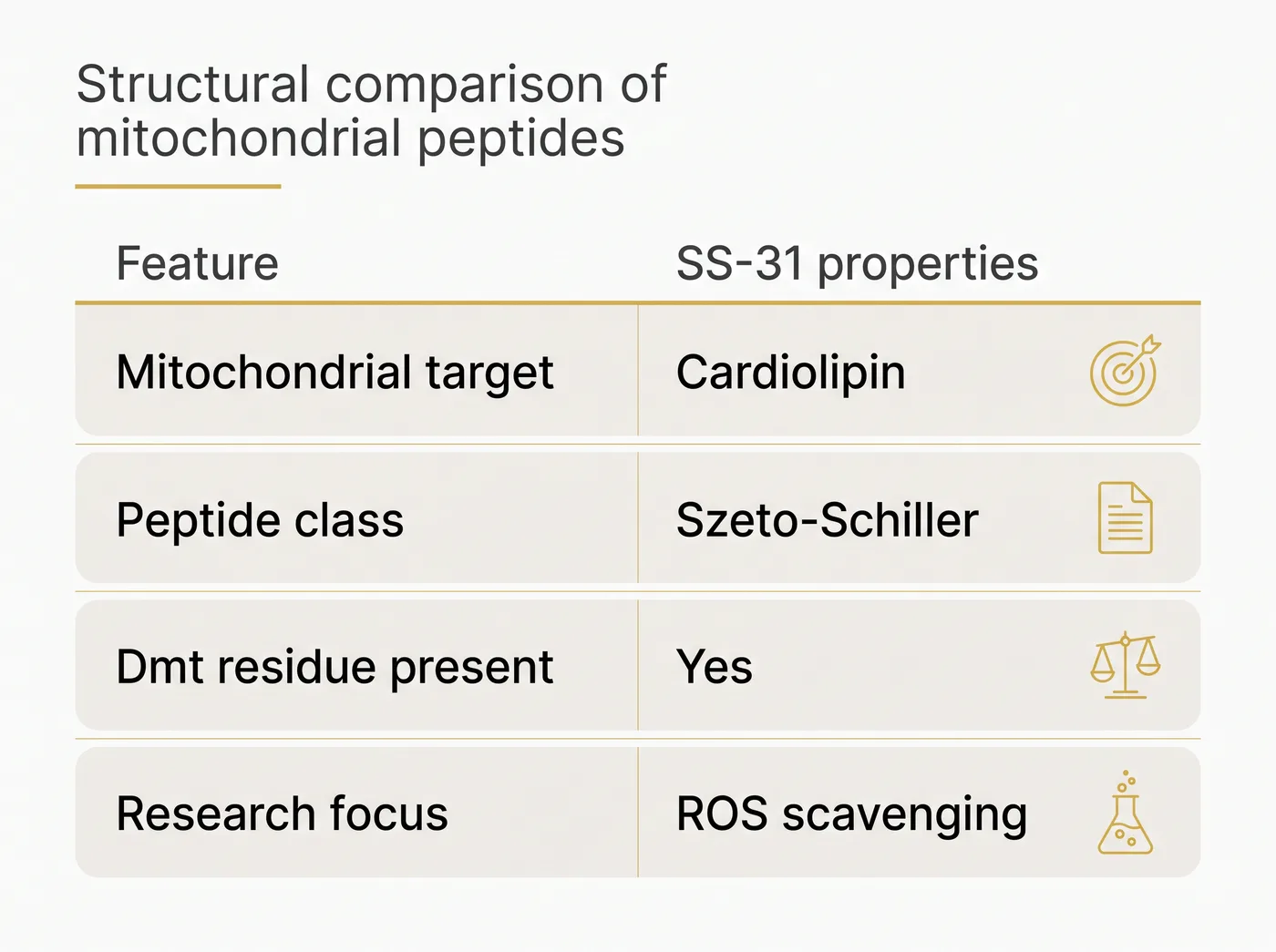
| Feature | SS-31 | SS-20 |
|---|---|---|
| Peptide class | Szeto-Schiller (aromatic-cationic) | Szeto-Schiller (aromatic-cationic) |
| Mitochondrial targeting | Binds strongly to cardiolipin | Binds strongly to cardiolipin |
| Dmt residue present | Yes | No |
| Research focus | Structural binding and intrinsic ROS scavenging | Pure structural membrane stabilization |
The differences in the Szeto-Schiller family come down to tiny structural choices. For instance, SS-20 is a closely related sibling compound. Both share the alternating motif that drives them to bind cardiolipin, but they diverge at a single amino acid. SS-31 contains a 2-prime,6-prime-dimethyltyrosine (Dmt) residue, which gives the peptide intrinsic reactive oxygen species scavenging properties. SS-20 lacks this Dmt residue, meaning researchers study it purely for its physical stabilization of the membrane structure rather than its direct scavenging action.
What SS-31 has actually been studied for
Type the compound name into a forum search and you will find people making sweeping claims about its capabilities. The actual published literature is far more constrained. Researchers primarily study SS-31 to see what happens when mitochondria are placed under extreme metabolic or structural stress, observing how the stabilization of cardiolipin affects cellular survival Elamipretide review.
In early preclinical animal and cell models, investigators looked heavily at cardiovascular stress. They studied isolated guinea pig hearts undergoing ischemia-reperfusion injury, measuring contractile force and heart rate parameters. In mouse models, it has been evaluated for its effects on diabetic nephropathy and acute kidney ischemia to track mitochondrial integrity Kidney research. Other rodent models have examined neuroinflammation, synaptic structural complexity, and muscle fatigue in aged mice.
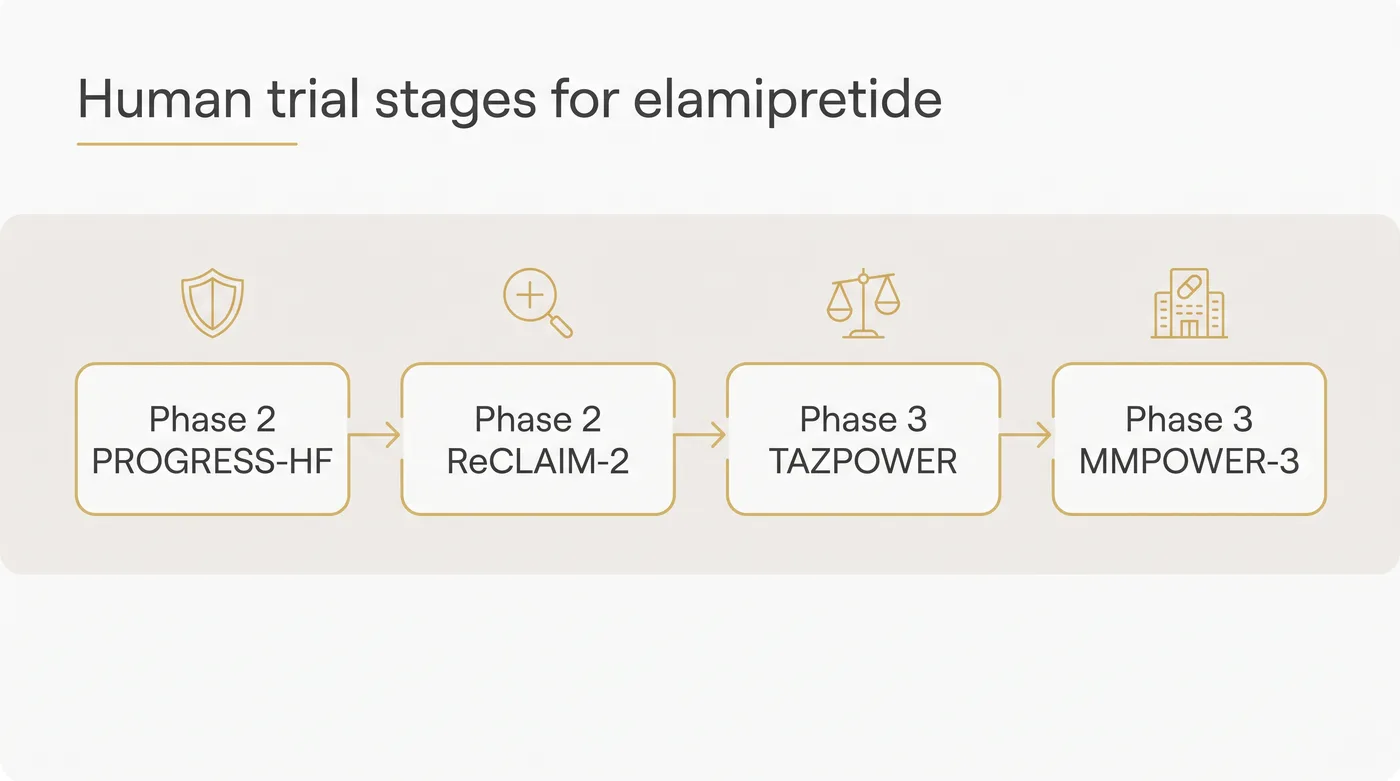
Human clinical trials are where SS-31 separates itself from the vast majority of research peptides. It has been investigated in phase 3 randomised, double-blind trials for primary mitochondrial myopathy, known specifically as the MMPOWER-3 trial. It was also evaluated in phase 2 and 3 crossover trials for Barth syndrome (TAZPOWER), where researchers measured muscle strength using handheld dynamometry alongside six-minute walk test distances. Further phase 2 studies have evaluated the compound in patients with heart failure (PROGRESS-HF) and age-related macular degeneration (ReCLAIM-2) Elamipretide review.
The regulatory status and federal approval
The legal and regulatory status of elamipretide shifted permanently in late 2025. In September of that year, the U.S. Food and Drug Administration granted approval to an elamipretide formulation. This specific approval was indicated for adult and pediatric patients with Barth syndrome who weigh at least 30 kilograms FDA approval document.
Because elamipretide is now the active component of an FDA-approved commercial drug, it sits in a strict regulatory category. Under the 2026 HHS and FDA compounding frameworks, the rules for licensed pharmacies are strict. Elamipretide is not listed on the FDA 503A bulk drug substances lists (neither Category 1 nor Category 2). The enforcement discretion that sometimes allows pharmacies to compound off-label medications from bulk substances simply does not apply here because an approved commercial version already exists.
Therefore, generic bulk compounding of this specific sequence operates entirely outside those permitted pharmacy pathways. The research vials sold online to laboratories are distinct from any approved commercial prescription drug and remain strictly for in vitro laboratory testing by qualified personnel.
Reading the laboratory certificate of analysis
If a laboratory is purchasing SS-31 for cell culture or assay development, the vial's certificate of analysis is the only document that truly matters. A lot number is the vial's passport; if the alphanumeric code on the glass does not perfectly match the third-party test report, the data belongs to someone else's chemistry. Marketing promises are easy to make, but mass spectrometry and liquid chromatography are merciless.
You are looking for two specific numbers on a high-performance liquid chromatography (HPLC) test. The first is the purity percentage. A chromatogram is a race where every impurity has to cross the finish line in public, showing up as tiny peaks alongside the main compound. Research-grade SS-31 should display a clean, massive peak indicating highly refined material. If the peak is messy or accompanied by a forest of smaller spikes, the synthesis was poorly controlled.
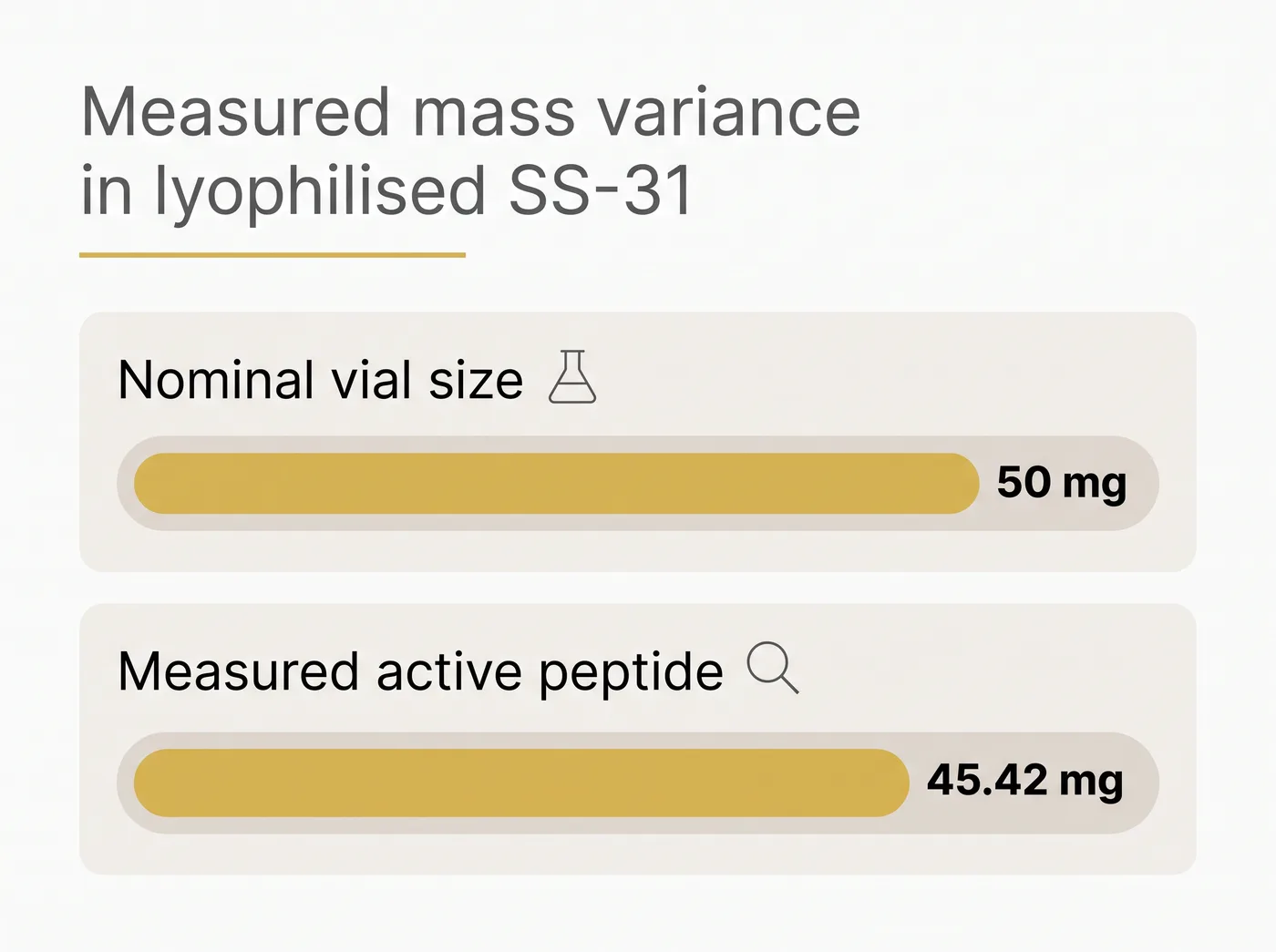
The second critical metric is the measured mass. Lyophilised powder naturally includes residual moisture and counterions left over from the synthesis process. A competent lab report will state the exact mass of the active tetrapeptide inside the vial. For example, a nominal 50 mg vial might yield a measured amount of 45.42 mg of actual SS-31. This is a normal and expected variance, but researchers must know the exact figure to calculate accurate molar concentrations for their bench work. For a clear example of what this level of rigorous analytical testing looks like, you can check the current measured purity (99.756%, Janoshik #85195), live stock status and price on NuuVive's SS-31.
Questions
What is the molecular weight of SS-31?
The precise molecular weight of the SS-31 tetrapeptide is 639.8 g/mol. This highly compact size, combined with its 3+ cationic charge, is what allows the molecule to bypass transport proteins and easily cross cellular and mitochondrial membranes.
Is elamipretide exactly the same compound as SS-31?
Yes, elamipretide is the International Nonproprietary Name (INN) for the exact same synthetic tetrapeptide sequence. In older preclinical literature and trial registries, it is also frequently referred to by the development codes MTP-131 or Bendavia.
Has SS-31 been studied in human clinical trials?
It has been extensively evaluated in phase 2 and phase 3 human clinical trials, primarily for specific genetic and metabolic conditions like Barth syndrome and primary mitochondrial myopathy. It has never been clinically tested in general adult populations for longevity or athletic performance.
Why is SS-31 not on the FDA 503A bulk drug substances list?
It is not on the bulk compounding list because it was granted approval as the active ingredient in a finished commercial prescription drug in September 2025. Compounds that serve as the active ingredient in an approved commercial drug generally do not require nomination to the 503A bulk list, fundamentally altering how pharmacies are permitted to compound them.
Sources
- SS-31, a Mitochondria-Targeting Peptide, Ameliorates Kidney Disease. National Library of Medicine
- pubmed.ncbi.nlm.nih.gov. National Library of Medicine
- fda.gov. U.S. FDA
- pubchem.ncbi.nlm.nih.gov. National Library of Medicine