
Compounds explained
MOTS-c vs SS-31: the differences between the mitochondrial peptides
NuuVive Journal · · 7 min read

Short answer
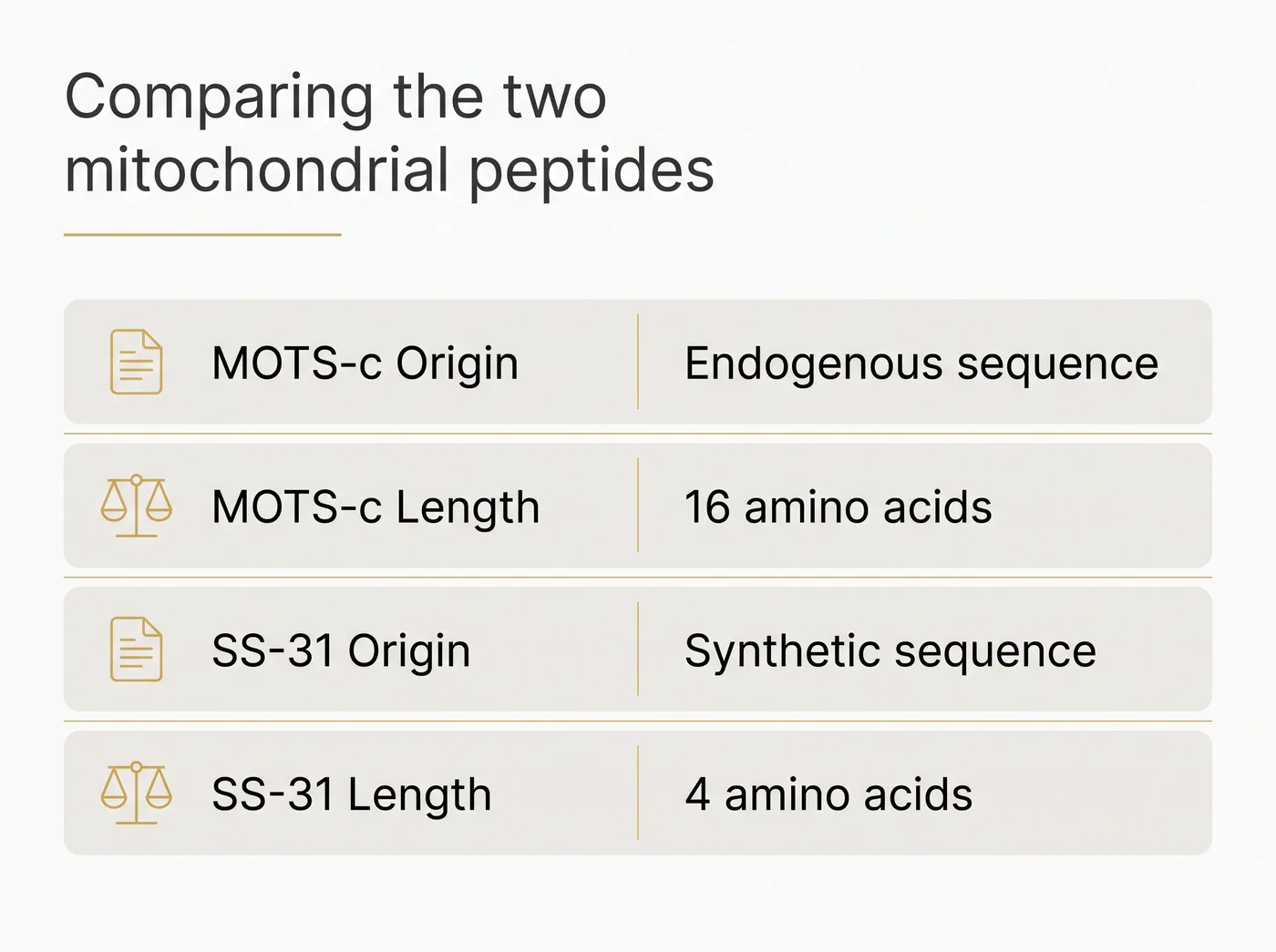
MOTS-c and SS-31 are fundamentally different in origin, structure, and mechanism. MOTS-c is a 16-amino-acid sequence naturally encoded by mitochondrial DNA that has been studied for its ability to travel to the cell nucleus and influence metabolic pathways. SS-31, generically known as elamipretide, is a synthetic four-amino-acid sequence created in a lab that has been investigated for binding directly to cardiolipin on the inner mitochondrial membrane. While MOTS-c remains unapproved, SS-31 has received FDA approval for a rare genetic disease.
Key takeaways
- MOTS-c is a 16-amino-acid peptide encoded endogenously by the MT-RNR1 gene in the mitochondrial genome.
- SS-31 is a fully synthetic tetrapeptide discovered by researchers who were originally studying opioid receptors.
- In laboratory models, MOTS-c has been studied for relocating to the cell nucleus to influence gene expression, whereas SS-31 has been investigated for localizing strictly to the inner mitochondrial membrane.
- Neither compound has completed, large-scale human evidence confirming systemic applications or athletic performance.
- MOTS-c is an unapproved investigational compound, while SS-31 received FDA approval as an orphan drug under the name elamipretide.
Origins and the accident of discovery
Mitochondria are often reduced to a textbook cliché about cellular powerhouses, but researchers view them as complex chemical factories that manufacture their own signaling molecules. MOTS-c is one of these native products. It was first described in the scientific literature in 2015 by Lee and colleagues 7. They identified it while investigating short open reading frames within mitochondrial DNA. As a mitochondrial-derived peptide, it originates endogenously, specifically encoded by the MT-RNR1 gene 2. It has been studied as a biological mechanism for cells to monitor their own metabolic stress.
SS-31 has a very different origin story. It was discovered in the early 21st century by researchers Hazel Szeto and Peter Schiller 3. The tetrapeptide was identified fortuitously while the scientists were conducting laboratory studies on opioid receptors. In the world of peptide chemistry, finding a family of molecules with mitochondrial-targeting properties while looking for opioid activity is a bit like searching for a wrench and finding a spark plug. The compound, which does not exist in nature, was eventually assigned the generic name elamipretide.
These diverging origin stories highlight the two main branches of modern peptide research. On side, scientists catalogue and replicate the exact sequences human biology already produces. On the other side, synthetic chemists build entirely novel structures to force a specific biochemical interaction that biology never intended. Knowing which path a peptide walked tells you a lot about how it will behave in a mass spectrometer. To see another classic example of a native sequence studied alongside a synthetic fragment, look at how Thymosin alpha-1 compares to TB-500.
Structural differences: natural helices versus synthetic modifications
The physical structure of a peptide dictates exactly how it interacts with laboratory instruments and cellular receptors. MOTS-c is a 16-amino-acid peptide with the precise sequence MRWQEMGYIFYPRKLR 6. It is characterized as a small molecular weight peptide that naturally folds into an alpha-helical structure. When a laboratory chemist runs a sample through a chromatogram, this sequence is what they are looking for. A chromatogram is essentially a race where every impurity has to cross the finish line in public, and the 16 standard amino acids of MOTS-c create a distinct, predictable peak.
SS-31 is a fraction of that size. It is a synthetic tetrapeptide, meaning it contains exactly four amino acids. Its specific sequence is D-Arg-Dmt-Lys-Phe-NH2 8. The "Dmt" stands for dimethyl tyrosine residues, and the "D-Arg" indicates an amino acid mirrored from its standard biological orientation. These non-standard residues are a dead giveaway that the molecule was engineered in a lab rather than transcribed by cellular machinery. The synthetic tweaks make it look less like biology and more like a chemistry department showing off.
Because of these modifications, SS-31 is highly water-soluble, possesses a molecular weight of 639.8 g/mol, and carries a net cationic 3+ charge at physiological pH 8. This heavy positive charge has been investigated for driving the molecule toward the negatively charged environment of the mitochondria. Structural differences at this fundamental level dictate the completely divergent mechanisms of action these two compounds exhibit in cellular studies.
Where they go and what they have been studied for
The most significant difference between MOTS-c and SS-31 in research models is where they end up inside a cell. MOTS-c has been investigated as a retrograde metabolic signaling hormone. During periods of cellular stress, MOTS-c has been studied for its translocation from the mitochondria directly to the cell nucleus 2. Once in the nucleus, it has been studied for its influence on nuclear gene expression via transcription factor binding and its interaction with systemic metabolic pathways such as AMPK and Akt. It has been evaluated in animal models involving high-fat diet-fed mice and ovariectomized mice, looking at parameters like insulin sensitivity, fat accumulation, visceral fat mass, running endurance, and grip strength 2.
SS-31 has not been studied as acting on the cell nucleus. It has been investigated for localizing strictly to the inner mitochondrial membrane, where it biophysically binds to a unique phospholipid called cardiolipin 5. In these models, SS-31 was investigated for how it interacts electrostatically and hydrophobically with the electron transport chain mechanics by binding to cardiolipin. It has been studied in isolated mitochondria for its effects on reactive oxygen species generation and cristae architecture. In animal models involving mice, rats, and dogs, it was investigated for parameters including ischemia-reperfusion kidney injury, diabetic nephropathy, heart failure, and cognitive impairment 3.
| Feature | MOTS-c | SS-31 (Elamipretide) |
|---|---|---|
| Origin | Endogenous (mitochondrial genome) | Synthetic laboratory creation |
| Structure | 16 standard amino acids | 4 modified amino acids |
| Cellular Target | Cell nucleus (retrograde signaling) | Inner mitochondrial membrane (cardiolipin) |
| Mechanism | Gene expression and AMPK pathway | Biophysical binding and electron transport |
Human trials for the two compounds also diverged heavily. MOTS-c has seen phase 2a clinical trials registered on clinicaltrials.gov. Studies such as the MOTS-MET trial evaluated MOTS-c in human subjects with prediabetes, overweight parameters, and insulin resistance, while other trials examined end-stage kidney disease among renal transplant recipients 2. SS-31 advanced further through the pipeline, undergoing phase 2 and phase 3 clinical trials like PROGRESS-HF, TAZPOWER, and MMPOWER-3 to evaluate its effects in human patients with heart failure and primary mitochondrial myopathy 3.
Missing human evidence
Read enough marketing copy online, and you will find assertions that these molecules hold the key to limitless endurance and stalled aging. The actual scientific literature is far more sobering. Despite intensive investigation, human evidence does not exist confirming outcomes for cognitive decline or routine athletic performance for either compound 2.
For MOTS-c, there are no completed, large-scale phase 3 human clinical trials providing evidence in disease, weight, lifespan, or physical capacity models. The FDA has explicitly noted a lack of completed clinical data for MOTS-c as an investigational drug in humans 2. The only registered observational study was a very small trial of 10 young men, which merely measured endogenous MOTS-c levels in skeletal muscle and blood circulation in response to physical exercise 2. Anyone asserting that the science is settled regarding human longevity is ignoring the glaring gap where phase 3 data should be.
The regulatory divide and FDA status
The differing trial outcomes led to completely different legal realities. MOTS-c remains strictly an experimental, unapproved chemical. In the context of the 2026 HHS 503A enforcement discretion policy, its status has been actively contested. The FDA removed MOTS-c from its Section 503A Category 2 list in April 2026. While an FDA advisory committee recommended adding the peptide to the Section 503A Bulks List in July 2026, the FDA has not issued a final rulemaking 2. Consequently, compounding pharmacies remain heavily restricted from distributing it. It is also listed on the 2026 World Anti-Doping Agency (WADA) Prohibited List under Metabolic Modulators. To untangle this regulatory knot, read the complete breakdown of MOTS-c legality and see exactly how the new HHS rules apply.
Unlike MOTS-c, SS-31 reached formal regulatory authorization for a highly specific application. In September 2025, the FDA granted approval to elamipretide as an orphan drug for Barth syndrome 3. Because it is the active pharmaceutical ingredient in an FDA-approved drug, it falls under a different regulatory prong of Section 503A than unapproved bulk substances like AOD-9604 or Epitalon.
This means the 2026 HHS 503A enforcement discretion policy strictly governing unapproved bulk nominations does not apply to SS-31 in the same manner. However, commercial compounding of elamipretide is severely restricted by the manufacturer's patents and orphan drug exclusivity. When a molecule crosses the finish line into FDA approval, it gains a legal framework but often loses its accessibility to general compounding. For those procuring unapproved reference materials for laboratory analysis, the only defense against poor quality is a rigorous analytical report. You can review NuuVive's MOTS-c for the current price, stock, and measured purity.

Questions
Can a laboratory test distinguish between MOTS-c and SS-31?
Yes. A mass spectrometer easily distinguishes them by their distinct molecular weights. MOTS-c is a 16-amino-acid peptide, while SS-31 is a much smaller tetrapeptide with a mass of 639.8 g/mol.
Why is MOTS-c on the WADA prohibited list?
MOTS-c is listed on the 2026 World Anti-Doping Agency Prohibited List under Metabolic Modulators. This is based on its theoretical mechanism of action regarding AMPK pathways and energy metabolism, despite the lack of large-scale human trials.
Does SS-31 exist in the human body naturally?
No. SS-31 is a fully synthetic sequence developed in a laboratory. It contains modified amino acids, such as D-arginine and dimethyltyrosine, which are not naturally assembled by cellular translation machinery.
Are compounding pharmacies allowed to sell MOTS-c?
Under current enforcement discretion policies, compounding pharmacies face heavy restrictions regarding MOTS-c. It lacks formal inclusion on the approved FDA bulks list and is not a component of an FDA-approved medication.
Sources
- MOTS-c: A promising mitochondrial-derived peptide for therapeutic exploitation. National Library of Medicine
- Elamipretide: A Review of Its Structure, Mechanism of Action, and Therapeutic Potential. National Library of Medicine
- Frontiers | Cardiolipin remodelling in mitochondrial therapeutics: translational evidence chains from elamipretide to emerging strategies. Frontiers
- pubchem.ncbi.nlm.nih.gov. National Library of Medicine
- pubmed.ncbi.nlm.nih.gov. National Library of Medicine
- pubchem.ncbi.nlm.nih.gov. National Library of Medicine