
Reading lab reports
Adamax lab report: what to check
NuuVive Journal · · 5 min read

Short answer
Reading an Adamax lab report requires checking the mass spectrometry data to confirm the 1032 Da molecular weight and reviewing the high-performance liquid chromatography results for purity. A trustworthy certificate must also feature a verifiable lot number linking the physical solid to the analytical results, issued by a named independent laboratory with a recent test date.
Key takeaways
- Mass spectrometry must confirm the 1032 Da molecular weight to prove the sample actually contains Adamax.
- High-performance liquid chromatography determines the purity percentage but cannot identify the compound on its own.
- A valid certificate must include a traceable lot number that matches the printed label on the glass.
- Net peptide content and chromatographic purity measure two different properties of the solid.
The identity problem
You cannot look at a lyophilised powder and guess its molecular sequence. Adamax is a synthetic designer analogue, modified from the base structure of Semax. Because it is an unassigned designer compound, it lacks a universally verified chemical registry number. That means a piece of paper simply printing the name at the top is not enough. The laboratory must prove the molecule is present in the sample.
Mass spectrometry is the instrument for this job. Liquid chromatography-mass spectrometry subjects the material to a high-energy field and measures the mass of the resulting ions. For this specific sequence, the primary ion should align with a monoisotopic mass of 1032 Da. If the mass is off by even a fraction, the laboratory is looking at a different molecule entirely.
Minor mass shifts tell a story about the synthesis process. Methionine, an amino acid present in the sequence, is highly susceptible to oxidation. An oxidised methionine adds sixteen atomic mass units to the total. Without high-resolution mass spectrometry mapping these tiny deviations, a certificate is merely making a very confident guess.
Chromatograms and the purity percentage
Once identity is confirmed, the next question is purity. High-performance liquid chromatography is the standard method for establishing how much of the sample is the target compound versus leftover synthesis fragments. You can think of a chromatogram as a race where every impurity has to cross the finish line in public. The optical detector records everything that elutes from the column.
The separation relies on reversed-phase liquid chromatography, typically employing gradients of aqueous acetonitrile mixed with an ion-pairing agent like trifluoroacetic acid. As the solvent mix changes, different molecules detach from the column at different times. A sharp, symmetrical peak on the graph represents the primary compound, while smaller bumps indicate synthesis errors or degradation products.
The purity figure you see at the top of the report is simply the area under that main peak divided by the total area of all peaks combined. It is a chromatographic measurement. For context, NuuVive's Adamax tested at 99.907% purity on Janoshik report #99778. A good certificate will show you the integration table so you can see how that percentage was calculated.
The hidden weight of salts and moisture
A common mistake when reading a document is confusing the purity percentage with the actual mass of the peptide. Chromatographic purity is a ratio of the active material against its impurities. It ignores the invisible components that make up the solid. Synthetic peptides exist as salts, not free bases. When the sequence is cleaved with TFA during manufacturing, those counterions remain bound to the molecule.
Alongside the counterions, the lyophilised powder holds residual moisture. Amino acid analysis is required to determine the net peptide content, which is the actual mass fraction of the target sequence excluding water and salts. This explains why a ten-milligram specification might yield a different analytical weight on the scale.
On a precise laboratory balance, the total mass must account for these additions. On the same Janoshik report #99778, the measured amount of the 1032 Da compound was 11.48 mg. The extra weight comes from the necessary salt forms and moisture that allow the solid to remain stable in the glass.
Lot numbers and traceability
A certificate without a lot number is just a picture of some material, somewhere, tested on some Tuesday. Regulatory guidelines demand a distinctive combination of letters and numbers from which the complete history of manufacture can be determined. That alphanumeric code is the only thread linking the physical item on your desk to the analytical results on the screen.
Traceability requires an unbroken chain of evidence. The lot number printed on the label must match the one typed on the certificate. If a vendor uses a generic certificate to sell a different batch, the purity percentage is meaningless.
The laboratory issuing the report matters just as much as the numbers on it. An accredited testing facility operates under strict rules for competence and consistent operation, ensuring their measurement uncertainty is controlled. A report from a nameless internal department offers no impartiality and cannot be independently verified.
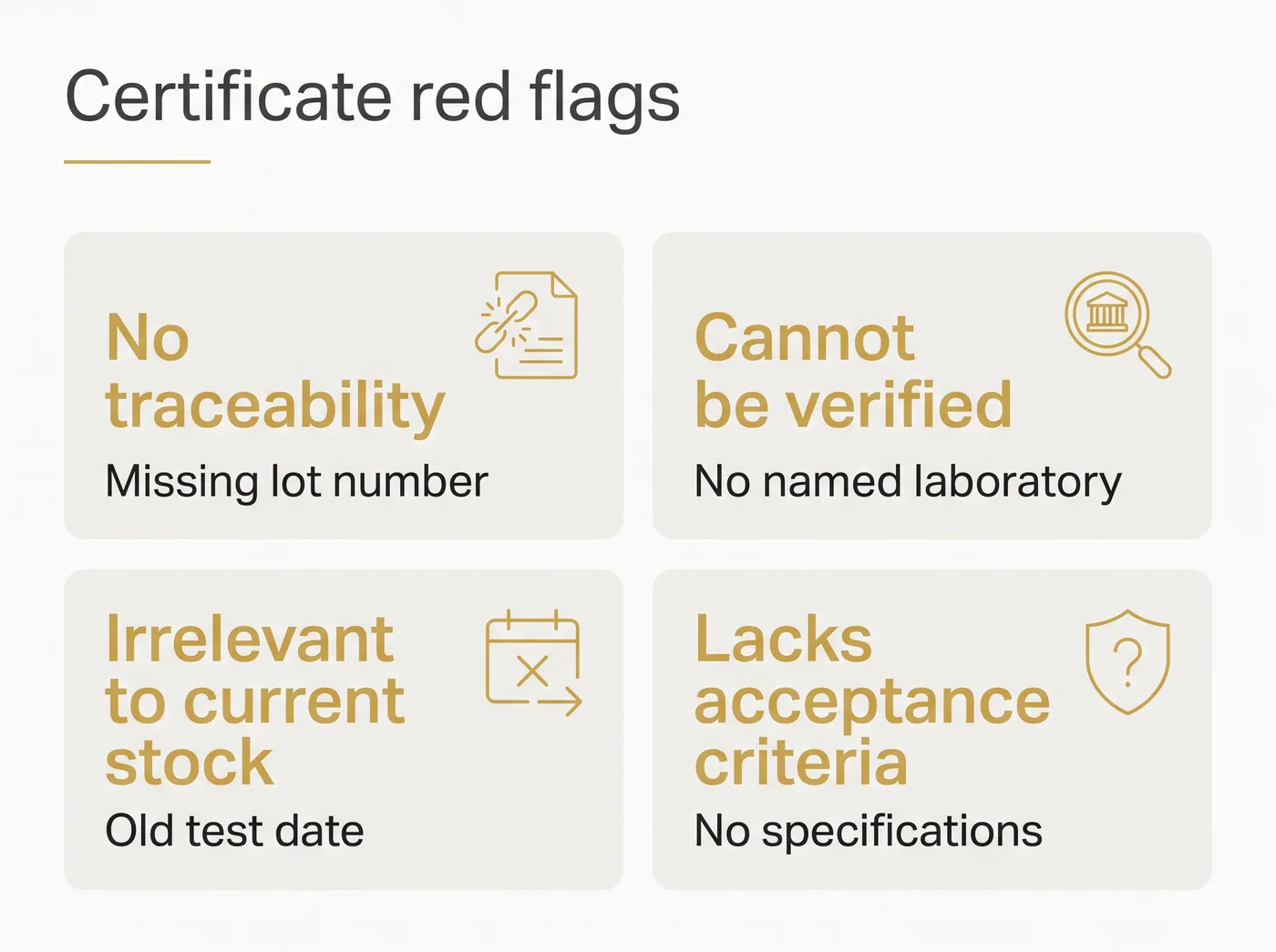
Red flags on a certificate
Spotting a weak certificate requires about thirty seconds once you know where to look. Start with the dates. A three-year-old report attached to a batch sold today is absurd. The test date should be recent and logically aligned with the manufacturing timeline of the lot.
Next, look for missing specifications. A valid analytical report will list the acceptance criteria next to the measured result. If a document only shows the final number without stating what limits the material was supposed to meet, it is not a proper certificate of analysis. It is merely a data sheet.
Finally, watch out for documents that blur the lines between sister products. A report for Selank tells you nothing about a modified analogue, even if they share structural similarities. Every distinct sequence requires its own dedicated analysis. You can review the current price, stock and independent test results showing 99.907% purity for NuuVive's Adamax directly in the catalogue.
Questions
What does a 1032 Da result mean on the report?
Daltons measure the molecular weight of the compound. The 1032 Da result confirms that the mass spectrometer detected the sequence corresponding to Adamax, proving the identity of the solid.
Why is the measured amount higher than ten milligrams?
The solid contains the target compound bound to necessary counterions from the manufacturing process, along with residual moisture. The total mass on the scale will naturally be higher than the target sequence weight alone.
How can I check if the laboratory is real?
Look for a verifiable report number and the name of an independent testing facility. Trustworthy analytical laboratories allow you to input the report number on their own database to verify the results match the document.
Does the purity percentage account for water content?
No. The purity percentage comes from high-performance liquid chromatography, which measures the ratio of the target molecule to other synthesis impurities. It ignores water and salt content.