
Peptide chemistry
KPV identity: structure, molecular weight and form
NuuVive Journal · · 5 min read

Short answer
KPV is a synthetic tripeptide consisting of the sequence lysine-proline-valine. As a free base, it has the chemical formula C16H30N4O4 and a molecular weight of 342.43 g/mol. Laboratories supply it as a lyophilised white solid, typically stabilised as an acetate or trifluoroacetate salt. Because the solid contains these counterions and residual moisture, the handled material has a higher total mass than the bare sequence, requiring precise characterisation via liquid chromatography and mass spectrometry.
Key takeaways
- KPV is a structurally compact tripeptide defined by the specific sequence Lys-Pro-Val.
- The theoretical free-base molecular weight is 342.43 g/mol, but the salt counterion pushes the mass of the handled solid significantly higher.
- Laboratory suppliers distribute the compound as a lyophilised, highly hygroscopic powder requiring strict cold-chain storage.
- Reversed-phase liquid chromatography paired with mass spectrometry is the standard method for verifying the sequence identity.
The chemistry of a three-residue sequence
You might look at a sequence of exactly three amino acids and assume the analytical chemistry is a breeze. It is just three building blocks, after all. But precision scales poorly, and the shorter a synthetic peptide is, the less room there is for standard analytical margins of error. KPV is formally designated by the sequence Lysine-Proline-Valine (Lys-Pro-Val), an arrangement carrying the canonical CAS registry number 67727-97-3 National Library of Medicine.
To understand the physical properties of the molecule, you just need to look at those three residues. The N-terminus is anchored by lysine, which contributes a basic, positively charged side chain. The C-terminus is valine, providing a branched-chain, non-polar side chain. Sitting right in the middle is proline, the structural oddity of the amino acid world.
Proline contains a cyclic pyrrolidine ring that lacks an amide hydrogen. This restricts rotational freedom around the adjacent peptide bonds, forcing the micro-sequence into a rigid conformation. This rigidity dictates how the molecule behaves when dissolved in a mobile phase for analysis, directly impacting its chromatographic footprint. You can explore more about how specific residues dictate sequence behaviour in the primer on peptide science basics.
Building the chain with solid-phase synthesis
Synthesising a peptide from scratch is a highly controlled sequence of addition and protection. Most modern facilities rely on Fmoc solid-phase peptide synthesis (SPPS), where the chain is built sequentially on an insoluble resin support Journal of Peptide Science. The Fmoc chemical group temporarily protects the fragile N-terminus of each incoming amino acid, ensuring that it only reacts precisely where intended.
Once the Lys-Pro-Val sequence is fully assembled on the resin, it has to be detached. The complex is cleaved with trifluoroacetic acid (TFA), which simultaneously strips away the temporary side-chain protecting groups. Because KPV is so short, there is little tolerance for sequence deletion errors during this process. A missing proline or a skipped valine creates a completely different molecular entity, one that a strict laboratory setup has to hunt down and quantify.
Side reactions are an unavoidable reality of SPPS. Truncated sequences or uncoupled free amino acids possess molecular masses uncomfortably close to the main sequence. If a laboratory skips orthogonal testing methods, these synthesis by-products can easily hide beneath the primary signal on a basic chromatogram.
The molecular weight trap
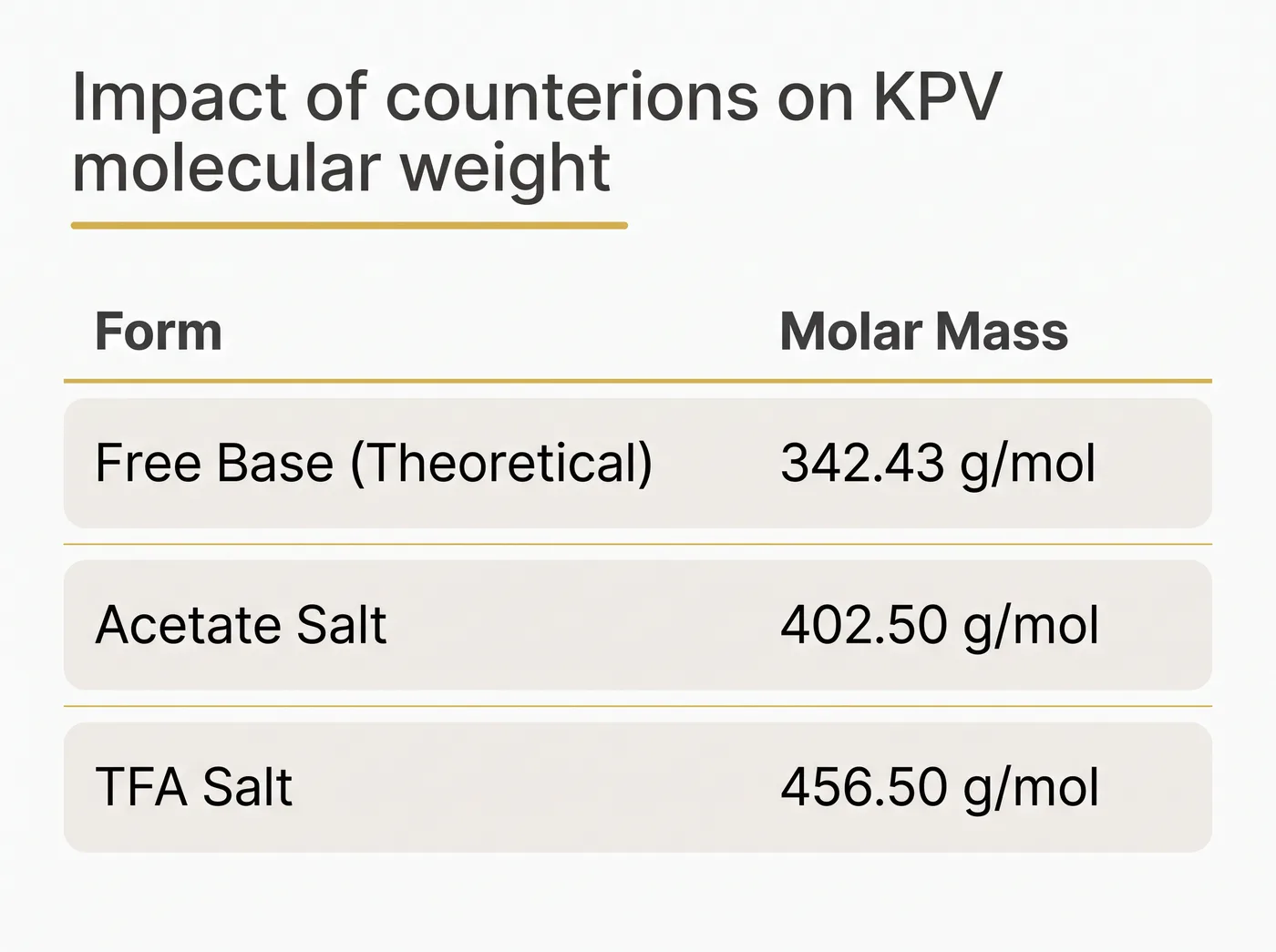
If you plug the formula C16H30N4O4 into a calculator, you get a theoretical exact mass of 342.43 g/mol National Library of Medicine. This is the free-base molecular weight. Unfortunately, relying strictly on this number is a classic analytical trap. It is a bit like weighing a car and forgetting to account for the chassis.
Synthetic peptides are virtually never isolated or handled as free bases. The acidic cleavage and purification steps leave the sequence paired with a counterion, most commonly acetate or trifluoroacetate. This salt formation stabilises the structure, but it also alters the gravimetric reality of the material inside the vial. The counterion physically adds mass.
| Form | Chemical Formula | Molecular Weight |
|---|---|---|
| Free Base | C16H30N4O4 | 342.43 g/mol |
| Acetate Salt | C18H34N4O6 | 402.50 g/mol |
| TFA Salt | C16H30N4O4 • CF3COOH | 456.50 g/mol |
If an analytical preparation demands a specific molar concentration, the technician must calculate the exact mass of the solid using the specific salt multiplier. Using the free-base figure of 342.43 g/mol to weigh an acetate salt yields a mathematically flawed solution. A transparent certificate of analysis will always unequivocally declare the salt form for this exact reason.
The lyophilised powder and moisture control
Laboratory suppliers distribute KPV as a lyophilised crystalline or amorphous solid. Lyophilisation, or freeze-drying, is a multi-stage process that removes water from the purified liquid via sublimation under a vacuum Pharmaceutical Research. The liquid is frozen, subjected to primary drying to pull the bulk ice out, and then secondary drying removes bound residual moisture. The result is a stable, off-white powder.
The dry solid exhibits exceptional long-term stability when stored at or below -20 °C. The basic lysine residue grants the powder high aqueous solubility, and sample introductions for chromatography typically use a mild acidic mobile phase. Repeated freeze-thaw cycles of a dissolved sample degrade the peptide bonds, making rigorous cold-chain management a fundamental requirement of the laboratory. For a deeper look at cold-chain mechanics, review the guide on storage and cold chain.
Chromatography and the purity distinction
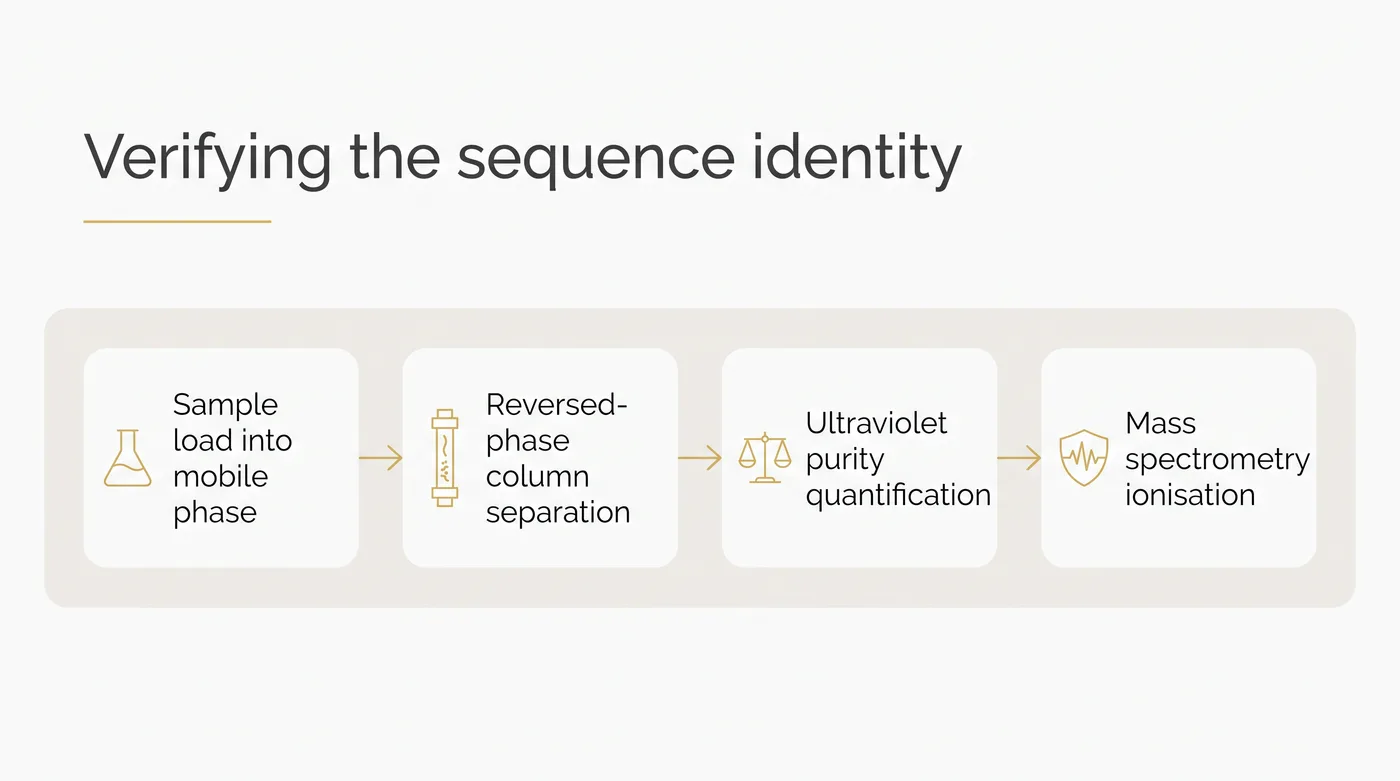
To prove that the white powder in the vial is indeed Lys-Pro-Val, laboratories rely on reversed-phase high-performance liquid chromatography (RP-HPLC). A chromatogram is effectively a race where every impurity has to cross the finish line in public. The method uses a stationary phase column and an acetonitrile gradient to resolve the target sequence from related synthetic impurities Methods in Molecular Biology 386.
However, RP-HPLC only establishes chromatographic homogeneity. A main-peak purity of 99% indicates that 99% of the material that absorbed ultraviolet light belonged to the main sequence. It does not measure the absolute peptide content, because it ignores non-UV-absorbing moisture and salt counterions. This distinction is identical to the testing framework used for larger structural proteins like TB-500.
To establish the actual chemical identity, the chromatography system is coupled to a mass spectrometer. Mass spectrometry ionises the sample and analyses the mass-to-charge ratio of the intact peptide Waters. When the observed primary ion peak aligns precisely with the theoretical exact mass of 342.43 g/mol, the identity of the sequence is confirmed. Check NuuVive's KPV for the current price, stock and measured purity.
Questions
What is the CAS registry number for KPV?
The sequence carries the canonical CAS registry number 67727-97-3. This identifier is widely referenced across chemical supplier catalogues and structural databases to specifically identify the Lys-Pro-Val arrangement.
Why does the salt form change the molecular weight?
During synthesis and purification, the peptide pairs with acidic counterions like acetate or trifluoroacetate. These counterions remain part of the dried solid structure, physically adding mass to the material handled in the laboratory without altering the core amino acid sequence.
Can you determine absolute mass using an HPLC purity percentage?
No. A 99% HPLC purity confirms that 99% of the UV-absorbing material is the target sequence. It does not account for the weight of non-UV-absorbing salts or residual moisture, which means the absolute target mass is always lower than the total scale weight.
What makes the solid hygroscopic?
The structural composition of KPV includes a highly basic lysine residue and terminal charges, making the short sequence strongly polar. This polarity causes the dried solid to readily absorb ambient water from the surrounding atmosphere.
Sources
- nih.gov. National Library of Medicine
- HPLC analysis and purification of peptides (Methods in Molecular Biology 386). Springer
- Advances in Fmoc solid-phase peptide synthesis (Journal of Peptide Science). Wiley
- Design of freeze-drying processes for pharmaceuticals: practical advice (Pharmaceutical Research). Springer
- waters.com. Waters