
Peptide chemistry
Retatrutide identity: structure, molecular weight and form
NuuVive Journal · · 5 min read

Short answer
Retatrutide is a synthetic, 39-amino-acid peptide with the molecular formula C221H342N46O68 and an average molecular weight of 4731.33 g/mol in its free base form. It features a polypeptide backbone modified with three non-canonical amino acids and a specific C20 fatty diacid lipid conjugate at the Lys17 position. For laboratory research, it is supplied as a lyophilised white powder, generally as a sodium or acetate salt, and requires sub-zero storage to preserve structural integrity.
Key takeaways
- Retatrutide is a 39-amino-acid peptide with a complex structure that includes a C-terminal serinamide and multiple non-standard amino acid substitutions.
- The molecule is defined by its lipid tail, a C20 fatty diacid conjugated exclusively at the Lys17 position via a specific chemical linker.
- Its average molecular weight is 4731.33 g/mol, though this figure shifts when the peptide is supplied in its sodium or acetate salt forms.
- High-resolution mass spectrometry and tandem fragmentation are required to verify the location of the lipid conjugate.
- The material is supplied as a lyophilised solid resulting from standard solid-phase peptide synthesis and rigorous freeze-drying.
The 39-amino-acid architectural blueprint
When you look at a structural diagram of retatrutide, you are looking at a highly engineered synthetic molecule. The foundation is a single-chain sequence of 39 amino acids, based on a polypeptide backbone. However, standard amino acids are fragile in chemical environments, prone to rapid degradation. To address this, the sequence incorporates three non-proteinogenic substitutions.
At positions 2 and 20, you will find alpha-aminoisobutyric acid residues. Position 13 features an alpha-methyl-leucine substitution. These modifications are not random; they introduce strict conformational constraints. The bulky side chains of these non-canonical amino acids force the peptide backbone into a specific spatial arrangement. The entire sequence then terminates in a C-terminal serinamide.
Building this sequence relies entirely on solid-phase peptide synthesis. The process builds the chain one amino acid at a time on a solid resin support. As detailed in the literature covering Advances in Fmoc solid-phase peptide synthesis, each coupling step requires control to avoid aspartimide formation or truncation. The sheer length of retatrutide means that even a 99 percent success rate at each coupling step would yield a massive array of deletion impurities by the time the sequence is complete.
The lipid tail and the mass discrepancy
The most distinguishing feature of retatrutide is not its backbone, but what hangs off it. At the lysine residue located at position 17, the molecule features a massive, highly specific lipid conjugation. This is a C20 fatty diacid moiety connected to the peptide via a hydrophilic chemical linker made of [2-(2-aminoethoxy)ethoxy]acetic acid and gamma-glutamic acid.
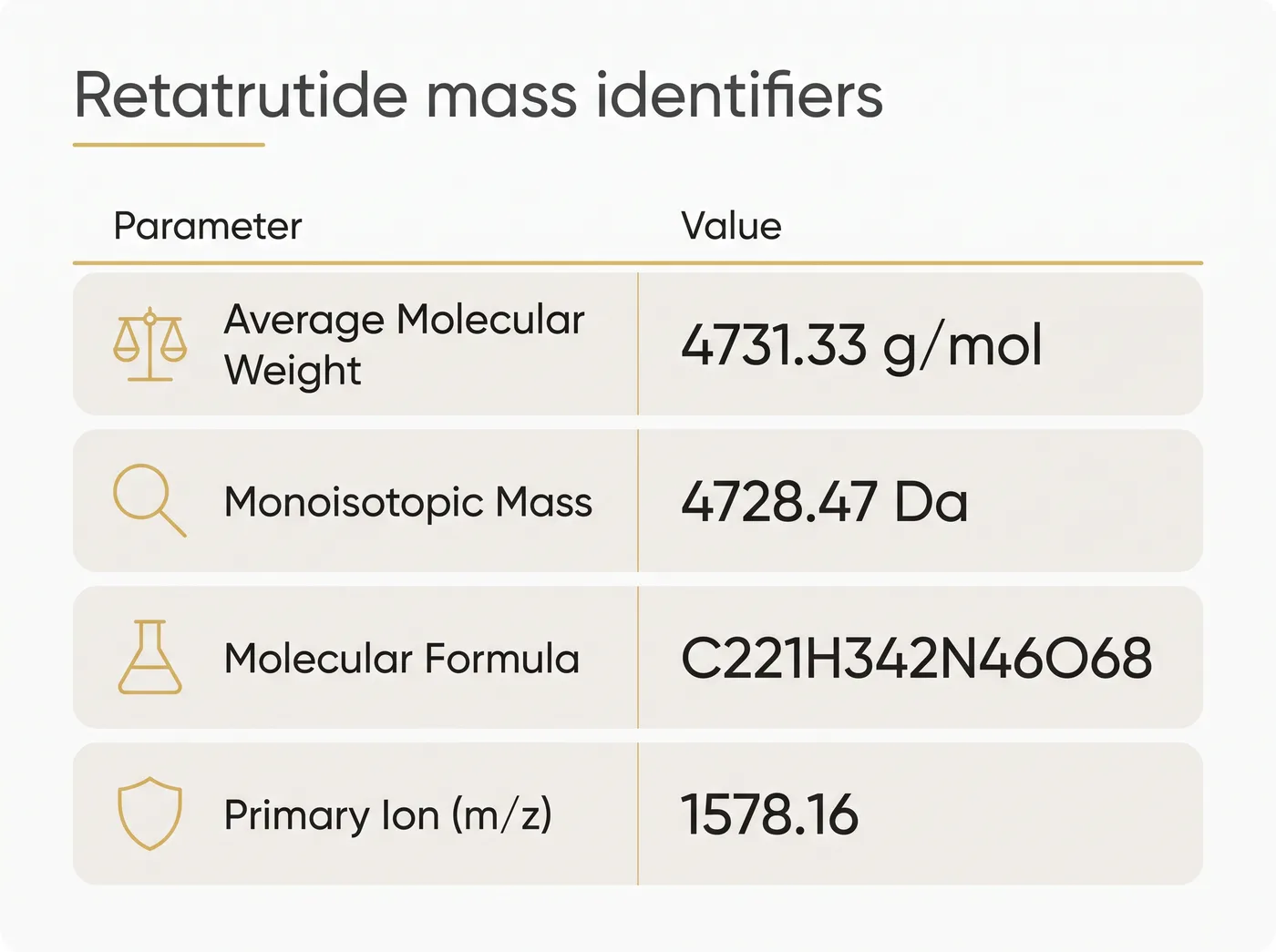
This lipid tail dictates the physicochemical behaviour of the peptide in solution. It is also the reason the molecular weight is so high. The free base form of retatrutide has a molecular formula of C221H342N46O68, yielding an average molecular weight of 4731.33 g/mol. Yet, if you look at a high-resolution mass spectrometry report, you will see an exact monoisotopic mass of 4728.4718 Da. This discrepancy is a basic fact of heavy molecules: the average weight accounts for the natural abundance of heavier isotopes like Carbon-13, while the monoisotopic mass calculates only the lightest, most abundant isotopes.
Retatrutide is rarely handled as a free base. It is catalogued as a sodium salt or an acetate salt. The addition of these counter-ions alters the total mass of the solid powder in the vial. When researchers calculate molarity for analytical preparations, they must account for the specific salt fraction present in the batch.
Solid state and the freeze-drying process
Retatrutide is supplied for laboratory use as a white, lyophilised powder. The transition from a liquid synthetic mixture to a stable solid is not simply a matter of evaporation. It requires a carefully controlled freeze-drying process.
According to research on the Design of freeze-drying processes for pharmaceuticals, the procedure involves freezing the solution below its collapse temperature, followed by primary drying under a vacuum to allow ice to sublimate directly into vapour. A secondary drying phase removes residual bound moisture. If the temperature exceeds the collapse threshold during this process, the resulting solid will melt into a useless film rather than forming the porous white cake expected of a reference standard.
The final solid requires cold-chain storage. The long-chain structure and the complex lipid conjugate are vulnerable to degradation. Storage at -20 degrees Celsius is universally required for the lyophilised powder to prevent the slow breakdown of the molecule over time.
How the laboratory proves the structure
A certificate claiming a peptide is retatrutide is meaningless without the chromatography to back it up. Proper characterisation requires orthogonal analytical techniques. Reversed-phase high-performance liquid chromatography is the standard for determining purity. The method separates the main peptide peak from synthesis truncations and oxidation products.
Chromatographic purity alone does not confirm the identity of the molecule. To prove that the sequence is correct and that the lipid is attached to Lys17 rather than a random primary amine, analysts turn to LC-MS, CE, and software solutions that pair chromatography with tandem mass spectrometry. In electrospray ionisation, retatrutide is often monitored via its [M + 3H]3+ precursor ion at a mass-to-charge ratio of 1578.16.
Tandem mass spectrometry fragments the peptide backbone to create a fragment map of b-ions and y-ions. If the lipid is conjugated at the wrong position, the fragmentation pattern will immediately reveal the error. This is the difference between a rigorous structural confirmation and a simple absorbance check. For a detailed look at the chemical specifications and purity data of this material, you can view the complete documentation for Retatrutide on its main reference page.
Questions
Why does retatrutide have multiple reported molecular weights?
The average molecular weight of the free base is 4731.33 g/mol, but mass spectrometry reports the exact monoisotopic mass of 4728.47 Da. Additionally, the compound is supplied as a sodium or acetate salt, which adds the mass of the counter-ions to the total weight of the solid.
What is the purpose of the C20 fatty diacid?
The lipid conjugate alters the solubility and behaviour of the peptide in solution. It is covalently attached to the Lys17 residue via a specific chemical linker, adding significant mass and complexity to the baseline 39-amino-acid structure.
How is the exact location of the lipid conjugate verified?
Laboratories use tandem mass spectrometry to fragment the peptide backbone. By mapping the resulting fragments, analysts can prove that the complex lipid tail is attached exclusively at the 17th position rather than mis-conjugated elsewhere in the sequence.
Why must the lyophilised powder be stored below freezing?
The complex structure, including the non-canonical amino acids and the bulky lipid tail, is susceptible to chemical degradation at room temperature. Storage at -20 degrees Celsius restricts molecular mobility and preserves the integrity of the solid reference material.