
Reading lab reports
Selank + Semax: what is in the vial?
NuuVive Journal · · 7 min read

Short answer
A Selank + Semax vial contains a physical mixture of two distinct synthetic heptapeptides (seven-amino-acid chains) in lyophilised powder form. Selank (TKPRPGP) and Semax (MEHFPGP) share a structural design but possess entirely different N-terminal sequences. Laboratories verify the vial's contents by using high-performance liquid chromatography to separate the mixture into two distinct peaks, and mass spectrometry to confirm the exact molecular weight of each individual compound.
Key takeaways
- A mixed vial contains two distinct peptide chains that must be separated and analysed independently.
- Chromatography separates the peptides based on their distinct chemical interactions with a laboratory column.
- Mass spectrometry confirms the exact mass of each separated component to establish its chemical identity.
- A trustworthy certificate of analysis must list a specific lot number that links the laboratory result to the physical vial.
- Method validation ensures the laboratory can accurately measure one compound in the presence of the other.
Two distinct compounds in one vial
Opening a laboratory report for a mixed vial can feel like trying to read two separate documents printed over each other. When you look at a vial containing both Selank and Semax, you are looking at a physical mixture of two different synthetic heptapeptides. They are not chemically bonded to one another; they simply share the same glass space as a lyophilised white powder. To understand how a laboratory confirms what is in that vial, you have to look at the structures.
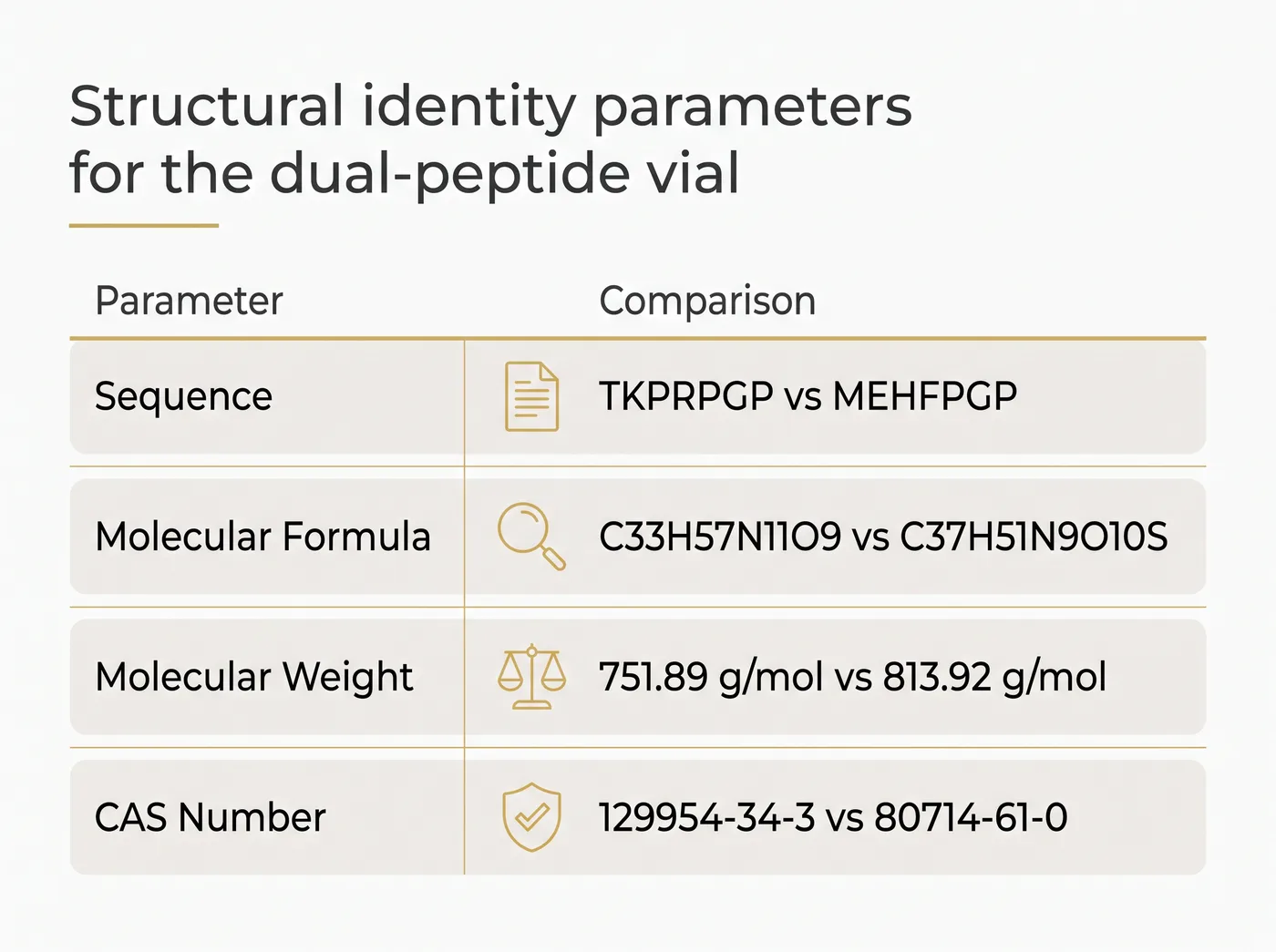
Both peptides are seven amino acids long, and both share a structural design choice at one end. Their C-terminal sequence is Pro-Gly-Pro. That sequence is a deliberate synthetic addition intended to increase conformational stability. But that is where the similarity ends. The N-terminal sequences, empirical formulas and molecular weights are entirely distinct, which is what a laboratory relies on to tell them apart.
| Property | Selank | Semax |
|---|---|---|
| Amino acid sequence | Thr-Lys-Pro-Arg-Pro-Gly-Pro | Met-Glu-His-Phe-Pro-Gly-Pro |
| Molecular formula | C33H57N11O9 | C37H51N9O10S |
| Molecular weight | 751.89 g/mol | 813.92 g/mol |
| CAS Number | 129954-34-3 | 80714-61-0 |
Selank is a synthetic analogue of a tetrapeptide (Thr-Lys-Pro-Arg), extended by the stabilising tripeptide. Semax is an analogue of a synthetic peptide fragment (Met-Glu-His-Phe), extended by that same tripeptide. Semax also contains a single sulphur atom, contributed by the N-terminal methionine. This detail matters immensely when the sample hits the laboratory equipment. Buyers and obscure testing facilities frequently confuse these free base forms with their amidated or acetylated variants, but those are chemically distinct materials with different molecular weights. A thorough laboratory report leaves no ambiguity about which structure is present.
Separating the pair on a chromatogram
Before a laboratory can measure the purity of either peptide, it has to separate them. You cannot measure a crowd; you have to line everyone up single file. That process is called reversed-phase high-performance liquid chromatography (RP-HPLC). The laboratory dissolves a sample from the vial into a liquid mobile phase and forces it through a tightly packed column under high pressure. This is a race where every impurity has to cross the finish line in public.
The column is packed with a hydrophobic stationary phase, typically C18 silica. Because Selank and Semax have different N-terminal sequences, they interact differently with that packing material. Selank contains highly basic residues like lysine and arginine, whereas Semax contains a hydrophobic phenylalanine and an oxidisable methionine. As the mobile phase gradient shifts, the peptides release from the column at different moments. A UV detector captures them as they exit, drawing a peak for each component on the final chromatogram.
According to the ICH Q2(R2): Validation of analytical procedures, an analytical method must demonstrate specificity. That means the method must be demonstrated capable of measuring the exact compound of interest without interference from other compounds present in the sample. For a dual-peptide vial, specificity is the whole game. The laboratory must demonstrate their gradient can resolve the Selank peak from the Semax peak, as well as separate both from any truncated synthesis errors or degradation products. If the method cannot resolve intact Semax from oxidised Semax, the purity number is merely a guess printed on expensive letterhead.
Confirming the molecular weight
To confirm that the two peaks on the chromatogram are actually the peptides listed on the label, the liquid leaving the chromatography column is directed into a mass spectrometer. This instrument measures the mass-to-charge ratio of the molecules. The process typically begins with electrospray ionisation, a technique that turns the liquid sample into a fine aerosol of highly charged droplets. As the solvent evaporates, the droplets shrink until the electrical repulsion forces them to eject individual peptide ions into the vacuum of the mass analyser.
Because both Selank and Semax are relatively short heptapeptides, they will primarily present to the detector as singly protonated ions. The mass spectrometer will record a specific mass-to-charge ratio (m/z) for each. For Selank, the theoretical calculated mass is approximately m/z 752.4. For Semax, the calculated mass is approximately m/z 814.4. By matching the exact mass measured by the instrument against the theoretical mass calculated from the amino acid sequence, the laboratory confirms the identity of the material.
This step eliminates the guesswork. A peak on a chromatogram might look perfect, but if the mass spectrometer reads m/z 854.98 instead of 814.4, the vial contains N-Acetyl Semax Amidate, not Semax free base. A rigorous laboratory report will provide the mass spectrometry data alongside the chromatogram, showing you what crossed the finish line.
System suitability and method standardisation
A chromatography method is only as trustworthy as the rules governing its operation. Instruments drift, columns degrade, and laboratory temperatures fluctuate. To ensure the results are reliable on any given Tuesday, the laboratory must adhere to established standard practices. The Pharmacopeial Discussion Group: harmonised general chapter on chromatography establishes the mathematical envelope for system suitability. Before running the actual sample, the laboratory runs a known standard to verify that the column efficiency (theoretical plates) and peak symmetry (tailing factor) meet strict criteria.
This standardisation ensures the gradient elution is working as intended. If a laboratory skips these system suitability checks, the resulting chromatogram is essentially an uncalibrated sketch. The exact configuration of the mobile phase matters here. Most peptide separations use an acidified water and acetonitrile gradient, often relying on 0.1% trifluoroacetic acid to keep the peaks sharp and symmetrical. Detailed laboratory reports will sometimes list these specific run conditions, providing another layer of transparency for researchers who want to understand how the purity number was generated.
Validation practices also require defining the working range and precision of the method. The Eurachem guide: The fitness for purpose of analytical methods outlines how a laboratory must demonstrate that their measurement remains accurate across different concentrations. When you see a purity figure that extends to three decimal places, that precision is only meaningful if the underlying method has been validated to that degree of accuracy.
Reading the documentation
All this highly technical machinery ultimately produces a single document: the certificate of analysis. When you evaluate that document, the first thing to check is not the purity percentage, but the lot number. As defined in 21 CFR Part 210: Current good manufacturing practice, general, a lot number is a distinctive combination of letters and numbers from which the complete history of the material can be determined. If the laboratory report lacks a specific lot number, it is disconnected from the physical vial. It is just a picture of a good result from an unknown time and place.
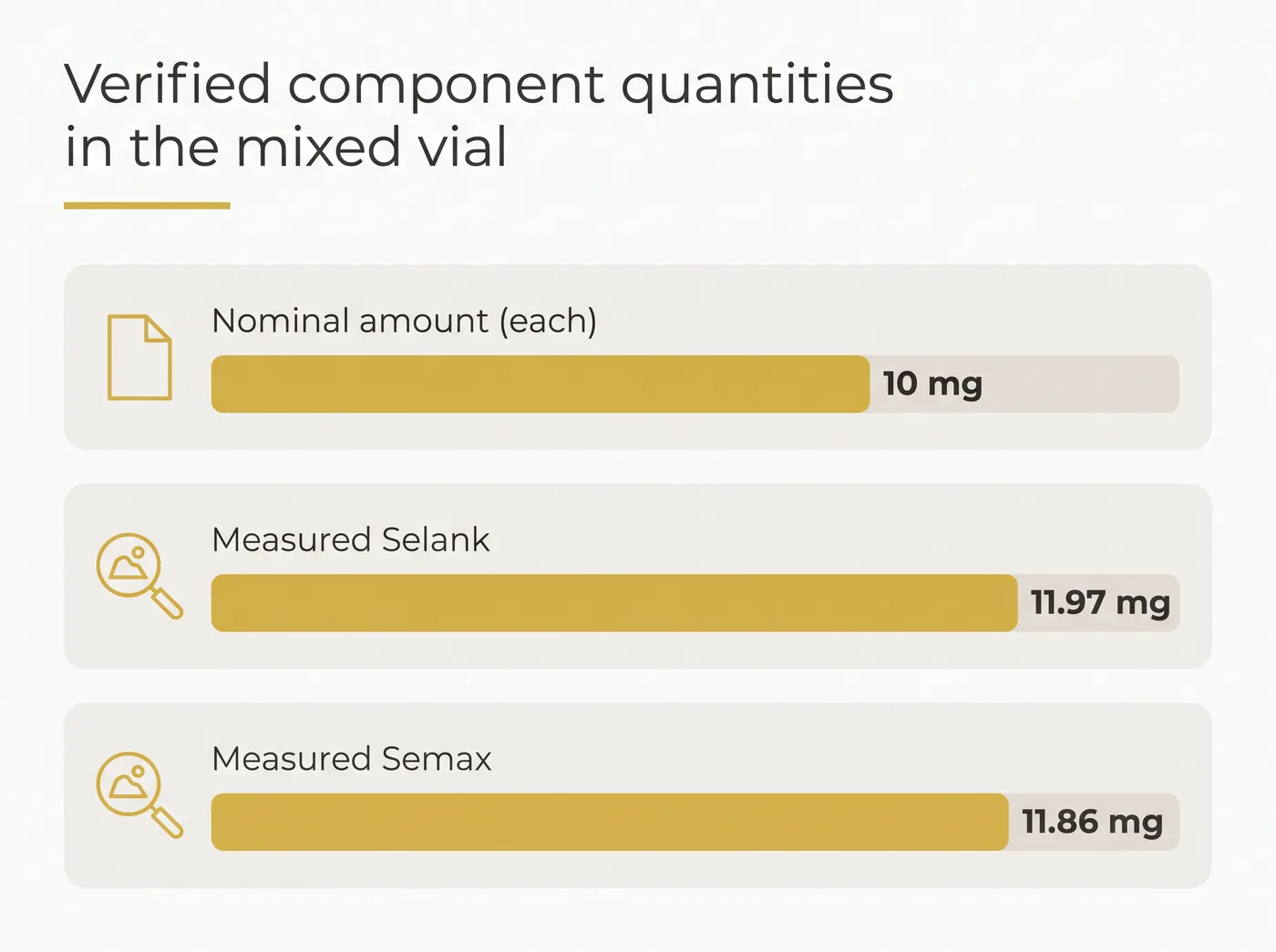
For a dual-peptide mixture, the certificate must explicitly report the purity and quantity for both components independently. A single overall purity number for a mixed vial is analytical nonsense. The report should show separate integrations for the Selank peak and the Semax peak. The same applies to the total mass. The laboratory must quantify how many milligrams of each specific peptide are present in the freeze-dried solid.
When the documentation is complete, it tells a clear, verified story about the material. For example, NuuVive's Selank + Semax blend provides both peptides at 10 mg nominal mass per vial, with verified lot measurements showing 11.97 mg for Selank (Janoshik #93614) and 11.86 mg for Semax, alongside an overall purity of ≥99%, based on the lowest of its components (Selank 99.682%, Janoshik #86683; Semax 99.248%, Janoshik #165292).
Questions
Why does a mixed vial require a specific high-performance liquid chromatography method?
A mixed vial contains two different compounds that must be physically separated before they can be measured. The chromatography method must be specifically designed to separate those exact two peptides from each other, ensuring that the purity calculation for one does not accidentally include the other.
Can mass spectrometry determine the purity of the mixture on its own?
No, mass spectrometry confirms the identity of the molecules by measuring their exact mass, but it is not typically used to calculate percentage purity. Purity is determined by the chromatography system, which measures the relative size of each peak as it exits the column.
What happens if a laboratory uses the wrong CAS number on a report?
A mismatched CAS number indicates a failure in documentation or analytical verification. If a report lists the CAS number for an acetylated variant while testing a free base peptide, the laboratory is comparing the sample against the wrong theoretical standard, rendering the identity confirmation useless.