
Peptide chemistry
SS-31 identity: structure, molecular weight and form
NuuVive Journal · · 6 min read

Short answer
SS-31 is a synthetic tetrapeptide with the molecular formula C32H49N9O5 and an exact mass of 639.8 g/mol. Also known by the international nonproprietary name elamipretide, its sequence is D-Arg-Dmt-Lys-Phe-NH2. The structure relies on alternating basic and aromatic residues, including the unnatural amino acid 2',6'-dimethyltyrosine. Laboratories supply it as a lyophilised powder, typically as an acetate or trifluoroacetate salt, which requires analytical verification through high-performance liquid chromatography and mass spectrometry.
Key takeaways
- The sequence D-Arg-Dmt-Lys-Phe-NH2 incorporates unnatural amino acids and a terminal amide.
- The exact molecular weight of the pure peptide base is 639.8 g/mol.
- Lyophilised samples contain counterions and moisture, which must be factored into accurate mass calculations.
- Mass spectrometry is mandatory to confirm the specific molecular mass alongside standard chromatography.
The architecture of a four-block peptide
Somewhere between unboxing a new laboratory delivery and running an analytical sweep, a single chemical formula dictates every parameter of the test. If you look closely at the sequence printed on an SS-31 vial, it breaks almost every conventional rule of standard peptide chemistry. This synthetic tetrapeptide is essentially four molecular building blocks engineered to alternate perfectly between basic and aromatic properties. Before you load a sample into a machine, you need to understand how those modifications change the way the molecule behaves on a column.
The formal sequence for SS-31 is D-Arg-Dmt-Lys-Phe-NH2. To understand why those exact letters matter, you have to look at what they replace. The very first block is an arginine residue, but it uses the D-enantiomer rather than the standard L-configuration. The second position features 2',6'-dimethyltyrosine, abbreviated as Dmt. This is a highly modified, unnatural amino acid where two extra methyl groups have been grafted onto the aromatic ring 1. Finally, the chain ends with phenylalanine, but instead of the usual free carboxylic acid tail, the structure is capped with a primary amide.
Every one of these modifications changes the physicochemical profile of the solid. The amidation at the C-terminus removes a native negative charge, while the basic arginine and lysine residues give the molecule a net positive charge. SS-31 belongs to a category known as aromatic-cationic peptides, meaning it alternates between basic and aromatic residues. The basic amino acids provide cationic properties, while the aromatic rings deliver hydrophobicity. At a standard laboratory pH of 7.4, the whole structure carries a net positive charge of plus three, a detail that dramatically influences its retention time during peptide analysis.
Calculating mass and the missing weight
If you hand a chemical formula to a mass spectrometer, it expects an exact and unyielding number. The molecular formula for the SS-31 base is C32H49N9O5. If you tally up those specific carbon, hydrogen, nitrogen and oxygen atoms, you arrive at an exact molecular weight of 639.8 g/mol. This theoretical figure is the absolute foundation of laboratory verification. Without it, you are flying blind when interpreting the peaks on an analytical readout.
But this exact mass also introduces one of the most common mathematical errors in laboratory calibration. When an analyst weighs a sample of SS-31, the white powder resting on the balance is never just the free peptide base. It is an isolated salt, usually containing tightly bound moisture from the manufacturing environment. Think of the highly basic peptide as a chemical sponge. During synthesis, it accumulates counterions, such as acetate or trifluoroacetate, simply to remain stable as a solid.
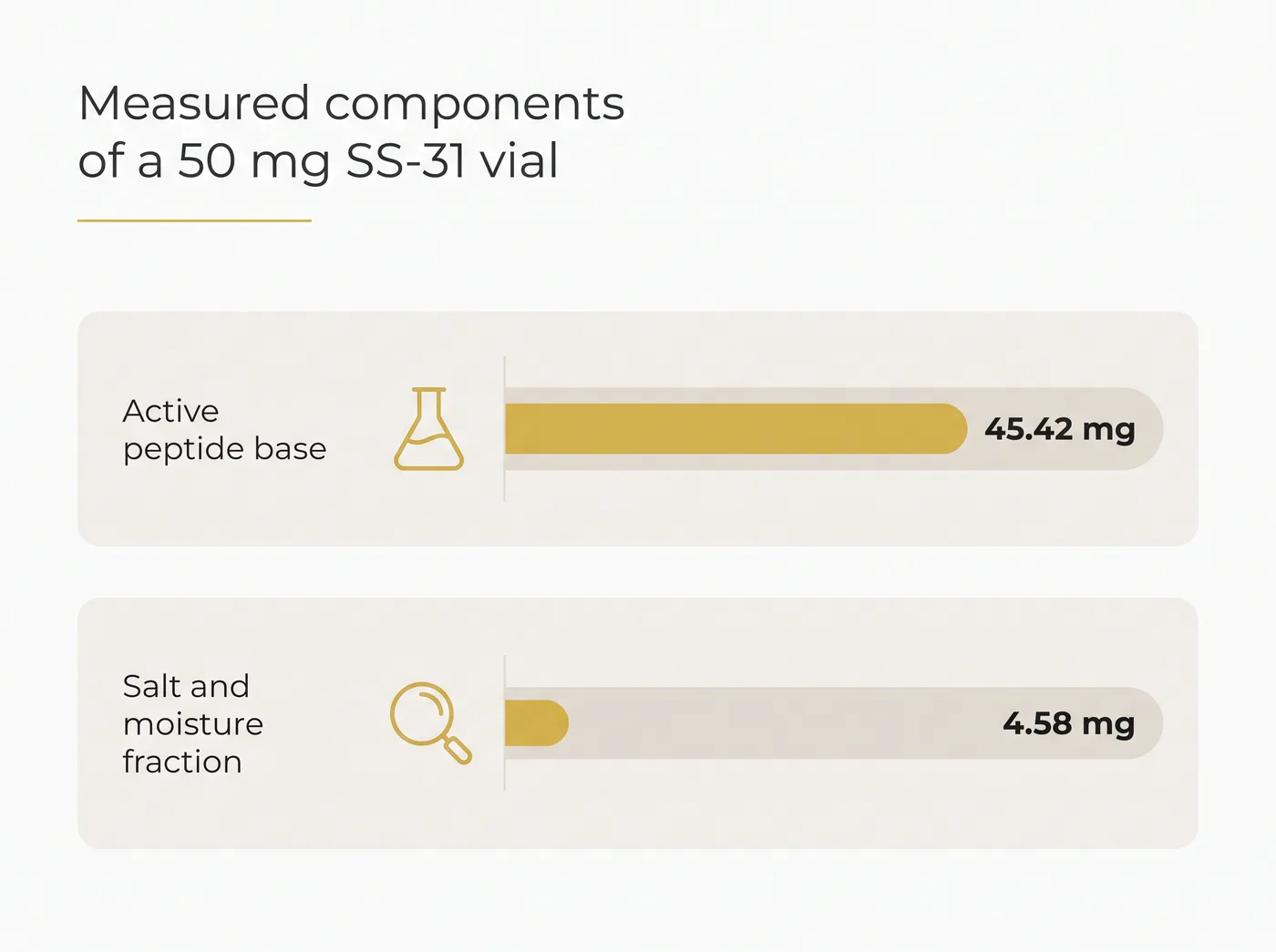
These counterions add physical mass to the solid without adding any active peptide molecules. When measuring a sample of the lyophilised powder for an analytical load, a laboratory is not loading pure C32H49N9O5. This discrepancy explains why NuuVive's SS-31 tested at 45.42 milligrams of active peptide per 50-milligram vial on Janoshik report #85195. The remaining 4.58-milligram fraction is simply the expected salt and water weight, a principle of net peptide content that applies equally when evaluating other complex structures like NAD+.
From synthesis to solid powder
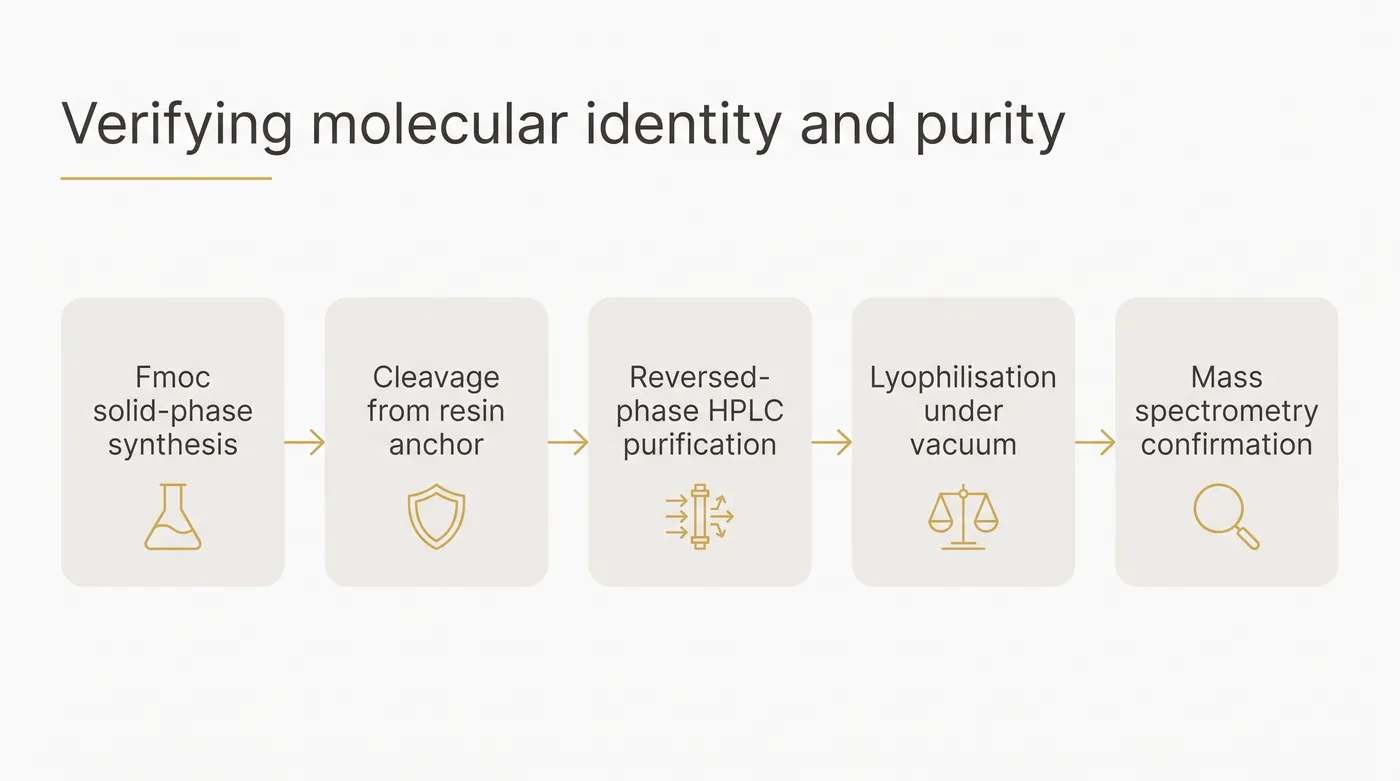
Building a custom sequence with non-standard amino acids requires precise step-by-step assembly. Most commercial laboratories rely on Fmoc solid-phase peptide synthesis, a chemical method that anchors the first amino acid to a resin and adds the subsequent blocks one by one 3. At each step, specific reagents strip away protective chemical caps so the next residue can attach. Once the full four-block sequence is complete, strong chemical washes cleave the peptide from its resin anchor, leaving a crude liquid solution that requires extensive purification.
Solid-phase synthesis is notoriously prone to minor side reactions, generating incomplete fragments or chiral inversions. Removing these close structural cousins requires highly controlled chromatography before the solution ever reaches the freeze-drying stage. Freeze-drying, or lyophilisation, involves freezing the purified solution and lowering the ambient pressure so the frozen water sublimates directly into a gas 4.
The temperature must be carefully managed to ensure the final product forms a stable, off-white solid rather than a degraded paste. A poorly controlled freeze-drying cycle leaves excess bound water in the vial, which quietly accelerates degradation and ruins the shelf life of the resulting powder.
Reading the laboratory evidence
A certificate of analysis is the only proof that this complex process worked. When you open a laboratory report for SS-31, you should look for two distinct analytical methods working together. The first is reversed-phase high-performance liquid chromatography. In this test, a sample load is pushed through a C18 column using a liquid gradient, often a careful mixture of water and acetonitrile 2. The machine separates the molecules based entirely on how they interact with the column chemistry.
A chromatogram is basically a chemical race where every synthesis impurity has to cross the finish line in public. If the manufacturing process left behind fragments missing a single methyl group on the tyrosine residue, they will elute at slightly different times than the main product. High-quality research materials demand a chromatographic purity of at least 95 percent, though premium synthesis pushes this threshold significantly higher. As an example, NuuVive's SS-31 claims ≥99% purity and tested at 99.756% on Janoshik report #85195.
But chromatography has a blind spot. It can confirm the sample is clean and homogenous, but retention time alone cannot prove the exact molecular identity of that primary peak. That absolute confirmation requires mass spectrometry. The testing laboratory must ionise the sample, then measure the mass-to-charge ratio of the resulting fragments. For SS-31, the mass spectrometer should reveal a primary ion peak at roughly 640.4 m/z, representing the 639.8 g/mol base molecule plus a single added proton.
Testing for purity and mass identity is about knowing what is in the vial before you commit time and laboratory resources to a complex analytical method. A single missing methyl group or unexpected counterion can derail a sensitive instrument calibration. You can review the current analytical certificates, stock levels and measured purity for NuuVive's SS-31.
Questions
What is the difference between elamipretide and SS-31?
They refer to the exact same chemical structure. SS-31 is the common laboratory designation, while elamipretide is the formal international nonproprietary name assigned to the synthetic tetrapeptide.
Why is the exact mass 639.8 g/mol but the mass spec shows 640.4 m/z?
The molecular weight of the free base is 639.8 g/mol. However, during positive ion electrospray mass spectrometry, the highly basic peptide accepts a proton to become ionised. This added proton increases the observed mass-to-charge ratio by approximately one atomic mass unit.
Does the salt form change the molecular weight?
The counterion does not change the 639.8 g/mol molecular weight of the pure peptide chain itself. It does, however, increase the total molecular weight of the resulting solid salt compound, which you must account for when weighing materials for laboratory analysis.
How should the solid powder be stored upon arrival?
Lyophilised SS-31 is highly hygroscopic. It should be kept sealed and stored in a freezer at -20 degrees Celsius, protected from light and ambient moisture, to prevent degradation prior to laboratory testing.
Sources
- nih.gov. National Library of Medicine
- HPLC analysis and purification of peptides (Methods in Molecular Biology 386). Springer
- Advances in Fmoc solid-phase peptide synthesis (Journal of Peptide Science). Wiley
- Design of freeze-drying processes for pharmaceuticals: practical advice (Pharmaceutical Research). Springer