
Compounds explained
What is retatrutide? What it has been studied for
NuuVive Journal · · 7 min read

Short answer
Retatrutide is a synthetic 39-amino-acid peptide engineered as a triple hormone receptor agonist. Originally developed in the late 2010s, it targets the GLP-1, GIP, and glucagon receptors simultaneously. It is an investigational compound currently studied in phase 3 human clinical trials for obesity, type 2 diabetes, obstructive sleep apnea, and osteoarthritis. It is not approved by the FDA for any use and remains strictly within the bounds of laboratory and clinical research.
Key takeaways
- Retatrutide is a synthetically engineered peptide that targets three distinct metabolic receptors: GLP-1, GIP, and glucagon.
- It is currently being investigated in phase 3 human clinical trials for metabolic conditions, sleep apnea, and osteoarthritis.
- Because clinical trials are ongoing, long-term human data spanning multiple years does not yet exist.
- The FDA considers it an investigational new drug, meaning it is entirely unapproved for medical use.
- When sourcing the compound for laboratory use, researchers rely on third-party chromatography to verify its exact identity and purity.
The architecture of a triple agonist
Imagine a lock with three keyholes. Now imagine trying to forge a single key that turns all three at once. That is the fundamental premise behind retatrutide. Developed by Eli Lilly scientists in the late 2010s, it is a synthetic peptide made of 39 amino acids PubChem. It belongs to a class of compounds called incretin mimetics, but with a structural twist that sets it apart from earlier iterations in the laboratory.
The foundation of the molecule is a continuous helical structure built upon a glucose-dependent insulinotropic polypeptide (GIP) peptide backbone. If you were to look at it under a mass spectrometer, you would find a molecular weight of approximately 4731.3 g/mol PubChem. But a bare string of amino acids degrades rapidly in a biological environment. To solve this, chemists modified the structure with non-proteinogenic amino acids, specifically 2-aminoisobutyric acid, to improve its structural integrity.
The defining feature, however, is lipidation. The molecule is fitted with a fatty diacid side chain. Think of this fatty chain as an anchor. It is designed to bind reversibly to albumin in the bloodstream, a mechanism studied to prolong the compound's half-life and allow for less frequent intervention in experimental models. The result is a highly engineered molecule designed to simultaneously engage three distinct metabolic pathways in a single structure PubMed.
Semaglutide, tirzepatide and retatrutide: tracing the lineage
To understand what this compound is, you have to look at what came before it. The evolution of incretin mimetics in research has been a steady march from single targets to multiple targets. Researchers categorise these compounds based on how many receptor pathways they are designed to activate. To see how researchers compare compounds in completely different classes, you can read about the structural differences between CJC-1295 and ipamorelin.
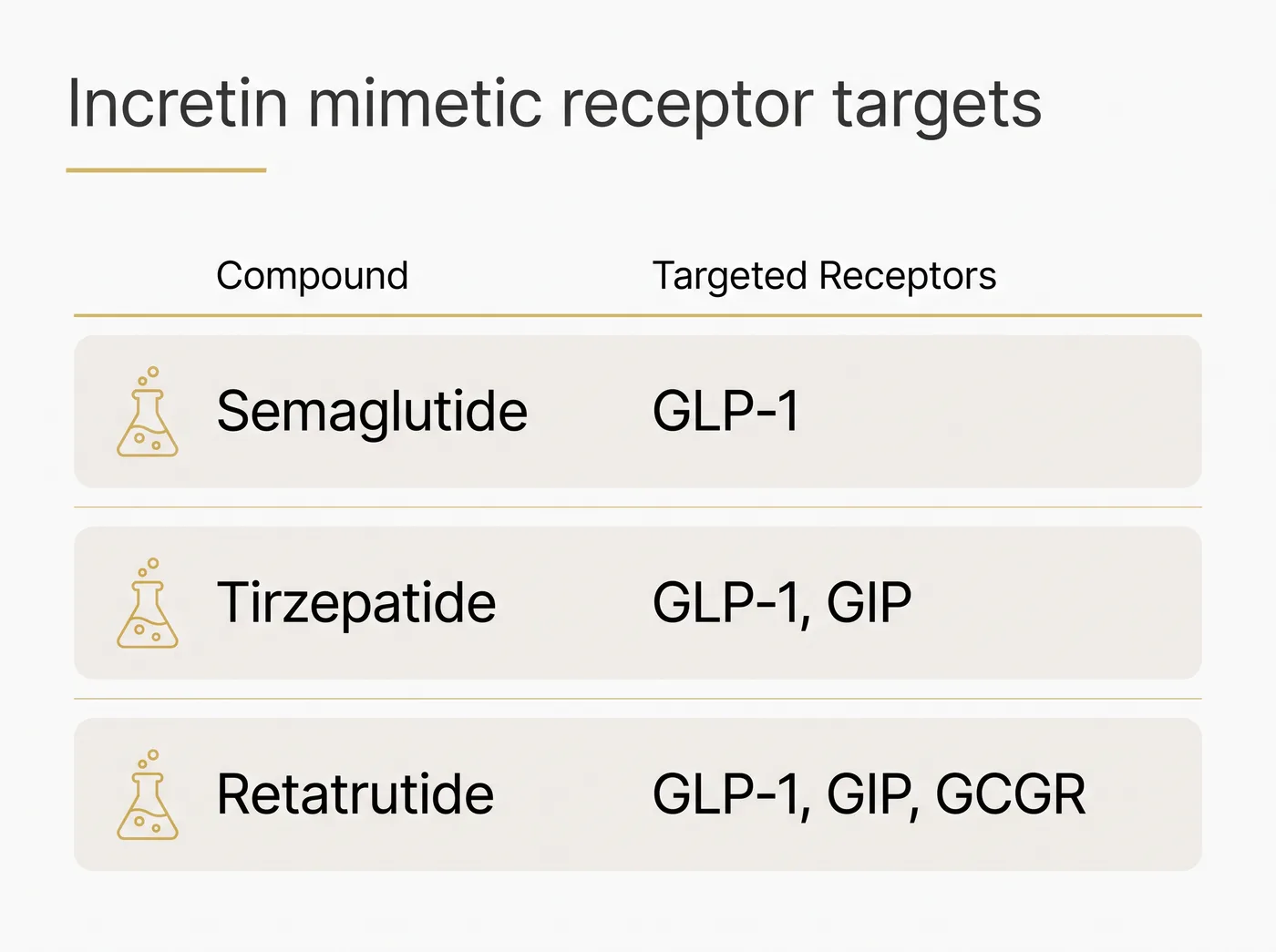
The first major compound in this modern era was Semaglutide. It is a single agonist. Its sole mechanism of action is targeting and activating the glucagon-like peptide-1 (GLP-1) receptor PubChem. The next generation introduced dual agonists. Tirzepatide is the most prominent example of this class, targeting both the GLP-1 and the GIP receptors PubChem. Adding the second target allowed researchers to study combined mechanisms on metabolic regulation.
Retatrutide steps into the territory of a triple agonist. It retains the GLP-1 and GIP targets but adds a third: the glucagon (GCGR) receptor PubMed. The inclusion of this glucagon receptor pathway is not an accident. It is specifically intended in experimental designs to influence hepatic fat metabolism and increase systemic energy expenditure, a mechanism not engaged by single or dual incretin agonists PubMed. For a closer look at their legal status and chemical architecture, you can read a detailed breakdown of the three compounds.
| Compound | Target class | Receptors targeted |
|---|---|---|
| Semaglutide | Single agonist | GLP-1 |
| Tirzepatide | Dual agonist | GLP-1, GIP |
| Retatrutide | Triple agonist | GLP-1, GIP, GCGR |
The research history: what it has been studied for
Retatrutide first entered phase 1 human trials in 2019, with receptor pharmacology and proof-of-concept designs detailed in major scientific journals by 2022. Since then, it has been studied across a range of models to assess its mechanisms on appetite regulation, glucose control, and metabolic energy expenditure. In vitro cell models have been used to investigate its binding affinity and activation of the human and murine GLP-1, GIP, and glucagon receptors.
In preclinical animal models, researchers have studied the compound to observe its effect on caloric intake, systemic energy expenditure, and hepatic lipid metabolism PubMed. Moving into human participants, phase 2 clinical trial data covering obesity and type 2 diabetes were published in 2023. Phase 3 trials began producing data between 2025 and 2026. If your interest leans toward the cellular side of energy research, you might also want to read about the research history of NAD+.
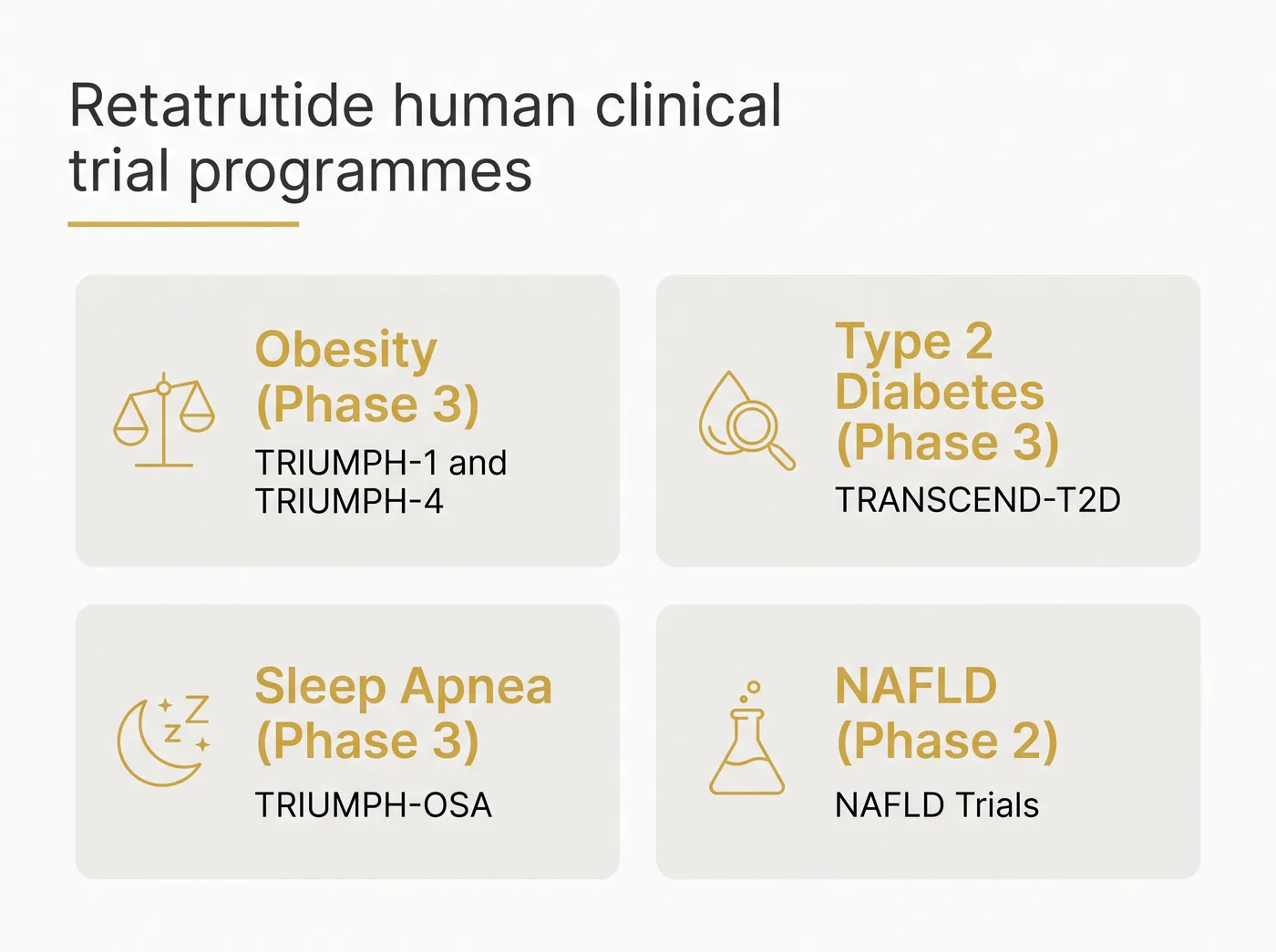
The phase 3 human trial data is currently extensive. It has been studied in overweight and obese adults without diabetes in the TRIUMPH clinical trial program, which includes studies like TRIUMPH-1 and TRIUMPH-4 PubMed. It has also been studied in human participants with type 2 diabetes to observe its impact on glycemic control through the TRANSCEND-T2D trial program PubMed.
Beyond basic metabolic parameters, the compound is being evaluated in adults with moderate to severe obstructive sleep apnea and concurrent obesity in the TRIUMPH-OSA trials PubMed. It has also been investigated in human participants with knee osteoarthritis to study joint pain secondary to mechanical load and inflammation, and in phase 2 trials involving participants with non-alcoholic fatty liver disease (NAFLD) to assess changes in hepatic fat concentration.
The evidence that does not exist yet
When reading about investigational compounds online, distinguishing between what has been measured and what is merely hoped for is a critical skill. Because the clinical development program is still ongoing, long-term human data spanning multiple years post-trial does not yet exist. There is currently no completed human evidence from large-scale cardiovascular outcome trials assessing the compound's long-term cardiovascular outcomes.
Additionally, there is no human evidence regarding the compound in pregnancy or in pediatric populations. Finally, published human evidence directly comparing retatrutide head-to-head in completed phase 3 trials against established dual or single incretin agonists over extended periods is not yet available. Anyone claiming definitive knowledge of these long-term outcomes is substituting enthusiasm for data.
The regulatory reality
The regulatory status of retatrutide is blunt and uncompromising. As of late 2026, it is an investigational new drug and is strictly unapproved by the FDA PubMed. It is not approved for type 2 diabetes, obesity, or any other condition. Consequently, it cannot be legally sold or marketed for human consumption outside of authorized, regulated clinical trials. Eli Lilly intends to submit an application for regulatory review in early 2027, but until that process concludes, the compound remains purely experimental.
You might occasionally hear about research compounds being legally compounded by pharmacies. This requires strict categorization, and retatrutide does not make the cut. It is not covered by the October 2026 US HHS interim enforcement discretion policy that permits state-licensed pharmacies to temporarily compound a specific list of six unapproved research peptides. To understand exactly how these policies apply, you can review Where retatrutide stands in FDA trials.
The FDA has explicitly stated in public communications and warning letters that retatrutide does not meet the statutory exemptions under Section 503A or 503B of the Federal Food, Drug, and Cosmetic Act. This means it cannot be legally used in pharmacy compounding under federal law. It belongs strictly in a laboratory. If the federal statutes seem like a maze, trace the exact boundaries in this plain guide to the US legal status of retatrutide.
How to read a retatrutide lab report
If you are managing a laboratory and sourcing this compound for research, the only thing standing between your experimental integrity and a vial of unknown white powder is a third-party Certificate of Analysis (COA). A genuine lab report is not a marketing flyer. It is a dense, mathematical document produced by an analytical chemist who has run the sample through high-performance liquid chromatography (HPLC) and mass spectrometry.
The mass spectrometry must verify the molecular weight of 4731.3 g/mol PubChem. If the number is off, the sequence is wrong. The HPLC chromatogram is a race where every impurity has to cross the finish line in public. You are looking for a single, sharp peak indicating the primary compound, with minimal surrounding noise. A standard research grade purity requirement is greater than 99 percent.
A lot number on the vial acts as the passport; it must match the lot number on the COA perfectly. If a vendor obscures the testing laboratory's name or contact information, it is an immediate red flag. For a concrete example of what rigorous documentation looks like, including measured purity results and verifiable test reports, you can examine NuuVive's Retatrutide.
Questions
Is retatrutide the same as tirzepatide?
No. While both are synthetically engineered incretin mimetics, tirzepatide is a dual agonist targeting the GLP-1 and GIP receptors. Retatrutide is a triple agonist that targets GLP-1, GIP, and adds a third pathway by targeting the glucagon receptor.
Has the FDA approved retatrutide for public use?
No. It is currently classified as an investigational new drug. It is entirely unapproved by the FDA and cannot be legally sold or marketed for any condition.
Can a compounding pharmacy make retatrutide legally?
No. It is not included in the HHS interim enforcement discretion policy of late 2026. The FDA has stated that it does not meet the statutory exemptions under Section 503A or 503B, meaning it cannot legally be used in pharmacy compounding.
What phase of clinical trials is retatrutide in?
It is currently undergoing phase 3 human clinical trials for obesity, type 2 diabetes, obstructive sleep apnea, and knee osteoarthritis. Phase 2 trials have also investigated it in participants with non-alcoholic fatty liver disease.
Sources
- pubchem.ncbi.nlm.nih.gov. National Library of Medicine
- pubchem.ncbi.nlm.nih.gov. National Library of Medicine
- pubchem.ncbi.nlm.nih.gov. National Library of Medicine
- pubmed.ncbi.nlm.nih.gov. National Library of Medicine
- pubmed.ncbi.nlm.nih.gov. National Library of Medicine
- pubmed.ncbi.nlm.nih.gov. National Library of Medicine