
Legal status
What is Semax and is it legal in the US?
NuuVive Journal · · 7 min read

Short answer
Semax is not an FDA-approved drug and has not passed Western clinical trials. Because it is not a controlled substance, possessing it is not a criminal offense, and chemical suppliers sell it strictly for laboratory research. While it is not on the permanent 503A bulks list, an October 2026 HHS enforcement discretion policy permits state-licensed pharmacies to compound Semax free base, provided specific prescription and reporting conditions are strictly met.
Key takeaways
- Semax is a synthetic seven-amino-acid peptide derived from a fragment of adrenocorticotropic hormone (ACTH).
- It has been studied in cell cultures, rodent models of cerebral ischemia, and small human trials in Eastern Europe.
- There are no large-scale, Phase III clinical trials demonstrating outcomes to Western regulatory standards.
- Semax is not an FDA-approved drug and cannot be sold for human consumption.
- A late 2026 HHS policy outlines strict conditions under which state-licensed pharmacies may compound the peptide.
The origin and structure of the peptide
Search for this compound online and you will hit a wall of marketing noise. Behind that fog lies a quiet trail of Russian scientific literature from the 1990s and a convoluted bureaucratic fight in Washington. Only the latter is worth your time.
At its core, the compound is a synthetic regulatory heptapeptide characterized by the amino acid sequence Met-Glu-His-Phe-Pro-Gly-Pro. With a molecular weight of approximately 813.9 g/mol, it belongs to a class of peptides investigated in neuroprotection and cognitive research 1. The molecule was originally designed in the 1980s by researchers at the Institute of Molecular Genetics of the Russian Academy of Sciences.
To understand the structure, you have to look at where it came from. The peptide is an analogue of a specific fragment of a naturally occurring hormone called adrenocorticotropic hormone, or ACTH. Specifically, it mimics the ACTH 4-10 fragment. The Soviet-era researchers wanted to study the signaling properties of this fragment without the parent hormone's tendency to trigger cortisol release. To achieve this, they isolated the 4-10 section and attached a stabilizing tail consisting of three amino acids: Pro-Gly-Pro.
Think of the Pro-Gly-Pro tail as a molecular anchor. In a laboratory environment, endogenous peptides are notoriously fragile, breaking down rapidly when exposed to enzymes. Adding this synthetic tail was added to resist enzymatic degradation, keeping it intact long enough to be studied in various models. The structural identity and exact composition of the compound are cataloged publicly by the National Library of Medicine 1.
What Semax has been studied for
In scientific literature, Semax has been investigated primarily within the contexts of neurology, cognitive regulation, and neuroprotection. The research spans several decades but remains heavily concentrated in specific geographical regions and experimental models.
Laboratory researchers have evaluated the peptide in cell cultures to measure its influence on the expression of brain-derived neurotrophic factor (BDNF) and tropomyosin receptor kinase B (TrkB) signaling. Cellular models have also been used to track dopaminergic and serotonergic turnover, as well as the modulation of genes associated with immune and vascular responses following ischemic events 5.
In animal models, rodent studies have investigated the compound using various cognitive paradigms. Rats and mice have been run through the novel object recognition test, the Barnes maze, and open-field tests to observe learning behavior, attention, and memory consolidation. Researchers have also studied animal models of cerebral ischemia, optic nerve injury, and oxidative stress to study its potential applications in neuroprotection 5.
In humans, the compound has been studied in small clinical trials, almost exclusively conducted in Russia by groups affiliated with its original development. These small-scale human studies investigated the compound in patients recovering from acute ischemic stroke, individuals undergoing stroke rehabilitation, patients with diabetic eye disease, and adults subjected to stress and cognitive challenges 2.
Semax vs Selank: the structural differences
If you read about one of these Russian peptides, you will inevitably read about the other. Semax is frequently studied alongside a related synthetic heptapeptide known as Selank 3. Because they share the same origin and the same stabilizing tail, marketing materials often lump them together. But from a chemical and research perspective, they are entirely distinct molecules.
While Semax is an analogue of the ACTH hormone fragment, Selank is a synthetic analogue of tuftsin, an endogenous immunomodulatory tetrapeptide cleaved from immunoglobulin G. The core sequence of tuftsin is Thr-Lys-Pro-Arg. When the Russian institute added the identical Pro-Gly-Pro tail to this tuftsin core, they created Selank 3. Because their core amino acid sequences differ entirely, the two peptides are researched in completely different models.
| Feature | Semax | Selank |
|---|---|---|
| Origin molecule | Adrenocorticotropic hormone (ACTH 4-10) | Tuftsin (immunoglobulin G fragment) |
| Amino acid sequence | Met-Glu-His-Phe-Pro-Gly-Pro | Thr-Lys-Pro-Arg-Pro-Gly-Pro |
| Primary research models | Cerebral ischemia, BDNF expression, memory | Unpredictable chronic mild stress, GABAergic system |
| PubChem CID | 9811102 | 11765600 |
Where Semax literature focuses heavily on focal ischemia and cognitive paradigms 5, Selank research is concentrated on behavioral challenge models. Researchers studying Selank typically observe GABAergic system modulation, serotonin metabolism, and anxiety-modulating parameters in rats subjected to chronic mild stress 4.
FDA status and the 503A compounding battle
Semax is not an FDA-approved drug. It has never undergone a New Drug Application (NDA) process, meaning the agency has not verified it for any use. Consequently, importing or selling the compound for human consumption as an unapproved new drug violates the Federal Food, Drug, and Cosmetic Act.
Because it is not a controlled substance, possessing the peptide is not a criminal offense, and chemical suppliers sell it as a research chemical for in vitro laboratory research. But the regulatory framework for pharmacies is much more complex. Under Section 503A of the FD&C Act, bulk drug substances used for compounding by state-licensed pharmacies must meet specific criteria, such as having a USP monograph or appearing on the FDA's 503A Bulks List. Semax meets none of these criteria.
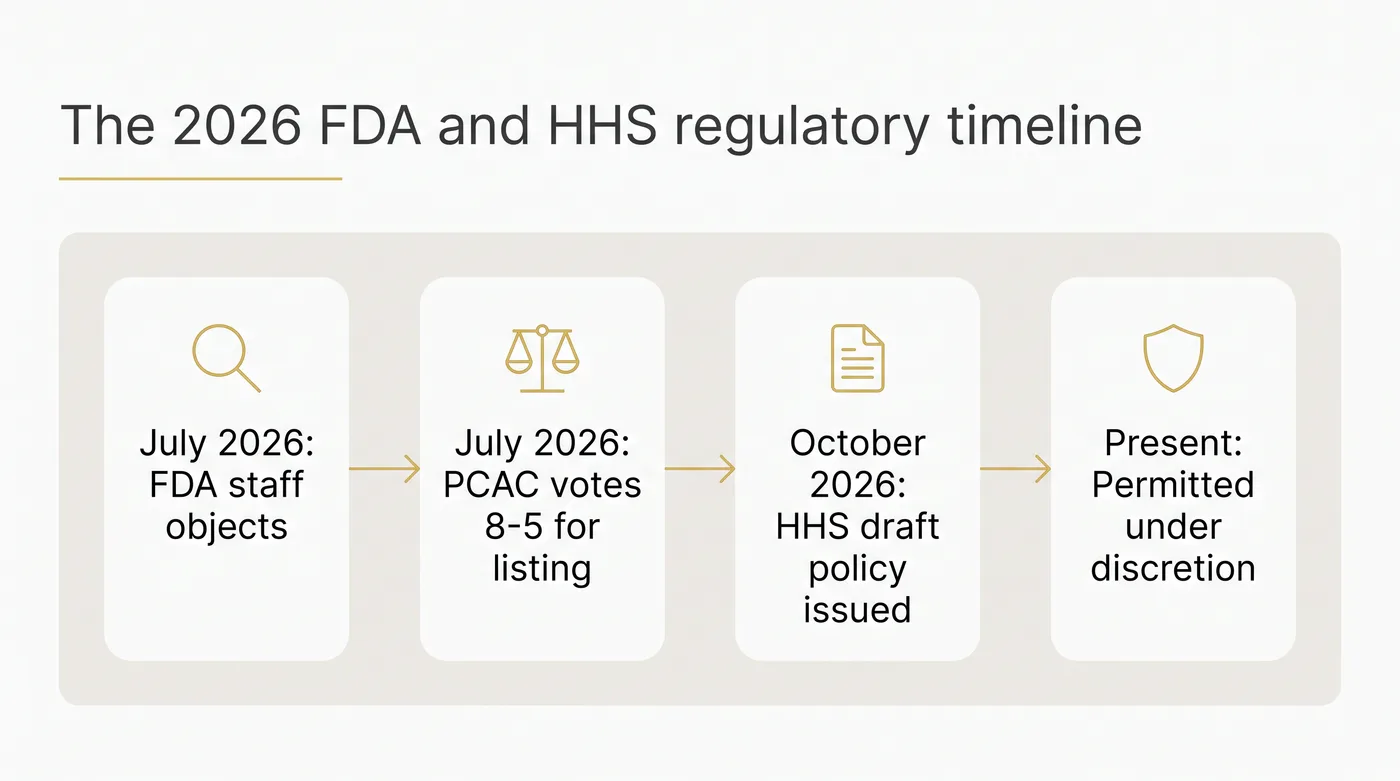
The bureaucratic machinery finally addressed this in July 2026. The FDA's Pharmacy Compounding Advisory Committee (PCAC) evaluated the compound for three nominated uses: cerebral ischemia, migraine, and trigeminal neuralgia. The FDA's career scientists explicitly recommended against adding it to the bulks list, citing insufficient clinical information, risks of bleeding, and chemical analysis concerns due to inconsistent naming conventions. Despite the staff's objections, the advisory committee voted 8-5 to recommend its addition to the list.
An advisory committee vote is strictly non-binding. The formal rulemaking process was not completed, meaning the peptide was not legally added to the 503A list by rule. This created a regulatory gray area, leaving compounders and the public waiting for a final decision.
The 2026 HHS enforcement discretion policy
The standoff broke on October 30, 2026, when HHS published an interim enforcement discretion policy concerning certain compounded peptides. This policy effectively rewrote the immediate rules of engagement for pharmacies.
Under this draft policy, the FDA announced it does not intend to pursue regulatory action against licensed 503A pharmacies, federal facilities, or licensed physicians that compound a specific formulation: Semax free base. This enforcement discretion is contingent upon compounders meeting 10 strict conditions. These include requiring a patient-specific prescription, compounding with a single active ingredient, and adhering to rigorous reporting rules.
It is vital to understand what this policy is and what it is not. It is a temporary exercise of enforcement discretion. It does not constitute FDA approval, it does not officially add the compound to the 503A bulks list, and it can be revised or withdrawn by the agency at any time. For anyone navigating HHS's new peptide policy, the distinction between "approved" and "permitted under discretion" is the entire ballgame.
Reading the lab reports
When a compound sits outside the standard pharmaceutical supply chain, the burden of verifying its identity falls entirely on the buyer. A vague PDF with a generic stamp is what careless sellers hope you will accept. A legitimate supplier provides a batch-specific Certificate of Analysis (CoA) produced by an independent analytical laboratory.
The two metrics that matter are identity and purity. Identity is verified using mass spectrometry, which confirms that the molecular weight of the powder in the vial matches the 813.9 g/mol weight of the target peptide 1. If the mass is wrong, the vial contains the wrong molecule.
Purity is measured using High-Performance Liquid Chromatography (HPLC). A chromatogram is a race where every impurity has to cross the finish line in public. You are looking for a single, dominant peak indicating that the vast majority of the material is the peptide you requested, with minimal fragmented amino acids left over from the synthesis process. For the exact measured purity, current price, and stock of NuuVive's Semax, view the product documentation.
Questions
Is Semax a controlled substance in the US?
No, it is not classified as a controlled substance under the Controlled Substances Act. Possessing the compound for laboratory research is not a criminal offense, though it cannot legally be sold or marketed for human consumption.
What is the difference between Semax and Semax acetate?
Semax free base is the pure peptide molecule, while Semax acetate refers to the peptide bound to an acetate salt. The 2026 HHS enforcement discretion policy explicitly specifies "Semax free base" in its compounding conditions.
Why is the Pro-Gly-Pro tail added to the peptide?
The Pro-Gly-Pro tripeptide sequence is attached to the C-terminus of the ACTH 4-10 fragment to prevent the molecule from breaking down rapidly. Endogenous peptides are fragile, and this synthetic tail was added to resist enzymatic degradation during laboratory research.
Is Semax officially on the FDA 503A bulks list?
No. While the Pharmacy Compounding Advisory Committee voted 8-5 to recommend its addition in July 2026, the FDA has not finalized a rule to add it to the permanent list. It currently operates under an interim HHS enforcement discretion policy.
Sources
- pubchem.ncbi.nlm.nih.gov. National Library of Medicine
- semax review - Search Results. National Library of Medicine
- pubchem.ncbi.nlm.nih.gov. National Library of Medicine
- selank review - Search Results. National Library of Medicine
- The peptide semax affects the expression of genes related to the immune and vascular systems in rat brain focal ischemia: genome-wide transcriptional analysis. National Library of Medicine