
Compounds explained
The origin, research areas and legal status of Semax
NuuVive Journal · · 6 min read

Short answer
Semax is a synthetic heptapeptide built from a fragment of adrenocorticotropic hormone (ACTH), stabilized with a proline-glycine-proline sequence. Developed by Russian scientists in the 1980s, it is studied in animal models of cerebral ischemia and cognitive function, alongside regional pilot human studies for stroke recovery. It is not an FDA-approved drug, but a late-2026 enforcement discretion policy by the HHS allows certain compounding by U.S. pharmacies.
Key takeaways
- Semax is a synthetic heptapeptide based on a non-hormonal fragment of adrenocorticotropic hormone (ACTH).
- It has been extensively studied in Russian literature for ischemic stroke recovery and cognitive modulation, primarily investigating BDNF pathways.
- Large-scale Western clinical trials evaluating the compound to FDA standards do not exist.
- A late-2026 HHS policy temporarily permits U.S. pharmacies to compound the free base form under specific regulatory conditions.
- It differs fundamentally from Selank, which is derived from tuftsin and heavily evaluated in GABAergic models.
A tailored fragment of a stress hormone
Mention this compound online and you will immediately hit a wall of forum mythology and conflicting claims. Strip away the marketing, and you are left with a decades-old synthetic peptide with a very specific, well-documented molecular history.
Semax is a synthetic heptapeptide, meaning it is a chain of exactly seven amino acids. The specific sequence is Met-Glu-His-Phe-Pro-Gly-Pro National Library of Medicine. It is built upon the structural foundation of adrenocorticotropic hormone (ACTH), a naturally occurring hormone. However, it only borrows a tiny fragment of the parent molecule, using the ACTH(4-7) core sequence while completely leaving behind the sections that trigger cortisol or corticosteroid release.
The clever bit of chemistry happens at the end of the chain. Researchers grafted a proline-glycine-proline sequence onto the C-terminus. In the brutal chemical environment of a biological system, enzymes typically shred short peptides in minutes. This Pro-Gly-Pro tail acts as a molecular shield, vastly extending the compound's stability without adding biological bulk. It clocks in with a molecular weight of 873.9 g/mol National Library of Medicine.
The evidence base in mice, mazes and stroke trials
Developed in the 1980s at the Institute of Molecular Genetics of the Russian Academy of Sciences, Semax was first formally detailed in the scientific literature in 1991 Semax literature review. Since then, it has been heavily evaluated in cellular and animal models of cerebral ischemia, optic nerve damage, and memory assessment.
In laboratory settings, researchers use rodent models to investigate the peptide's interaction with brain-derived neurotrophic factor (BDNF) and tropomyosin receptor kinase B (TrkB) signaling. Behavioral assessments, such as the Barnes maze and novel object recognition tests, have been used to study cognitive modulation. Cellular models focus on its capacity to modulate the expression of genes tied to inflammatory and stress responses, investigating key proteins in ischemic damage like CREB, c-Fos, and MMP-9.
The human data is distinctly regional. Small-scale clinical trials in Russia have evaluated the compound in populations recovering from ischemic stroke. One notable open-label study tracked 110 post-stroke patients, measuring plasma BDNF levels alongside Barthel index recovery metrics. Other pilot studies have assessed its inclusion in models of transient ischemic attacks, glaucomatous optic neuropathy, and children with ADHD.
Where the evidence stops cold
Despite a lively internet presence, Semax lacks large-scale, independently replicated Western Phase 2 or Phase 3 randomized controlled trials. A quick search of the United States clinical trials registry yields no active or completed Phase 3 clinical trials ClinicalTrials.gov. There are currently no regulatory-grade human evaluations establishing sustained outcomes for cognitive enhancement, ADHD, or neurodegenerative diseases under Western standards.
There is an equally stark absence of long-term human data assessing prolonged systemic exposure in non-stroke populations. This is exactly what the scientific literature reveals: an interesting compound with extensive preclinical data and regional pilot studies, but a gaping void when it comes to independent, regulatory-grade replication. For a look at a nine-amino-acid peptide with its own evidence gaps, check out the science and regulatory status of DSIP.
This missing evidence is the most important thing a prospective buyer should understand. A research chemical supplier is not a pharmacy, and the presence of a compound in a rat study does not make it an approved drug.
Molecular differences between the two peptides
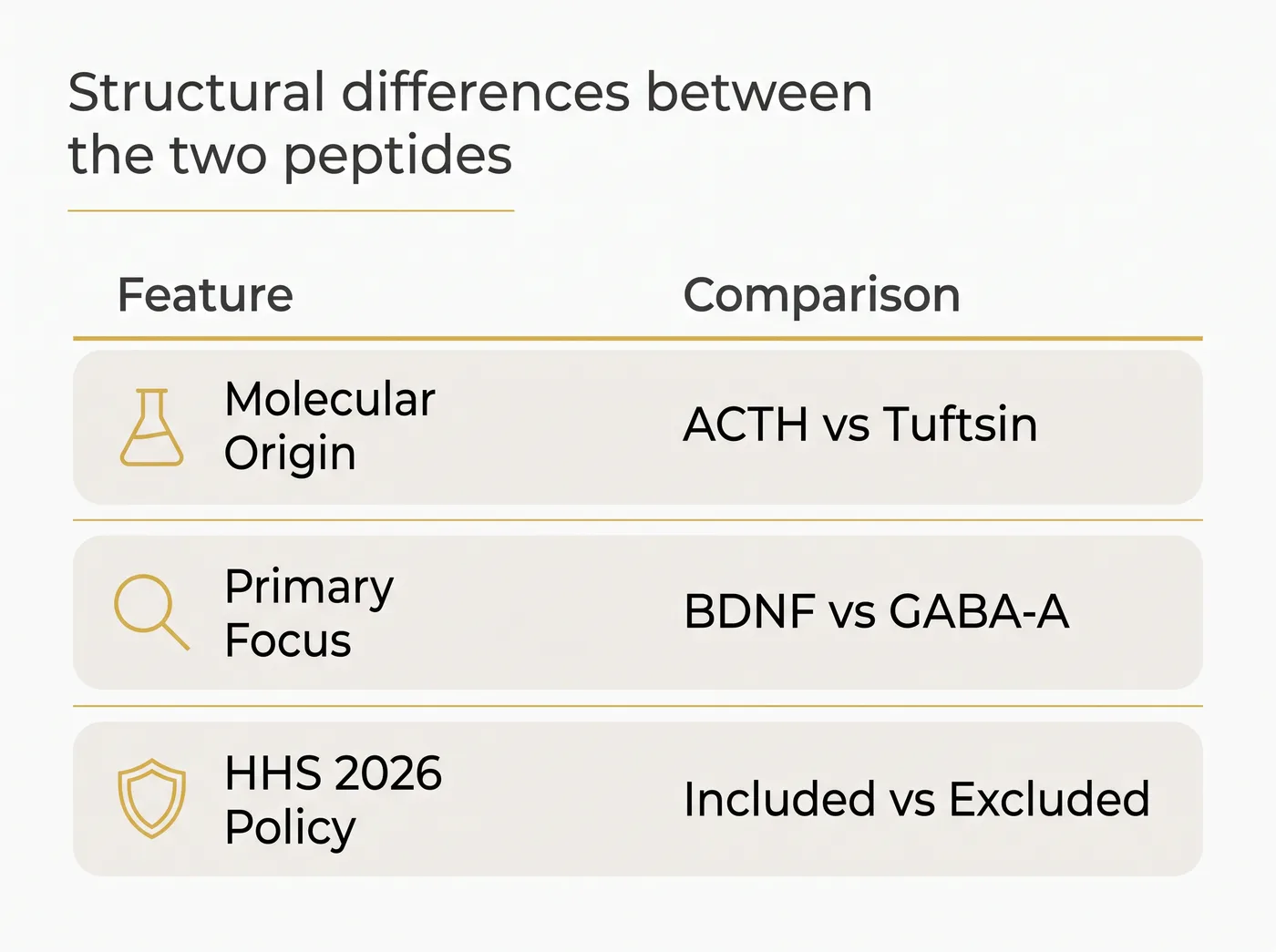
People often confuse Semax and Selank, lumping them together because both are heptapeptides developed by the same Russian institute in the same era, and both share that identical Pro-Gly-Pro stabilizing tail. It is a bit like confusing a sports car with a tractor because they both have round tires. As Selank vs Semax: what is the difference? highlights, they are structurally and functionally distinct molecules with entirely different research indications.
While Semax is modeled on an ACTH fragment, Selank is a synthetic analogue of tuftsin, an immunoglobulin G-derived tetrapeptide National Library of Medicine. Selank's sequence is Thr-Lys-Pro-Arg-Pro-Gly-Pro, giving it a molecular weight of approximately 751.9 g/mol.
| Feature | Semax | Selank |
|---|---|---|
| Origin | Adrenocorticotropic hormone (ACTH) fragment | Tuftsin analogue (immunoglobulin G derivative) |
| Amino Acid Count | Seven (heptapeptide) | Seven (heptapeptide) |
| Primary Sequence | Met-Glu-His-Phe-Pro-Gly-Pro | Thr-Lys-Pro-Arg-Pro-Gly-Pro |
| Research Focus | Neuroprotection and BDNF modulation | GABA-A receptor modulation and stress responses |
| 2026 HHS Compounding Status | Included in enforcement discretion policy | Excluded from the policy |
Research into Selank focuses heavily on its action as a positive allosteric modulator of GABA-A receptors and its influence on stress responses Selank literature review. Semax investigations, conversely, remain tethered to neuroprotection and BDNF modulation. If you are curious about a synthetic peptide studied for completely different central nervous system interactions, explore the research background of PT-141.
The U.S. legal status and the 2026 HHS policy
The regulatory framework shifted dramatically in late 2026. Prior to this, Semax existed strictly as an unapproved chemical entity outside the FDA's drug pathway. U.S. pharmacies had no explicit legal authority to compound it, relegating it entirely to the research chemical market. If you want to understand exactly how this administrative puzzle fits together, step through the detailed breakdown of Semax legality.
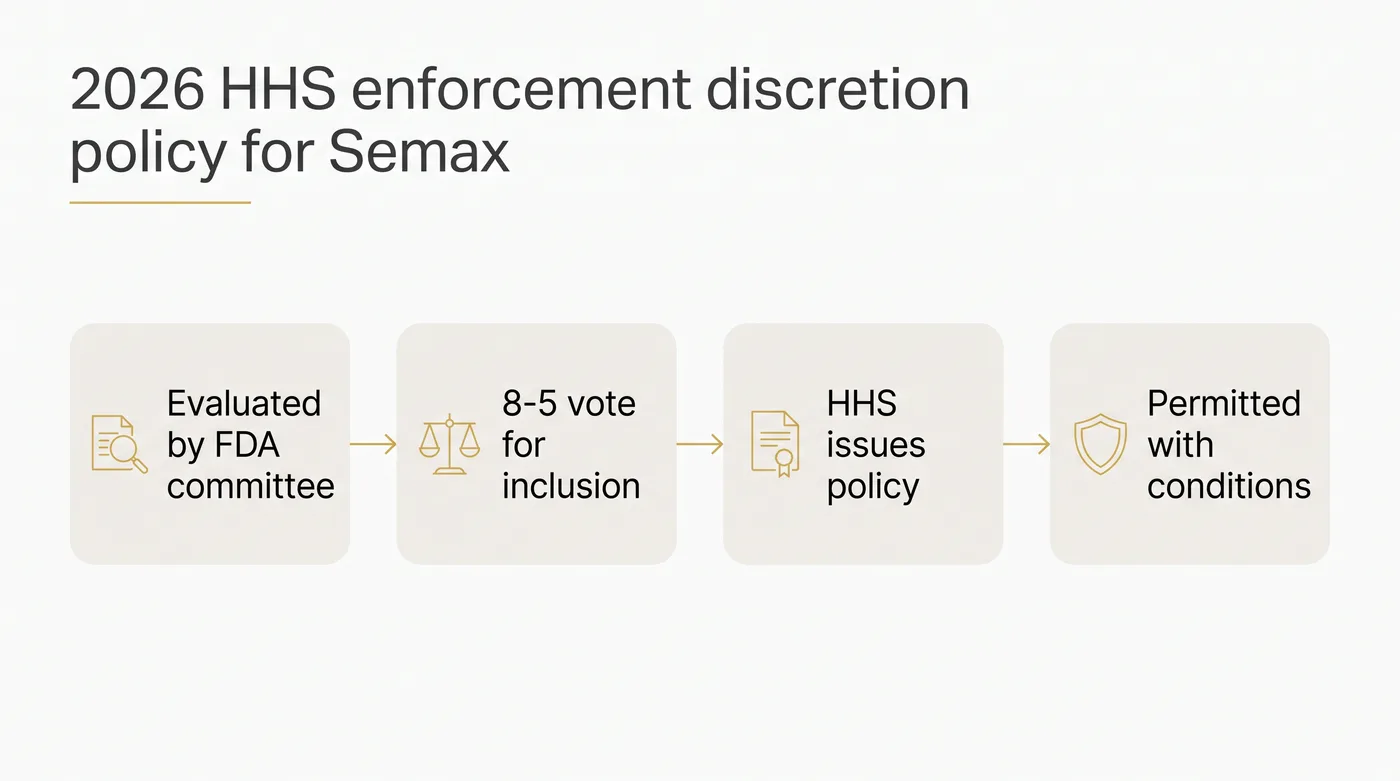
In July 2026, the FDA Pharmacy Compounding Advisory Committee reviewed Semax for potential inclusion on the Section 503A bulks list. Agency scientists recommended against it, citing a lack of clinical data to characterize it fully to Western standards. Despite this, the committee ultimately issued a non-binding 8-5 vote in favor of inclusion.
On October 28, 2026, the HHS published an interim enforcement discretion policy. As detailed in a breakdown of the new HHS peptide policy, this temporarily permits state-licensed 503A compounding pharmacies to compound the free base form of Semax, provided a valid prescription exists and all ten specific regulatory conditions are met. This explicitly does not constitute FDA approval, but rather a temporary legal buffer while formal rulemaking proceeds. Interestingly, Selank was entirely excluded from this policy.
Checking the lab report for the vial's passport
Whether evaluating peptides for a university lab or private research, reading a certificate of analysis (COA) is the only way to separate actual chemical synthesis from marketing fog. A lot number is the vial's passport, connecting the physical white powder to a third-party analytical test.
Look directly for high-performance liquid chromatography (HPLC) results. A chromatogram is essentially a race where every chemical impurity has to cross the finish line in public. A clean peak indicates a high-purity compound, while multiple jagged peaks suggest degradation or poor synthesis. Mass spectrometry confirms the identity, ensuring that the 873.9 g/mol weight matches the expected heptapeptide National Library of Medicine.
Never accept a document that lacks a verifiable testing date, a testing facility letterhead, or an exact lot number. If the paperwork is vague, the powder is a gamble. For a concrete look at how these analytical standards apply to current, verified inventory, check the Semax lab results.
Questions
Is Semax a steroid?
No. Although it is derived from a fragment of adrenocorticotropic hormone (ACTH), it lacks the segments of the hormone responsible for steroidogenic activity. It does not trigger the release of cortisol or corticosteroids.
What is the purpose of the Pro-Gly-Pro tail?
The proline-glycine-proline sequence at the end of the molecule prevents rapid enzymatic degradation. Without it, the peptide would be broken down almost immediately in biological environments.
Can a laboratory purchase Semax in the United States?
Yes, it is available as a "Research Use Only" compound for laboratory investigation. Additionally, a late-2026 HHS policy permits U.S. pharmacies to compound it under strict enforcement discretion when a valid prescription is provided.
How does Semax differ from N-Acetyl Semax Amidate?
N-Acetyl Semax Amidate is a modified version of the standard Semax peptide. It has an acetyl group added to one end and an amide group added to the other, which are structural alterations studied for their potential to further increase the molecule's stability.
Sources
- pubchem.ncbi.nlm.nih.gov. National Library of Medicine
- pubmed.ncbi.nlm.nih.gov. National Library of Medicine
- ClinicalTrials.gov. clinicaltrials.gov
- pubchem.ncbi.nlm.nih.gov. National Library of Medicine
- pubmed.ncbi.nlm.nih.gov. National Library of Medicine