
Policy and economics
Where retatrutide stands in FDA trials
NuuVive Journal · · 6 min read

Short answer
Retatrutide is an unapproved investigational drug that has completed its primary Phase 3 clinical trials, known collectively as the TRIUMPH programme. As of late 2026, the manufacturer is compiling the necessary manufacturing data to submit a Biologics License Application. The formal regulatory submission is projected for the first quarter of 2027, which will trigger a lengthy review period and physical factory inspections before any final regulatory decision.
Key takeaways
- Retatrutide has completed its main Phase 3 clinical trials but remains an unapproved investigational compound.
- The sponsor plans to submit a formal Biologics License Application in the first quarter of 2027.
- The delay between trial completion and submission is spent compiling strict manufacturing and controls data.
- Once submitted, the regulatory agency requires a 60-day administrative window just to decide if the application is complete enough to review.
- Physical factory inspections must be passed before any commercial availability is authorised.
The holding pattern of late-stage development
Finishing a massive clinical trial programme is a bit like finishing a novel. The writing is done, but the manuscript still has to survive the editor, the legal department, and the printing press before anyone can buy a copy. Eli Lilly has wrapped up the primary clinical data for retatrutide, completing a sprawling series of Phase 3 evaluations known collectively as the TRIUMPH programme. Yet, as of late 2026, the compound remains entirely experimental and unapproved.
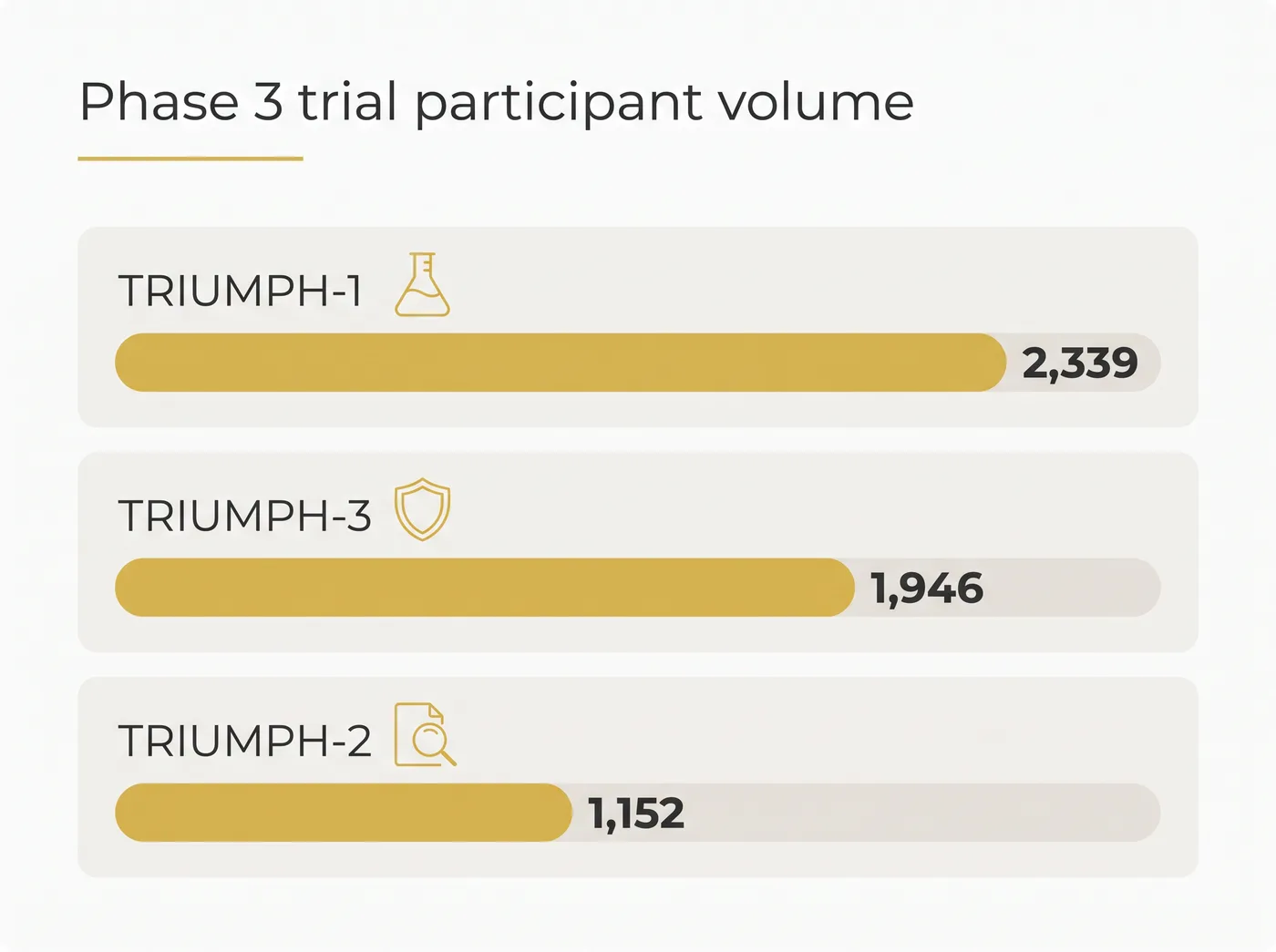
The sheer scale of these trials reflects the immense capital required to bring a new molecule to the regulatory starting line. By the middle of 2026, the participant data was securely locked and analysed. TRIUMPH-1, the registration trial, concluded its primary phase on 6 April 2026, encompassing 2,339 participants. Ten days later, TRIUMPH-3 finished with an additional 1,946 participants. The raw logistics of coordinating roughly 5,800 participants across multiple international sites is staggering.
| Trial Identifier | Participant Count | Primary Completion Date |
|---|---|---|
| TRIUMPH-1 | 2,339 | 6 April 2026 |
| TRIUMPH-3 | 1,946 | 16 April 2026 |
| TRIUMPH-2 | 1,152 | Data announced 23 July 2026 |
The sponsor wasted no time announcing the topline results. The data was published in major medical journals, with the TRIUMPH-1 findings appearing in the *New England Journal of Medicine* New England Journal of Medicine and the TRIUMPH-2 results printed in *The Lancet* The Lancet by late September 2026. You might assume that with published data and thousands of finished participants, the regulatory submission was already filed. It is not. This delay is a perfect illustration of how modern pharmaceutical economics operate; the science is only half the battle.
The paperwork mountain and the biologics license application
When a company holds the data from thousands of trial participants, the clinical question is largely answered, but the regulatory question has barely been asked. On 23 July 2026, Kenneth Custer, executive vice president and president of Lilly Cardiometabolic Health, stated publicly that the company possessed the complete clinical data package required to support global regulatory submissions. However, retatrutide will be submitted under a Biologics License Application rather than a standard New Drug Application.
This distinction is not merely bureaucratic trivia. A Biologics License Application demands an exhaustive chemistry, manufacturing, and controls package. The regulatory agency does not just want to know the statistical outcomes of the clinical trials; they want definitive proof that the exact same compound can be manufactured millions of times without a single deviation in purity or structure. Compiling this takes months of painstaking analytical work.
The manufacturing controls package is a logistical hurdle designed to ensure that commercial scale-up maintains absolute consistency. It is the recipe book and the factory floor plans wrapped into one massive dossier. Finalising these documents is the primary reason the sponsor has projected their formal filing date for the first quarter of 2027. The clinical data is sitting in the vault, waiting for the factory blueprints to catch up.
The 60-day silence and the review clock
Once the delivery vans finally drop off the application in early 2027, the review does not start immediately. The regulatory agency has a standard 60-day administrative window built into their procedures U.S. FDA. During this initial period, they do not evaluate the data at all. They merely check if the paperwork is formatted correctly and complete enough to warrant a formal review.
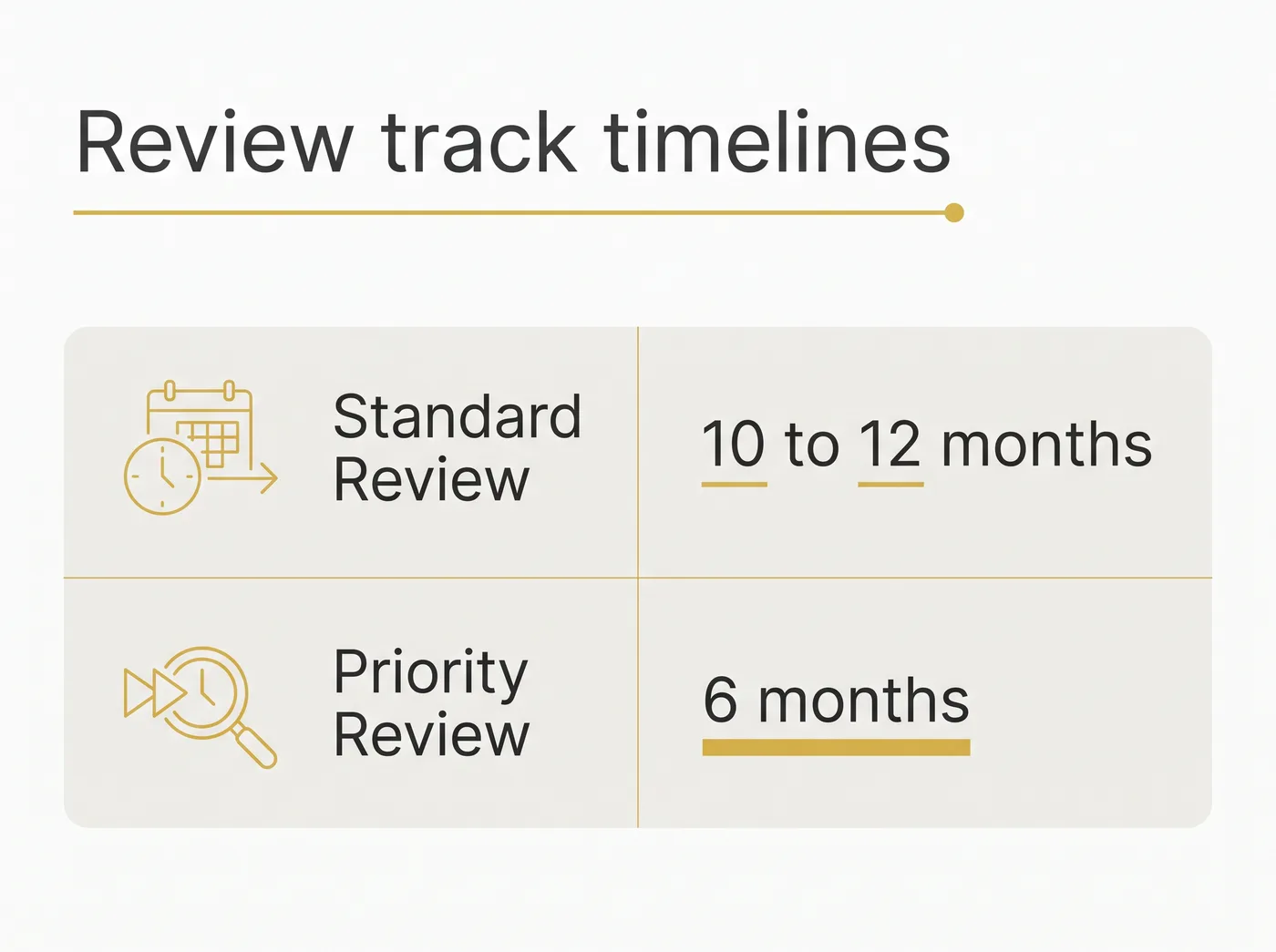
If the dossier passes this preliminary formatting check, the application is officially accepted. At that point, the review clock starts ticking, and the agency assigns a target action date under the Prescription Drug User Fee Act. They also decide which review track the application merits U.S. FDA. A standard review timeline takes 10 to 12 months from the acceptance date.
However, if the agency determines the compound represents a significant advance over existing standard-of-care options, they may grant Priority Review. This accelerated track shortens the timeline to just 6 months. The financial implications of those two tracks are vast. Six months of early commercial exclusivity is worth an astronomical sum, making the quiet lobby for Priority Review one of the most intense phases of the entire process. Meanwhile, evaluators will audit the massive dataset.
Physical inspections and the factory floor
While government statisticians comb through the data, looking for anomalies and dropouts, field inspectors handle the physical reality of the compound. Before any application is approved, regulators must inspect the designated manufacturing and formulation facilities. They are required to verify that the physical plants comply strictly with Current Good Manufacturing Practice regulations.
An inspector walking the factory floor is not looking at clinical trial outcomes. They are looking for supply-chain bottlenecks, poor documentation practices, and physical equipment flaws. They need to know that the facility can reliably execute the processes detailed in that massive manufacturing controls package submitted months prior. This is where the brilliant chemistry of a laboratory meets the gritty reality of industrial production.
If an inspector finds a violation, the entire multi-billion-dollar application grinds to a halt. The physical infrastructure must be as flawless as the clinical statistics. Passing these inspections is a non-negotiable economic hurdle for the sponsor.
When the timeline actually ends
Predicting regulatory decisions requires looking at the calendar, the assigned track, and the sheer volume of paperwork. If the sponsor hits their planned filing target in the first quarter of 2027, the earliest possible regulatory decision would arrive in the third or fourth quarter of 2027, assuming a Priority Review is granted. The clock is rigid, and the bureaucracy does not rush.
If the agency defaults to the standard review timeline, the final action date pushes deep into the first or second quarter of 2028. Consequently, analysts project that post-approval supply chain scale-up and commercial availability will realistically commence in late 2027 or early 2028. The machinery of approval moves precisely because the stakes are so incredibly high.
Until those final stamps are acquired and the factory inspections are passed, the compound remains strictly experimental, confined to the laboratory and the paperwork pile. For professionals studying the compound in a laboratory setting, pure reference material is available to examine its properties. You can find analytical-grade material on the Retatrutide page.
Questions
Has retatrutide been submitted to the regulatory agency yet?
Not yet. As of late 2026, the sponsor is finalising the chemistry, manufacturing, and controls documentation. The formal submission is projected for the first quarter of 2027.
What does a Biologics License Application require?
The BLA requires an extensive manufacturing control package to prove the exact structure can be replicated consistently on an industrial scale.
Can the review process be sped up?
Yes, if the agency grants Priority Review. This designation reduces the standard review timeline from roughly a year down to six months, though it requires the compound to represent a significant advance over existing options.
What happens if an inspector finds a fault at the factory?
The agency will issue a Complete Response Letter. This halts the entire approval timeline until the physical manufacturing flaws are corrected, regardless of how strong the clinical data might be.
Sources
- www.nejm.org. NEJM
- www.thelancet.com. The Lancet
- www.fda.gov. U.S. FDA
- www.fda.gov. U.S. FDA