
Compounds explained
Wolverine vs GLOW vs KLOW: which blend is which?
NuuVive Journal · · 5 min read

Short answer
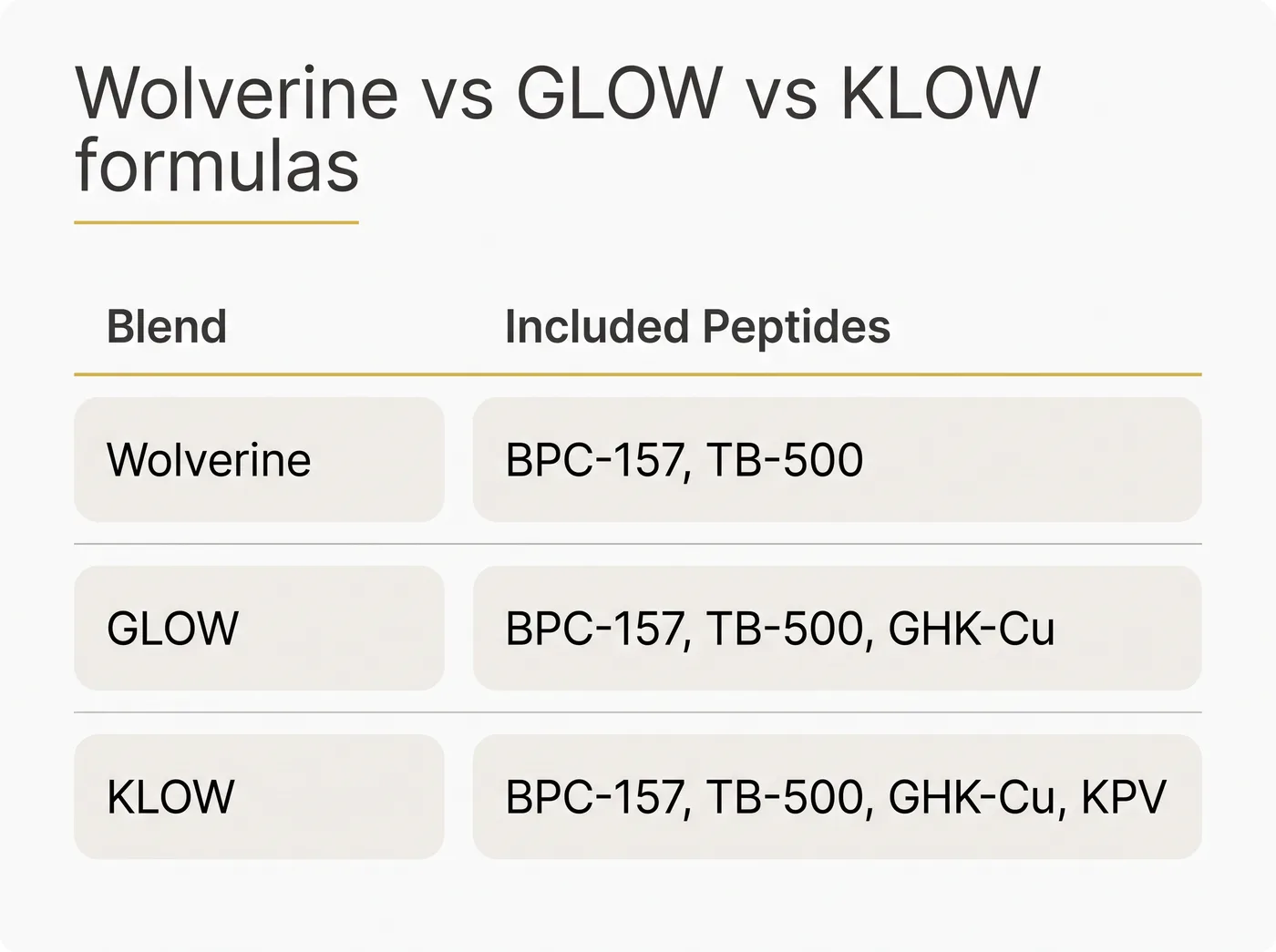
The Wolverine blend contains two peptides: BPC-157 and TB-500. The GLOW blend builds on this two-compound base and adds GHK-Cu, a copper tripeptide studied in tissue remodeling models. The KLOW blend combines the three compounds in GLOW and adds a fourth, KPV, an amino acid sequence investigated in animal models of barrier biology.
Key takeaways
- The Wolverine blend combines BPC-157 and TB-500, two compounds investigated in animal models of musculoskeletal injury.
- GLOW adds GHK-Cu to that exact foundation, introducing a copper complex studied in extracellular matrix research.
- KLOW builds on the GLOW formula by adding KPV, a three-amino-acid fragment studied in barrier biology models.
- Only three of these four peptides (BPC-157, TB-500 and KPV) are covered by the October 2026 HHS compounding policy, while GHK-Cu is not.
- Testing a blend requires a laboratory to separate multiple compounds on a chromatogram to verify the mass and purity of each.
The foundation: Wolverine's two-peptide base
Scan a vendor catalogue and you might assume you are looking at a superhero roster instead of a chemistry inventory. The marketing fog around peptide blends is notoriously thick. But behind the flashy capital letters, the Wolverine, GLOW and KLOW blends are just Russian dolls of amino acid sequences. They all start with the same two-part foundation, commonly sold as the Wolverine blend: BPC-157 and TB-500.
The first ingredient, BPC-157, is a laboratory-made chain of 15 amino acids (molecular weight ~1,419.5 g/mol) modeled after a protein discovered in human gastric juice 4. Scientists investigate it in animal models involving tendon, ligament and bone injury 5. Human data is exceedingly rare, restricted to one retrospective review involving twelve patients with musculoskeletal knee pain 1. No large-scale human clinical trials exist.
The second half of that base is TB-500. This is a seven-amino-acid fragment of thymosin beta-4, a 43-amino-acid protein found in nearly all human cells 7. Researchers study this specific fragment in preclinical animal and cell models of cell migration and actin regulation 8. According to FDA reviews, there are zero published human trials for the TB-500 fragment. If you want to know more about this specific sequence, read a complete breakdown of TB-500.
Both of these base compounds sit in a specific regulatory bucket. Neither is approved by the FDA, but both are explicitly covered by an October 2026 HHS enforcement discretion policy. This policy allows state-licensed pharmacies to compound them under strict conditions while final rules are drafted. Read more about the BPC-157 and TB-500 base.
GLOW: adding copper to the equation
If Wolverine is the two-part foundation, GLOW is the three-part expansion. It uses the exact BPC-157 and TB-500 base and drops in a third molecule: GHK-Cu. This changes the research focus entirely, introducing pathways that researchers investigate in skin and structural models.
GHK-Cu is a copper-binding tripeptide originally isolated from human plasma in 1973 9. It consists of three amino acids bound to a copper ion, giving it a molecular weight of roughly 400.9 to 404.3 g/mol. It has been studied in preclinical models of extracellular matrix remodeling and collagen synthesis 10. While small human clinical trials exist, they only evaluate topical cosmetic creams. To get the full story on this copper complex, check out a detailed breakdown of GHK-Cu chemistry and trials.
Here is the regulatory twist that careless sellers ignore: GHK-Cu is not part of the October 2026 HHS compounding policy. It currently lacks a lawful pathway for compounding in the United States. A blend is only as compliant as its strictest ingredient, which makes GLOW's legal footprint distinctly different from the Wolverine base.
KLOW: bringing KPV into the mix
The KLOW blend is the four-part version of the formula. It combines the three peptides in GLOW (BPC-157, TB-500 and GHK-Cu) and adds a fourth: KPV. This addition was designed to incorporate dedicated barrier-biology signaling into the research framework.
KPV is a tiny synthetic fragment made of just three amino acids (Lys-Pro-Val), corresponding to the tail end of alpha-MSH 11. Researchers have investigated it in animal models of inflammatory bowel disease, examining its role in inhibiting specific inflammatory signaling pathways 12.
Like TB-500, KPV has no published human clinical trials. However, unlike GHK-Cu, KPV is explicitly included in the HHS enforcement discretion policy, permitting compounding under specified federal conditions pending final FDA rulemaking. Learn more about the KPV molecule.
Comparing the formulas side by side
Keeping track of which acronym contains which molecule is half the battle when looking at vendor catalogues. Here is exactly what is inside each formulation.
| Blend Name | BPC-157 | TB-500 | GHK-Cu | KPV |
|---|---|---|---|---|
| Wolverine | Yes | Yes | No | No |
| GLOW | Yes | Yes | Yes | No |
| KLOW | Yes | Yes | Yes | Yes |
Reading the lab reports for a multi-peptide vial
Adding peptides to a vial is easy for a synthesizer, but it makes verifying the final product a massive headache. When you buy a single compound, the lab report is straightforward. A chromatogram acts like a chemical obstacle course where every impurity must reveal itself. A single sharp peak means a clean product.
With a blend, you are watching three or four separate races at once. The testing laboratory has to separate GHK-Cu, BPC-157, TB-500 and KPV to prove the mass and purity of each. If a vendor hands you a certificate of analysis for a blend that only shows one purity percentage, fold it into a paper airplane. You need to see the exact measured amount for every single compound on the label.
A genuine lab report lists the target mass and the measured mass for every active ingredient. It is the only way to know if the ratios in the vial match the label on the outside. For the current price, stock and independent Janoshik laboratory measurements, see NuuVive's GHK-Cu + BPC-157 + TB-500 blend.
Questions
What is the Wolverine blend made of?
The Wolverine blend is a two-peptide combination containing BPC-157 and TB-500. Both are synthetic fragments investigated in animal models of musculoskeletal injury.
Are these blends approved for human use?
No. None of the peptides in the Wolverine, GLOW or KLOW blends are FDA-approved drugs. BPC-157, TB-500 and KPV are covered by an HHS compounding policy pending final rules, but GHK-Cu is not.
What does GHK-Cu add to the GLOW blend?
GHK-Cu is a copper-binding tripeptide. It is added to the BPC-157 and TB-500 base to introduce a compound that has been studied in preclinical models of extracellular matrix remodeling and collagen synthesis.
How can I tell if a peptide blend is legitimate?
A legitimate blend requires a third-party laboratory report that separates each compound on a chromatogram. The report must show the exact measured mass and purity percentage for every individual peptide listed on the label.
Sources
- Emerging Use of BPC-157 in Orthopaedic Sports Medicine: A Systematic Review. National Library of Medicine
- pubchem.ncbi.nlm.nih.gov. National Library of Medicine
- pubmed.ncbi.nlm.nih.gov. National Library of Medicine
- pubchem.ncbi.nlm.nih.gov. National Library of Medicine
- pubmed.ncbi.nlm.nih.gov. National Library of Medicine
- pubchem.ncbi.nlm.nih.gov. National Library of Medicine
- pubmed.ncbi.nlm.nih.gov. National Library of Medicine
- pubchem.ncbi.nlm.nih.gov. National Library of Medicine
- pubmed.ncbi.nlm.nih.gov. National Library of Medicine