
Compounds explained
What is TB-500? What it has been studied for
NuuVive Journal · · 7 min read
Short answer
TB-500 is a synthetic, laboratory-produced heptapeptide made of seven amino acids. It is specifically engineered to isolate the active G-actin-binding sequence of Thymosin Beta-4, a 43-amino-acid protein found naturally in almost all mammalian cells. While the full-length Thymosin Beta-4 protein has been evaluated in small human clinical trials for eye and skin conditions, the synthetic TB-500 fragment itself has only been investigated in cellular assays and animal models of tissue injury.
Key takeaways
- TB-500 is a synthetic 7-amino-acid fragment, not the full 43-amino-acid naturally occurring Thymosin Beta-4 protein.
- The compound is engineered to isolate a specific structural sequence (Ac-LKKTETQ) that binds to actin in living cells.
- While the parent protein has seen small human trials, TB-500 itself has zero human clinical trials on record.
- It sits outside the FDA approved drug pathway and is governed by strict compounding and research regulations.
- Authentic laboratory documentation must confirm the exact 889 g/mol molecular weight to prove you are not buying a different compound.
The molecule in the vial: chemistry and origins
Search for this peptide online and you are immediately hit with a barrage of exaggerated claims and confusing forum threads. Behind that noise lies a quiet, highly specific body of preclinical research. Understanding what this molecule actually is requires ignoring the marketing fog and looking straight at the laboratory data.
To understand TB-500, you have to look at the molecule it was copied from. In the late 1970s and early 1980s, researchers isolating compounds from calf thymus extracts identified a 43-amino-acid protein they called Thymosin Beta-4 (Tβ4). It turned out this protein is endogenous, meaning it is produced naturally in almost all mammalian cells, particularly in wound fluids and blood platelets. Its main job in biology is acting as a G-actin sequestering molecule, regulating the cellular skeleton. For a look at another endogenous molecule found in every living cell, explore the metabolism research and history of NAD+.
By the early 1990s, molecular biologists mapped exactly how this parent protein worked. They found that the heavy lifting was done by a tiny section of the protein, the amino acids at positions 17 through 23. That specific motif (Ac-LKKTETQ) was identified as the active domain that drives actin-binding mechanics. In the early 2000s, chemists synthesized just that 7-amino-acid sequence in a laboratory. That truncated synthetic fragment is what researchers call TB-500 National Library of Medicine.
Think of the parent protein as a complete delivery truck, while TB-500 is just the engine block resting on a laboratory workbench. By stripping away the rest of the 43-amino-acid structure, analytical chemists created a lightweight, 889 g/mol fragment to study actin dynamics in a highly controlled environment. This distinction matters, yet the names are constantly confused by careless marketers who hope you will not notice. If you are curious about another synthetic molecule built specifically for the laboratory, check out the history and chemistry of ipamorelin.
Differences between TB-500 and thymosin beta-4
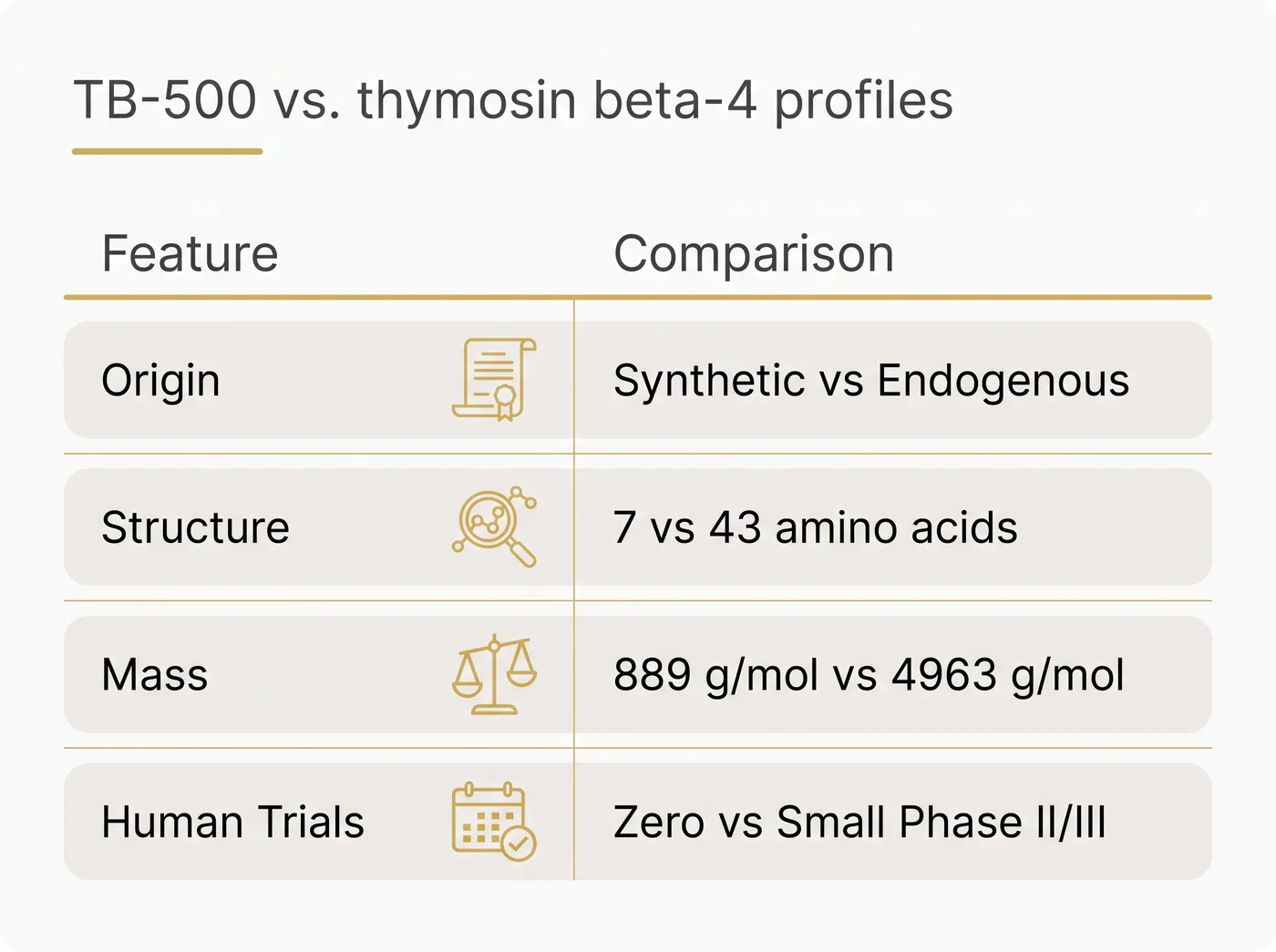
The single most common error in peptide literature is conflating TB-500 with its parent protein. Marketers frequently use the names interchangeably, slapping research about one onto a label for the other. In chemistry, however, they represent distinct biochemical entities with entirely different structural masses and evidence bases.
| Feature | Thymosin Beta-4 (Tβ4) | TB-500 |
|---|---|---|
| Origin | Endogenous (natural mammalian protein) | Fully synthetic laboratory fragment |
| Structure | 43 amino acids | 7 amino acids (Ac-LKKTETQ) |
| Molecular Weight | ~4963 g/mol | ~889 g/mol |
| Human Trials | Small Phase II/III (e.g., eye drops) | Zero human clinical trials |
The full-length Tβ4 possesses multiple functional domains that interact with a wide range of biological activities beyond actin binding. The synthetic TB-500 fragment was designed with extreme narrowness to mimic only the specific G-actin-binding properties of positions 17-23 National Library of Medicine. Nearly all foundational biological research, and all human clinical trials on record, studied the full-length parent protein. Assertions regarding TB-500 in human applications inevitably extrapolate data from Tβ4 studies rather than direct investigation of the synthetic fragment itself.
What the research actually looks like
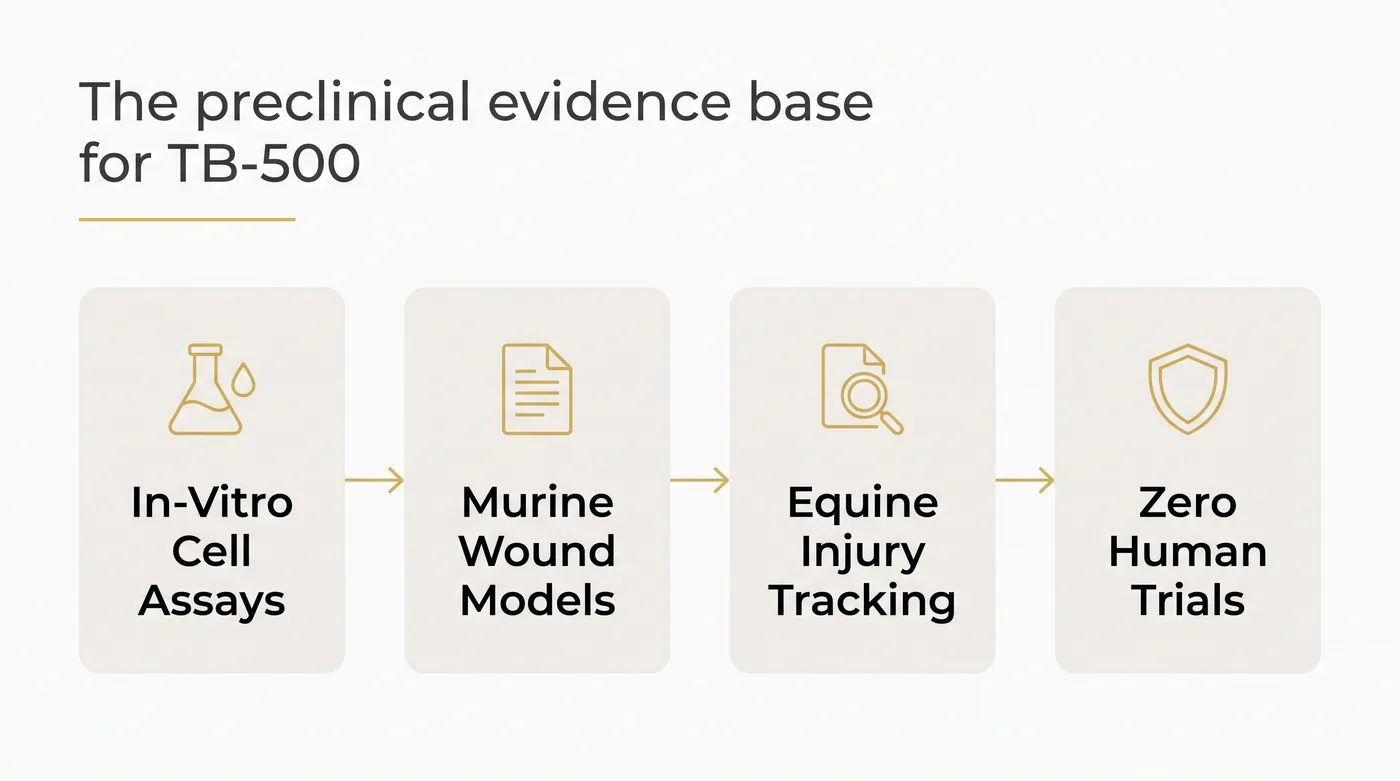
When you strip away the forum hype, the evidence base for TB-500 is highly specific and strictly preclinical. In vitro (cellular) studies form the foundation. Researchers have extensively evaluated the synthetic fragment in sterile cell cultures to map how the LKKTETQ motif dictates actin polymerization dynamics, endothelial cell migration, and fibroblast behavior. These cellular assays are where the fundamental mechanics of the peptide are established without the noise of a living system. For a look at how another tiny synthetic sequence is studied under a microscope, explore the cellular research origins of Epitalon.
Moving up to preclinical animal models, TB-500 has been studied broadly in mice, rats, and equine models. Researchers have evaluated the compound in wound models evaluating skin repair, collagen deposition, and re-epithelialization Lin et al.. It gained intense focus in analytical and anti-doping literature around 2012 when laboratories in Ghent and Hong Kong identified it as a designer veterinary preparation being studied in racehorses. The animal data focuses heavily on mapping the peptide's interaction with inflammatory signaling and cellular mobilization following musculoskeletal or soft tissue injury. To see how scientists map out the evidence for a completely different mitochondrial compound, read about the animal research behind MOTS-c.
What about human studies? The answer is a flat zero. Extensive scoping reviews have confirmed that there is an absolute lack of human clinical trials evaluating the synthetic TB-500 fragment Cushman et al.. The full-length parent protein, Thymosin Beta-4, has been evaluated in small Phase II and Phase III trials, most notably topical eye-drop formulations for severe dry eye syndrome and neurotrophic keratopathy, as well as topical applications for venous leg ulcers Hannappel. But none of that data applies directly to the 7-amino-acid synthetic fragment. Anyone telling you otherwise is reading the wrong paperwork or selling something.
Legal status and the 2026 HHS policy
Neither TB-500 nor Thymosin Beta-4 is approved by the U.S. Food and Drug Administration (FDA) for human use. There are no manufactured, FDA-approved finished drug products containing either substance marketed in the United States. They sit firmly in the category of investigational research compounds, which means their regulatory environment is notoriously strict and complex.
The compounding status of these peptides has been a massive focal point of regulatory review under Section 503A of the Federal Food, Drug, and Cosmetic Act. Historically, TB-500 was scrutinized heavily due to the profound lack of human exposure data. In 2026, the Pharmacy Compounding Advisory Committee (PCAC) held hearings regarding the inclusion of several peptides. The committee voted in a non-binding advisory capacity to recommend adding TB-500 to the 503A Bulks List, but FDA staff formally opposed this inclusion, citing human-evidence concerns.
In October 2026, HHS published a draft policy establishing a temporary enforcement discretion framework regarding compounding rules. This document names TB-500, but it does not add the fragment to the approved bulks list. Instead, it maintains the compound in a strict regulatory grey area until a final rule is published. In the sports world, the rules are much simpler: the World Anti-Doping Agency (WADA) explicitly bans both compounds at all times under the S2.3 Growth Factors section of the Prohibited List.
This regulatory environment is exactly why rigorous researchers care so deeply about sourcing. If a compound exists in a regulatory grey zone, the burden of verifying its identity falls entirely on the buyer reading the lab report. For a deep dive into how changing rules impact research availability, see HHS's new peptide policy: what changed for BPC-157, TB-500 and 4 more.
Reading the lab report: what to check before buying
Because the synthetic fragment is an unregulated research chemical, the market is flooded with vague white powders. A legitimate supplier does not ask for trust; they provide a Certificate of Analysis (CoA) from an independent third-party analytical laboratory. If you are evaluating a vial, the CoA is its passport. You are looking for two specific analytical methods: High-Performance Liquid Chromatography (HPLC) for purity, and Mass Spectrometry (MS) for identity.
Mass spectrometry is the ultimate polygraph test. It measures the exact molecular weight of the substance in the vial. For TB-500 (Ac-LKKTETQ), the mass spectrometry result must show a molecular weight of exactly 889 g/mol. If the report shows ~4963 g/mol, the vial contains the full-length Thymosin Beta-4 protein. If it shows any other number, it is a different compound entirely, or worse, degraded synthesis material.
Next, look at the HPLC chromatogram. This is a visual graph where every impurity has to cross the finish line in public. You want to see one single, sharp spike representing the peptide, with a measured area percentage confirming high purity. Anything less than a transparent, verifiable report is a red flag. For researchers who demand exact analytical standards and independently verified batch records, you can review the current third-party mass spectrometry and HPLC purity reports at NuuVive's TB-500.
Questions
Is TB-500 the same as Thymosin Beta-4?
No. Thymosin Beta-4 is a naturally occurring 43-amino-acid protein found in mammalian cells. TB-500 is a synthetic 7-amino-acid laboratory fragment engineered to mimic a specific binding section of the parent protein.
Has TB-500 been tested in human clinical trials?
No. There are zero registered human clinical trials evaluating the synthetic TB-500 fragment. Small human studies exist only for the full-length parent protein, Thymosin Beta-4.
Is TB-500 FDA approved?
Neither TB-500 nor Thymosin Beta-4 is approved by the FDA for human use. They are classified as investigational research chemicals and lack approved drug labels.
Why is it banned by WADA?
The World Anti-Doping Agency lists Thymosin Beta-4 and its synthetic fragments on its Prohibited List. They are permanently banned in and out of competition under the growth factors category.
Sources
- pubmed.ncbi.nlm.nih.gov. National Library of Medicine
- pubchem.ncbi.nlm.nih.gov. National Library of Medicine
- pubchem.ncbi.nlm.nih.gov. National Library of Medicine
- pubmed.ncbi.nlm.nih.gov. National Library of Medicine
- pubmed.ncbi.nlm.nih.gov. National Library of Medicine