
Compounds explained
What is GHK-Cu? What it has been studied for
NuuVive Journal · · 5 min read

Short answer
GHK-Cu, or copper tripeptide-1, is a naturally occurring complex of the amino acid sequence glycyl-L-histidyl-L-lysine bound to a copper ion. First isolated from human plasma in 1973, it has been studied in animal and cell models of skin and inflammation. Human evidence is restricted to topical applications in small studies and a Phase 2 trial for skin wounds. It is not an FDA-approved drug.
Key takeaways
- GHK-Cu is a tripeptide copper complex composed of glycine, histidine, and lysine.
- It has been investigated in cell and animal models for its role in extracellular matrix remodelling and inflammatory signalling.
- Human clinical data is limited to topical applications, with no published trials evaluating other formats.
- It is not an FDA-approved medication.
- Since May 2026, topical GHK-Cu sits in Category 1 of the FDA's 503A compounding list, while other formats are excluded.
The chemistry of a blue tripeptide
Look up copper peptides online and you are immediately buried in a landslide of cosmetic marketing and longevity blogs. Strip away the glossy packaging, however, and you are left with a very specific, heavily scrutinised molecule that has spent fifty years under the microscope. GHK-Cu is a naturally occurring human tripeptide copper complex. It was originally isolated from human plasma, though it is also found in human saliva and urine.
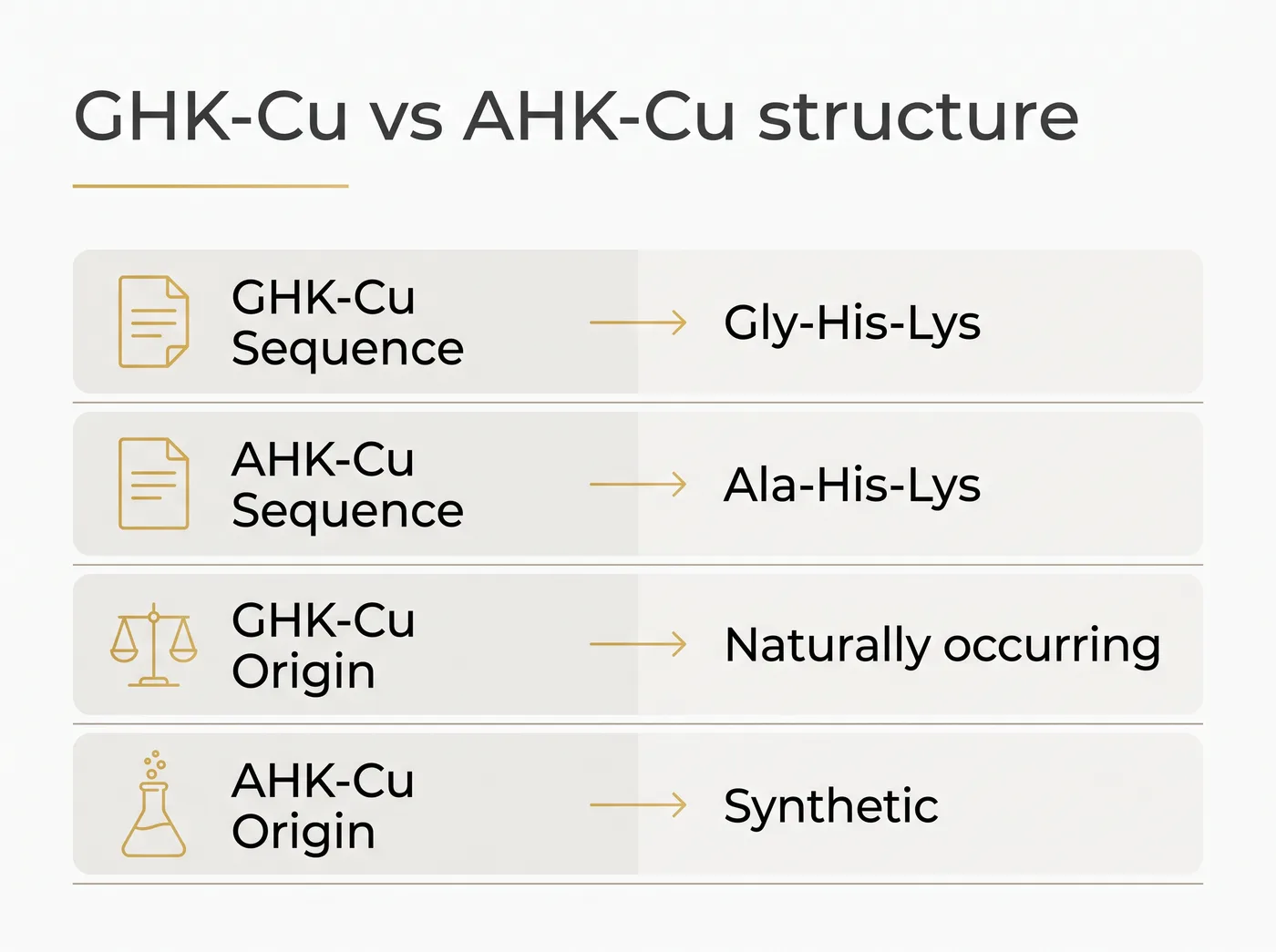
The structure is straightforward. The peptide chain consists of exactly three amino acids: glycyl-L-histidyl-L-lysine, commonly abbreviated as Gly-His-Lys. This short chain binds to a copper(II) ion, creating the complex known as GHK-Cu. For the 1:1 copper complex, the molecular weight sits at 402.92 g/mol 3.
The molecule was first identified in 1973 by researchers Loren Pickart and Michael M. Thaler. They initially studied it as a factor in the survival of cultured liver cells in a laboratory setting. That early work kicked off decades of laboratory investigation into how this specific sequence interacts with cellular pathways. If you enjoy tracking down how these molecules were first discovered, you might also like the history and chemistry of ipamorelin.
What GHK-Cu has been studied for
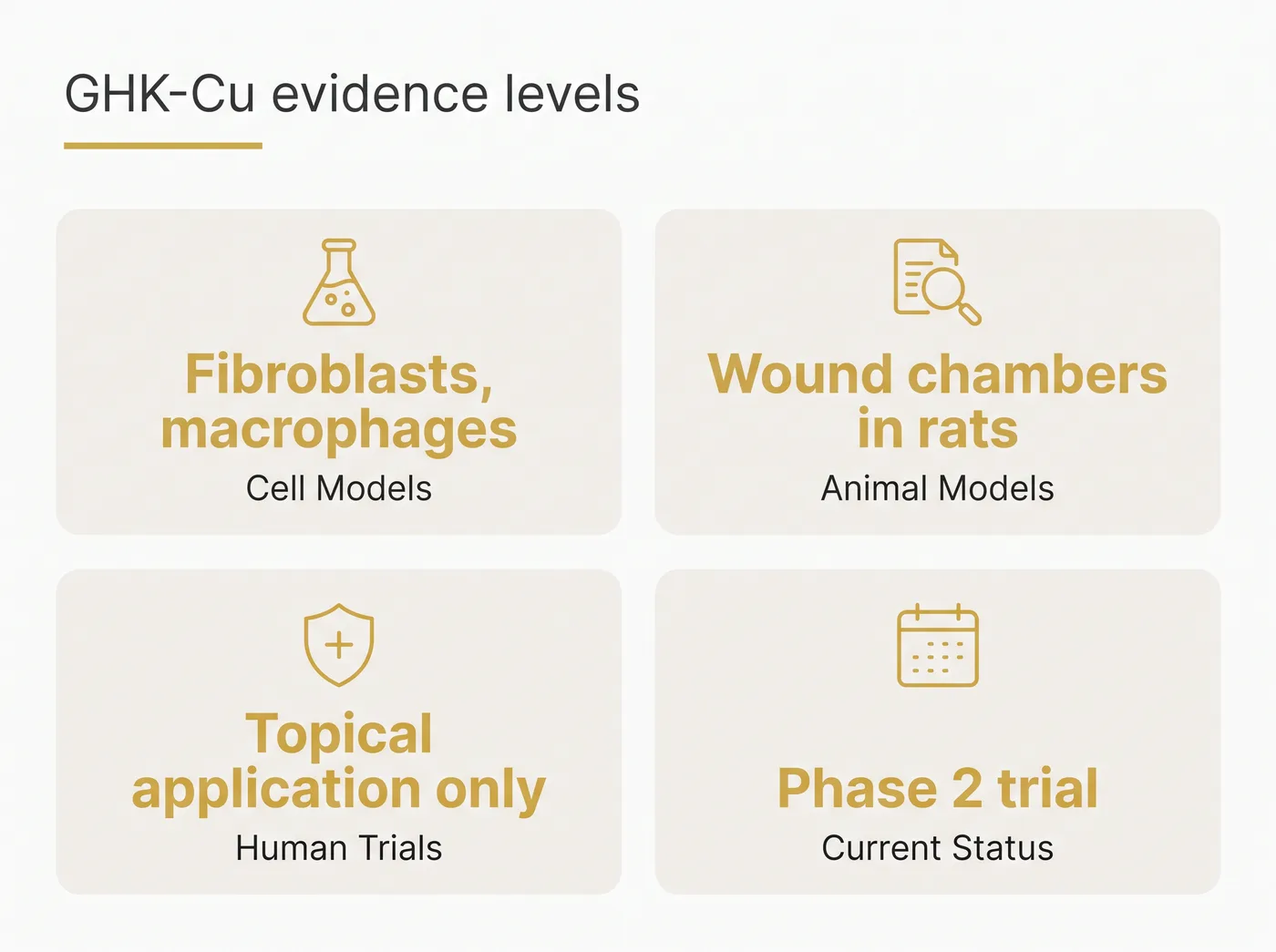
The research base for GHK-Cu is extensive, but it is heavily stratified by the type of model used. In cell models, researchers have studied GHK-Cu in human skin fibroblasts and macrophage cell cultures. These in vitro studies aim to observe its role in modulating collagen and elastin synthesis, as well as extracellular matrix remodelling. Scientists also use these cell cultures to investigate the activation of antioxidant pathways and the suppression of inflammatory signalling pathways, specifically looking at NF-kB and p38 MAPK 5.
Moving up to animal models, GHK-Cu has been studied in rats and mice. Researchers have evaluated its effects on acute wounds and measured collagen production using implanted wound chambers. Other animal studies have investigated epigenetic pathways in aging mice, looking at how the peptide interacts with gene expression over time. If you are curious about other molecules investigated in similar laboratory contexts, you can also read about what NAD+ has been studied for.
In humans, the evidence narrows significantly. Topical GHK-Cu has been evaluated in small clinical trials to observe its effects on photoaged facial skin, specifically measuring fine lines, skin firmness, and collagen synthesis. Other small human studies have looked at post-CO2 laser resurfaced skin and venous leg ulcers. Currently, a Phase 2 clinical trial is evaluating the application of a topical GHK-Cu gel for acute skin wounds, using standardised punch-biopsy wounds on adults 1. If you want to see how a completely different molecule is evaluated in pigmentation models, check out what MT-2 has been studied for.
GHK-Cu vs AHK-Cu: a one-amino-acid difference
If you spend enough time reading about copper peptides, you will eventually encounter AHK-Cu. It is a synthetic tripeptide copper complex that looks nearly identical to GHK-Cu on paper, but a single structural change sends its research profile in a completely different direction.
The concrete difference in structure is the substitution of the first amino acid. AHK-Cu replaces the glycine found in GHK-Cu with alanine, making its sequence L-alanyl-L-histidyl-L-lysine 6. That minor swap changes how the molecule is studied.
While GHK-Cu research is heavily centred on skin and wound models, AHK-Cu is investigated primarily in in vitro cell models for hair follicle biology. Specifically, laboratory studies on AHK-Cu measure its capacity to stimulate the proliferation of human dermal papilla cells.
| Feature | GHK-Cu | AHK-Cu |
|---|---|---|
| Origin | Naturally occurring | Synthetic |
| Sequence | Gly-His-Lys | Ala-His-Lys |
| Primary research focus | Skin and wound models | Hair follicle cell models |
| PubChem CID | 71587328 | 168431292 |
The 2026 HHS compounding policy
GHK-Cu is not an FDA-approved drug for any medical indication. Because it lacks approval, its availability through pharmacies is dictated by a specific set of compounding regulations that recently underwent a major shift.
Following a regulatory reversal updated on May 14, 2026, the FDA placed GHK-Cu back into Category 1 of its interim 503A bulk drug substances list, but with a massive caveat: the inclusion is restricted strictly to topical forms. Under this interim enforcement discretion policy, the FDA does not intend to pursue action against licensed 503A compounding pharmacies that compound topical GHK-Cu preparations pursuant to a patient-specific prescription.
Other formats of GHK-Cu remain excluded from Category 1 and are listed under nominated but withdrawn substances. This means compounding pharmacies cannot legally compound them under the 503A exemption. The FDA's Pharmacy Compounding Advisory Committee has scheduled a formal review for February 2027 to evaluate whether GHK-Cu will be permanently added to the 503A bulks list. If you want to see how regulators categorise a completely different molecule, you can read about the origins and compounding status of MOTS-c.
Reading a GHK-Cu lab report
When a compound sits outside the standard pharmaceutical supply chain, the burden of verifying what is actually in the vial falls entirely on the buyer. A lot number is the vial's passport, and the certificate of analysis is its background check. If a vendor cannot provide a recent, third-party lab report tied to the specific batch you are looking at, you are flying blind.
A proper lab report relies on two main tests. Mass spectrometry confirms the identity of the molecule by weighing it. For GHK-Cu, the lab is looking for the specific mass of the peptide complex. High-performance liquid chromatography measures purity. A chromatogram is a race where every impurity has to cross the finish line in public; the main peak should represent the vast majority of the material in the sample.
You can review the current batch purity, mass spectrometry results, and pricing on NuuVive's GHK-Cu.
Questions
Is GHK-Cu FDA approved?
No. GHK-Cu is not an FDA-approved drug for any medical indication. It is studied strictly as an experimental compound.
What is the molecular weight of GHK-Cu?
The molecular weight of the 1:1 GHK-Cu complex is 402.92 g/mol.
Are there human trials for other formats of GHK-Cu?
No. There are no published human clinical trials evaluating other formats of GHK-Cu for any indication. All human clinical data is limited to topical applications.
What is the difference between GHK-Cu and AHK-Cu?
GHK-Cu is a naturally occurring peptide containing glycine, studied primarily in skin and wound models. AHK-Cu is a synthetic peptide that replaces glycine with alanine, and is investigated primarily in cell models for hair follicle biology.
Sources
- ClinicalTrials.gov. clinicaltrials.gov
- pubchem.ncbi.nlm.nih.gov. National Library of Medicine
- pmc.ncbi.nlm.nih.gov. National Library of Medicine
- pubchem.ncbi.nlm.nih.gov. National Library of Medicine